Act I
The command echoed across the airport terminal like a gunshot.
“Rex, get him!”
Every conversation stopped.
Suitcases froze mid-roll. Parents pulled their children closer. Travelers who had been rushing toward the glass exit doors slowed down and turned, their faces pale under the cold winter light spilling in from outside.
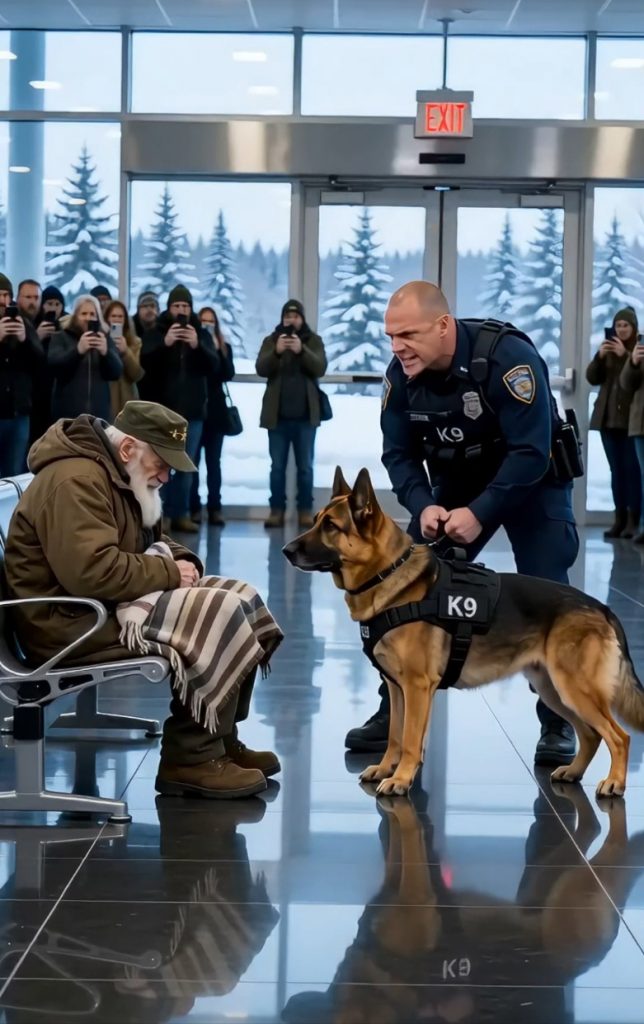
On the polished black tile floor, the old man sat alone on a metal bench.
His hands trembled beneath a striped blanket. His white beard rested against his chest. A faded green military cap, decorated with gold stars and old insignia, sat low on his forehead as if he were trying to hide from the world.
But Officer Dening would not let him disappear.
He stood a few feet away in his dark navy uniform, both hands tight around the leash of a German Shepherd wearing a black K9 harness. His jaw was clenched. His face had gone red with anger.
“I said get him!” Dening shouted.
The dog barked once.
Not a vicious bark.
Not the sound of an animal ready to attack.
It was sharp, confused, almost like a question.
Rex stared at the old man. His ears were alert, his body tense, but his paws did not move forward. Behind him, Dening jerked the leash hard enough to make several people gasp.
The veteran slowly raised his head.
His eyes were red, wet, and exhausted. Not drunk. Not dangerous. Just deeply tired, as if he had been carrying something invisible for so long that his body had finally started to break beneath it.
For one breath, man and dog looked at each other.
Then Rex whimpered.
The sound was so soft that it almost vanished under the hum of the terminal lights.
Dening’s mouth opened in disbelief.
“Rex,” he hissed.
But the dog was no longer listening.
Slowly, with his tail lowered and his head gentle, Rex walked toward the old veteran. The crowd leaned in without meaning to. Phones lifted higher. A child whispered, “Mom, what’s he doing?”
Rex reached the bench.
Then, instead of lunging, barking, or showing his teeth, the K9 lowered his head onto the old man’s lap.
The veteran’s shaking hand hovered above him.
For a moment, he seemed afraid to touch the dog.
Then his fingers settled into Rex’s fur, and his face broke open with a grief so old it silenced everyone watching.
Officer Dening stood frozen.
Because the dog had not disobeyed.
The dog had remembered.
And the old man on the bench was not a trespasser at all.
Act II
His name was Samuel Mercer, though almost no one in the terminal knew it.
To them, he was just an old man holding up the exit lane during a snow delay. A weary figure in a brown winter jacket, sitting too still, clutching an old blanket, staring at the doors as if the world beyond them had become too heavy to enter.
He had arrived at the airport four hours earlier with one small duffel bag and a folded envelope tucked inside his coat.
The ticket agent remembered him because he had asked the same question three times.
“Is this the flight from Denver?”
When she told him yes, he nodded, then walked away without explaining why he was not boarding it.
By noon, the storm had worsened. Snow covered the pine trees beyond the glass doors. Flights were delayed. Travelers grew impatient. Security became tense.
That was when Officer Dening noticed him.
Dening was the kind of man who enjoyed being noticed back.
He walked through the terminal like the badge had been made heavier just for him. His boots struck the tile with purpose. His vest read POLICE and K9 in bold white letters. Rex walked beside him, calm and disciplined, his eyes always moving, always reading the room.
Most people smiled when they saw Rex.
Children waved. Travelers softened. Even anxious passengers seemed comforted by the dog’s steady presence.
But Dening did not like that.
He wanted respect to look more like fear.
When an airport employee mentioned that an elderly man had been sitting near the exit doors for hours, Dening took it as an insult before he took it as a concern.
“Is he bothering anyone?” the employee asked.
“He’s loitering,” Dening said.
“He looks cold.”
“He looks like a problem.”
Samuel was not a problem.
He was waiting for a girl who had stopped writing back twelve years ago.
Her name was Lily.
She was his granddaughter, though the word still hurt to say. He had never held her as a baby. Never watched her take a first step. Never saw birthdays, graduations, scraped knees, or school plays.
All he had was a photograph.
A little girl in a yellow raincoat standing beside her mother, holding a toy airplane and smiling with two missing front teeth.
On the back, someone had written:
She asks about you.
Samuel had carried that photo through shelters, hospitals, bus stations, and long nights when the cold seemed to come from inside his bones.
He had once been Sergeant Samuel Mercer, decorated military dog trainer, search-and-rescue specialist, and the man younger handlers called when no one else could calm a frightened animal.
He had trained dogs to find survivors in collapsed buildings.
He had trained them to stop when force was wrong.
He had trained them to read the difference between danger and pain.
Years ago, people had trusted his hands.
Then came the accident.
Not overseas. Not in combat. Not in the place people expected heroes to break.
It happened after he came home.
Samuel’s son, Daniel, died in a winter highway crash while driving to visit him. Daniel’s wife blamed Samuel for asking them to come. Grief turned into silence. Silence turned into years.
Then Samuel lost his house.
Then his health.
Then the last pieces of the life that had once made sense.
He never fought the people who forgot him. He did not know how. He simply became smaller, quieter, easier to overlook.
But one month earlier, a letter came to the veterans’ shelter.
It was from Lily.
Grandpa,
I found your name in Mom’s old papers. I don’t know the whole story, but I want to. I’ll be landing December 18. Gate C. Please come if you can.
Samuel read the letter until the paper softened at the folds.
He borrowed a coat. He shaved as best he could. He polished the old gold pins on his cap with the edge of his sleeve.
And he came.
But Lily’s flight had been delayed. Then redirected. Then delayed again.
By the time Dening approached him, Samuel had been sitting under those airport lights for hours, hungry, exhausted, and terrified that he had made a mistake believing anyone still wanted him.
Dening saw only a man who would not move fast enough.
“Sir,” he snapped. “You need to clear this area.”
Samuel looked up slowly. “I’m waiting for someone.”
“You can wait outside.”
Samuel glanced at the snow beyond the glass doors. “I don’t have anywhere to go out there.”
That answer made Dening’s face harden.
Around them, people began to watch.
Samuel reached into his jacket, trying to show the letter.
Dening saw the movement and stepped back as if it were a threat.
“Hands where I can see them.”
Samuel froze.
The old reflex returned before the thought did. His shoulders tightened. His breathing changed. The terminal dissolved for half a second into another place, another winter, another command shouted too close to his ear.
“I’m only getting the letter,” Samuel whispered.
But Dening had already decided what the crowd would see.
An officer in control.
A suspect refusing orders.
A dog ready to prove him right.
He tightened the leash and pointed toward the trembling old man.
“Rex, get him!”
But Rex had smelled something before anyone else understood it.
Not fear.
Not threat.
Recognition.
Act III
Rex had not been born Rex.
His first name was Atlas.
He had been small then, all oversized paws and soft ears, found shivering behind a closed service garage after a flood. The shelter workers said he was too anxious. Too attached. Too stubborn.
Samuel Mercer said, “No. He’s listening.”
At the time, Samuel was volunteering with a rehabilitation program that paired veterans with rescue dogs. He was not officially training police K9s anymore. His knees hurt. His hands stiffened in the cold. His reputation had faded into the kind of memory departments praised at banquets but never called when budgets were signed.
Still, dogs knew him.
Atlas knew him most of all.
The puppy followed Samuel from the first day, pressing his nose into the old man’s palm whenever Samuel grew quiet. Samuel taught him patience before obedience. He taught him that a command was not the same as judgment. He taught him that strength without restraint was just fear wearing a uniform.
For six months, Atlas slept beside Samuel’s cot at the training center.
Then funding changed.
The program closed.
The dogs were transferred.
Atlas disappeared into the system and came out with a new name, a black tactical harness, and a handler named Dening.
Samuel never saw him again.
At least, he thought he never would.
Now, in the airport terminal, Rex rested his head on Samuel’s blanket as if the years between them had never happened.
Samuel’s fingers moved slowly over the dog’s skull.
“At-las?” he whispered.
Rex’s ears lifted.
The dog pressed closer.
Several people in the crowd heard the name. One woman lowered her phone, her expression changing from curiosity to something like shame.
Dening heard it too.
“What did you call my dog?”
Samuel did not look away from Rex. “That was his name.”
“No,” Dening said. “His name is Rex.”
“It is now.”
Dening stepped forward and reached for the leash, but Rex’s body shifted. Not aggressively. Not dangerously. Just enough to place himself between Dening and Samuel.
The crowd murmured.
Dening flushed.
“You don’t know this animal,” he snapped.
Samuel finally looked up.
His voice was soft, but it carried.
“I taught him not to hurt someone who was already broken.”
The words landed harder than any accusation.
Dening’s eyes narrowed. “You people always have a story.”
Samuel flinched at that.
Rex felt it.
The dog turned his head and nudged Samuel’s hand, grounding him back into the moment. The old man inhaled shakily. The crowd watched, confused by the intimacy of it, by the way this trained police dog seemed to understand the veteran better than the officer did.
Then an older airport janitor stepped forward.
His name tag read MARCUS.
“I know him,” Marcus said.
Dening turned sharply. “Stay out of this.”
Marcus did not.
“That man trained K9 units for this city before you had a badge.”
Dening laughed. “That right?”
Marcus pointed at the green cap on Samuel’s head. “Sergeant Mercer. Search and rescue. They brought him in after the north terminal collapse years ago. My brother was one of the men they pulled out.”
The terminal went quiet again, but this time the silence had changed.
It no longer belonged to fear.
It belonged to realization.
Samuel looked down, embarrassed by the attention. Praise had always made him uncomfortable. He had not come to be remembered by strangers. He had come because one girl had written one letter.
Dening’s face hardened further.
A small man being corrected in public can become dangerous without raising a weapon. He can become cruel with paperwork, with posture, with a lie spoken loudly enough.
“You expect me to believe that?” Dening said.
Marcus took out his phone. “I can prove it.”
But someone else already had.
A young woman near the coffee stand had searched Samuel’s name after hearing Marcus speak. Her eyes widened as article after article appeared on her screen.
“Sergeant Samuel Mercer,” she read aloud, voice trembling. “Decorated rescue trainer credited with saving eleven people after the Harbor Line collapse.”
Another person found an old photograph.
Samuel, younger but unmistakable, kneeling beside a German Shepherd with a puppy tucked against his boot.
The puppy’s markings were familiar.
A black saddle.
Tan legs.
One small dark streak near the left eye.
The woman turned her phone toward the crowd.
“That’s him,” she whispered. “That’s Rex.”
Dening stared at the image.
For the first time, uncertainty cracked through his anger.
Then the glass doors behind him slid open.
Cold air swept into the terminal.
A woman in a red scarf hurried inside, pulling a suitcase behind her. Her eyes searched the crowd frantically until they found the old man on the bench.
She stopped.
The suitcase fell onto its side.
“Grandpa?” she said.
Samuel’s hand froze in Rex’s fur.
He turned slowly toward the voice.
And the crowd parted.
Act IV
Lily Mercer had imagined this moment a hundred different ways during the flight.
In some versions, her grandfather hugged her immediately. In others, he was angry. In the one that scared her most, he did not come at all.
She had not imagined police lights reflecting in black tile.
She had not imagined a crowd filming.
She had not imagined her grandfather sitting under an exit sign with a K9’s head in his lap while an officer stood over him like he had been caught committing a crime.
Lily walked forward carefully.
She was thirty now, with Daniel’s eyes and her mother’s guarded posture. Snow clung to her boots. Her cheeks were flushed from the cold, but when she saw Samuel’s face, all the color seemed to leave her.
“You came,” she whispered.
Samuel tried to stand, but his legs shook.
Rex lifted his head, then stepped beside him like a brace.
“I didn’t know if you still wanted me to,” Samuel said.
Lily covered her mouth.
The answer was too small for the size of the wound between them.
Then Dening inserted himself between them.
“Ma’am, step back. This man is being detained.”
The crowd reacted instantly.
“For what?” someone demanded.
“He didn’t do anything,” another voice said.
Dening ignored them. “He refused a lawful order and interfered with a police K9.”
Samuel looked confused. “I only sat here.”
“You reached inside your coat.”
“For her letter.”
Lily’s face changed.
“What letter?”
Samuel slowly pulled the folded envelope from his jacket pocket. His hand trembled as he held it out.
Lily took it and recognized her own handwriting.
She looked at Dening.
“He was waiting for me.”
Dening’s jaw flexed. “That doesn’t change his behavior.”
“No,” Marcus said from behind him. “But the videos do.”
Nearly every phone in that small circle was now pointed at the officer. The first command. The second command. The leash jerk. The dog refusing. The veteran flinching. Rex comforting him.
All of it had been recorded.
Dening noticed too late.
His authority had depended on controlling the room.
But the room had become a witness.
An airport supervisor arrived, then two more officers. One of them, a woman with captain’s bars on her uniform, took in the scene with a single sharp glance.
“Officer Dening,” she said, “release the leash.”
Dening stiffened. “Captain, I had the situation under control.”
“I didn’t ask for your report. I said release the leash.”
He hesitated.
Rex looked back at him.
For once, Dening seemed to understand that the dog was not his shield anymore.
He let go.
The captain took the leash herself and knelt beside Rex, checking him with calm hands. Then she looked at Samuel.
“Sergeant Mercer?”
Samuel blinked. “Yes, ma’am.”
Her expression softened. “My father trained under you.”
Samuel’s eyes filled.
The captain stood and turned to Dening.
“You ordered a K9 to engage an elderly seated veteran in a crowded public terminal?”
“He made a suspicious movement.”
“He reached for a letter.”
“I couldn’t know that.”
“You could have asked.”
The sentence cut through him.
Because everyone knew it was true.
He could have asked.
He could have waited. He could have lowered his voice. He could have seen the shaking hands, the military cap, the old man’s exhaustion, the crowd’s concern, the dog’s hesitation.
Instead, he chose force because force was faster.
The captain removed Dening’s K9 lead from his vest.
His face went pale.
“Captain—”
“You’re relieved of K9 duty pending investigation.”
A ripple moved through the crowd.
Not applause.
Not yet.
Something deeper.
Justice beginning quietly.
Dening looked around, searching for someone who still saw him as the hero of the moment. But the bystanders stared back with cold disappointment. Even the people who had been afraid to speak earlier now stood straighter.
Lily moved past him and knelt in front of Samuel.
“I’m sorry,” she said.
Samuel shook his head immediately. “No.”
“Yes,” she whispered. “I believed the stories. Mom said you walked away from us.”
His eyes closed.
“I thought she didn’t want me near you.”
“She told me you blamed us for Dad.”
Samuel’s face crumpled, but he did not break into loud grief. It was quieter than that. Worse than that. The kind of pain that had been waiting years for permission to breathe.
“I blamed myself,” he said. “Never you.”
Lily reached for his hands.
They were cold.
She held them anyway.
Behind them, Rex sat close, his shoulder pressed against Samuel’s knee.
Then Lily noticed the dog’s face.
She looked from Rex to the old photograph still glowing on the stranger’s phone.
“Is that…”
Samuel nodded.
“At first, he was Atlas.”
Rex’s tail moved once against the floor.
Lily smiled through tears.
“Then maybe he’s been waiting too.”
Act V
The video spread before the storm ended.
By evening, millions had watched the moment Rex refused the command. They saw the officer’s rage, the old veteran’s fear, the dog’s hesitation, and then the impossible tenderness of a trained K9 choosing comfort over cruelty.
But the part that mattered most to Samuel happened after the cameras stopped.
It happened in a small airport office with warm lights and paper cups of coffee nobody drank.
Lily sat beside him, close enough that their shoulders almost touched. The captain took Samuel’s statement. Marcus waited near the door, arms folded, protective in the way strangers sometimes become family for an hour when decency demands it.
Rex lay at Samuel’s feet.
Every few minutes, the dog lifted his head to make sure the old man was still there.
Samuel told them about Atlas.
Not everything. Not at first. Just enough.
He talked about the rescue program. The flood. The stubborn puppy who refused to sleep unless Samuel left one hand hanging off the cot. The day the program closed and the dogs were taken away.
“I thought he’d forgotten me,” Samuel said.
The captain looked at Rex.
“He didn’t.”
Dening was placed on administrative leave that night. The investigation that followed uncovered complaints that had been ignored, reports softened, incidents dismissed because no one wanted the embarrassment of admitting a K9 officer had become the danger he claimed to prevent.
This time, there was no hiding it.
Too many cameras.
Too many witnesses.
One very famous dog.
But Samuel did not care about fame.
The next morning, Lily brought him breakfast in the hotel room the airline had arranged after the terminal incident. She knocked softly, as if she still feared he might vanish.
When he opened the door, she was holding a paper bag, two coffees, and the nervous smile of someone standing at the edge of a bridge.
“I don’t know how to do this,” she admitted.
Samuel stepped aside.
“Neither do I.”
That was where they began.
Not with grand speeches.
Not with perfect forgiveness.
With coffee gone lukewarm on a small table and two people comparing versions of a family story that had been twisted by grief. Lily learned that her grandfather had sent birthday cards every year until they were returned unopened. Samuel learned that Lily had kept asking about him until adults taught her not to.
Neither of them knew whether time could be recovered.
But they knew the truth could begin where the lie ended.
Three weeks later, the police department retired Rex from active K9 duty.
Officially, it was because his response during the airport incident raised questions about his suitability for enforcement work.
Unofficially, the captain said what everyone else was thinking.
“That dog has already served with more honor than most people ever will.”
A small ceremony was held in the same terminal, near the glass doors where everything had happened.
This time, there was no shouting.
No raised leash.
No trembling old man treated like a threat.
Samuel arrived in a clean wool coat Lily had bought him, though he insisted on wearing the same green cap. Lily stood beside him, one hand tucked through his arm.
When Rex entered without his tactical harness, the crowd applauded.
He wore only a simple collar.
For a moment, he looked younger.
The captain handed the leash to Samuel.
“Sergeant Mercer,” she said, “we were hoping you might know someone who could give him a good home.”
Samuel stared at the leash.
His hand shook.
Lily leaned close. “Grandpa.”
He looked at her.
Her eyes were bright.
“We have room,” she said.
Not I.
We.
Samuel looked down at Rex.
The German Shepherd stepped forward and pressed his head against the old man’s coat exactly as he had done on the airport bench.
Samuel closed his fingers around the leash.
The applause rose.
But Samuel barely heard it.
He was remembering a flooded alley, a frightened puppy, a cot in a training center, and the terrible day he thought he had lost everything good twice.
Rex had found him anyway.
That winter, Samuel moved into Lily’s guest room.
It was supposed to be temporary. That was what they both said at first. Temporary made it easier to accept. Temporary asked less of the heart.
But Lily bought Rex a bed.
Then Samuel fixed the loose hinge on her kitchen cabinet.
Then Rex started sleeping in the hallway between their rooms, as if guarding both the past and the future.
By spring, no one used the word temporary anymore.
Sometimes Samuel still woke before dawn with old memories sitting heavy on his chest. On those mornings, Rex would appear without being called, resting his head beside Samuel’s hand until the room became real again.
Sometimes Lily found him at the kitchen table, staring at Daniel’s photograph.
She never told him to stop grieving.
She simply sat with him.
One afternoon, a package arrived from the airport police department. Inside was Rex’s old black K9 harness, cleaned and folded neatly. Attached to it was a letter from the captain.
The department had revised its K9 use policy. Every handler would undergo new de-escalation training. Every complaint would be independently reviewed. And at the bottom, in handwriting added beneath the official text, the captain had written:
He reminded us what service is supposed to mean.
Samuel placed the letter beside the old photograph of Lily in her yellow raincoat.
Then he hung Rex’s harness in the hallway.
Not as a trophy.
As a warning.
Power without compassion could turn a uniform into a weapon.
But loyalty, real loyalty, could still pull someone back from the edge.
Months later, when snow returned to the pine trees outside the terminal, Samuel and Lily walked through the airport again. This time, they were not there because of a delayed flight or a desperate letter.
They were there to meet a veterans’ support group Samuel had agreed to help train.
Rex walked beside him, older now but steady, his eyes soft and alert.
Near the exit doors, Samuel paused.
The bench was still there.
For a moment, the noise of the terminal faded. He saw himself as he had been that day—cold, ashamed, afraid to hope. He saw Dening’s anger. He heard the command. He felt the whole world watching.
Then he felt Lily’s hand on his arm.
“You okay?” she asked.
Samuel looked down at Rex.
The dog looked back.
And for the first time in years, Samuel smiled without sadness hiding behind it.
“Yes,” he said. “I am.”
Outside, snow began to fall again beyond the glass doors.
Inside, an old veteran, his granddaughter, and the dog who refused to forget walked forward together.