Act I
The wolf was drowning when Elias Ward saw its eyes.
Not its teeth.
Not its claws.
Its eyes.
They were wide, wild, and bright with a terror so human that Elias forgot, for one reckless second, what kind of animal he was reaching for.
The frozen river groaned beneath him. Blue slabs of ice shifted against one another, grinding slowly in the black water as twilight fell over the northern wilderness. Snow-covered pines stood along the far bank, silent and watching beneath a pale pink sky.
Elias dropped to his stomach on the ice.
“Hey!” he shouted, stretching one gloved hand into the freezing water. “Hold on!”
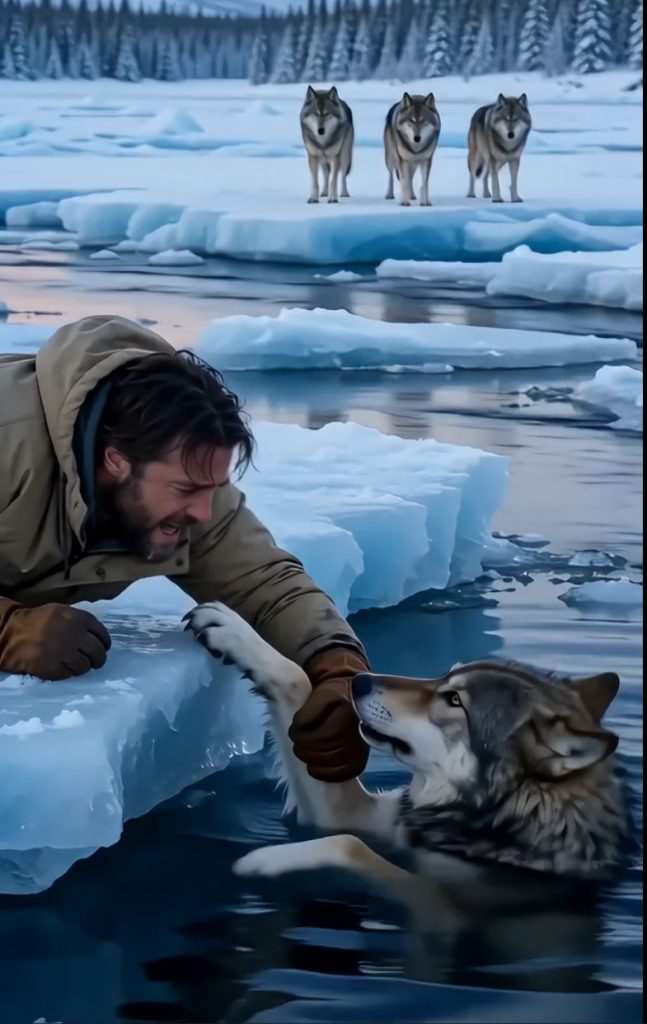
The wolf thrashed once, its thick gray fur soaked dark, its head slipping under before it fought back up again. One paw hooked desperately around Elias’s wrist.
The cold bit through his glove instantly.
Elias clenched his teeth and pulled.
The wolf was heavier than he expected. He dug his boots against the ice, chest scraping the frozen surface, shoulder burning as the current tried to drag the animal beneath the floe.
“Come on,” he growled. “Come on.”
The wolf vanished under the water.
Elias lunged farther.
His whole arm plunged into the black. For one horrifying second, his fingers found nothing but cold, current, and emptiness.
Then he caught fur.
He pulled with everything left in him.
The wolf’s head broke the surface in a violent spray. It gasped, coughed, and kicked weakly while Elias hauled its front half onto the ice, then its body, then its hind legs, inch by agonizing inch.
When it finally collapsed beside him, both of them lay still.
Man and predator.
Chest to chest with death.
Elias rolled onto his back, gasping so hard each breath hurt. His beard was rimmed with frost. His khaki jacket was soaked to the elbow. His hands shook uncontrollably.
The wolf lay beside him, panting, its wet head near his shoulder.
For a moment, there was only wind.
Then Elias heard the growl.
Low.
Vibrating.
Not from the wolf beside him.
From behind.
Slowly, he turned his head.
Five wolves stood on a distant sheet of ice, their gray coats glowing silver-blue in the fading light. They watched him without blinking. Then, one by one, they began to walk toward him.
Elias did not have the strength to stand.
The rescued wolf lifted its head slightly and placed one exhausted paw over his glove.
The pack kept coming.
And that was when Elias saw the torn red collar around the wolf’s neck.
The same collar his daughter had placed there three winters before she disappeared.
Act II
Before grief turned him into a man who lived alone, Elias Ward had known every voice in the wilderness.
He had been a field biologist once, though people in town still called him a ranger because the word made more sense to them. He could read tracks in old snow, tell storm direction from the weight of clouds, and recognize wolves by the way they moved through trees.
But his daughter, Mara, had been better.
She saw things Elias missed.
A bent reed near a stream. A change in bird calls. A wolf’s hesitation before crossing open ice. She had grown up following him through the northern forests with a notebook in her mittened hands and questions spilling out faster than he could answer.
By twenty-four, she had become the kind of wildlife researcher old men pretended not to respect until she proved them wrong.
Her project was the Blackpine Pack.
Five adults, three yearlings, and one remarkable female wolf Mara named Sable because of the dark streak across her spine. Sable was cautious, intelligent, and almost impossible to track unless she wanted to be found.
Mara loved her.
Not in the childish way people love wild animals by pretending they are pets.
She loved Sable as something free.
Something that deserved room to remain wild.
When the mining company arrived in Blackpine Valley, Mara was the first to speak against the access road. The proposed route cut through the pack’s winter corridor, crossed old ice shelves, and ran dangerously close to denning ground.
The company called her emotional.
The county called her young.
The papers called the debate complicated.
Mara called it simple.
“You can’t destroy a path animals have used for generations and then act shocked when everything starts dying in the wrong places,” she said.
Elias had warned her to be careful.
Not because she was wrong.
Because powerful people hated being proven wrong by a woman who refused to soften her voice.
Then came the storm.
Mara went out to retrieve a damaged trail camera near the frozen river and never came home. Searchers found her snowmobile two miles from the riverbank. They found broken ice nearby. They found one glove.
They did not find Mara.
The official report said accident.
Elias never accepted it.
Mara knew that river. She knew ice. She knew storms. She had crossed that wilderness since she was six years old. Something had happened out there, something more than weather, but every question Elias asked was met with tired eyes and closed doors.
The mining company received its road permit in spring.
The Blackpine Pack vanished from the valley by summer.
And Elias stopped being a man people visited.
For three years, he lived in a cabin at the edge of the old research zone, surrounded by maps, broken radio equipment, and Mara’s notebooks. He reread her field entries until the pages softened at the corners.
One line stayed with him more than all the rest.
Sable trusts distance. If she ever comes close, listen.
That afternoon, Elias had gone to the frozen river because the old receiver on Mara’s desk began to beep.
One weak signal.
Then another.
A collar frequency that should have gone silent years ago.
He followed it through the trees, across the ridge, down to the jagged blue ice.
And there, in the black water, he found Sable.
Not dead.
Not gone.
Waiting to be pulled from the place where Mara’s story had ended.
Act III
The pack stopped twenty feet away.
Elias lay on the ice, one arm numb, his body too exhausted to decide whether fear was useful. Sable remained pressed beside him, breathing hard, her paw still touching his glove like a warning or a claim.
The largest wolf stepped forward.
Gray muzzle. Yellow-green eyes. Ears fixed toward Elias.
He knew better than to stare too long. He lowered his gaze slightly, every instinct in him screaming that he had placed himself in the oldest possible bargain.
He had saved one of theirs.
Now they would decide what that meant.
The gray wolf sniffed the air.
The others spread loosely behind it, not attacking, not retreating.
Waiting.
Elias looked at Sable’s collar again. The red material was torn, faded, and crusted with ice. A small tracking unit still hung from it, cracked along one side.
Mara’s handwriting had been burned into the tag.
SABLE — BP-01
Elias reached toward it.
The gray wolf growled.
Sable lifted her head and made a low sound in return.
The pack went still.
Elias froze too.
Sable turned her eyes to him. Not tame. Never tame. But aware. Watching him with something that looked too much like recognition.
His throat tightened.
“You remember her,” he whispered.
Sable’s ears twitched at the sound of his voice.
The wind rose, cutting across the river. Ice shifted under them with a deep, hollow boom.
Elias knew they had to move.
The floe was unstable. His soaked sleeve was already stiffening. If he stayed there, the cold would finish what the river had started.
He rolled carefully to one knee.
The pack watched.
Sable tried to stand and collapsed.
Elias looked at the five wolves, then at the injured animal beside him.
“I can’t carry her,” he said, laughing once without humor. “You understand that, don’t you?”
The gray wolf turned.
Not away from him.
Toward the far bank.
Then it walked ten steps and stopped, looking back.
The others followed.
Elias stared.
“No,” he whispered. “No, that’s impossible.”
But the gray wolf waited.
Sable pushed herself up with a trembling effort, then leaned against Elias’s leg.
The message was clear enough to frighten him more than a charge would have.
Follow.
Elias slid one arm beneath Sable’s chest, not lifting her fully, just helping her balance. Together they moved across the ice in slow, brutal increments, guided by the pack ahead.
Every few steps, Elias nearly fell.
Every time, Sable steadied against him.
The pack led them off the river and into the pines.
Twilight deepened. The world turned blue. Elias’s wet sleeve had gone numb, and his teeth knocked together hard enough to hurt.
Still, the wolves continued.
Not toward his cabin.
Not toward the open trail.
Toward the old mining road.
The road that had been approved after Mara disappeared.
The road that should not have existed yet when she died.
Elias’s breath caught.
At the edge of the trees, the wolves stopped.
There, half-buried beneath snow and fallen branches, was a metal survey marker stamped with the mining company’s crest.
And tied to it with a faded strip of red cloth was Mara’s second glove.
Act IV
Elias fell to his knees in the snow.
For three years, he had imagined finding part of Mara.
A boot. A scarf. A bone-white piece of memory rising from thawed ground.
But the glove was worse in a way he had not prepared for.
It was ordinary.
Red wool. Torn at the thumb. The same glove she wore in the last photo he had of her, laughing beside a trail camera with snow caught in her eyelashes.
He reached for it, but Sable stepped in front of him.
Weak as she was, she blocked his hand.
Elias stopped.
The wolf sniffed the marker, then turned toward a cluster of rocks beyond the old road cut.
The gray wolf moved first.
Elias followed like a man in a dream.
Behind the rocks, hidden beneath a sheet of bark and snow, was a small orange field case.
Mara’s case.
He recognized the cracked corner. The black strap. The little strip of duct tape where she had written WARD in permanent marker so nobody at the research station could “accidentally” borrow it again.
Elias opened it with hands that barely worked.
Inside was a water-damaged notebook wrapped in plastic, a dead satellite phone, and a memory card sealed inside a sample vial.
He stared at the vial.
The world narrowed until he heard nothing but his own breathing.
Mara had found something.
And Sable had guarded it.
For years.
The trek back nearly killed him.
By the time Elias reached his cabin, night had settled hard over the forest. Sable followed until the porch light touched her fur, then stopped at the tree line with the pack behind her.
Elias turned.
The wolves stood in silence.
Sable’s eyes reflected the light.
“Thank you,” he said.
His voice broke on the second word.
Sable lowered her head once.
Then the pack vanished into the trees.
Inside, Elias built a fire with shaking hands and called the one person he still trusted.
Nora Bell, Mara’s former professor, arrived before dawn in a snowcat with two officers from the provincial wildlife crimes unit. She had aged in the years since Mara vanished, but her eyes were the same: sharp, kind, and furious when Elias placed the orange case on the table.
The memory card still worked.
Not perfectly.
Enough.
Mara had recorded trucks entering Blackpine Valley two days before the permit approval. Not company survey trucks. Heavy equipment. Men unloading drums. A temporary road already cut through protected land before any legal authorization existed.
Then the final video.
Mara’s face appeared close to the camera, wind whipping hair across her eyes.
“If this uploads, I made it back,” she said.
Elias gripped the back of a chair.
“If it doesn’t, someone needs to know Northstar Mining started work before approval. The county signed after the fact. The ice road they cut is unstable. It forced the pack onto the river shelf. Sable’s collar data proves it.”
She looked off-camera.
A headlight moved behind the trees.
Her voice dropped.
“They’re here.”
The video ended.
No scream.
No explanation.
Just darkness.
Nora covered her mouth.
One officer swore softly and looked away.
By noon, warrants were issued.
By nightfall, the old road camp was sealed off.
The investigation that had been buried beneath weather, money, and official convenience opened again with the force of ice breaking in spring.
The truth came slowly, then all at once.
Northstar Mining had entered the valley illegally before permits were finalized. County officials had backdated reports. Mara had recorded evidence. A security contractor had chased her from the road site during the storm. Her snowmobile went off the river shelf where the ice had been weakened by unauthorized drilling equipment.
No one admitted to pushing her.
No one had to.
They had built the danger, chased her into it, and called the river guilty.
Sable had been there.
Her collar data proved it.
For three years, the damaged device stored one final route: Mara’s last path, Sable’s pursuit, and the wolf’s repeated returns to the same hidden field case.
The animal people once called a threat had guarded the only witness Mara left behind.
Act V
Spring came late to Blackpine Valley.
It always did.
Snow held stubbornly in the shadows long after the town below began pretending winter was over. The river stayed dark and dangerous between blue shelves of ice, but the pines softened at the tips, and meltwater began to sing under the banks.
By then, Northstar Mining was no longer working in the valley.
Its permits had been suspended. Its executives were under investigation. Two county officials resigned. One contractor confessed to chasing Mara but insisted he only meant to scare her away.
Elias did not care what he meant.
Intentions did not warm the dead.
Mara’s memorial was held at the edge of the old research meadow, not in town. Elias refused the church, the community hall, and every polished place where people might speak about closure as if it were a door.
Mara belonged under open sky.
Nora came. So did researchers, students, rangers, neighbors who had once avoided Elias’s eyes, and a few people from town who stood in the back with the uncomfortable faces of those who had believed the convenient version.
Elias let them stand there.
That was enough.
He placed Mara’s red glove beside a small wooden marker carved with her name.
MARA WARD
Daughter. Scientist. Keeper of wild paths.
Beneath it, he added the line from her notebook.
If they come close, listen.
The wind moved through the trees.
For a moment, nobody spoke.
Then a howl rose from the ridge.
Long.
Low.
Clear.
Every head turned.
At the tree line stood six wolves.
Sable was among them.
Her fur had dried thick and dark-gray again, though she still favored one leg. Beside her stood the gray wolf who had led Elias from the ice. The others waited behind them, yellow-green eyes fixed on the gathering.
Nobody moved.
Not even the officers.
Elias stepped away from the memorial.
Nora whispered, “Elias.”
He lifted one hand to quiet her.
He did not approach the wolves. He knew better. Love was not ownership. Gratitude was not permission.
He simply stood where he was.
Sable watched him.
Then she lowered her head.
Once.
The same gesture she had given him outside his cabin.
Elias felt something inside his chest loosen painfully, like a knot frozen for years beginning to thaw.
“She did hear you,” Nora whispered.
Elias swallowed.
“No,” he said softly. “They did.”
The pack turned and disappeared into the trees, silent as smoke.
After the memorial, Elias returned to his cabin.
For a while, people expected him to leave. To sell the place. To move closer to town. To become someone less haunted now that he had answers.
But answers are not cures.
They are maps.
Elias stayed because the valley still needed witnesses.
The research station reopened under Mara’s name that autumn. Students came north to study migration corridors, ice safety, predator behavior, and the fragile line between human ambition and wild survival. Elias taught some of the field courses, though he refused to lecture indoors.
“Outside,” he would say, pulling on his gloves. “The land doesn’t fit in slides.”
Every winter, when the river began to freeze, he checked the ice shelves with younger researchers trailing behind him. He showed them where drilling had weakened the old crossing. He showed them the route Mara took. He showed them the place where he pulled Sable from the water.
He never made the story heroic.
“I was scared,” he told them. “I was freezing. I was stupid enough to reach for a wolf and lucky enough she let me.”
The students always laughed nervously.
Then he would look toward the trees and add, “But she had been reaching for us for years.”
No one laughed after that.
One evening, under the same pale blue and pink sky that had hung over the rescue, Elias walked alone to the riverbank.
The ice was stronger now, sealed white across the shallows. He stood at the edge with Mara’s notebook tucked inside his coat and watched the pines darken against the sunset.
A movement stirred on the far bank.
Sable stepped from the trees.
Older now. Still lean. Still wild. A faint scar marked the place where the torn red collar had once rubbed her neck. She no longer wore it.
Elias smiled.
“Good,” he murmured. “No more collars.”
Sable looked across the frozen river at him.
Behind her, shapes moved between the pines.
The pack.
Healthy.
Whole.
Free.
Elias did not call to her.
She did not come closer.
They stayed that way for a long time, separated by ice, joined by memory.
Then Sable lifted her muzzle and howled.
The sound rolled over the frozen river, through the trees, into the deepening blue of evening. One by one, the pack joined her.
Elias closed his eyes.
For three years, he had heard silence whenever he thought of his daughter’s last night.
Now the valley answered.
Not with comfort.
Not with peace.
With truth.
Mara had not vanished into nothing. She had left evidence. She had protected the wild until her final minutes. And the wild, in its own fierce and ancient way, had protected her story until someone finally listened.
When the howling faded, Sable turned back into the forest.
Elias watched until the last gray shape disappeared.
Then he looked down at the ice, at the river that had taken so much and returned just enough to keep him living.
He pressed one gloved hand to his chest.
“Thank you,” he whispered.
The wind carried the words across the frozen water.
This time, Elias did not feel alone.