Act I
The insult landed before the plane had even left the gate.
“Why do they even sell seats to people like you?”
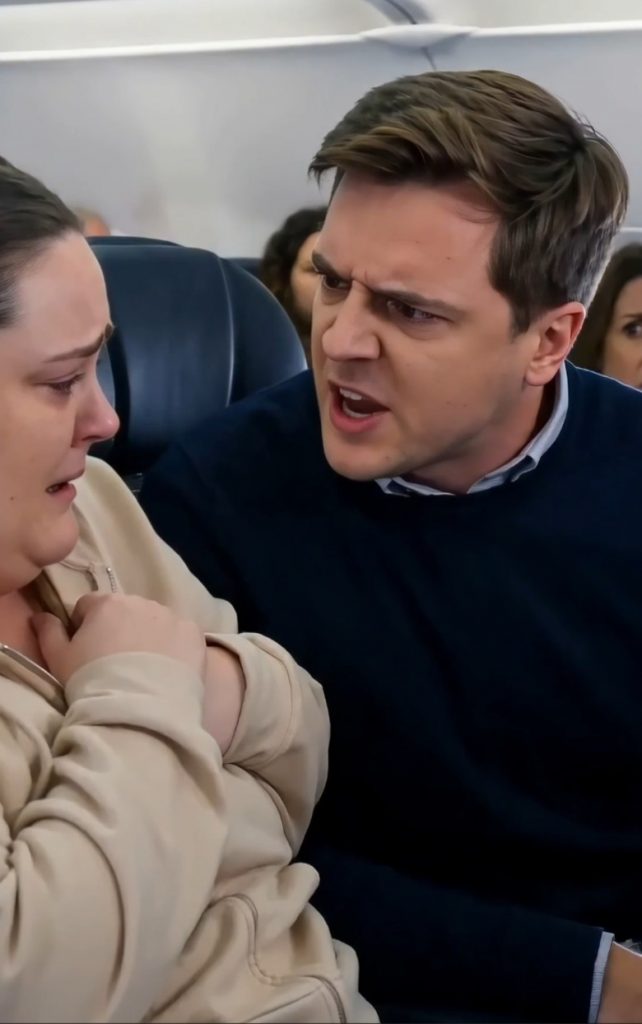
The man in the middle seat leaned toward her as he said it, his left finger stabbing the air near her face. His voice was loud enough to slice through the steady hum of the airplane cabin and make three rows of passengers turn at once.
Naomi Vale sat in the aisle seat with her hands clasped tightly in her lap.
She wore a cream-colored tracksuit, soft and plain, the kind of clothes a person chose when comfort was the only thing they could still control. Her long dark hair fell forward as she hunched slightly over herself, trying to make her body smaller in a space already designed to remind people of their limits.
The man beside her did not stop.
His name, she would later learn, was Clayton Reeves.
Middle-aged. Brown hair. Navy sweater. Expensive watch. The kind of man who had learned that volume could pass for authority if nobody challenged it quickly enough.
“You’re taking up the whole row,” he snapped. “This is ridiculous.”
Naomi turned her face toward him.
For half a second, their eyes met.
There was hurt in hers, but not confusion. She understood exactly what he was doing. He wanted her ashamed. He wanted her apologizing for existing. He wanted the aisle, the row, the cabin, the whole cold blue-and-gray interior of the aircraft to become a courtroom where she would plead guilty to making him uncomfortable.
Her lip trembled.
Then she looked down.
Behind Clayton, a woman in the next row brought a hand to her mouth. A man across the aisle shifted like he wanted to speak but had misplaced his courage somewhere under the seat in front of him.
Clayton took their silence as permission.
“Move somewhere else!” he shouted. “You’re bothering me!”
Naomi’s fingers rose to her chest. She caught a strand of hair and twisted it nervously, the small self-soothing motion of someone trying not to break in public.
“I’m in my assigned seat,” she said quietly.
Clayton threw up his left hand.
“I don’t care what your boarding pass says. Get up.”
The words hung in the cabin.
A flight attendant near the galley turned sharply, but she was still too far away.
Clayton leaned closer.
Naomi froze.
“GET UP!”
His hand struck her shoulder in a hard shove.
Gasps broke across the cabin. Someone said, “Hey!” Another passenger stood halfway before his seat belt snapped him back down. Naomi’s body jolted toward the aisle armrest, and for one awful moment she simply stared ahead, vacant and stunned, as if her mind had left before her body could follow.
Clayton’s face was flushed with rage.
But then a voice came from the front of the cabin.
“Sir. Remove your hand from that passenger immediately.”
The flight attendant walked toward them with a calm so sharp it felt like a blade.
Clayton looked up, still breathing hard.
“She needs to move,” he said. “I paid for my seat.”
The flight attendant stopped beside the row. Her name tag read Elise.
“So did she.”
Clayton scoffed. “Then put her somewhere else.”
Elise looked at Naomi.
And something shifted in her expression.
Recognition.
Not pity.
Recognition.
She glanced down at the tablet in her hand, then back at the woman in the cream tracksuit.
Her voice softened.
“Ms. Vale?”
Clayton blinked.
The man across the aisle looked up.
Naomi closed her eyes for one brief second.
Because the name had reached the cabin before she was ready for it to.
Act II
Naomi Vale had spent ten years teaching companies how dignity disappeared in ordinary places.
Not always in dramatic courtrooms. Not always in headlines. Sometimes it disappeared in a waiting room when no one made space for a patient. Sometimes in an office chair that did not fit. Sometimes in an airplane seat where a stranger decided your discomfort was less important than his entitlement.
She had built her career from moments like that.
At thirty-eight, Naomi was the founder of Vale Access Group, a consulting firm that worked with airlines, hospitals, hotels, and public venues on inclusive design. Her company did not sell kindness as a slogan. It sold measurements, policies, training, and accountability.
The work had started with her father.
Harold Vale had been a mechanic, a widower, and the first person who taught Naomi that shame was often manufactured by people who mistook inconvenience for injury.
After a surgery left him with mobility challenges, travel became a battlefield. Not because he lacked courage, but because every system around him seemed built to make him ask permission for basic dignity.
Naomi remembered the airport most.
Her father sitting in a broken wheelchair beside a gate agent who kept saying, “Just a few more minutes.”
Her father joking so Naomi would not cry.
Her father whispering, when they finally reached their seats, “Don’t ever let them make you grateful for being barely accommodated.”
He died two years later.
Naomi turned grief into work.
Then work became reputation.
Then reputation became power.
But power did not make her immune to humiliation.
That was the part people never understood.
On paper, Naomi was successful. Wealthy, even. She advised boards. She testified before transportation committees. She had been profiled in business magazines with titles that made her sound stronger than she felt.
But in airports, restaurants, gyms, conference halls, and planes, she still carried the same old awareness.
Who was staring.
Who was sighing.
Who thought her body gave them permission to comment.
That morning, she had almost canceled the flight.
She was not traveling for business, at least not at first. She was flying to Chicago for the unveiling of a small memorial garden named after her father at the rehabilitation center where he had learned to walk again. Her speech was folded inside her tote bag, rewritten six times and still not right.
The next day, she was scheduled to meet with executives from Horizon Aero Seating, a company hoping to win her firm’s certification for a new passenger cabin design. Their proposal was called Comfort Without Compromise.
Naomi had hated the title.
But she had agreed to the meeting because the industry needed better options, and she was tired of turning pain into speeches without changing the furniture of the world.
She boarded quietly.
No assistant. No business suit. No first-class seat. Her original flight had been canceled, and the airline had rebooked her into the last available aisle seat in economy.
She almost laughed when she saw it.
All those years advising companies on passenger dignity, and here she was, squeezing grief and exhaustion into 23C.
Then Clayton Reeves arrived.
He shoved his bag into the overhead bin, dropped into the middle seat, looked at her once, and sighed with theatrical disgust.
The performance began before his seat belt clicked.
Naomi had heard versions of it before. The muttered complaint. The exaggerated shifting. The demand that someone “do something.” The assumption that her presence was a problem to be solved.
But this time, she had no armor.
Her father’s speech was in her bag.
Her heart was already open.
So when Clayton raised his voice, she did not become the poised executive from magazine covers.
She became a daughter on her way to honor a dead man, trapped beside a stranger who had chosen cruelty before takeoff.
And then Elise said her name.
Act III
Clayton looked from the flight attendant to Naomi with sudden irritation.
“Wait,” he said. “You know her?”
Elise did not answer him.
She crouched slightly beside Naomi’s aisle seat, keeping her voice low enough to give her back some privacy.
“Are you hurt?”
Naomi swallowed.
“No.”
It was not entirely true.
Elise understood that.
“Would you like to move?”
Clayton laughed sharply. “Finally.”
Elise turned her head.
“Not you, sir.”
The cabin changed.
A few passengers who had been watching silently straightened. The woman behind Clayton lowered her hand from her mouth. The man across the aisle finally said, “He shoved her. I saw it.”
Another voice came from two rows back.
“I recorded it.”
Clayton’s face tightened.
“Oh, come on. I barely touched her.”
Elise stood.
“Sir, you will lower your voice.”
“I’m the one being squeezed in here.”
“No,” Elise said. “You are the one who put your hands on another passenger.”
That sentence carried down the row.
Clayton looked around and realized too late that the audience he had been performing for was no longer on his side.
Then the captain’s voice came over the speaker, calm but firm.
“Ladies and gentlemen, we’re going to remain at the gate for a few additional minutes. Please stay seated.”
The door had not closed yet.
That mattered.
Clayton noticed it too.
His anger shifted toward panic.
“This is absurd,” he said, reaching for his backpack. “I have an important meeting tomorrow.”
Naomi’s eyes lifted.
Something about those words cut through the fog.
Elise looked at her tablet again.
“Mr. Reeves,” she said, “you’re traveling to Chicago?”
“Yes,” he snapped.
“For Horizon Aero Seating?”
Clayton froze.
Naomi went still.
Elise’s face revealed nothing, but her eyes moved once toward Naomi, and that was enough.
Clayton followed the glance.
His expression flickered.
Naomi finally spoke, her voice quiet but clear.
“You’re with Horizon?”
Clayton said nothing.
The man across the aisle muttered, “Of course he is.”
Naomi reached slowly into her tote bag and removed a folder. Her hands trembled, but she opened it anyway.
On the top page was the proposal she had been scheduled to review the next afternoon.
Horizon Aero Seating
Comfort Without Compromise
Presenter: Clayton Reeves, Senior Director of Strategic Partnerships
The woman behind him whispered, “Oh my God.”
Clayton stared at the paper as if it had betrayed him.
Naomi looked at him, and the hurt in her face did not disappear. It changed shape.
It became understanding.
Not of him.
Of the scale of the lie.
“You were going to pitch me an accessibility certification,” she said.
Clayton’s mouth opened.
No sentence came.
Naomi looked down at the title again.
Comfort Without Compromise.
Then she let out one small, humorless breath.
“My father would have hated that.”
Clayton’s panic sharpened into calculation.
“Ms. Vale,” he said, suddenly lowering his voice, “I didn’t realize—”
The cabin reacted before Naomi did.
A short, bitter laugh came from somewhere behind them.
“You didn’t realize she mattered?” the woman behind him said.
Clayton turned red.
“That’s not what I meant.”
Naomi closed the folder.
“No,” she said. “I think it is.”
Act IV
Airport police boarded five minutes later.
Clayton tried to stand as soon as he saw them, but Elise blocked the aisle with the professional stillness of someone who had been underestimated many times and forgotten none of them.
“Sir, remain seated until instructed.”
“This is a misunderstanding,” Clayton said quickly.
Naomi looked out the small oval window.
Outside, ground crew moved beneath the bright airport lights, guiding luggage carts, waving wands, doing the invisible work that made travel possible. She focused on them because if she looked at Clayton too long, the tears might come again, and she did not want him mistaking them for defeat.
One officer spoke with Elise.
Another asked Naomi if she wanted to make a statement.
Clayton leaned toward her, voice low.
“Please. My career—”
Naomi turned.
He stopped.
There were moments in life when a person could apologize and mean it. This was not one of them. He was not sorry he had hurt her. He was sorry the woman he hurt had power attached to her name.
“Your career is not my emergency,” Naomi said.
The officer asked Clayton to step into the aisle.
He protested. Then argued. Then tried to make himself the victim of a situation everyone had watched him create. But the video from the passenger two rows back was already being shared with the crew. Witnesses were speaking up now, late but determined.
The man across the aisle gave his name.
The woman behind Clayton gave hers.
A college student in the row ahead said she heard the first insult.
One by one, the silence that had protected him became evidence against him.
Clayton was escorted off the plane.
At the front, he turned once.
Naomi expected anger.
Instead, she saw fear.
Not the deep, reflective fear of a man facing what he had become. The shallow fear of a man imagining what he might lose.
The door closed behind him.
For a few seconds, nobody spoke.
Then Elise returned to Naomi’s row.
“We have another seat available near the front,” she said gently. “It has an empty seat beside it. You can move there, or you can stay here. Your choice.”
Your choice.
The words almost undid her.
So much of the past ten minutes had been about choice being taken from her. Where to sit. How to feel. Whether to shrink. Whether to accept the shame someone else threw onto her lap.
Naomi looked at the empty middle seat beside her.
Then at the passengers still watching, some with sympathy, some with guilt.
“I’ll move,” she said.
Not because Clayton had told her to.
Because now it was hers to decide.
As she stood, the woman behind her touched her arm lightly.
“I’m sorry,” she whispered. “I should have said something sooner.”
Naomi looked at her.
The woman’s eyes were wet.
Naomi could have punished her with silence. Part of her wanted to. But she thought of all the times fear had sealed her own mouth, all the times people froze because cruelty moved faster than courage.
“Next time,” Naomi said, “say it sooner.”
The woman nodded.
Naomi walked up the aisle with Elise beside her.
Nobody clapped.
That would have made it smaller than it was.
Instead, the cabin remained quiet as she passed, a silence heavy with recognition. People made room. Knees pulled back. Bags shifted. Eyes lowered, then lifted again, as if apology could be practiced physically before it became words.
Naomi sat near the front.
The seat beside her remained empty.
She leaned back, closed her eyes, and finally let two tears slip down her cheeks.
Not because Clayton had broken her.
Because for a few minutes, in a plane full of people, he had tried to make her carry his ugliness as if it belonged to her.
And she was tired.
So tired.
But when the plane finally pushed back from the gate, Naomi reached into her tote bag and took out her father’s speech.
For the first time all day, she knew exactly what she needed to say.
Act V
The video was online before Naomi landed.
By the time the plane touched down in Chicago, Clayton Reeves’s name was already moving through group chats, industry circles, and company inboxes faster than any official statement could contain.
Horizon Aero Seating suspended him that evening.
The next morning, they canceled the meeting with Vale Access Group and sent Naomi a carefully worded apology full of phrases like isolated incident, inconsistent with our values, and immediate internal review.
Naomi read it once in her hotel room.
Then she set it aside.
She had heard enough polished language to know when words were being used to mop up blood without touching the wound.
At the memorial garden that afternoon, she stood in front of a small crowd beneath a young maple tree planted in her father’s honor. The sky was pale blue. The air smelled faintly of wet soil and spring.
Her cream tracksuit was gone.
She wore a navy dress now, simple and elegant, but her voice still carried the weight of 23C.
She looked down at the speech she had written, the one full of careful memories and safe gratitude.
Then she folded it.
“My father once told me,” she began, “not to be grateful for being barely accommodated.”
Several people in the front row smiled gently.
Naomi did not.
“I used to think he meant ramps, chairs, policies, seat width, doorways, counters, bathrooms, boarding procedures. And he did. Those things matter. They matter more than people realize until one of them fails.”
She paused.
“But yesterday, on a plane, I was reminded that access is not only design. It is culture. It is what happens when one person decides another person’s dignity is optional, and everyone nearby decides whether silence is easier.”
The crowd went still.
Naomi’s hands tightened once around the folded paper.
“A man tried to shame me for sitting in a seat I paid for. He wanted me embarrassed. He wanted me invisible. He wanted everyone around us to accept that his comfort mattered more than my humanity.”
Her voice trembled.
She let it.
“My father spent years being treated like a problem to be managed. I built my work because of him. But yesterday, I was not a founder or a consultant or a name on a contract. I was just a woman in a seat, trying not to cry.”
In the back of the crowd, Elise stood in uniform.
Naomi had invited her that morning.
The flight attendant’s eyes filled as Naomi looked toward her.
“And then someone said, ‘So did she.’”
A few people turned toward Elise.
Naomi smiled faintly.
“That sentence should not be heroic. It should be ordinary. But until it is ordinary, we honor the people who say it.”
The applause came slowly at first.
Then fully.
Not loud enough to erase what happened.
But strong enough to answer it.
Weeks later, Vale Access Group released a new training program for airlines and public-facing companies. Not a glossy campaign. Not a slogan. A practical, uncomfortable course built around real passenger experiences, bystander responsibility, escalation protocols, and the simple truth that dignity cannot depend on whether someone appears important.
Naomi named it Seat 23C.
Clayton’s career did not end overnight, because consequences rarely move as cleanly as stories pretend. But the contract he had flown to win was gone. His company faced questions it could not answer with branding. Other firms began reviewing not only their designs, but the people trusted to sell them.
Naomi never watched the full video.
She saw enough in memory.
What stayed with her was not Clayton’s face or his shouting.
It was the moment after.
The silence.
Then the first witness speaking.
Then another.
Then Elise offering her a choice.
That was where the world had shifted.
Not because cruelty vanished.
Because it was finally interrupted.
Months later, Naomi flew again.
Same airline.
Different city.
This time, she boarded early, placed her bag under the seat, and sat by the aisle without apology. A young mother across from her struggled with a stroller and a crying baby. Naomi stood to help before anyone asked.
The mother exhaled in relief.
“Thank you,” she said. “Traveling makes me feel like I’m already doing something wrong.”
Naomi looked at her.
For a moment, she saw her father at a gate. Herself in 23C. Elise in the aisle. The woman behind her whispering, I should have said something sooner.
“You’re not,” Naomi said.
The mother blinked quickly and nodded.
The plane filled.
Bodies passed. Bags bumped. People negotiated space in that awkward, human way that could become either kindness or cruelty depending on what each person chose.
Naomi watched it all.
Then she fastened her seat belt.
Outside the window, the runway stretched ahead, bright under the morning sun.
The aircraft began to move.
And this time, when Naomi leaned back in her seat, she did not try to make herself smaller.
She had spent too many years fighting for rooms, chairs, aisles, doorways, and policies that could hold real people as they were.
She deserved to take up the space she had paid for.
More than that.
She deserved to take up space because she was human.
And no man in a navy sweater, no cruel voice in a crowded cabin, no silent row of witnesses would ever get to make her forget that again.