Act I
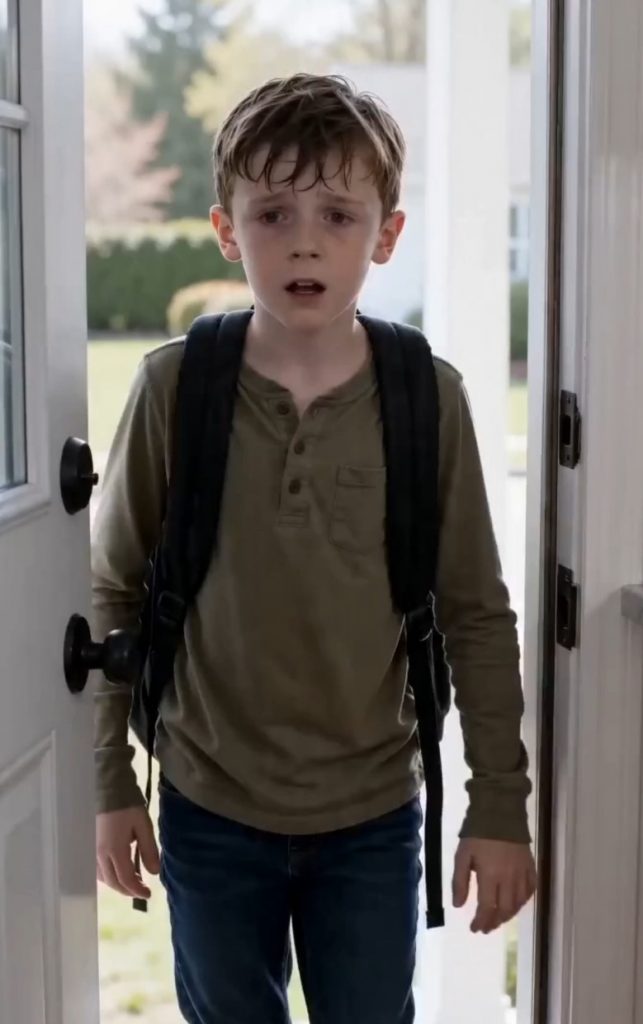
Jordan came through the front door like he had used every bit of strength just to reach it.
The door swung open behind him, letting pale afternoon light spill across the hardwood entryway. His black backpack hung heavy from both shoulders. His short brown hair was damp with sweat, and his face had gone so white it made the sage-green shirt he wore look almost bright against his skin.
He leaned one hand against the doorframe.
“Mom…”
The word was barely a whisper.
In the kitchen, Lisa did not move.
She stood by the sink in a tan knit sweater, one hand resting near her pregnant belly, the other holding her phone. Sunlight poured through the blinds above the sink, turning the white cabinets gold. It should have made the house look warm.
It did not.
Jordan stepped into the kitchen doorway, gripping the straps of his backpack with trembling fingers.
His lips shook.
“They said you don’t love me,” he said. “But you do, right?”
For one second, Lisa only stared at him.
There was no shock in her face. No concern. No motherly instinct at the sight of an eight-year-old boy barely standing.
Only irritation.
Then she lifted her phone slightly, as if his pain had interrupted something more important.
“Don’t call me that,” she snapped. “I’m not your real mother.”
Jordan froze.
The words did not make him cry.
Not at first.
They seemed to pass through him completely, stealing the last bit of strength from his body. His eyes widened, his shoulders dropped, and his small face folded inward as if something invisible had struck him.
Lisa stayed by the sink.
Jordan took half a step back.
Then he collapsed onto the hardwood floor with his backpack still on.
The sound of his body hitting the floor finally broke the house open.
The front door burst wider.
“Jordan!”
Mark Bennett rushed inside in his light blue dress shirt, tie loosened from work, his face turning to terror before he reached his son. He dropped to his knees beside the boy, one hand behind Jordan’s head, the other shaking as he touched his cheek.
“Jordan, buddy, wake up. Come on.”
Jordan did not answer.
Mark looked up at his wife.
“What happened, Lisa?”
Lisa’s mouth opened.
For the first time that afternoon, she looked afraid.
Not for Jordan.
For herself.
And Mark saw it.
Act II
Jordan had called Lisa “Mom” since he was four.
No one forced him.
That was the part Mark remembered later with the kind of ache that made breathing difficult.
Jordan’s birth mother, Anna, had died when he was two. For a long time afterward, Mark lived like a man walking through fog. He fed his son, dressed him, read bedtime stories, and held him when nightmares came, but grief sat in every room with them.
Then Lisa arrived.
At first, she seemed like sunlight after a long winter.
She was organized, lively, full of plans. She remembered preschool events. She put labels on Jordan’s lunchbox. She framed drawings for the refrigerator and told Mark the house needed laughter again.
Jordan adored her with the desperate openness of a child who had already lost one mother and could not bear to believe love might be temporary.
The first time he called her Mom, Lisa had cried.
At least, Mark thought she had.
She knelt in the hallway, pulled Jordan into her arms, and looked over his shoulder at Mark as if they were finally becoming a family.
Two years later, she adopted him legally.
It was Lisa’s idea.
“We should make it official,” she said. “I don’t want him ever feeling like he doesn’t belong.”
Mark believed her.
Jordan believed her more.
But pregnancy changed the house.
Or maybe it only revealed what had been hidden under the surface.
When Lisa found out she was expecting, she began saying things that sounded harmless if Mark was not listening closely.
“Jordan is old enough to be more independent.”
“He needs to stop clinging.”
“When the baby comes, he can’t expect everything to revolve around him.”
Then came the missed school pickups.
The forgotten permission slips.
The lunches packed without the snacks Jordan liked, then no lunches at all on days Lisa said she was “too exhausted to manage everyone.”
Mark worked long hours as a regional sales director, and Lisa used that distance well. She gave him updates in a calm voice. Jordan is testing boundaries. Jordan is jealous. Jordan is dramatic lately.
When Mark asked Jordan, the boy usually shrugged.
“I’m okay.”
Children protect the adults they love, even when those adults are hurting them.
That morning, Jordan had gone to school already unwell. He told Lisa his head hurt. She told him not to invent problems because she had an appointment and could not “play nurse.”
By noon, the school had called Lisa three times.
By one, they called Mark, but the message went to voicemail during a client meeting.
By two, Jordan had been sitting in the nurse’s office with a fever, clutching his backpack, listening to two boys outside the door repeat what their mother had overheard Lisa say at pickup the week before.
He’s not even hers.
She only has to pretend until the real baby comes.
Jordan did not understand adult cruelty.
But he understood enough.
When no one came, and the office got busy, he walked home.
Six blocks.
Then eight.
Then twelve.
By the time he reached the front door, he was not only sick.
He was carrying a question no child should ever have to ask.
Do you love me?
And Lisa answered it like a woman tired of pretending.
Act III
The ambulance arrived seven minutes after Mark called.
Those seven minutes became the longest of his life.
He sat on the hardwood floor with Jordan’s head in his lap, saying his son’s name again and again while Lisa hovered near the kitchen island, one hand over her belly, repeating, “I didn’t do anything.”
Mark barely heard her.
He heard the paramedic asking questions.
How long had he been feverish?
Had he eaten?
Had he walked in the cold?
Had he lost consciousness before?
Mark answered what he could.
Lisa answered nothing.
At the hospital, Jordan was placed under observation. The doctor explained it gently: fever, dehydration, exhaustion, and stress had overwhelmed his small body. He was stable now, but he should never have been walking home alone in that condition.
Mark stood beside the hospital bed, staring at his son’s pale face against the pillow.
Jordan looked even smaller without the backpack.
Lisa sat in the corner, arms crossed.
“He’s always been sensitive,” she said.
Mark turned slowly.
The doctor’s expression changed.
So did the nurse’s.
Lisa seemed to realize too late that the room was no longer her kitchen.
Here, coldness had witnesses.
Mark’s phone buzzed.
It was the school principal.
Then the nurse.
Then Jordan’s teacher.
By the time Mark stepped into the hallway, the truth began arriving in pieces.
The school had called Lisa repeatedly.
Lisa had answered once and said Jordan was “being dramatic.”
She had not picked him up.
She had not called Mark.
She had not authorized the school to arrange alternate transportation.
Then the principal hesitated.
“There’s something else,” she said.
Mark gripped the phone tighter.
“What?”
“Jordan was very upset today. Some children repeated something they said they heard from an adult. About Lisa not being his real mother.”
The hallway tilted.
Mark looked through the glass window at Lisa sitting beside their son’s hospital bed, scrolling on her phone.
His wife.
Jordan’s legal mother.
The woman who had promised before a judge to love and protect him.
The woman who had watched him fall.
That night, after Jordan finally slept, Mark went home alone to get clothes.
The house looked too bright when he entered.
Too normal.
A cereal bowl sat in the sink. Lisa’s phone charger hung from the outlet. Jordan’s backpack lay where the paramedics had removed it, one strap twisted beneath it.
Mark picked it up.
Inside he found a folder from school.
A note from the nurse.
A birthday party invitation Jordan had not mentioned.
And at the bottom, folded into a square, a drawing.
It showed four people.
Mark.
Lisa.
A baby in a crib.
And Jordan standing outside the house.
Above it, in Jordan’s careful handwriting, were five words:
Maybe I can be good.
Mark sat down on the floor.
For a long time, he could not move.
Then Lisa’s phone lit up on the kitchen counter.
A message preview appeared from a woman named Vanessa.
Did you talk to the school about the behavioral placement? If Mark signs before the baby comes, it’ll be easier.
Mark stared at the screen.
The house seemed to go silent around him.
Then he saw the file folder tucked under Lisa’s calendar.
Residential Intake Options.
Jordan Bennett.
Act IV
Lisa came home from the hospital just before midnight.
Mark was waiting at the kitchen table.
The folder lay open in front of him.
So did the school nurse’s note.
So did the adoption certificate, pulled from the family safe.
Lisa stopped in the doorway.
“What are you doing?”
Mark looked up.
His face was calm in a way that made her uneasy.
“Reading.”
She glanced at the documents and immediately hardened.
“You went through my things?”
“Our son collapsed on the floor after you told him you weren’t his mother.”
Her jaw tightened.
“I was upset.”
“He had a fever.”
“I didn’t know that.”
“The school called you.”
“He exaggerates.”
Mark stood.
The chair scraped against the hardwood.
“Do not call my son a liar because you got caught.”
Lisa’s face flushed.
For years, Mark had been gentle in arguments. Careful. Apologetic even when he was right. Lisa had built her confidence around that softness.
But the man across from her now was not negotiating.
He was awake.
Lisa pointed at the folder.
“You don’t understand what it’s been like. He’s needy. He stares at me all the time. He resents this baby.”
“He is eight.”
“He is not mine.”
The words came out again.
Sharper this time.
Cleaner.
Mark’s eyes moved to the adoption certificate.
“You stood in court and said he was.”
Lisa looked away.
“That was before.”
“Before what?”
She placed one hand over her pregnant belly.
“Before I had my own child.”
There it was.
Not hidden in tone. Not softened by excuses.
The truth.
Mark felt something inside him close.
“You wanted to send him away.”
“I wanted help.”
“You wanted him out of the house.”
“I wanted peace,” she snapped. “I wanted one thing in my life that wasn’t about Anna’s ghost and that boy’s sad eyes.”
Mark stared at her.
Jordan’s birth mother had been dead for six years, and still Lisa had found a way to envy her.
Lisa’s voice rose.
“You don’t see it. Everyone feels sorry for him. Poor Jordan. Sweet Jordan. I am pregnant, exhausted, and invisible in my own home.”
Mark’s voice dropped.
“So you made him invisible instead.”
She recoiled as if he had slapped her with the words.
He picked up his phone.
“I’ve already called my sister. Jordan and I are staying with her when he’s discharged.”
Lisa’s panic finally became visible.
“Mark, don’t be ridiculous.”
“I also called our attorney.”
“You can’t keep me from my baby.”
“I’m not talking about the baby.”
Lisa looked at the papers.
Then at him.
“You wouldn’t.”
Mark’s expression did not change.
“You adopted him. That means you don’t get to use ‘not real’ when you are angry and ‘legal rights’ when it benefits you.”
For the first time, Lisa had no answer.
Mark gathered the papers into a folder.
At the door, he stopped.
“One day, Jordan may ask me why the woman he called Mom said that to him.”
Lisa swallowed.
Mark’s eyes were wet now, but his voice held.
“And I will not lie to protect you from the truth you gave him.”
Then he left the bright kitchen behind.
And for the first time, Lisa stood alone in a house that had finally stopped pretending it was warm.
Act V
Jordan woke the next morning to find his father asleep in a chair beside his hospital bed.
Mark’s shirt was wrinkled. His hair was a mess. One hand rested near Jordan’s blanket, close enough that the boy could reach him without asking.
Jordan watched him for a while.
Then he whispered, “Dad?”
Mark woke instantly.
“Hey, buddy.”
Jordan looked around the room.
“Where’s Lisa?”
Mark took a slow breath.
“At home.”
Jordan’s eyes filled with fear.
“Is she mad?”
The question broke Mark in a way the hospital, the documents, and the ambulance had not.
Even after everything, Jordan was still worried about her anger.
Mark moved carefully onto the edge of the bed.
“Jordan, listen to me. None of this was your fault.”
The boy looked down at his hands.
“I tried to be good.”
“You are good.”
“I thought if I helped more, she’d like me when the baby came.”
Mark closed his eyes briefly.
Then he took Jordan’s hand.
“You do not have to earn a place in this family.”
Jordan’s lip trembled.
“But she said she’s not my real mother.”
Mark’s throat tightened.
“She said something cruel. And wrong.”
Jordan looked confused.
“She is not the woman who gave birth to you,” Mark said gently. “But she chose to become your mother in court. She promised to care for you. That promise was real, even if she failed it.”
Jordan stared at him.
“Can people stop loving you after they promise?”
Mark wanted to say no.
He wanted to give his son a soft answer, a clean one, something that would let the room breathe again.
But Jordan had been lied to enough.
“Sometimes people don’t know how to love the way they should,” Mark said. “But that does not mean you were hard to love.”
Jordan began to cry then.
Quietly at first.
Then with his whole small body.
Mark held him as carefully as he could, one hand against the back of his son’s head, the other wrapped around his shoulders.
“I’ve got you,” he whispered. “I’ve got you.”
The legal process that followed was not simple.
It rarely is.
Lisa gave birth to a healthy baby girl six weeks later. Mark made sure the baby was safe, loved, and cared for, but his marriage did not survive the truth. Temporary orders became formal agreements. Jordan began therapy with a woman who kept colored pencils in a jar and never rushed him when words were hard.
Lisa was granted supervised contact only after evaluation and counseling.
At first, Jordan refused to see her.
No one forced him.
That was the first new rule in his life.
His feelings were not treated as problems to manage.
They were listened to.
Mark moved with both children into a smaller house near his sister, where the kitchen was not as bright but somehow felt warmer. Jordan’s room had blue walls, glow-in-the-dark stars, and a desk where he could draw without anyone calling him dramatic.
One evening, months later, Jordan came home from school carrying a paper crown from a class event.
Mark was making pasta, badly.
Jordan stood in the kitchen doorway.
For a second, Mark’s heart clenched at the memory of another doorway, another question.
Then Jordan said, “Dad?”
“Yeah?”
“Can we put my drawing on the fridge?”
Mark turned off the stove.
“What drawing?”
Jordan pulled it from his backpack.
This one showed a house too.
But this time, everyone was inside.
Mark, Jordan, the baby in her high chair, Aunt Rachel visiting with a ridiculous smile, and a dog Jordan had added even though they did not own one yet.
Above the house, he had written:
This is where I live.
Mark placed the drawing in the center of the refrigerator with four magnets, one on each corner, as if securing it against the world.
Jordan watched carefully.
“You like it?”
Mark crouched in front of him.
“I love it.”
Jordan’s face softened.
Not fully healed.
Not untouched by what had happened.
But brighter.
That was enough for one evening.
Years later, Jordan would not remember every detail of the day he collapsed. He would remember the coldness of the floor, the white kitchen cabinets, the sound of his father calling his name.
But more than that, he would remember what came after.
The hospital chair.
The hand near his blanket.
The first time an adult told him that love was not something he had failed to earn.
Lisa’s sentence had been meant to cut him away from the family.
Instead, it exposed the truth.
A mother is not made real by biology alone.
A family is not made safe by photographs, matching holiday pajamas, or the soft light of a perfect suburban kitchen.
It is made real in the moment someone falls, and another person runs toward them.
That day, Lisa stayed by the sink.
Mark ran.
And Jordan, little by little, learned which one was love.