Act I
“Ma’am, please don’t touch anything.”
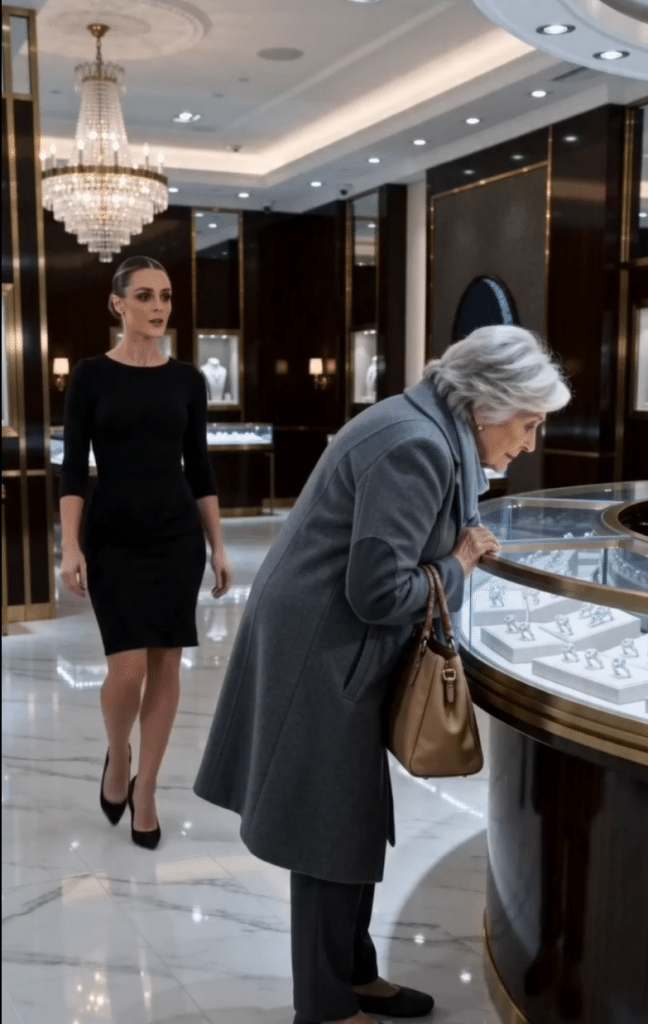
Claire’s voice sliced through the jewelry boutique.
The elderly woman looked up from the diamond case, one hand resting on the strap of her tan leather tote. Her charcoal coat was old but clean, with dark oval patches sewn carefully over both elbows. A pale blue scarf sat neatly at her throat.
“I’m just looking,” she said softly.
Claire’s eyes moved over the patched sleeves, the practical shoes, the modest bag.
Then she smiled.
Not kindly.
“Good,” she said. “Then do your looking from outside the store. People come here to buy, not to dream.”
The chandeliers glittered above them. Diamonds flashed beneath the glass. Two customers near the necklace display turned to stare.
The old woman did not answer.
She only looked at Claire with a calm that made the insult seem smaller than the person who had spoken it.
Then footsteps pounded from the back office.
The manager burst into the showroom, breathless, face pale.
“CLAIRE, SHUT UP!”
Claire spun around, stunned.
The manager pointed at the elderly woman with shaking disbelief.
“Do you even know who that is?”
Claire’s mouth opened.
For the first time since the old woman entered the boutique, fear touched her face.
And the woman in the patched coat quietly removed one glove.
Act II
Her name was Margaret Ellison.
But in the jewelry world, people spoke her name carefully.
Not because she shouted.
Because she remembered.
Forty years earlier, Margaret had been a young widow with two children and a folding table at weekend antique fairs. She bought broken brooches, repaired clasps by hand, reset loose stones, and learned the language of diamonds from old jewelers who had no sons willing to inherit their patience.
By fifty, she owned three boutiques.
By sixty, she owned mines, design houses, auction partnerships, and private vaults in four countries.
Ellison House did not chase wealth.
It defined it.
And Claire was standing in one of Margaret’s stores.
She just did not know it.
That was the point.
Margaret visited her boutiques unannounced twice a year. No entourage. No custom suit. No warning call. She dressed as she pleased, often in the same patched coat she had owned for decades.
Her late husband had mended those elbows himself.
She kept the coat because it reminded her of hunger, love, and the years when every dollar mattered.
It also revealed things.
People who respected only money rarely recognized value when it arrived without decoration.
Claire had failed in less than three minutes.
Act III
The manager stepped closer, voice trembling.
“Mrs. Ellison, I am so sorry.”
Claire went white.
“Mrs… Ellison?”
Margaret looked at her.
“Yes.”
Claire swallowed hard.
“I didn’t realize—”
“That I could buy something?” Margaret asked.
The words were gentle.
That made them worse.
Claire’s eyes filled with panic.
“No, ma’am, I only meant—”
“You meant I looked poor.”
The boutique went silent.
Margaret turned toward the display case.
“I came in to see the new anniversary collection.”
The manager rushed forward with keys.
“Of course. Immediately.”
Margaret raised one hand.
“No.”
He froze.
She looked back at Claire.
“I would like her to show it to me.”
Claire’s throat tightened.
“Me?”
“Yes,” Margaret said. “Since you understand so much about who belongs here.”
Act IV
Claire’s hands shook as she unlocked the case.
Inside lay the Ellison Star collection, diamonds cut with a rare blue-white fire, arranged in velvet like captured moonlight.
Margaret pointed to a necklace.
“That one.”
Claire lifted it carefully.
Her arrogance was gone now, replaced by the fear of someone who had mistaken cruelty for confidence and suddenly found an audience.
Margaret studied the piece.
“My husband designed the first sketch of this setting at our kitchen table,” she said. “We were so broke we used a grocery receipt because we couldn’t afford proper paper.”
Claire said nothing.
Margaret continued.
“I wore thrift-store shoes to my first investor meeting. A man at the door told me the cleaning entrance was in the back.”
Claire’s face flushed.
“What happened?” one customer whispered.
Margaret smiled faintly.
“I bought his building ten years later.”
No one laughed.
They were too busy watching Claire understand.
Margaret placed the necklace back on the velvet.
“Luxury is not the right to look down on people,” she said. “It is the responsibility to make beauty without losing decency.”
Then she turned to the manager.
“Pull her personnel file.”
Claire’s eyes snapped up.
“Mrs. Ellison, please.”
Margaret looked at her patched sleeves.
“You told me people come here to buy, not to dream.”
Her voice hardened for the first time.
“My dear, dreaming is how this entire company began.”
Act V
Claire was not fired that day.
That surprised everyone.
Instead, Margaret gave her one choice.
Resign immediately with a reference that said nothing, or spend six months in the restoration workshop under the oldest jeweler in the company, with no commission, no showroom floor, and no permission to judge a customer before serving them.
Claire chose the workshop.
At first, she hated it.
The work was slow. Humbling. Invisible.
She cleaned tarnished settings, repaired old chains, and learned that the smallest stones were often the ones people cried over most because they belonged to mothers, grandmothers, husbands, daughters.
One afternoon, a woman came in with a ring worth almost nothing on paper.
Claire nearly dismissed it out of habit.
Then she saw the woman’s hands trembling.
So she listened.
Six months later, Margaret returned to the boutique in the same patched coat.
Claire saw her immediately.
This time, she did not look at the sleeves.
She looked at the woman.
“Welcome back, Mrs. Ellison,” Claire said. “Would you like to see the anniversary collection, or would you prefer tea first?”
Margaret studied her.
Then she smiled.
“Tea first.”
The diamonds still glittered.
The chandeliers still shone.
But Claire finally understood what the old woman had known all along.
A jewel’s worth could be measured.
A person’s could not.