Act I
The first thing Clara felt was the water.
Not pain.
Not a miracle.
Water.
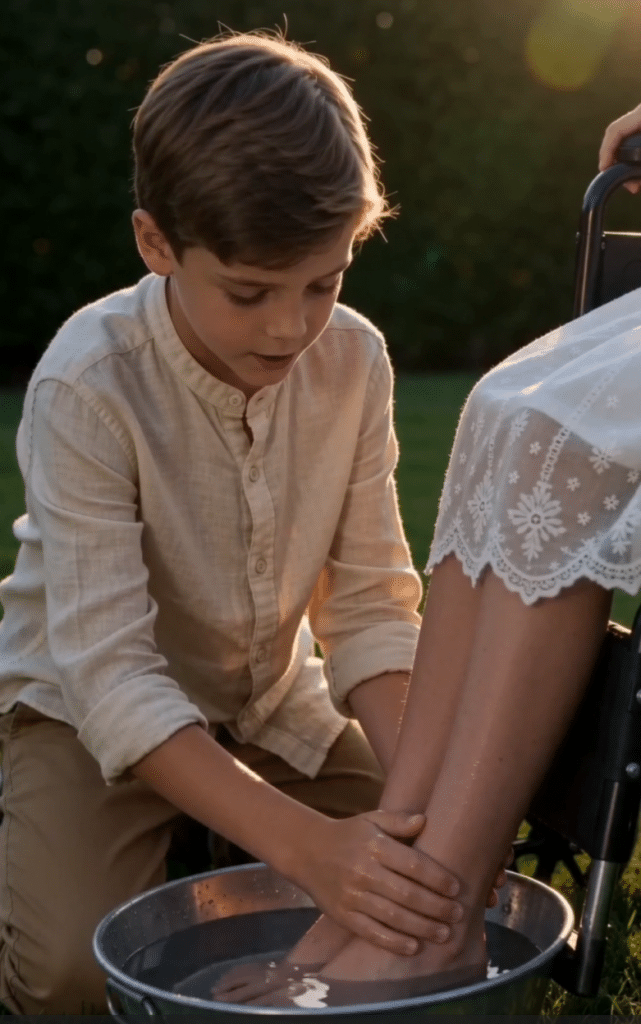
Cool around her toes, light against skin everyone had told her could no longer feel anything at all.
She gasped so sharply the birds scattered from the hedge.
“Wait…” Her blue eyes widened as she stared down at the metal basin on the grass. “I can feel this.”
The boy kneeling in front of her did not look surprised.
He was maybe nine years old, with short brown hair, a beige linen shirt, and wet hands resting gently around her ankles. He looked too calm for a child who had slipped into the private backyard of one of the most guarded homes in Westbridge.
“Don’t be scared,” he whispered. “Just trust me.”
Clara Sinclair had spent eight months in that wheelchair.
Eight months since the fall.
Eight months since doctors, specialists, and her father’s private medical team told her the same thing in soft, careful voices: the damage was permanent, recovery uncertain, hope dangerous.
She had learned to smile when adults cried.
She had learned to say thank you when people called her brave.
She had learned not to ask why her memories of that night came in pieces.
Rain on marble.
A broken music box.
Her father shouting.
A hand on her shoulder.
Then nothing.
Now, in the golden light of her own backyard, a stranger boy had placed her bare feet into a basin of water, and the impossible had answered.
“I can feel it,” she said again, this time louder.
The French doors burst open.
Her father came running across the lawn.
Julian Sinclair was usually a controlled man. Black suits. Calm voice. Perfect posture. The kind of man who made servants lower their eyes and lawyers answer on the first ring.
But now he looked undone.
His shirt was open at the collar. His hair was disheveled. His face was twisted with something too sharp to be concern.
“GET AWAY FROM HER!”
The boy stood slowly.
Water dripped from his hands into the grass.
Clara looked up at her father, confused by the terror behind his rage.
“Dad…” Her voice trembled. “Why are you scared?”
Julian stopped a few feet away.
The question struck him harder than any accusation.
Behind Clara, the boy looked at him with a steady, knowing expression no child should have had.
The garden went quiet.
The sun slipped lower behind the trees.
And Clara suddenly understood that her father was not afraid because a strange boy had touched her feet.
He was afraid because she had felt them.
And if she could feel her legs again, she might also remember who pushed her.
Act II
The boy’s name was Elias Reed.
People in the old part of town called him Eli. Some said it fondly. Others said it with the uneasy respect reserved for children who seemed to know things adults had worked hard to hide.
His mother, Miriam Reed, had been a physical therapist before she died.
Not a famous one. Not the sort Julian Sinclair hired for glossy medical consultations. Miriam worked with people who had been written off by better-funded clinics: factory workers, accident survivors, elderly patients whose insurance ran out before their pain did.
She had gentle hands and a stubborn mind.
That was why Julian fired her after only six weeks.
Miriam had been hired quietly after Clara’s accident. Julian wanted someone discreet, someone who would come through the side entrance and not ask questions. But Miriam asked questions anyway.
Why did Clara react to temperature if her condition was total loss of sensation?
Why did she flinch in sleep when pressure was applied to her feet?
Why did her medical file contain three different versions of the same fall?
Most dangerous of all, Miriam asked why Clara whispered the same sentence every time she woke from nightmares.
Daddy, don’t.
Julian dismissed her the next morning.
By noon, every clinic in the county had received a warning that Miriam Reed was unstable, unprofessional, and not to be trusted near vulnerable patients.
By winter, she was dead.
The official cause was a late-stage infection that had gone untreated too long because poor women do not always have the luxury of becoming sick loudly.
But before she died, Miriam gave Eli a notebook wrapped in wax paper.
Inside were Clara Sinclair’s therapy notes.
Not stolen, Miriam said.
Saved.
“She can feel,” Miriam whispered from her bed, her voice thinner than the blanket covering her. “Not always. Not everywhere. But enough.”
Eli had cried and told her he did not understand.
Miriam had touched his cheek.
“You don’t have to understand all of it. Just remember this: fear can lock a body almost as tightly as injury. And sometimes the first thing a person needs to feel is safety.”
There was more in the notebook.
A diagram of Clara’s reflex tests.
A description of the basin therapy Miriam had wanted to try.
A note about the night of the accident.
Subject startles at male voice. Repeats phrase: “He took Mommy’s key.” Strong distress when father enters room during memory work. Possible trauma-related suppression. Recommend independent evaluation.
At the bottom of the last page, Miriam had written one sentence for her son.
If I am gone and no one believes me, find the girl before they make her disappear inside that chair.
Eli waited three months.
He watched the Sinclair house from behind the hedges.
He learned the gardener’s schedule. The security blind spots. The hour Clara was taken outside for sun because her father believed fresh air looked good when donors visited.
That afternoon, the nurse had left Clara alone near the rose hedge to take a phone call.
Eli slipped through the gap in the fence carrying a metal basin and a bottle of water from the garden spigot.
Clara did not scream.
She only stared at him.
“Are you lost?” she asked.
“No,” Eli said. “You are.”
She should have been afraid.
Maybe she was.
But there was something in his face that reminded her of warm rooms, soft voices, and the blurry woman who used to hold her feet and say, “Tell me what you feel, not what they told you to feel.”
So Clara let him take off her shoes.
She let him place her feet in the water.
And when sensation flashed through her like lightning beneath ice, the world her father built began to crack.
Because inside the house, Julian Sinclair had been watching the garden camera.
And for the first time in eight months, his daughter’s body had betrayed his lie.
Act III
Julian reached Clara first.
He pushed past Eli and grabbed the handles of the wheelchair.
“We’re going inside.”
Clara twisted to look at him.
“No.”
The word was small.
But it stunned him.
For months, Clara had obeyed every instruction. Take the medicine. Rest now. Don’t strain. Don’t listen to people who give you false hope. Daddy knows what’s best.
Now she held the arms of the wheelchair and looked at him as if seeing a stranger wearing her father’s face.
Julian lowered his voice.
“Clara, sweetheart, you’re confused.”
Eli spoke before she could.
“She felt the water.”
Julian turned on him.
“You don’t know anything.”
“I know my mother said you lied.”
Julian’s expression went flat.
There it was.
Not surprise.
Recognition.
Clara saw it.
“My mother?” she whispered.
Eli reached into his pocket and pulled out a folded piece of paper, damp from his wet hands. He held it out to her.
Julian moved to snatch it.
Clara’s hand shot forward first.
Everyone froze.
Her fingers closed around the paper.
Julian stared at her hand.
So did Clara.
It had been instinctive. Quick. Certain. A movement no one had told her she could make.
Slowly, she unfolded the page.
It was not from Eli’s mother.
It was from hers.
Caroline Sinclair.
The woman Clara had been told died in a car accident when she was six.
The handwriting was soft and slanted, familiar from birthday cards Clara kept in a locked drawer.
My darling Clara,
If you ever forget what happened, it will not be because you are weak. It will be because fear taught your mind to hide the truth until it was safe.
Your father does not own your body.
He does not own your memory.
He does not own the key.
Clara stopped reading.
Her breath came unevenly.
“The key,” she whispered.
Julian’s face went pale.
Eli watched him carefully.
“My mom found that letter hidden inside Clara’s therapy cushion,” he said. “Mrs. Sinclair must have put it there before she died.”
Julian stepped toward him.
“She did not die,” Eli said.
The garden seemed to tilt.
Clara looked up.
“What?”
Eli’s voice softened.
“My mother thought your mom was alive when you fell.”
Julian lunged.
This time, someone else stopped him.
A woman’s voice rang from the terrace.
“Touch that boy and I call the police.”
Mrs. Alvarez, the old housekeeper, stood at the French doors with a phone in one hand and a face full of years she had spent being silent. Behind her were two kitchen staff, the gardener, and Clara’s nurse, all frozen between fear and decision.
Julian straightened.
“Go inside,” he ordered.
Mrs. Alvarez did not move.
“I heard her scream that night.”
Clara’s world narrowed to the old woman.
Mrs. Alvarez began crying.
“I heard your mother too.”
Julian’s voice dropped.
“Be careful.”
“No,” Mrs. Alvarez said. “I was careful for eight months. That was my sin.”
Clara’s hands shook around the letter.
“What happened to my mother?”
Julian looked at his daughter.
For one moment, he almost seemed fatherly. Exhausted. Grieved. Human.
Then his eyes flicked toward the house.
Toward the study.
Toward the safe behind the portrait.
And Eli understood.
“The key,” the boy said. “It opens something in there.”
Clara looked at him.
Then at her father.
And suddenly the memory came back with the force of a door breaking open.
Her mother’s voice.
“Run, Clara!”
Her father shouting, “Give me the key!”
A hand.
A shove.
The sound of her body hitting the stairs.
Clara screamed.
Act IV
The police arrived before Julian could remove anyone from the property.
Mrs. Alvarez had already sent the garden footage, Miriam Reed’s notes, and a photograph of Caroline’s letter to Detective Nora Hayes, a woman who had once investigated Caroline Sinclair’s disappearance before the case was quietly shut down by men with better suits than ethics.
This time, Hayes came herself.
No patrol car spectacle.
No sirens.
Just three officers, a warrant, and the kind of calm that made Julian stop performing.
Clara sat in the garden with a blanket around her shoulders. Eli stayed beside her, his wet hands now folded in his lap. He looked like a child again, smaller after the danger had been named.
Detective Hayes crouched in front of Clara.
“I know you’re scared,” she said. “But I need to ask. Do you remember your father pushing you?”
Julian exploded.
“She is a traumatized child being manipulated by a trespasser!”
Clara flinched.
Then she stopped.
She looked down at her feet in the basin.
The water moved around her toes.
“I remember,” she said.
Her voice shook.
But it did not vanish.
“I was at the top of the stairs. Mom was in the study. Dad wanted the key. Mom told me to run to Mrs. Alvarez. I turned. He grabbed me. I fell.”
Julian stared at her as if betrayal were something a child could commit by telling the truth.
“You don’t understand what you saw.”
Clara looked at him.
“You were angry.”
“I was protecting this family.”
“From Mom?”
His mouth tightened.
From behind the officers, Mrs. Alvarez whispered, “From what she knew.”
Detective Hayes turned to the study.
The safe was opened under supervision.
Inside were the things Caroline Sinclair had hidden before the night Clara fell.
A flash drive.
Trust amendments.
Medical reports.
Photographs of offshore accounts.
A small brass key.
And a video recording.
Julian tried to stop them from playing it.
That was how everyone knew they should.
Caroline appeared on the study monitor, pale and frightened but composed. She sat in the very chair Julian used now, wearing a white sweater, one side of her face shadowed by the desk lamp.
“If you are seeing this,” she said, “then Julian has either taken me or convinced the world I left.”
Clara covered her mouth.
Caroline continued.
“My husband has been misusing the Sinclair Children’s Trust for years. When I discovered the transfers, he had me declared unstable by Dr. Bell and tried to force me into private care. I hid the master key with Clara because he would never believe a child could protect what adults failed to.”
Julian’s face had turned gray.
The detective watched him, then returned to the screen.
Caroline’s voice broke only at the end.
“Clara, my love, if you see this one day, please know you were never the reason I vanished. You were the reason I fought.”
The video ended.
For a moment, no one spoke.
Then Detective Hayes looked at Julian.
“Where is your wife?”
He said nothing.
Mrs. Alvarez stepped forward.
“The guesthouse cellar.”
Julian turned on her, all mask gone.
“You old traitor.”
She lifted her chin.
“No. Just late.”
They found Caroline alive beneath the old guesthouse.
Weak. Hidden. Kept under false medical supervision by people Julian paid to call imprisonment treatment.
Clara was not allowed to go down the stairs, so they brought Caroline out wrapped in a blanket into the sunset garden.
Mother and daughter saw each other across the lawn.
Clara made a sound like she had been holding it in for eight months.
Caroline fell to her knees beside the wheelchair.
“My baby.”
Clara reached for her.
Their hands met.
Then Clara leaned forward, and her feet shifted in the basin.
Not much.
Barely an inch.
But enough.
Caroline saw it.
Eli saw it.
Julian saw it too, from between two officers.
And that tiny movement broke him more completely than the handcuffs.
Act V
Julian Sinclair’s trial lasted longer than the newspapers expected.
Rich men rarely fall without trying to drag the floor down with them.
He claimed Caroline was unstable. He claimed Clara’s memories had been planted. He claimed Miriam Reed had manipulated medical records out of bitterness after being dismissed. He claimed the hidden room beneath the guesthouse was a therapeutic space.
The jury heard him.
Then they saw the footage.
Clara at the top of the stairs.
Caroline running from the study.
Julian grabbing for the brass key.
The fall was not shown publicly. Caroline insisted on protecting her daughter from becoming an image people replayed for horror. But the court saw enough.
So did the world.
Miriam Reed’s name was cleared. Her notes became central to the medical review that proved Clara had been misdiagnosed, overmedicated, and denied appropriate trauma-informed therapy. Dr. Bell lost his license first, then his freedom. Julian lost the trust, the house, and finally the daughter he had tried to trap inside a story of helplessness.
But recovery did not arrive like a miracle.
It came slowly.
Clara’s legs did not simply wake and obey. Some days she felt warmth. Some days pressure. Some days nothing but frustration so sharp she threw pillows across the therapy room and then apologized until Caroline held her face and said, “You are allowed to be angry.”
Eli visited every Tuesday.
At first, Clara called him the healer boy because that was what the staff whispered.
He hated it.
“My mom was the healer,” he said. “I just brought the water.”
Caroline heard that and created the Miriam Reed Fund for patients denied care because they were poor, inconvenient, or not believed quickly enough. Eli did not understand the paperwork, but he understood when Caroline gave him Miriam’s notebook back, professionally preserved, with his mother’s name embossed on the cover.
He cried then.
Not loudly.
Clara took his hand.
This time, neither of them needed a basin.
Months passed.
The Sinclair house changed in ways Julian would have hated.
The portrait hiding the safe was removed. The study became a therapy room with sunlight, open shelves, and no locked drawers. The French doors to the garden stayed open whenever weather allowed.
Mrs. Alvarez became the official household manager, though she said she had been doing the work unofficially for years.
Caroline kept the guesthouse cellar sealed for evidence until the trial ended.
Then she had it filled in.
Not remodeled.
Not repurposed.
Filled.
Some rooms did not deserve second lives.
On the first anniversary of the day Eli entered the garden, Clara asked to go outside at sunset.
She wore a pale blue dress and no shoes. Her wheelchair rolled over the grass toward the same place where the basin had sat.
Caroline walked beside her.
Eli was waiting near the hedge with another metal basin.
Clara frowned.
“You brought it again?”
He shrugged.
“It seemed important.”
She smiled.
This time, the water was warm.
Eli poured it slowly while Clara lowered her feet in. Caroline knelt beside her daughter, one hand resting lightly on the wheelchair arm.
Clara closed her eyes.
For a moment, there was only the sound of water, leaves, and evening birds.
Then her toes moved.
All five on her right foot.
Small.
Unsteady.
Beautiful.
Caroline covered her mouth.
Eli grinned.
Clara opened her eyes, annoyed and thrilled at once.
“Don’t make a big face.”
“I’m not,” Eli said, making a very big face.
She laughed.
It was the first laugh Caroline had heard from her daughter that did not have fear hiding under it.
A therapist would later explain that movement could return in fragments. That trauma recovery and neurological healing were complicated. That hope had to be disciplined, careful, grounded.
Caroline listened.
She respected science.
She respected caution.
But she also respected the truth that no chart could fully hold: a child had been told she was broken by the man who broke her, and another child had carried water across a garden to prove she still belonged to herself.
Clara looked toward the French doors.
For months, she could not face them without remembering her father running toward her in rage.
Now they stood open.
Warm light spilled from the house.
Mrs. Alvarez was setting dinner. Caroline’s laughter had returned to the kitchen. Eli had tracked mud through the hallway and been scolded like family.
Clara reached down and touched the water with her fingers.
“Dad was scared,” she said quietly.
Caroline’s face softened.
“Yes.”
“Because I could feel.”
“Yes.”
Clara looked at her feet.
“Because if I felt my legs, I might remember.”
Caroline’s eyes filled.
“You did remember.”
Clara nodded.
Then she lifted her chin.
“But I also remember Eli saying not to be scared.”
Eli looked embarrassed.
“I was scared too.”
Clara smiled.
“That’s okay.”
The sun lowered behind the trees, turning the lawn gold.
Not the false gold of wealth or chandeliers or locked rooms dressed as safety.
Real gold.
Light on wet hands.
Light on open doors.
Light on a girl’s bare feet in a basin of water, learning sensation could return without permission from the man who stole it.
Clara moved her toes again.
This time, everyone saw.
No one screamed.
No one ran to stop her.
No one told her what she felt was impossible.
And for the first time since the fall, Clara Sinclair looked down at her own body and believed it was telling her the truth.