Act I
Eleanor Ashcroft stopped walking in the middle of the ballroom.
The champagne flute in her hand trembled once, then went still.
Around her, the gala continued in its polished little world. Crystal chandeliers poured warm light over navy gowns, black tuxedos, white roses, and silver trays. The orchestra played softly from the balcony. Men discussed donations in voices trained never to sound desperate. Women smiled beneath diamonds bright enough to make the room look almost holy.
But Eleanor saw none of it.
She saw the necklace.
A young waitress in a black-and-white staff uniform was carrying a tray of champagne near the far end of the ballroom. She looked barely twenty, with dark hair pinned back and nervous shoulders. Around her neck, resting just above her collarbone, was a silver chain.
And hanging from it was a five-petal flower pendant.
Diamonds in each petal.
A tiny blue stone at the center.
Eleanor’s face went white.
The flute slipped from her hand and shattered on the marble.
Several guests turned.
“Mrs. Ashcroft?” someone asked.
She did not answer.
She moved across the ballroom as if pulled by something stronger than dignity.
The waitress noticed too late.
Eleanor reached her and caught both her shoulders with trembling hands.
“That necklace,” she whispered.
The girl recoiled, tray tilting dangerously.
“I’m sorry—”
“Where did you get it?”
The room began to quiet.
The girl’s eyes widened in fear. She looked around at the wealthy guests, at the broken glass behind Eleanor, at the security men already shifting near the doors.
“I… I’ve had it,” she stammered. “I didn’t steal it.”
The words struck Eleanor like a slap.
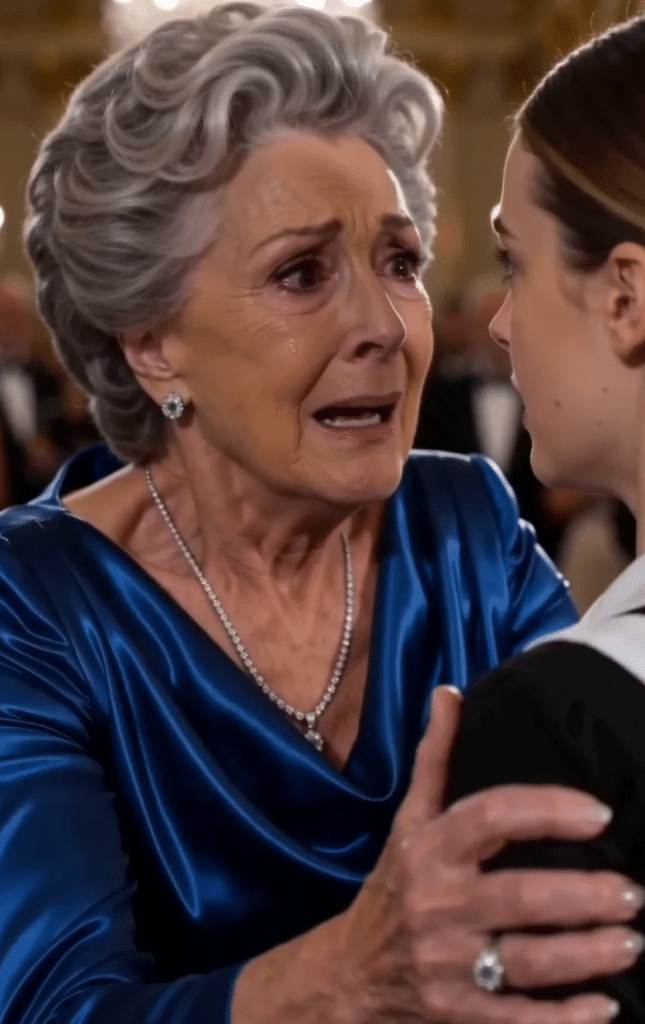
She let go immediately, horrified by the fear in the girl’s face, but she could not step away. Tears had already gathered in her eyes. Her whole body seemed to tremble beneath the navy satin gown.
“No,” Eleanor said, voice breaking. “No, child, I’m not accusing you.”
The girl clutched the pendant with one hand.
Eleanor stared at her face.
The dark eyes.
The shape of her mouth.
The small cleft in her chin that Eleanor had kissed once, only once, before the world stole the right to do it again.
“What’s your name?” Eleanor asked.
The girl swallowed.
“Rosie.”
The ballroom disappeared.
Eleanor covered her mouth.
Because twenty-two years earlier, her newborn daughter had vanished from Ashcroft House wearing that exact necklace.
Her name had been Rosalie.
Act II
Eleanor Ashcroft had been forty-eight when Rosalie was born.
By then, society had already decided her story.
She was the elegant widow of William Ashcroft, patron of museums, owner of estates, keeper of a family fortune that had passed through men for generations. She had no children. No heir. No scandal. No softness left that anyone could see.
Then Rosalie came.
Unexpected.
Impossible, according to doctors who had long ago given Eleanor careful, pitying answers.
William had died two months before Eleanor learned she was pregnant. For weeks, she kept the news secret, moving through grief with one hand pressed to her stomach beneath black silk. People said she looked composed.
She was not composed.
She was terrified.
But when Rosalie was born, small and furious and alive, Eleanor laughed for the first time since her husband’s funeral.
The necklace had been William’s final gift, though he never knew who would wear it.
He had designed it for the child they had stopped hoping for. Five diamond petals for five lost pregnancies. A blue sapphire at the center because Eleanor’s mother used to say blue was the color of promises that survived winter.
On the back, William had engraved three tiny letters.
R.A.B.
Rosalie Ashcroft Bellamy.
Bellamy was Eleanor’s maiden name, added because William said any daughter of theirs should carry both histories, not just his.
Rosalie wore the pendant only once.
At her christening.
Three days later, she was gone.
The official story was a kidnapping.
A nurse found the nursery window open. A blanket lay on the floor. The pendant was missing. No ransom note ever came. A body was never found, but after six months the police called the case cold. After one year, newspapers stopped printing Rosalie’s photograph. After three years, Eleanor’s doctor began suggesting she accept that grief was turning into obsession.
Only one person benefited from Rosalie’s disappearance.
Eleanor’s nephew, Marcus Bellamy.
With no child, Marcus remained the assumed successor to Ashcroft holdings. He was charming, useful, and always available in those awful months after Rosalie vanished. He handled police calls. Managed the estate. Spoke to reporters. Took Eleanor’s shaking hands and promised he would never stop searching.
He did stop.
Quietly.
Efficiently.
He redirected funds. Closed private inquiries. Dismissed staff who remembered too much. He told Eleanor certain detectives were exploiting her pain. He told her hope could be cruel.
Eleanor hated him for that.
Then, slowly, she relied on him anyway.
That was the terrible genius of grief. It made even cages feel like something to lean on.
The gala that night was Marcus’s idea.
The Ashcroft Children’s Foundation had reached its thirtieth anniversary. The ballroom was full of donors, politicians, and reporters. Marcus had planned a speech about legacy and resilience. He had arranged Eleanor’s seat near the front, where the cameras could catch her clapping.
He had not arranged for a waitress named Rosie to walk through the room wearing a necklace that should have been lost with a stolen baby.
Rosie stood frozen under the chandelier, still clutching the pendant.
Eleanor tried to steady her voice.
“May I see the back?”
Rosie shook her head quickly.
“It’s all I have.”
The answer was not refusal.
It was survival.
Eleanor lowered her hands.
“I understand.”
Rosie stared at her, uncertain.
“No, you don’t,” she whispered. “People see it and think I took it. I didn’t. My mother said it was mine before I could talk.”
“Your mother?”
“She raised me.” Rosie swallowed. “She died last year.”
Eleanor’s chest tightened.
“What was her name?”
“Nora Vale.”
At the sound of that name, an elderly housekeeper standing near the service doors gasped.
Eleanor turned.
“Mrs. Vale?”
The old woman covered her mouth.
Rosie looked between them.
“You knew her?”
The housekeeper’s eyes filled with tears.
“She worked in the nursery,” she whispered. “The night the baby disappeared.”
Act III
The ballroom changed in an instant.
Not visibly.
The chandeliers still burned. The flowers still stood in perfect white arrangements. The champagne still shivered in crystal flutes.
But beneath the elegance, something old and buried began to move.
Marcus Bellamy appeared from the crowd with a smile that did not reach his eyes.
“Aunt Eleanor,” he said, touching her elbow. “You’ve had a shock. Let’s take this somewhere private.”
Rosie stepped back at the word private.
Eleanor noticed.
So did Marcus.
His gaze dropped to the necklace, and for one naked second his face revealed fear.
Then the mask returned.
“My dear,” he said to Rosie, smooth and gentle, “that is a valuable piece. Perhaps someone gave it to you without explaining where it came from.”
Rosie’s chin lifted.
“It’s mine.”
Marcus smiled sadly for the crowd.
“Of course you believe that.”
Eleanor turned to him.
“Do not speak to her like that.”
The room fell still.
Marcus blinked.
For years, he had spoken over Eleanor in the language of care. He arranged her calendar, managed her appearances, guided her hand through legal papers, and called it protection. He had forgotten what her voice sounded like when it did not ask permission.
Eleanor looked at Mrs. Vale.
“Nora worked in the nursery?”
The old housekeeper nodded, crying now.
“She was dismissed after the investigation. Mr. Marcus said she had fallen asleep on duty.”
Marcus’s jaw tightened. “This is not the time.”
“It is exactly the time,” Eleanor said.
Rosie touched the pendant.
“My mother said she was paid to leave London. She said if I ever found a woman who cried when she saw the flower, I should show her the paper.”
Eleanor’s breath caught.
“What paper?”
Rosie hesitated.
Then she reached into the front of her uniform and pulled out a small envelope, folded flat and wrapped in plastic. She had kept it against her skin.
Marcus moved.
Too fast.
He reached for it, but a security guard stepped between them.
Not one of Marcus’s men.
One of Eleanor’s.
Eleanor had hired him quietly years earlier, after realizing grief had made people too comfortable handling her.
“Give it to me,” Eleanor said softly.
Rosie did.
Inside was a brittle page torn from a medical file.
At the top was a birth record.
Female infant. Rosalie Ashcroft Bellamy.
Beneath it, in rushed handwriting, were Nora Vale’s words.
I did not steal the baby. I was told she was being moved for safety. When I learned the truth, it was too late. I kept her alive. I named her Rosie so some part of her name would survive.
Eleanor’s vision blurred.
Rosie was staring at the page now as if it had become a mirror she was afraid to understand.
Eleanor kept reading.
Mr. Marcus said Mrs. Ashcroft was unstable and the child would be better hidden until the estate was secure. He said no one would believe a nursery maid over a Bellamy.
The room erupted.
Marcus spoke sharply.
“This is a forgery.”
Rosie flinched at the force of his voice.
Eleanor did not.
She turned the pendant gently in Rosie’s hand.
“May I?”
This time, Rosie let her.
Eleanor pressed one diamond petal inward.
A tiny hidden clasp opened at the back.
Rosie gasped.
She had never known.
Inside the pendant was a sliver of blue silk and a microscopic curl of dark baby hair, sealed beneath glass. William had insisted on the compartment before Rosalie was born.
“To hold proof that love was here,” he had told Eleanor.
Eleanor looked at Rosie through tears.
“My husband made this,” she whispered. “No one knew how it opened except him and me.”
Marcus stepped backward.
And every guest in that ballroom saw the exact moment a powerful man realized the dead had kept better records than the living.
Act IV
Eleanor did not embrace Rosie immediately.
She wanted to.
God help her, she wanted to pull the girl into her arms and say daughter until the word repaired everything time had broken.
But Rosie stood trembling, surrounded by strangers, suddenly transformed from waitress to lost heir in a room that had laughed at staff all evening without ever seeing them.
Eleanor understood fear better than she had twenty minutes earlier.
So she offered her hand instead.
Rosie stared at it.
Then, slowly, took it.
Marcus laughed.
It was ugly because it was desperate.
“You cannot be serious,” he said. “A necklace and a servant’s confession? This girl could be anyone.”
Rosie’s face tightened.
Eleanor looked at him.
“She is not anyone.”
“She is a liability.”
The word slipped out before he could dress it better.
A chill moved through the ballroom.
Eleanor’s voice dropped.
“Is that what my daughter was to you?”
Marcus went pale.
The doors opened before he could answer.
A woman in a charcoal suit entered with two attorneys and a police inspector. Eleanor had sent the message the moment she saw the pendant. One word to her private counsel.
Flower.
That was enough.
Her attorney, Grace Halden, crossed the room carrying a sealed file.
“We received the DNA order you authorized years ago,” she said quietly. “The preserved sample from Rosalie’s christening gown remains viable. If Miss Rosie consents, we can confirm identity legally.”
Rosie’s eyes widened.
Eleanor turned to her.
“Only if you want to.”
No one had asked Rosie what she wanted all night.
Maybe no one had asked her often enough in life.
She looked at Marcus. Then at the necklace. Then at Eleanor.
“I want to know why my mother was scared until she died.”
The inspector stepped forward.
“So do we.”
Marcus tried to leave.
He did not get far.
Two officers stopped him near the marble archway while guests watched in a silence sharper than applause. He protested, threatened, named friends in government, accused Eleanor of being manipulated.
Eleanor listened to none of it.
Her attention stayed on Rosie.
The girl’s face had gone pale. Her knees seemed unsteady. Eleanor guided her to a chair near the wall, not the servants’ exit, not a back room, but the front of the ballroom where everyone could see she was not being hidden again.
“Did Nora love you?” Eleanor asked.
Rosie looked startled.
Then defensive.
“Yes.”
“Good,” Eleanor said, voice breaking. “Then whatever else she did, she gave you what I could not.”
Rosie stared at her.
The anger came then.
Not loud.
Worse.
Quiet.
“Why didn’t you find me?”
Eleanor closed her eyes.
There were answers.
Police reports. lies. doctors. Marcus. years of being told hope was madness. Private detectives who vanished when they came too close.
But no answer could stand before that question and remain whole.
“I failed,” Eleanor said.
Rosie’s mouth trembled.
Eleanor opened her eyes.
“I was lied to, but I also trusted the wrong people because grief made me tired. I will not ask you to make that smaller for me.”
Rosie looked down at the pendant.
For a moment, she seemed very young.
Then she whispered, “My mother said rich people only apologize when they want something back.”
Eleanor nodded through tears.
“Then don’t give me anything back yet.”
Across the ballroom, Marcus was led away.
His speech about legacy remained folded in his jacket pocket.
He would never give it.
Act V
The DNA results arrived three days later.
Rosie did not cry when they were read.
Eleanor did.
The report confirmed what the pendant had already told her heart: Rosie Vale, catering staff, orphan, scholarship dropout, waitress at the Ashcroft gala, was Rosalie Ashcroft Bellamy.
Her daughter.
Alive.
Twenty-two years late.
The world devoured the scandal.
Heiress Found Working Gala.
Ashcroft Baby Abduction Case Reopened.
Nephew Arrested in Estate Fraud Investigation.
The headlines made it sound like a fairy tale because headlines often insult pain by making it tidy. They did not mention Rosie sitting on the bathroom floor of Eleanor’s townhouse because the reporters outside made her feel trapped. They did not mention Eleanor waking at four in the morning and walking to the old nursery just to touch the crib rail. They did not mention the first dinner, where mother and daughter sat across from each other with too much silverware and no idea how to speak.
Rosie stayed in Nora’s old apartment for the first month.
Eleanor hated it.
She said nothing.
That was the first lesson.
Love that arrives late must knock.
It cannot simply enter because blood gives it a key.
Marcus’s crimes widened under investigation. He had not only arranged Rosalie’s disappearance; he had used her presumed death to control trust assets, foundation appointments, and estate transfers for decades. Doctors were questioned. Former staff were found. Payments were traced through charities with names too gentle for what they had hidden.
Nora Vale’s name was cleared publicly.
That mattered to Rosie more than the inheritance.
At the hearing, Eleanor stood beside her daughter as the court acknowledged that Nora had not stolen Rosalie, but had protected her after realizing she had been used in the abduction. Rosie held Nora’s photograph in both hands.
“She was poor,” Rosie told the reporters afterward. “That is why no one believed her. Not because she was a liar.”
Eleanor stood slightly behind her.
Not speaking for her.
Listening.
Months passed.
The Ashcroft Children’s Foundation was rebuilt from the ground up. Rosie insisted the first reform be simple: no gala, no committee, no donor event would ever again treat staff as invisible. Eleanor agreed before the board could object.
Rosie also refused to change her name completely.
“Rosalie feels like someone in a portrait,” she said one afternoon.
Eleanor looked at her carefully.
“And Rosie?”
“Rosie survived.”
So the legal papers read Rosalie “Rosie” Ashcroft Vale.
Eleanor cried over that too.
Rosie teased her for crying too much.
Eleanor accepted the criticism with gratitude.
One year after the gala, the ballroom opened again.
This time, there were no champagne towers.
No speeches by Marcus Bellamy.
No staff uniforms designed to make people blend into walls.
The event honored Nora Vale and every worker whose warning had ever been dismissed because they did not have the right accent, salary, or last name. Former housekeepers stood beside judges. Nurses beside donors. Waiters beside board members. Nobody entered through the service door.
Rosie wore a deep green dress.
The silver flower pendant rested at her throat.
Eleanor wore navy again, though not the same gown. She had tried it on and found she could not bear the memory of standing frozen beneath the chandelier, seeing a ghost on a waitress’s collarbone.
Before the guests arrived, mother and daughter stood alone in the ballroom.
The chandeliers glowed above them.
For a while, neither spoke.
Then Rosie said, “I was so scared when you grabbed me.”
Eleanor closed her eyes.
“I know.”
“I thought you were going to say I stole it.”
“I know.”
Rosie touched the pendant.
“I spent my whole life explaining I didn’t steal things that were already mine.”
Eleanor’s face crumpled.
“I am so sorry.”
Rosie looked at her then.
Really looked.
Not at the matron, not at the name, not at the fortune, not at the woman who had lost her.
At the mother who had failed, been deceived, survived, and was still standing there with empty hands, waiting.
Rosie reached out.
Eleanor froze.
Then Rosie took her hand.
It was not forgiveness in full.
Not yet.
But it was a beginning.
Across the room, musicians began tuning their instruments. Staff entered through the main doors carrying trays of food they were invited to eat from later. The room filled slowly with people and voices, but Eleanor barely heard them.
She was looking at her daughter.
Alive.
Whole in ways no report could measure.
Wounded in ways no fortune could repay.
The flower pendant caught the chandelier light and scattered it across both their hands.
Five petals.
Five lost hopes.
One blue promise at the center.
For twenty-two years, Eleanor had believed the necklace had vanished with her baby into darkness.
But it had not vanished.
It had stayed against Rosie’s heart through foster rooms, cheap apartments, service corridors, hunger, grief, and every room where someone looked at her uniform and assumed she owned nothing precious.
The necklace had not been proof of wealth.
It had been proof of belonging.
And now, beneath the same chandeliers where Eleanor first mistook terror for theft, Rosie lifted her chin and walked beside her mother into a ballroom that finally knew her name.