Act I
The little girl stood beside the banquet table like a shadow that had wandered into the wrong world.
Everything around her glittered.
The ballroom rose in gold and glass, with chandeliers spilling light over marble floors and white tablecloths. Women in satin gowns leaned over plates they barely touched. Men in tuxedos laughed softly, their voices polished by money, wine, and the belief that nothing ugly could reach them through doors guarded by men in black.
Then the child appeared.
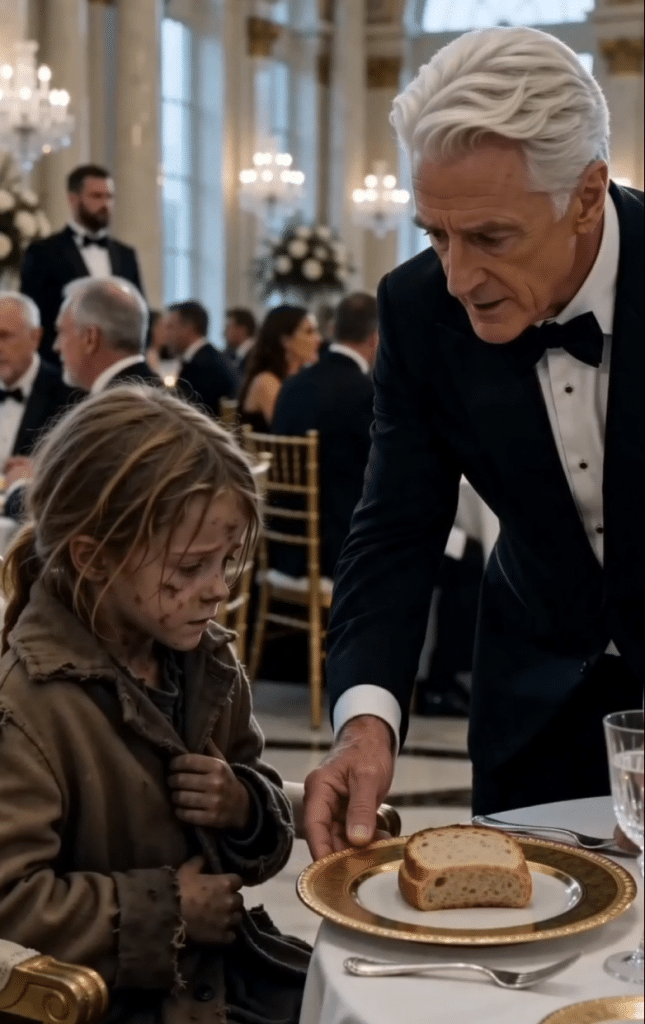
She was small, maybe eight years old, with dirt smudged across her cheeks and soot darkening the edges of her hands. Her light brown hair hung in tangled strands beneath an oversized brown coat that swallowed her shoulders and nearly reached her knees. Beneath it, her dress was thin, stained, and torn at the hem.
She looked at the table.
Not the jewels.
Not the chandeliers.
The bread.
Her fingers tightened around the front of her coat.
“Can I sit here?” she asked.
The guests nearest her went quiet.
A young man in a tuxedo stepped in at once, his hand firm on her shoulder. He had the alert, embarrassed expression of someone trained to protect wealthy people from discomfort.
“You need to leave,” he said.
The girl looked down.
“I’m just hungry.”
The words were so soft that several people pretended not to hear them.
At the head of the table, an elderly man with sleek white hair slowly raised one hand.
“Wait.”
The young man stopped.
The old man was Lord Edmund Vale, though in America they called him simply Edmund Vale because titles made people uncomfortable unless they came attached to donations. He owned hotels, shipping interests, and half the buildings facing the square outside. That night’s gala had been arranged in his honor, a celebration of the Vale Foundation’s work for children in crisis.
The irony had not yet reached him.
Edmund looked at the girl for a long moment.
Then he took a piece of bread from the silver basket, placed it on a gold-rimmed plate, and pushed it toward the empty chair beside him.
“Sit,” he said. “Eat. Stay.”
The young man withdrew his hand.
The girl climbed slowly into the chair, too small for it, too wary to trust the kindness. She did not grab the bread. She looked at Edmund first, waiting for the trick.
“There’s butter too,” he said gently.
She ignored the butter.
She picked up the bread with both hands and took one careful bite, as if afraid someone might change their mind before she could swallow.
A woman at the table dabbed her lips with a napkin and looked away.
Edmund did not.
The girl ate three bites, then stopped suddenly, remembering something more important than hunger. She reached inside her coat and pulled out a white cloth napkin, folded tightly around something heavy.
Her small hands shook as she opened it.
Inside was a silver ring with a large blue gemstone.
The entire world dropped out from beneath Edmund Vale.
The sapphire caught the chandelier light and burned cold and bright against the white cloth.
The girl held it out.
“My mom said give this to the man with white hair.”
Edmund did not take it at first.
He could not.
That ring had belonged to his wife, Margaret. Then to his only daughter, Caroline. It had vanished twenty years ago on the same night Caroline was declared dead after a fire in the east wing of this very building.
He had buried his daughter without it.
He had dreamed of that ring for two decades.
Now it lay in the dirty hands of a hungry child.
Edmund finally reached for it, his fingers trembling.
“Where is your mother?” he asked.
The girl looked straight at him.
Her eyes were watery, exhausted, and far too knowing.
“She said you left us here.”
The ballroom went silent.
And somewhere beneath the marble floor, behind a locked door no guest had ever seen, a woman was waiting for the child to return.
Act II
The girl’s name was Rose.
She said it after Edmund led her away from the table, past the staring guests, past the musicians who had stopped playing, and into a private sitting room behind the ballroom.
The young man in the tuxedo followed, but Edmund raised a hand.
“No one touches her.”
The man stepped back, chastened.
Rose sat on the edge of a velvet chair with the bread still in her lap. She did not lean back. Children who have been moved too often never trust chairs enough to relax into them.
Edmund stood before her, the sapphire ring in his palm.
The stone seemed to pulse with all the years he had tried to bury.
“Rose,” he said softly, “what is your mother’s name?”
She looked down.
“Mara.”
Edmund waited for recognition.
None came.
“Mara what?”
“She doesn’t say the other name unless she’s crying.”
His chest tightened.
“And when she cries?”
Rose touched a crumb on the plate.
“She says Vale.”
Edmund gripped the back of the nearest chair.
Mara Vale.
There had never been a Mara Vale in his family.
But there had been a Caroline Vale.
His daughter.
His only child.
Caroline had been twenty-two when she disappeared into the fire that ruined the east wing of Vale House. She was wild, kind, stubborn, and forever bringing home wounded things: birds, stray dogs, broken-hearted friends, causes no one else wanted to fund.
She had also been pregnant.
Edmund learned that only after she died.
Or rather, after he was told she died.
His brother, Alistair, had handled everything. The police. The insurance. The private medical report. The sealed funeral. Edmund had been half-mad with grief, sedated by doctors, surrounded by people telling him not to ask what pain could not answer.
The body, they said, was too badly damaged for him to see.
The child, they said, had not survived.
The ring, they said, was lost in the fire.
Edmund believed them because grief had made disbelief feel like cruelty.
Then Alistair took control of the foundation, expanded the charity, rebuilt the ballroom, and turned Caroline’s death into a public mission. Every year, the gala raised money for children no one in the ballroom ever had to meet.
And now Rose sat in front of Edmund, wearing poverty like a second skin, carrying Caroline’s ring.
“My mother is alive?” he whispered, not quite to the child.
Rose looked up quickly.
“No. My mom is Mara.”
Edmund sank slowly into a chair.
Of course.
Not Caroline.
Caroline’s daughter.
The child who was supposed to have died in the fire.
She had lived. She had grown. She had become a mother herself.
And she had raised Rose somewhere inside the shadow of his name.
Rose reached into her coat again and removed a folded piece of brown paper. It was old, rubbed soft at the corners, and written in a hand Edmund knew so well that seeing it made his eyes burn.
Caroline’s handwriting.
Papa,
If this reaches you, then I was wrong to think I could come home safely.
Alistair knows about the trust. He knows my child inherits Mother’s shares. He knows the foundation was never meant to belong to him.
He locked the east wing before the fire. He took my baby from me after I gave birth. He told me you signed the order. I did not believe him at first.
Then no one came.
Edmund stopped reading.
The room blurred.
He could hear the gala outside, the soft murmur of donors returning to their champagne, but it sounded distant now, obscene.
He forced himself to continue.
If my daughter survives, tell her I did not leave her. Tell my father I waited until waiting became another kind of death.
The sapphire opens what my uncle buried.
C.
Edmund lowered the letter.
Rose watched him carefully.
“Are you mad?”
He looked at her small face.
“At you? Never.”
“At my mom?”
“No.”
“At the lady who said she’d call the men if I came upstairs?”
Edmund went still.
“What lady?”
Rose pressed her lips together.
“She wears pearls and smells like roses. Mom says never let her see the ring.”
Edmund knew before the name arrived.
Vivienne Vale.
Alistair’s widow.
The woman who had taken his brother’s seat on the foundation board after his death. The woman currently hosting the gala in the ballroom. The woman who had smiled across from Edmund all evening while the granddaughter he never knew existed begged for bread ten feet away.
Outside, applause began.
Someone was calling Vivienne to the stage.
Edmund stood.
The sapphire ring closed in his fist.
“Rose,” he said, voice low, “where did your mother send you from?”
The child looked toward the floor.
“Downstairs.”
“There is no downstairs.”
Rose shook her head.
“There is if you know which wall opens.”
Act III
Vale House had secrets built into its bones.
It had once been a private residence, then a hospital during the war, then a luxury events hall after Edmund inherited it. There were service tunnels under the ballroom, storage corridors behind the kitchens, old rooms sealed during renovations because rich people preferred history when it did not smell of damp stone.
Edmund had not entered the lower east wing in twenty years.
Alistair told him it was unsafe after the fire.
Vivienne later said the same.
No one questioned it because the dead have a way of making certain doors impolite.
Rose led him through the catering corridor, past startled chefs and waiters who moved aside when they saw Edmund’s face. The young man in the tuxedo followed them, this time not as enforcer, but witness.
His name was Thomas.
He had been the one told to remove Rose.
Now he looked sick with shame.
Rose stopped beside a paneled wall near the old wine cellar. She pressed her palm against a carved flower in the wood and pushed twice.
Nothing happened.
She swallowed.
“My mom said use the blue.”
Edmund looked at the ring.
The sapphire.
He pressed the stone into the center of the carved flower.
A latch clicked.
The wall opened.
Cold air breathed out.
Behind it, a narrow staircase descended into darkness.
Thomas whispered, “My God.”
Edmund stepped down first.
The stairs led to a corridor lit by a single weak bulb. The air smelled of dust, old plaster, and something faintly medicinal. At the end of the hall was a door with scratches around the lock.
Rose ran to it.
“Mom?”
A woman’s voice answered from inside, thin but alert.
“Rosie?”
Rose burst into tears.
Edmund nearly fell against the wall.
That voice.
Not Caroline’s.
But something in it carried her.
Thomas forced the lock with a catering knife and his shoulder. The door gave way.
Inside was a small room with a cot, blankets, a basin, and shelves stacked with old foundation files. A woman in her late twenties sat upright against the wall, pale and trembling, one hand pressed to her side.
Her eyes went first to Rose.
Then to Edmund.
She went still.
For one impossible moment, three generations stared at one another across a room meant to erase them.
“Mara,” Edmund said.
She flinched at the sound of her name.
“My mother said you had kind eyes,” she whispered. “I thought she made that up so I wouldn’t hate you.”
Edmund entered slowly, as if approaching a wounded animal.
“I did not know,” he said.
Mara laughed once, bitter and broken.
“That’s what she hoped.”
Rose climbed onto the cot and wrapped both arms around her mother. Mara held her fiercely, kissing her dirty hair again and again.
“I told you to eat first,” Mara whispered.
“I did,” Rose said. “He gave me bread.”
Mara looked at Edmund, and for the first time, something in her face softened.
Not forgiveness.
Recognition of a beginning.
Edmund noticed the files.
“What are these?”
Mara’s expression hardened.
“The truth.”
For years, she explained, she and her mother had lived in hidden places owned by the foundation. Caroline survived the fire but was kept drugged and confined long enough for Alistair to seize power. When she escaped, she found her infant daughter had been placed under a false name in one of the foundation’s private homes.
Caroline stole her back.
They ran.
But Alistair’s people kept finding them.
Caroline died when Mara was twelve, still trying to reach Edmund. After that, Mara lived under borrowed names, moving between shelters, kitchens, and abandoned foundation properties. She learned the organization from underneath: the public charity above, the private network below.
Children hidden in paperwork.
Money redirected through fake care programs.
Facilities closed on paper but still used in secret.
Vivienne inherited the system after Alistair’s death.
And Mara discovered the final piece only months ago.
The original Vale Trust.
Margaret’s will had placed controlling foundation shares not with Alistair, not with Edmund alone, but with Caroline and her descendants. If Caroline’s line survived, Vivienne had no authority at all.
“She found out I had the documents,” Mara said. “She locked us down here three days ago. I got Rose out through the laundry vent.”
Edmund looked at his great-granddaughter.
Rose was still holding the bread.
A child had crawled out of the walls of his own foundation and asked to sit at his table.
Edmund’s grief hardened into something colder.
“Vivienne is giving a speech upstairs,” Thomas said quietly.
Mara reached beneath the cot and pulled out a metal case.
“Then let her finish,” she said. “People like her only tell the truth when the room is full enough to watch them lie.”
Edmund took the case.
And above them, beneath chandeliers paid for by stolen mercy, Vivienne Vale lifted her champagne glass to toast the children her foundation claimed to save.
Act IV
Vivienne was perfect at the podium.
Pearls at her throat. Silver hair swept back. A black gown cut with just enough restraint to suggest taste instead of vanity. Behind her, a projection showed smiling children in clean clothes holding books and blankets.
“Tonight,” she said, “we honor the forgotten.”
Edmund entered the ballroom through the center doors.
Rose walked beside him, one hand in his.
The room shifted.
Vivienne faltered for half a breath when she saw the child.
Then she smiled.
That was her talent.
She could turn fear into elegance before most people recognized it.
“Edmund,” she said warmly, “there you are. We were just speaking about compassion.”
“Yes,” Edmund said. “I heard.”
His voice carried.
The guests turned fully now.
Thomas stood near the doors with two senior staff members and, more importantly, the head of security, who had been loyal to Edmund before Vivienne hired men with colder faces.
Mara entered last.
Wrapped in a dark coat, pale but standing.
Vivienne’s smile died.
A murmur went through the ballroom.
Edmund walked to the front, still holding Rose’s hand. The child gripped him tightly but did not hide.
Vivienne lowered her glass.
“This is not the time.”
Edmund looked at the guests.
“My granddaughter was held beneath this ballroom while you dined above her.”
Gasps moved across the tables.
Vivienne snapped, “He is unwell.”
Edmund lifted the sapphire ring.
“No. I am late.”
The room quieted.
“This ring belonged to my wife. Then to my daughter Caroline. Tonight, it was returned to me by a hungry child wearing my family’s coat because the Vale Foundation spent twenty years hiding the very people it was legally bound to protect.”
Vivienne stepped toward him.
“Enough.”
Mara’s voice cut through the room.
“No.”
Everyone turned.
Mara moved to the podium with Rose beside her. She was weak, but there was nothing fragile in her eyes.
“My name is Mara Vale,” she said. “My mother was Caroline Vale. She survived the east wing fire. She was kept from her father because her uncle wanted control of the trust.”
Vivienne laughed, sharp and brittle.
“This is fantasy.”
Thomas opened the metal case.
Inside were documents, photographs, medical records, trust papers, and letters sealed in plastic.
Edmund removed one and held it up.
“This is Caroline’s birth record for Mara. This is Margaret Vale’s will. This is the original trust clause naming Caroline’s descendants as controlling beneficiaries. And these are internal foundation transfers signed by Vivienne Vale authorizing payments to facilities that officially closed years ago.”
Vivienne’s face turned gray.
A man at the donors’ table stood.
“I’m calling counsel.”
“Good,” Edmund said. “Call police too.”
Two uniformed officers entered from the rear.
Then came a woman in a navy suit carrying a court order. Helen Price, the foundation’s former auditor, dismissed three years earlier after questioning missing funds.
She looked at Vivienne.
“I told you records breathe.”
Vivienne backed away from the podium.
“You have no idea what I preserved,” she hissed. “Alistair built this foundation into something powerful. Caroline would have destroyed it.”
“She would have saved it,” Edmund said.
“She was reckless.”
“She was my daughter.”
“She was pregnant with a scandal.”
Mara stepped forward.
“No,” she said. “She was pregnant with me.”
The simplicity of it broke the room more than any legal document could.
Rose looked at Vivienne with the solemn stare of a child who had already seen too much.
“My mom said you locked the door.”
Vivienne did not answer.
Rose lifted her chin.
“She was right.”
A detective approached Vivienne.
The woman in pearls looked around the ballroom, searching for one friendly face, one donor still willing to mistake polish for innocence.
She found only witnesses.
As officers took her glass from her hand, Vivienne looked at Edmund with hatred stripped bare.
“You let this happen.”
The words landed.
Edmund did not deflect them.
“Yes,” he said. “I did.”
Mara looked at him.
Pain moved across her face, but so did something else.
Respect, perhaps, for a man who did not try to escape the truth by denying his share of it.
Edmund faced the room.
“This gala is over. The investigation begins tonight. Anyone who gave money to this foundation should prepare to learn where it really went.”
Then he looked down at Rose.
She was staring at the untouched banquet tables.
“May I eat now?” she whispered.
The ballroom cracked.
Not with laughter.
With shame.
Edmund knelt in front of her, heedless of marble, age, or audience.
“Yes,” he said, his voice breaking. “You may eat now. You may eat first.”
Act V
The Vale Foundation did not survive in its old form.
Edmund made sure of that.
The investigation reached farther than anyone expected. Closed homes. falsified records. missing funds. children moved through private channels while donors applauded photographs of staged kindness.
Some guests claimed they had been deceived.
Some had.
Others had simply preferred not to ask questions that might ruin a beautiful evening.
Vivienne’s arrest became the headline, but Edmund refused to let her become the whole story. That would have been too easy. One cruel woman. One corrupt branch. One scandal cleaned with statements and resignations.
No.
He opened everything.
The accounts.
The sealed wings.
The archives.
His own failures.
When reporters asked how he could not have known his daughter survived, Edmund said, “Because I let grief become obedience. Because powerful men told me the door was closed, and I accepted that a closed door meant an empty room.”
Mara watched the statement from a hospital bed with Rose curled beside her, eating toast with jam from a real plate.
She did not forgive him that day.
He did not ask her to.
Forgiveness, she told him later, had been demanded from her too often by people who wanted to skip the truth.
So Edmund learned to arrive without asking for emotional payment.
He brought documents.
Doctors.
Lawyers.
Food.
He sat quietly while Mara slept. He read to Rose in the corner. He answered every question she asked, even the ones that hurt.
“Did you love my grandma?”
“Yes.”
“Then why didn’t you find her?”
“Because I believed the wrong people.”
“Will you believe us now?”
“Yes.”
“Even if important people say we’re lying?”
Edmund looked at her small face.
“Especially then.”
Months passed.
Mara recovered slowly. She moved with Rose into the west wing of Vale House only after Edmund signed the property into an independent trust in her name. She refused rooms near the ballroom. She chose the old library suite instead, where morning light came through tall windows and every door opened from the inside.
Rose gained weight.
Not quickly, but steadily.
At first, she hid rolls beneath pillows and filled her coat pockets with fruit. No one scolded her. The cook simply began leaving a basket outside her room with a note that said: For later, if later feels safer.
One morning, Rose brought the basket back empty.
That was the first victory.
The ballroom remained closed for nearly a year.
When it reopened, there were no chandeliers blazing over champagne tables. No gowns. No speeches about charity from people who had never been hungry.
There were long wooden tables.
Soup.
Bread.
Doctors.
Social workers.
Legal advocates.
Former staff who had come forward.
Families searching for records.
Children who had been turned into numbers by a foundation built to protect them.
Above the entrance, Edmund had a new plaque installed.
Not his name.
Not Caroline’s.
Not even Mara’s.
It read:
Sit. Eat. Stay.
Rose chose the words.
On the first day, she stood beside Edmund at the door wearing a clean yellow dress and a cardigan too large for her because she still liked clothes that felt like hiding places. Mara stood behind her with one hand on her shoulder.
People entered carefully.
Some ashamed.
Some angry.
Some afraid to hope.
A little boy near the back clutched a paper bag and stared at the tables.
Rose noticed him.
She walked over, picked up a piece of bread, placed it on a plate, and pushed it toward him.
“Sit,” she said. “Eat. Stay.”
Edmund turned away before anyone could see his tears.
Later that evening, after the hall emptied, Mara walked with him to the old portrait gallery. For decades, it had held paintings of Vale men in dark suits, holding books, maps, and titles they had mistaken for virtue.
Mara had changed it.
Caroline’s portrait now hung at the center.
Not the formal portrait Edmund remembered, but a recovered photograph enlarged and framed: Caroline laughing in a garden, one hand raised against the sun, the sapphire ring bright on her finger.
Below it hung a smaller frame.
A copy of her letter.
Papa, if this reaches you…
Edmund stood before it for a long time.
Mara stood beside him.
“She waited for you,” she said.
“I know.”
“She hated you sometimes.”
“I know.”
“She loved you anyway.”
His face crumpled.
Mara did not comfort him.
Not immediately.
Then, after a moment, she took the sapphire ring from her pocket and held it out.
Edmund shook his head.
“No. It belongs to you.”
Mara looked at the stone.
“It belonged to women who had to hide proof because men kept stealing truth.”
She took his hand, placed the ring in his palm, and closed his fingers around it.
“Keep it where people can see it,” she said. “Not in a vault. Not in a drawer. Not at a grave.”
The next week, Edmund had the ring placed in a glass case at the entrance of the reopened hall. Beneath it, a small card explained its history in plain words.
No poetry.
No family myth.
Just truth.
This ring was carried by a child who was hungry. It opened a door adults had kept closed.
On the anniversary of the gala, Rose asked to visit the table where she had first asked to sit.
The gold-rimmed plates were gone now. So were the floral towers and the expensive little portions no one ate.
But Edmund remembered exactly where she had stood.
Rose touched the back of the chair.
“I thought he was going to throw me out.”
“Thomas?”
She nodded.
“He works here now,” Edmund said. “Properly.”
Rose looked toward the kitchen, where Thomas was helping unload boxes of donated winter coats. He had resigned from private event security and asked to stay with the new center. Mara made him start at the door.
He never complained.
Rose climbed into the chair.
This time, her feet almost reached the floor.
Edmund sat beside her.
For a while, they said nothing.
Then Rose looked up at the chandeliers, dimmed now, no longer pretending to be stars.
“My mom says Grandma Caroline used to sing.”
“She did.”
“Do you remember?”
“Yes.”
“Can you?”
Edmund smiled sadly.
“Not well.”
“That’s okay,” Rose said. “People don’t have to do things well for them to matter.”
He looked at her.
There were moments when he wondered how a child who had been given so little could understand so much.
Then he began to sing.
Quietly.
Badly.
A lullaby Caroline had loved as a little girl.
Mara appeared in the doorway before the second verse. She did not interrupt. She leaned against the frame, listening, one hand pressed to her heart.
Rose rested her head against Edmund’s sleeve.
The ballroom held them gently.
Not as a monument to wealth now, but as a room learning its purpose too late and trying anyway.
A child had once stood there in a dirty coat and asked if she could sit.
The world had nearly sent her away.
Instead, she opened her hand.
A ring appeared.
A lie ended.
And the man with white hair finally understood that hunger is not always for bread.
Sometimes it is for a name.
For a witness.
For one person at the table to say, Stay.
You were never the one who did not belong.