Act I
The first thing the guests noticed was her feet.
Bare.
Dusty.
Out of place against the polished marble floor of the ballroom.
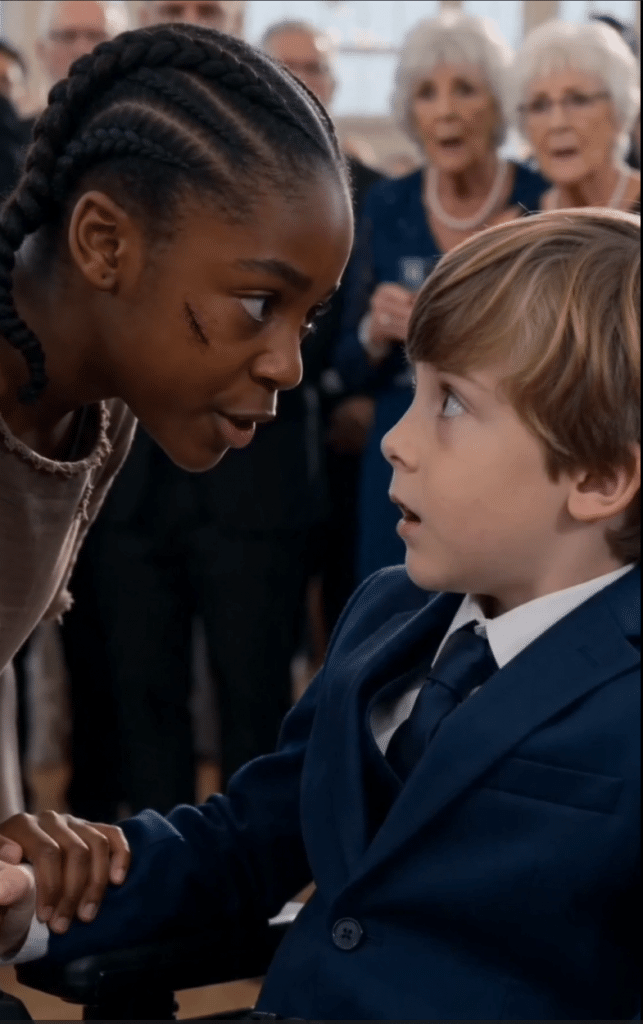
The girl stood beneath a chandelier worth more than most houses, wearing a worn brown dress that had been mended at the shoulder with thread a shade too dark. Her hair was braided neatly, but her face carried the marks of a life that had never been allowed to look soft for long. A thin scar ran across her left cheek, pale under the golden light.
And she was holding the hand of the most protected boy in the room.
Noah Sterling sat in a dark blue suit inside a sleek motorized wheelchair, his tie perfectly straight, his shoes polished, his white pocket square folded like a little flag of wealth. He was nine years old, heir to the Sterling medical fortune, and the face of that evening’s gala.
Every poster near the entrance had shown his smile.
The Miracle of Hope Gala.
For children like Noah.
Except now Noah was not smiling.
He was staring at the barefoot girl as if she had just spoken in a language only he remembered.
She leaned close to him, still gripping his hand.
“Leave with me,” she whispered, “and I’ll make you face silence.”
An elderly woman near the champagne table gasped.
Another guest covered her mouth.
The string quartet faltered.
The girl did not look at any of them.
She looked only at Noah.
He had not spoken publicly in nearly two years. That was part of the story everyone knew. After the accident that killed his mother, Noah had lost the use of his legs and most of his voice. His uncle, Marcus Sterling, had become his guardian, his protector, and the grieving hero of every charity article written since.
Marcus now came rushing through the crowd in a light gray three-piece suit.
He moved like a man used to people making way.
“Get inside now,” he ordered Noah. “This isn’t a joke.”
The girl did not step back.
Marcus turned on her.
“Let him go. Now.”
Noah’s fingers tightened around hers.
The crowd saw it.
So did Marcus.
His face darkened.
The girl lifted her chin.
“I know what they did to him.”
The ballroom went silent.
Marcus gave a short, cold laugh. “You know nothing.”
But she was already reaching toward Noah’s lapel.
Not for his tie.
Not for his pocket square.
For the tiny silver pin shaped like a dove, fastened just above his heart.
Noah watched her hand as if it were moving toward a locked door inside his own body.
Marcus lunged.
“Don’t touch that.”
Too late.
The girl twisted the pin.
Something clicked.
The soft blue light inside the dove went dark.
Noah gasped.
Not loudly.
Not dramatically.
Just one sharp breath, as if the air had finally reached a place it had been forbidden to go.
Then his lips trembled.
And for the first time in two years, Noah Sterling whispered one word in front of everyone.
“Mom.”
Act II
Her name was Amara Bell.
Before the gala, nobody in that ballroom knew it.
To them, she was a disturbance. A poor child who had slipped past security. A barefoot girl with a scar on her cheek and a silver bracelet around her wrist, standing too close to a boy who belonged to a world of private tutors, medical foundations, and trust funds.
But Amara had known Noah before the wheelchair.
Not well.
Not as a friend from school or a child invited to his birthday parties.
She had known him from the garden behind St. Catherine’s Rehabilitation Center, where wealthy patients had private rooms and children from public clinics waited three hours for appointments that lasted fifteen minutes.
Her mother, Dr. Celeste Bell, worked there.
Celeste was not famous, but she was brilliant. A pediatric neurologist with a reputation for listening when other doctors were too busy naming conditions. She believed children told the truth with their bodies long before adults believed their words.
After Noah’s accident, Celeste was one of the first specialists called.
The official story was tragic but clean.
A late-night crash. Noah’s mother, Elise Sterling, killed instantly. Noah left with spinal trauma, speech difficulties, and emotional shock. His uncle Marcus stepped in as guardian. The Sterling Foundation transformed grief into philanthropy.
But Celeste saw contradictions.
Noah’s scans did not match the severity of his reported paralysis. His vocal shutdown changed depending on who was in the room. His reactions sharpened when certain devices were removed and faded when Marcus’s private medical team returned.
Celeste wrote notes.
Then warnings.
Then a formal complaint.
Two weeks later, she lost access to Noah’s case.
Marcus called her reckless.
The hospital called her disruptive.
The foundation called her “emotionally compromised.”
Celeste did not stop.
She had seen children harmed by polite lies before. She knew how easily powerful families could turn a diagnosis into a cage, especially when the child inside it could not explain what was happening.
Then she found the dove pin.
It was listed in Noah’s file as a “calming monitor,” a wearable device designed to track stress responses. But Celeste had tested one discarded prototype from Marcus’s private clinic and found something else.
The device emitted a low-frequency vibration.
Not strong enough to injure.
Subtle enough to confuse the body.
Placed near the chest and collar, it could interfere with breathing rhythm, trigger panic, and reinforce vocal hesitation in a child already traumatized. Paired with medication and fear, it could make silence feel like survival.
Celeste suspected the wheelchair had a similar purpose.
Not to help Noah move.
To teach him not to try.
Then Celeste disappeared.
Not into thin air.
Into paperwork.
Her medical license was suspended pending investigation. Her records were seized. She was accused of stealing patient files. A warrant appeared. Her house was searched.
Amara was seven then.
She remembered hiding under the kitchen table while men in dark coats took her mother’s folders.
She remembered Celeste kneeling in front of her afterward, pressing the silver bracelet onto her wrist.
“If anything happens to me,” Celeste whispered, “you find Noah Sterling.”
“How?”
“Go where they make people clap for him.”
Amara did not understand.
Celeste kissed her forehead.
“And remember this: silence can be made. But it can also be broken.”
The next morning, Celeste was gone.
For two years, Amara moved from relatives to shelters to temporary homes that never lasted. She kept the bracelet. She kept the memory. And she kept the one piece of evidence her mother had hidden inside a library book before the search.
A photograph of Noah standing.
Act III
The second word Noah whispered was harder.
“Don’t.”
It was small, cracked, and almost lost beneath the sudden roar of the guests.
But Amara heard it.
So did Marcus.
His face went white.
“Noah,” he said sharply. “Stop.”
The boy flinched.
That single flinch told the ballroom more than Marcus wanted.
Amara stepped between them, still holding the dead dove pin in her hand.
“You made him scared of his own voice.”
Marcus’s eyes snapped to the security guards. “Remove her.”
No one moved immediately.
The guests were watching Noah now.
Watching his mouth.
Watching his hand, still gripping Amara’s.
Watching Marcus lose control in the one place he had built to display it.
Amara reached into the pocket of her worn dress and pulled out a folded photograph.
She held it up.
The nearest guests leaned forward.
In the picture, Noah was younger. Six, maybe seven. He stood between two parallel bars in a therapy room, knees shaking but upright, one hand raised in a triumphant little fist.
Beside him was Dr. Celeste Bell, smiling.
On the back, in blue ink, were the words:
He can try. Do not let them teach him helplessness.
Noah stared at the photograph.
His eyes filled.
Marcus recovered quickly.
“That photo is old,” he said. “Before his condition worsened.”
Amara shook her head.
“No. Before you made it worse.”
The crowd murmured.
Marcus turned toward them, smoothing his voice.
“This child is being manipulated. Her mother was removed from my nephew’s care for dangerous misconduct.”
Amara’s scar tightened as she clenched her jaw.
“My mother tried to protect him.”
“Your mother stole confidential records.”
“She hid them because you were changing them.”
That landed.
Not because the guests knew it was true.
Because Marcus reacted too fast.
“Enough.”
He grabbed Amara’s wrist.
Noah cried out.
It was not a full scream.
But it was sound.
Real sound.
The room froze.
Noah pushed his hands against the armrests of his motorized wheelchair. His face twisted with effort, panic, and rage.
“Let,” he breathed.
Marcus stared down at him.
Noah’s voice shook.
“Her. Go.”
Amara’s eyes filled with tears, but she did not pull away.
The silver bracelet on her wrist caught the chandelier light.
Noah saw it.
His eyes widened.
“Mom had that.”
Amara looked at him, stunned.
“What?”
Noah pointed with trembling fingers.
“Mom’s bracelet.”
Marcus’s grip loosened.
Only for a second.
But Amara felt it.
She pulled free and touched the silver band around her wrist.
“My mother gave it to me.”
Noah shook his head slowly.
“My mom wore one like that in the car.”
Marcus said, “Noah, you’re confused.”
But Noah was looking at the bracelet now with a clarity nobody in the room had seen from him all night.
Amara turned the band over.
Inside, faintly engraved, were three initials.
E.S.B.
Elise Sterling Bell.
Amara stopped breathing.
Because her mother’s full name was Celeste Bell.
And suddenly, the two children understood before the adults did.
The doctor who vanished and the mother who died had been connected long before the accident.
Act IV
A woman stepped out from the back of the ballroom.
She was not dressed for the gala.
She wore a dark coat, flat shoes, and carried a leather satchel against her side. Her hair was streaked with gray, her face tired, her eyes fixed on Amara as if the sight of the girl standing beneath the chandelier hurt and healed her at once.
Amara whispered, “Aunt Ruth?”
Ruth Bell moved toward her.
Security tried to block her.
The guests, now fully awake to the shape of the scandal, did something they had not done when Amara entered barefoot.
They made room.
Ruth reached the children and opened her satchel.
“I have the rest,” she said.
Marcus’s face changed.
“You were warned to stay away.”
Ruth looked at him.
“I was warned by men who thought warnings were law.”
From the satchel, she removed a sealed folder, a small hard drive, and a stack of medical records.
“Elise Sterling was my sister,” Ruth said.
The room erupted.
Noah stared at her.
Amara looked down at the bracelet like it had become hot against her skin.
Ruth continued, voice shaking but clear.
“Elise married into the Sterling family and lost her name inside it. After she began questioning Marcus’s control over the family trust, she contacted Dr. Celeste Bell. My sister Celeste. Not as a stranger. As family.”
Marcus stepped forward. “This is fantasy.”
Ruth held up the hard drive.
“This is the dashcam file from Elise’s car.”
Marcus stopped.
“Elise was not killed by weather,” Ruth said. “Her brake system had been tampered with. She survived long enough to tell Celeste that Noah was not safe.”
Noah began to tremble.
Amara squeezed his hand.
Ruth looked at him gently.
“Your mother wanted you to have choices. She was trying to change your guardianship before the crash.”
Marcus’s mask finally split.
“Do you have any idea what I did for that boy?”
Noah flinched again.
But this time, he did not look down.
Ruth turned to the guests.
“After Elise died, Marcus gained temporary control of Noah’s medical decisions and the Sterling Foundation. The trust remains under his management as long as Noah is medically declared incapable of independent participation.”
An older board member near the front whispered, “That can’t be.”
Amara lifted the dove pin.
“My mother proved the device was interfering with his breathing and speech.”
Ruth placed the medical reports on the piano nearby.
“And the wheelchair settings were altered to restrict voluntary movement during therapy sessions.”
Marcus laughed, but no one believed the sound anymore.
“He is disabled,” he snapped. “You vultures are using him.”
Ruth’s voice softened.
“No one is saying Noah should not use a wheelchair. We are saying you used it to decide what he was allowed to become.”
That sentence changed the room.
Noah’s chair was not the lie.
Marcus’s ownership of it was.
A board member approached Noah slowly, kneeling at a respectful distance.
“Noah,” she said, “do you want us to call an independent doctor?”
Marcus snapped, “He cannot answer that.”
Noah looked at Marcus.
Then at Amara.
Then at the dead dove pin in her palm.
His voice was faint, but this time everyone heard it.
“Yes.”
The word cracked across the ballroom louder than thunder.
Marcus stepped back.
For the first time all evening, he looked smaller than the children.
Act V
The gala ended with no auction, no applause, and no closing speech from Marcus Sterling.
The guests left in shaken silence while investigators arrived through the service entrance. By midnight, the dove pin, wheelchair control logs, medical records, trust documents, and dashcam file were all in legal custody.
Marcus called it an ambush.
Then a misunderstanding.
Then a conspiracy.
But the evidence did not care what name he gave it.
Within weeks, the Sterling Foundation board suspended him. Independent physicians reviewed Noah’s case. The court removed Marcus from medical authority. The investigation into Elise Sterling’s crash reopened, and Celeste Bell’s suspended license was restored after her hidden notes were authenticated.
But Celeste did not come home immediately.
That was the wound Amara had not expected.
She had spent two years imagining reunion as a door flying open. Instead, it came quietly in a hospital room three states away, where Celeste had been recovering under witness protection after Ruth finally found her.
Amara stood in the doorway and saw her mother thinner, older, alive.
For one second, she was furious.
Then she was eight years old again.
She ran.
Celeste caught her and broke down.
“I tried to get back,” she kept saying. “I tried, baby. I tried.”
Amara held her mother’s shirt in both fists.
“I kept the bracelet.”
“I know.”
“I found Noah.”
“I know.”
“I was scared.”
Celeste closed her eyes.
“I know. And I am so sorry you had to be brave before anyone made you safe.”
Noah’s recovery was not a miracle.
No one called it that twice around Celeste Bell.
He still used his wheelchair. Some days he needed it fully. Some days he used braces. Some days his voice came easily; other days it vanished under stress, and everyone learned not to punish him for that.
The difference was choice.
The difference was truth.
The difference was that no adult stood over him anymore deciding that silence made him easier to manage.
Amara visited him often.
At first, the Sterling mansion made her uncomfortable. Too many polished floors. Too many people speaking softly. Too many rooms where a child could disappear behind wealth.
So Noah asked to meet somewhere else.
They chose the public library.
The first time, Amara arrived wearing shoes Ruth had bought her. She kicked them off under the table halfway through.
Noah noticed.
“Shoes bother you?”
“Rich shoes do.”
“They’re sneakers.”
“They know what they are.”
He laughed so hard his voice cracked.
She grinned.
That laugh did more for him than three formal speeches about resilience.
Months later, the ballroom reopened for a different gathering.
No gala.
No donors posing beside children.
No posters of Noah smiling bravely beside Marcus.
This time, the event was organized by the newly renamed Elise and Celeste Child Choice Fund. It supported independent medical reviews, disability rights advocacy, and legal protection for children whose care was being controlled by money instead of need.
Noah spoke at the opening.
Not alone.
Amara stood beside him, one hand resting on the microphone stand in case his voice faltered.
It did, once.
He stopped.
The room waited.
No one rushed him.
No one answered for him.
After a breath, he continued.
“My chair is not the thing that trapped me,” he said. “The lie did.”
Amara looked at him.
His voice strengthened.
“And the first person who broke the lie was a girl nobody wanted to let into the room.”
The audience turned toward Amara.
She hated it.
Then, slowly, she lifted her chin.
The scar on her cheek caught the chandelier light.
She did not hide it.
After the speeches, the music began.
Children moved across the ballroom in every possible way. Some walked. Some rolled. Some danced with braces. Some stayed seated and clapped. Some only watched, which Celeste said was participation too if they chose it.
Noah guided his motorized chair toward Amara.
“Dance?”
She raised an eyebrow.
“You asking or ordering?”
“Asking.”
“Good.”
She held out her hand.
He took it.
They moved beneath the chandelier, awkward and laughing, their hands linked the same way they had been the night everything changed.
Near the edge of the floor, Marcus’s former seat remained empty.
No one mentioned him.
Some punishments are legal.
Some are social.
Some are simply the sound of a room learning to continue without the person who once controlled its silence.
Later, after the guests left, Noah and Amara sat near the tall arched windows with two slices of cake between them.
Noah looked at the silver bracelet on her wrist.
“Do you want to keep it?”
Amara touched it.
“It belonged to your mom.”
“And your aunt. And your mom kept it safe through you.”
Amara thought about that.
Family had become complicated since the truth came out. Elise Sterling had been Ruth and Celeste’s half-sister, separated by adoption and money and the kind of secrets adults used to call protection. The bracelet had passed from Elise to Celeste as proof of that hidden bond, then from Celeste to Amara as a map back to Noah.
“It belongs to the story,” Noah said.
Amara smiled faintly.
“That was dramatic.”
“I live in a mansion. It happens.”
She laughed.
Then she unclasped the bracelet and wrapped it around both their hands for a moment, silver against brown skin and pale knuckles, a circle made of all the things adults had failed to break.
“You can wear it on special days,” she said.
Noah nodded.
“And you wear it on dangerous days.”
“Every day can be dangerous.”
“Then keep it.”
So she did.
Years later, people still remembered the barefoot girl who interrupted a gala and made the boy in the wheelchair speak.
They told it wrong most of the time.
They said she healed him.
She did not.
They said she made him stand.
She did not.
They said she gave him his voice.
That was wrong too.
Noah’s voice had always been his.
Amara only reached through the noise, touched the hidden device on his lapel, and proved that the silence around him had been manufactured by people who profited from it.
That was the real miracle.
Not that a boy spoke.
But that, for once, everyone listened.