Act I
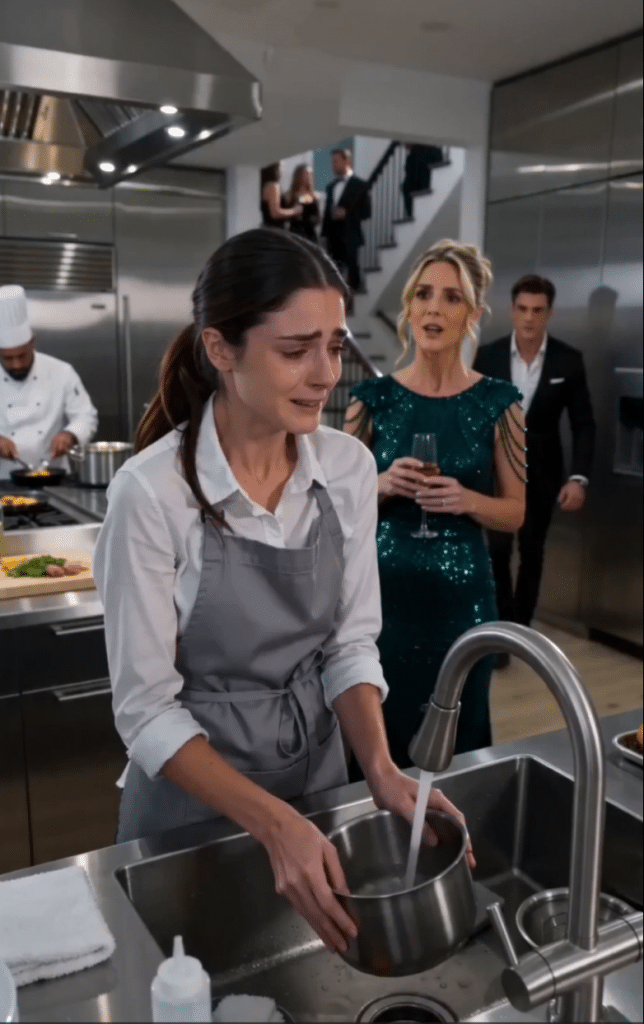
Lucia was crying into the sink when Alejandro found her.
Not loudly.
Not dramatically.
The kind of crying rich people preferred from the people they hurt — silent, contained, almost apologetic. Her dark hair was tied back, her brown apron soaked at the waist, her sleeves pushed up as she rinsed a heavy metal pot beneath water hot enough to turn her hands red.
Upstairs, the party sparkled.
Laughter drifted down the staircase. Champagne glasses chimed. A string quartet played beneath the high ceiling of Alejandro’s mansion while guests in diamonds and black suits admired the art, the flowers, the view, the host.
The host who was not supposed to be home yet.
Alejandro De la Cruz stepped into the kitchen with thunder in his face.
The chef went still at the stove.
Lucia froze with both hands inside the sink.
And beside the island, holding a champagne flute like a crown, Valentina Moreau turned with a perfect socialite smile that cracked the moment she saw him.
“Alejandro,” she said lightly. “What are you doing here?”
He did not answer.
His eyes moved from Valentina’s emerald sequined gown to Lucia’s wet apron. From the champagne in Valentina’s hand to the pot in Lucia’s. From the party noise upstairs to the tears on Lucia’s face.
Then he looked directly at Valentina.
“What is going on here?”
Valentina gave a soft laugh, the kind meant to make anger seem vulgar.
“Oh, come on. Don’t overreact. Lucia just wanted to help.” She glanced at Lucia as if she were discussing a chair moved into the wrong corner. “She likes to feel useful.”
The chef lowered his knife.
Lucia stared at the sink.
Alejandro’s jaw tightened.
“Useful?”
Valentina lifted one shoulder.
“She was uncomfortable upstairs. You know how these things are. It’s easier for everyone when people stay where they fit.”
The kitchen went so quiet the running water sounded violent.
Alejandro turned away from Valentina and walked to Lucia.
His voice changed.
Not softer exactly.
More dangerous because it had become controlled.
“Look at me.”
Lucia did not move.
“Lucia.”
Slowly, she lifted her face.
Her eyes were wet. Her cheeks were flushed with humiliation. There was soap on one wrist, and a tiny red mark where the edge of the pot had scraped her skin.
Alejandro looked at it.
Then back at her.
“Did you want to be down here?” he asked. “Washing dishes while they host a party upstairs in my house?”
Lucia swallowed.
Behind him, Valentina’s expression sharpened.
“Don’t make this sentimental,” she said.
Alejandro did not look at her.
Lucia’s lips trembled.
For five years, she had learned how to endure rooms where people spoke around her as if she were a stain they could cover with manners. She had learned how to lower her eyes, how to keep her voice calm, how to survive on the edge of a life that should have included her.
But something in Alejandro’s face broke through every lesson.
So she told the truth.
“No,” she whispered.
Then, with a pain so honest the chef turned away, she added, “She said I belong in the kitchen because I’m your daughter’s mother.”
Alejandro went still.
Upstairs, the guests laughed at something.
Downstairs, the man who owned the house stared at the woman in the emerald gown as if he had never seen her before.
And Valentina, for the first time all evening, looked afraid.
Act II
Lucia had not come to the mansion as a servant.
That was the part Valentina needed everyone to forget.
She had arrived at three in the afternoon in a simple navy dress, carrying a wrapped gift in both hands. The gift was small, tied with yellow ribbon, and chosen after three nights of standing outside toy-store windows wondering what a five-year-old girl might love from a mother she barely knew.
Inside was a hand-painted music box.
On the lid, Lucia had painted tiny white stars around a little girl sitting beneath a moon.
For Sofia.
Her daughter.
Alejandro’s daughter.
The child whose birthday party had filled the mansion with flowers, balloons, photographers, investors, family friends, and women who leaned close to one another and whispered when Lucia walked in.
Sofia had been born during the worst year of Alejandro’s life.
Back then, he was not yet the untouchable man people toasted at galas. He was the disinherited son of a powerful family, trying to build his first hotel, drowning in debt, fury, and pride. Lucia worked in the estate kitchens then, but she was never just “the help” to him.
She challenged him when he was cruel.
Fed him when he forgot to eat.
Called him arrogant to his face and smiled when he looked shocked.
They fell in love in places wealthy families did not think mattered: service corridors, laundry rooms, quiet gardens after midnight, the kitchen after everyone else had gone to bed.
Then Alejandro’s father found out.
Don Rafael De la Cruz did not shout. He never had to. He summoned Lucia into his study and placed a check on the desk large enough to buy silence from almost anyone.
Lucia refused it.
That was when he told her the truth, or what he wanted her to believe was truth.
Alejandro had chosen his inheritance.
Alejandro had agreed she was a mistake.
Alejandro would marry someone “suitable” before the year ended.
Lucia was pregnant when she left.
She wrote to Alejandro five times.
No answer.
She called the estate.
No one connected her.
By the time Sofia was born, Lucia was alone in a rented room above a bakery, holding a daughter with Alejandro’s dark eyes and telling herself love could be real even if men were not brave enough to claim it.
Then came the hospital bill.
The fever.
The night Sofia struggled to breathe.
Lucia went to the De la Cruz estate because pride meant nothing beside a child’s life. Rafael met her at the gate. He saw the baby. He saw proof.
And he made a bargain with the devil’s calm.
Sofia would be treated. Sofia would be safe. Sofia would have doctors, education, a name.
But Lucia would sign temporary guardianship until she “stabilized.”
No court, Rafael promised. No scandal. Just papers.
Lucia signed because her daughter was burning in her arms.
By the time she understood what she had signed, Sofia was inside the mansion and Lucia was outside the gate.
Alejandro returned from Europe three months later and was told Lucia had abandoned the baby for money.
Lucia was told Alejandro had ordered her kept away.
Years passed.
Rafael died.
Old staff disappeared.
Records vanished.
And Valentina arrived.
She was everything the De la Cruz world admired. Blonde, polished, educated in Switzerland, perfect in photographs, and cruel in ways that sounded like etiquette. She became Alejandro’s public companion, then his fiancée in every gossip column, though he never set a wedding date.
She adored Sofia in public.
In private, she called the child “difficult.”
Sofia began asking why her mother never came.
That question, small and stubborn, eventually reached Alejandro’s old driver, Tomas, who had kept one thing Rafael failed to destroy.
A bundle of Lucia’s letters.
The first time Alejandro read them, he did not speak for an hour.
The second thing he did was find Lucia.
The third was invite her to Sofia’s birthday.
Not as a guest.
As her mother.
And now, three hours into that birthday, Lucia was standing in his kitchen with dishwater on her hands because Valentina had decided the child’s mother should be reminded of her place.
But Alejandro had come home early.
And the house was about to learn his.
Act III
Valentina recovered with the speed of someone who had practiced innocence in mirrors.
“Alejandro,” she said, lowering her voice, “she is twisting this.”
Lucia looked down immediately.
That movement enraged him more than any accusation could have.
Not because he blamed her.
Because he recognized what years of being disbelieved had done. Lucia did not expect justice. She expected consequences for speaking.
Alejandro took the towel from beside the sink and gently placed it in her hands.
“Dry them,” he said.
Valentina laughed under her breath.
“You cannot be serious.”
He turned.
“I have never been more serious in my life.”
The chef stepped back from the stove.
Valentina’s eyes flicked toward him.
“You can leave,” she snapped.
“No,” Alejandro said. “He stays.”
The chef went perfectly still.
Valentina’s smile vanished.
“This is embarrassing.”
“Yes,” Alejandro said. “For you.”
Her face hardened.
“You invited her into this house without preparing anyone. What did you expect? People know what she was.”
Lucia flinched.
Alejandro stepped closer to Valentina.
“What was she?”
Valentina lifted her chin.
“A kitchen girl.”
The words hung between them, ugly and naked.
Alejandro’s voice dropped.
“No. She was the woman my family lied about. She was the mother of my child. She was the person I should have found years ago.”
Valentina’s eyes flashed.
“And yet you didn’t.”
That landed.
She saw it and pressed harder.
“You let everyone believe she left. You let Sofia be raised without her. You let your father’s version stand because it was easier than tearing apart your own name.”
Lucia looked at him then.
Not accusing.
That was worse.
Alejandro absorbed it because it was true.
“I did,” he said.
Valentina blinked. She had expected denial, not confession.
He looked at Lucia.
“I should have looked harder.”
Lucia’s eyes filled again.
“You believed them.”
“I did.”
For one moment, the kitchen was not a battlefield.
It was two people standing in the wreckage of all the years stolen by silence.
Then Valentina broke it.
“How touching. Are we all supposed to applaud? She disappears for five years and returns just in time to claim a child, a fortune, and your guilt.”
Lucia’s face went pale.
“I never asked for money.”
“No,” Valentina said coldly. “Women like you never ask. You just arrive with tears and a baby and wait for men to feel noble.”
Alejandro’s hand closed into a fist at his side.
Before he could speak, a small voice came from the staircase.
“Mamá?”
Everyone turned.
Sofia stood halfway down the stairs in a pale blue party dress, her dark curls pinned with white ribbons. Behind her, guests had gathered near the landing, drawn by the rising tension. They could see the kitchen now. The sink. The pot. The apron. Lucia’s tears.
The whole house could see.
Sofia came down one step.
“Why is my mamá washing dishes?”
Lucia covered her mouth.
Valentina’s face tightened.
“Sofia, sweetheart, go upstairs.”
But the child did not move.
She looked at Alejandro.
“Papa?”
Alejandro walked to the foot of the stairs.
His voice softened.
“Come here, mi vida.”
Sofia ran to him, but her eyes stayed on Lucia.
“She was supposed to sit with me,” Sofia said. “Valentina said she had work to do first.”
A murmur passed through the guests.
Valentina said quickly, “Children misunderstand.”
Sofia frowned.
“She said if Mamá wanted to be part of the party, she could start by cleaning what better people used.”
The words changed the room.
Even the guests who had spent years pretending not to see cruelty knew they had just heard it from a child.
Alejandro looked up at the landing.
At the investors.
The cousins.
The board members.
The socialites who had smiled while Lucia disappeared from the ballroom.
Then he looked at Valentina.
“You said that in front of my daughter?”
Valentina’s champagne glass trembled.
“She needed to understand boundaries.”
“No,” Alejandro said. “You needed her to inherit yours.”
Act IV
Alejandro did not shout.
That frightened Valentina more.
He walked to the kitchen island, picked up a clean glass, and set it down slowly. The small sound made the room tighten.
“Tomas,” he called.
The old driver stepped from the edge of the crowd. He had been standing there quietly, face heavy with the sorrow of a man who had watched too many lies take root.
“Yes, sir.”
“Bring the letters.”
Valentina’s expression froze.
Lucia looked confused.
Alejandro did not.
Tomas disappeared into the side hall and returned with a leather folder. Inside were five letters, their envelopes yellowed, their edges worn from years hidden in a locked glove compartment.
Alejandro lifted the first.
“This was written three weeks before Sofia was born.”
Lucia began to cry silently.
He read only a line.
Alejandro, I don’t know what they told you, but I am carrying your daughter. I don’t want your money. I want her to have her father if you are willing to be one.
The room was silent.
He lifted the second.
“This was written after Sofia’s hospital stay.”
Please tell me she is alive. Please, Alejandro. If you hate me, hate me later. Just tell me my baby survived.
Sofia clung to his leg.
Lucia turned away, shaking.
Alejandro lowered the letter.
“My father intercepted these. His attorney helped. Several people in this room benefited from keeping Lucia away.”
A woman near the landing looked down.
A cousin stepped backward.
Valentina swallowed.
“This has nothing to do with me.”
Alejandro opened the final document in the folder.
“No?”
He placed it on the island.
“This is the petition drafted two months ago to terminate Lucia’s remaining parental rights permanently.”
Lucia stared at it.
“What?”
Alejandro’s eyes never left Valentina.
“It was prepared by your attorney.”
Valentina’s mask cracked.
“My attorney manages family risk.”
“My daughter is not a risk.”
“She becomes one if that woman decides to fight.”
Lucia stepped back as if struck.
Alejandro’s voice sharpened.
“Say her name.”
Valentina’s jaw tightened.
“What?”
“Say Lucia’s name.”
She said nothing.
“That is what this has always been. You could not stand that she had a name. A history. A claim no diamond could outrank.”
Valentina looked toward the guests, searching for allies.
She found none eager enough to move.
So she reached for the oldest weapon in rooms like that.
Class.
“You think they will accept her?” she asked, voice rising. “Look at them. Look at her. She was rinsing pots in your kitchen because that is the only room in this house where she makes sense.”
Lucia flinched.
Sofia pulled away from Alejandro and went to her mother.
Without hesitation, without shame, the little girl wrapped both arms around Lucia’s waist.
“No,” Sofia said. “She makes sense with me.”
The words broke something open.
Lucia dropped to her knees and held her daughter, finally, in front of everyone.
Not as a visitor.
Not as a secret.
As a mother.
Alejandro turned to the crowd.
“The party is over.”
No one moved.
He looked at the musicians near the staircase.
“The party is over.”
This time, people began collecting themselves in embarrassed silence. Women gathered purses. Men avoided eye contact. The same people who had watched Lucia be humiliated now looked desperate to escape the room where silence had become evidence.
Valentina stood alone in emerald sequins, still glittering under the kitchen lights.
“You’ll regret this,” she said.
Alejandro looked at the folder.
“No,” he said. “I regret everything before this.”
Then he removed her engagement ring from the island, where she had placed it earlier to avoid scratching it while admiring the table settings.
He held it out.
“Take it.”
Her face went slack.
“Alejandro.”
“You will leave my house tonight. Your attorney will hear from mine in the morning. If you or anyone connected to you approaches Lucia or Sofia, I will make every letter, every petition, every payment, and every lie public.”
Valentina stepped close enough that only the people nearest could hear her.
“You still need me.”
Alejandro looked past her.
At Lucia.
At Sofia.
At the old chef wiping his eyes with a dish towel.
At Tomas standing like a guard beside the truth he had carried too long.
“No,” Alejandro said. “I needed to wake up.”
Valentina’s face twisted.
For one second, the elegance vanished completely.
Then she turned and walked out through the kitchen, not the grand staircase, not the ballroom, not the entrance where photographers waited.
The kitchen.
The room where she had tried to bury another woman.
Act V
The mansion did not feel grand after everyone left.
It felt exposed.
Flowers still covered the dining tables. Half-filled champagne glasses sat abandoned beside untouched plates. Sofia’s birthday cake remained in the ballroom, five candles waiting in pink frosting, the little sugar flowers beginning to soften under the lights.
Lucia stood in the kitchen doorway, arms wrapped around herself, looking ready to disappear.
Alejandro saw it and felt the full weight of what his family had trained her to expect.
Humiliation, then removal.
Pain, then silence.
Not this time.
He walked to the island and untied the brown apron from her waist with careful hands, the way someone might remove a chain.
Lucia did not look at him.
“I can do it.”
“I know.”
He placed the apron on the counter.
“You never should have had to wear it tonight.”
She gave a small, bitter laugh.
“I wore worse.”
The words cut him.
Sofia had fallen asleep on a kitchen chair, one hand still holding the yellow ribbon from Lucia’s gift. The music box sat open beside her, turning slowly, playing a soft little melody Lucia had chosen because she used to hum it while rocking her daughter in the hospital.
Alejandro looked at the child.
“I missed everything,” he said.
Lucia followed his gaze.
“No. You missed what they took.”
“I stopped looking.”
“Yes.”
There was no cruelty in her voice.
Only truth.
He nodded because he deserved it.
For the next weeks, the world did what the world always does when rich families bleed in public.
It talked.
Valentina gave no interview, though anonymous sources tried to paint Lucia as opportunistic and Alejandro as unstable. That ended when Alejandro released just enough documentation to make further gossip dangerous: the intercepted letters, the guardianship irregularities, the termination petition drafted without Lucia’s knowledge.
Names began falling.
Rafael’s old attorney resigned from two boards.
A judge ordered a review of Sofia’s custody history.
Staff who had been dismissed years earlier came forward with stories of letters hidden, phone calls blocked, visitors turned away.
The De la Cruz family did not collapse.
It was cleaned.
Painfully.
Publicly.
Not perfectly.
But for the first time, truth entered rooms that had been decorated to keep it out.
Lucia did not move into the mansion immediately.
She refused.
Alejandro did not argue. He bought no grand house for her, sent no diamonds, made no speeches about making things right with money. He had learned, at last, that money had been one of the weapons used against her.
Instead, he signed what the court required.
Equal parental recognition.
Restored rights.
Full access.
A formal apology entered into the legal record, not hidden in a private conversation where pride could soften it.
Lucia read the document twice.
Then she looked at him across the attorney’s table.
“You understand this doesn’t fix us.”
“Yes.”
“It fixes paperwork.”
“Yes.”
“She is not a bridge between us.”
Alejandro nodded.
“No. She is a child. Our child. That is enough work.”
For the first time, Lucia looked at him without armor.
Not forgiveness.
Not yet.
But something less frozen than before.
Sofia adjusted faster than the adults expected and slower than they hoped. She loved having her mother near, then panicked whenever Lucia left. She asked Alejandro whether people could be taken away for being poor. She asked Lucia whether kitchens were bad.
Lucia answered that kitchens were not bad.
Kitchens fed people.
What was bad was making someone stand there to remind them they were unwanted.
After that, Sofia insisted her next birthday breakfast be made in the kitchen with everyone present.
No caterers.
No guests.
No gowns.
Just pancakes, fruit, coffee, burned toast, and Alejandro trying so hard not to ruin eggs that Lucia finally laughed at him.
The laugh startled all three of them.
Sofia grinned.
“Mamá laughed.”
Lucia tried to hide it.
Alejandro did not.
He held onto the sound like a man hearing music return to a silent house.
Months later, the mansion hosted another event.
Not a gala.
A family dinner for the staff, old and new.
The ballroom remained closed. The chandeliers stayed dark. The kitchen doors were opened wide, and long tables were set across the terrace so no one had to disappear behind swinging doors to be useful.
Lucia arrived in a red dress Sofia had helped choose.
Not expensive.
Perfect.
Alejandro met them at the garden steps.
For a moment, neither adult spoke.
Then he said, “You look beautiful.”
Lucia lifted an eyebrow.
“Careful.”
He smiled faintly.
“I know.”
Sofia ran ahead to show Tomas the music box, leaving them together beneath the warm evening sky.
Lucia looked through the open kitchen doors.
“I hated that room for a while.”
“I know.”
“She wanted me to feel small there.”
Alejandro’s face darkened.
Lucia shook her head.
“But the kitchen was never the insult. She was.”
He looked at her then, really looked.
The woman who had once fed him when he was too proud to admit hunger.
The mother who had lost years and still came back with a gift in her hands.
The person his world had tried to reduce to labor, shame, and rumor.
“You belong wherever you choose to stand,” he said.
Lucia’s eyes softened, but she did not let him off easily.
“That took you long enough to learn.”
“Yes,” he said. “It did.”
Inside, the chef called for help carrying plates. Sofia shouted that Papa was bad with plates and should not be trusted. Tomas laughed so hard he had to lean against the counter.
Lucia looked toward the sound.
Then she stepped into the kitchen.
Not because anyone ordered her.
Not because she needed to prove usefulness.
Because her daughter was there.
Because food was waiting.
Because a room that had witnessed humiliation could also witness return.
Alejandro followed, stopping at the doorway for half a second.
The memory flashed before him: Lucia at the sink, tears in her eyes, Valentina glittering beside her, the cruel sentence that had split his life into before and after.
She belongs in the kitchen.
He understood now what Valentina never had.
Belonging was not about class, clothes, or who held the champagne.
Belonging was who a child ran to when she was scared.
Who kept letters when truth was dangerous.
Who stood in a room full of witnesses and finally said no.
Lucia took a platter from the chef and turned back, catching Alejandro watching her.
“What?” she asked.
He shook his head.
“Nothing.”
But it was not nothing.
It was the sight of a woman standing in the same kitchen where she had been insulted, no longer trapped by it, no longer defined by it, no longer alone.
Sofia ran between them, one hand grabbing Lucia’s and the other reaching for Alejandro.
“Come on,” she said. “Everyone’s waiting.”
And this time, when Lucia walked out of the kitchen, she did not leave as someone dismissed from the party.
She walked out through the open doors beside her daughter.
Beside the man who had finally chosen truth over pride.
Into a garden full of people who stood when she arrived.
Not because Alejandro told them to.
Because everyone in that house now understood what Valentina learned too late.
The woman she tried to send below stairs was not beneath anyone.
She was the reason the whole house had finally risen.