Act I
“I’m a general. Treat me now.”
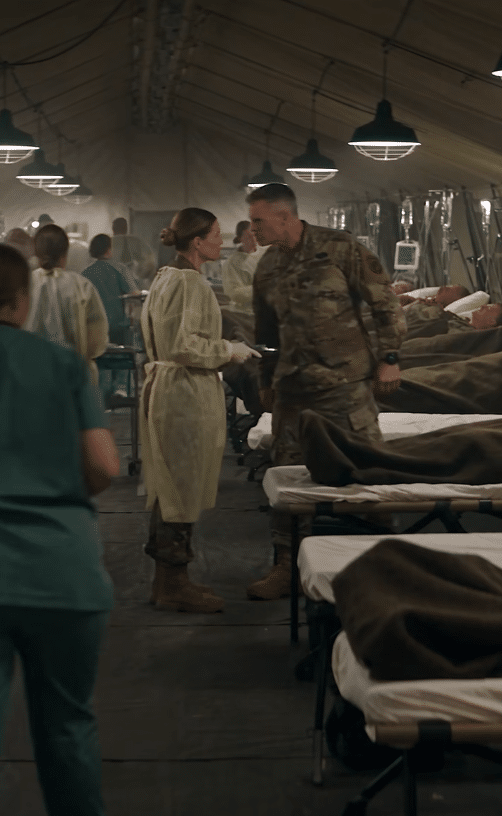
Brigadier General Richard Caldwell stood beside a portable medical bed, his torn combat-uniform sleeve revealing a relatively minor arm injury.
Across from him, a female doctor in navy medical scrubs was examining several critical casualties. Her brown hair was secured in a neat bun, and an open disposable protective gown hung over her uniform.
She barely looked up.
“The critical cases come first.”
Caldwell’s expression hardened.
He was fifty years old, accustomed to being recognized, obeyed, and accommodated. Even in a crowded field hospital, he expected his rank to place him ahead of everyone else.
But the woman in front of him wasn’t impressed.
She had patients whose lives depended on immediate attention. A wounded soldier was struggling to breathe, another was losing consciousness, and medical staff were moving rapidly between portable beds.
Caldwell’s arm could wait.
His pride apparently could not.
He grabbed the medical tray from her hands and yanked it away.
The supplies scattered across the floor.
Before she could react, he slapped her hard across the face.
Her head turned with the impact. Her cheek reddened and began to swell, and a faint trace of blood appeared at the corner of her mouth.
Then he drove a punch into her stomach.
She folded forward, losing her breath, and caught herself against the rail of a nearby bed.
But even then, her eyes moved toward the critical patients.
Caldwell looked down at her.
“Doctors serve rank.”
The words hung in the crowded hospital.
Several nurses froze.
A medic stared at the fallen supplies, while another continued working beside a patient who desperately needed attention.
Then an injured senior officer lying nearby slowly turned his head.
He looked at the doctor.
His expression changed.
For a moment, he seemed unable to believe what he was seeing.
Then, in a voice filled with disbelief, he whispered two words.
“White Phoenix?”
Caldwell turned toward him.
He had no idea why the wounded officer suddenly looked so shaken.
And he had no idea that the nickname he had just heard was about to change the entire atmosphere of the field hospital.
Act II
The doctor was named Dr. Elizabeth Morgan.
She was forty-three years old, calm under pressure, and known among military medical personnel for an unusual ability to remain focused when everything around her was falling apart.
She had learned early in her career that a medical emergency did not care about rank.
A private with a critical injury deserved the same urgency as a general.
A senior officer might have more decorations, more responsibilities, and more people waiting for his decisions.
But inside a medical tent, a patient’s condition determined the order of treatment.
That principle guided Elizabeth’s work.
She rarely discussed her military background outside the professional circles that needed to know it. Most personnel who encountered her in a field hospital saw only a physician in navy scrubs, protective gloves, and a disposable gown.
She preferred it that way.
Her reputation had been built through years of difficult assignments, demanding medical decisions, and the trust of people who had depended on her when evacuation was impossible.
She had witnessed the consequences of poor leadership.
She had also seen extraordinary courage from ordinary soldiers.
Those experiences had shaped her into a physician who never confused authority with importance.
That day, the field hospital was overwhelmed.
Casualties had arrived in waves, stretching the medical staff and filling every available bed. Monitors beeped continuously, IV stands crowded the narrow aisles, and medics hurried between patients.
Elizabeth had been coordinating triage.
She had just finished directing attention toward a critically wounded soldier when Brigadier General Caldwell demanded immediate treatment for his arm.
His injury was painful, but it was not life-threatening.
She told him the critical cases had to come first.
For most people, that would have been an understandable medical decision.
Caldwell saw it differently.
He had spent years expecting people to respond to his rank before considering anything else. In his mind, being a general meant that ordinary rules should bend around him.
The fact that a female physician had refused to do so felt like an insult.
He didn’t ask for an explanation.
He didn’t consult the medical staff.
He simply decided that she needed to be reminded who held authority.
What Caldwell failed to understand was that Elizabeth’s calmness wasn’t submission.
She had worked in environments where panic could cost lives.
She had learned to control her emotions because other people needed her to think clearly.
And no amount of intimidation was going to make her abandon a patient who needed urgent care.
But the man lying in the nearby bed knew something Caldwell didn’t.
He recognized the doctor.
And he remembered a mission that many people had never expected to survive.
Act III
The wounded senior officer shifted painfully against his pillow.
His name was Colonel James Porter.
He had been brought into the field hospital with injuries sustained during a recent operation. Exhausted and in considerable pain, he had spent most of the last hour receiving treatment.
But the moment he saw Elizabeth’s face, his attention had sharpened.
He remembered her.
Not from an ordinary hospital assignment.
From a place where medical decisions had been made under extraordinary pressure.
A place where evacuation routes disappeared, communications failed, and wounded personnel had to be treated while danger remained close.
The operation had been called Iron Valley.
For those who had been there, the name carried a weight that never entirely disappeared.
Porter remembered the confusion.
He remembered the wounded.
He remembered the hours when medical personnel worked without knowing whether the next casualty would be the last one they could save.
And he remembered a physician whose presence had become a source of hope.
The soldiers had given her a nickname.
White Phoenix.
It wasn’t a title printed on a uniform.
It wasn’t an official award.
It was a name passed quietly between people who had witnessed what she had done.
Porter looked at her again.
The navy scrubs.
The neat brown bun.
The focused expression.
The way she had remained concerned about her patients even after being struck.
He knew he wasn’t mistaken.
“White Phoenix?”
The nickname escaped him before he could stop himself.
Caldwell turned toward the bed.
“That supposed to mean something?”
He sounded irritated.
He expected the wounded officer to explain himself or return to silence.
But Porter didn’t look at him with uncertainty.
He looked at him with something closer to disbelief.
“Ask anyone who survived Iron Valley.”
The words changed the room.
A nurse glanced toward Porter.
One of the medics stopped for half a second before returning to his patient.
Another wounded soldier, lying farther down the row, slowly lifted his head.
Caldwell’s expression tightened.
Iron Valley.
He knew the operation’s name.
He had heard senior officers refer to it in serious conversations. He knew it had involved extraordinary circumstances and that some of the people associated with it had earned reputations far beyond their official positions.
But he had never connected that history to the quiet doctor standing in front of him.
Elizabeth said nothing.
She didn’t explain the nickname.
She didn’t describe the operation.
She simply steadied herself against the bed rail and looked back toward the patient who still needed attention.
That silence unsettled Caldwell more than an argument would have.
Because Porter wasn’t speaking like a man telling a story.
He was speaking like someone who had just recognized a person he owed his life to.
And Caldwell was beginning to wonder what else he didn’t know.
Act IV
The field hospital continued operating, but the atmosphere had changed.
Porter watched Elizabeth carefully.
He remembered the people who had been carried into the medical area during Iron Valley.
He remembered the desperate decisions.
He remembered how she had remained composed when the situation seemed impossible.
The nickname White Phoenix had not been given lightly.
It represented something that those who survived the operation understood without needing a formal explanation.
To them, it meant a physician who kept working when others had run out of options.
Someone who had refused to abandon the wounded.
Someone whose medical judgment had mattered when every minute counted.
Caldwell looked from Porter to Elizabeth.
He was trying to understand why a wounded senior officer would recognize an ordinary-looking doctor with such reverence.
His earlier confidence had begun to disappear.
He glanced at the medical tray scattered across the floor.
Then at Elizabeth’s swollen cheek.
Then at the patients still waiting for care.
The contrast was impossible to ignore.
He had demanded priority because of his rank.
She had refused because someone else’s life mattered more.
He had used physical force to impose his authority.
She had remained focused on her responsibility even after being attacked.
And now the people around him were no longer looking at him as the senior officer in the room.
They were looking at the doctor.
A nurse quietly began collecting the spilled supplies.
A medic stepped closer to check on Elizabeth, but she remained attentive to the patients.
Porter continued watching Caldwell.
He didn’t need to raise his voice.
The operation’s name had already done what an argument could not.
Caldwell knew that Iron Valley was not an ordinary military story.
He knew people had returned from it carrying memories that were rarely discussed in public.
And now he was standing in front of someone whose role in that operation was clearly far more significant than he had imagined.
Still, Porter had not revealed her rank.
He hadn’t explained her position.
He hadn’t told Caldwell what she had become after Iron Valley.
The mystery remained.
But the general’s expression was changing with every passing second.
The nickname had reached him.
The operation had reached him.
And suddenly, he was afraid to ask the question whose answer might destroy the authority he had been so desperate to display.
Act V
Caldwell stood motionless beside the medical beds.
His torn sleeve no longer seemed important.
His arm injury no longer seemed like the most urgent thing in the room.
He was staring at Elizabeth Morgan.
She was still wearing navy scrubs.
Her protective gown was open.
Her cheek was swollen, and she was guarding her stomach after the punch.
Yet her attention remained fixed on the patients.
She hadn’t demanded that anyone punish Caldwell.
She hadn’t announced her achievements.
She hadn’t even asked the wounded colonel to explain what he remembered.
She was doing what she had been doing before the confrontation.
Treating the people who needed her.
Porter watched her with quiet respect.
He remembered Iron Valley as a place of confusion and loss.
But he also remembered the moments when someone had refused to give up.
That was why the nickname had survived.
Not because it sounded impressive.
Because the people who used it had a reason to remember.
Caldwell looked around the hospital.
The nurses were no longer responding to his demands.
The medics were focused on their patients.
The wounded officer who had spoken seemed completely certain of what he had recognized.
And the doctor he had assaulted had never stopped being a doctor.
The scattered instruments were being collected.
The critical patients were still receiving care.
Caldwell’s behavior would have to be formally addressed. Witnesses had seen the assault, medical staff had been present, and the injuries were visible. His rank could not erase what had happened.
But the general was now facing a question much larger than the incident itself.
Who exactly was the woman he had just attacked?
He looked at Porter again.
Then back at Elizabeth.
His voice was no longer commanding.
It was uncertain.
“Iron Valley… she is…?”
Nobody answered.
Elizabeth turned toward the next patient.
Porter remained silent.
And Caldwell was left staring at the woman whose nickname had survived one of the military’s most difficult operations.
He had believed that rank made him untouchable.
Now he was discovering that the greatest respect in that hospital belonged to someone who had never needed to demand it.