Act I
“Move your granddaughter.”
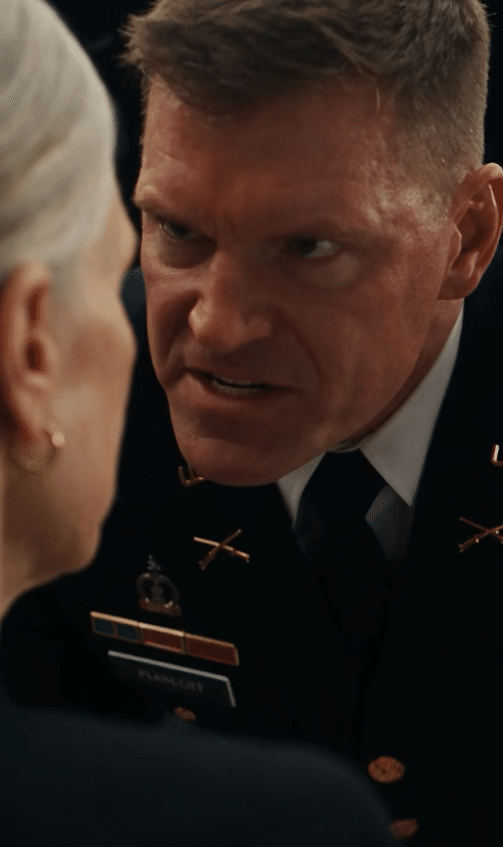
The order came from a man wearing a Brigadier General’s uniform, and it was loud enough to silence the first few rows of the auditorium.
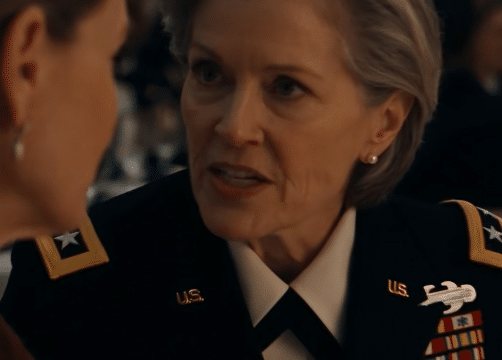
A sixty-eight-year-old woman sat in the front row beside her young granddaughter. Her silver hair was neatly arranged in a bun, and a gray shawl rested over her dark navy dress.
The little girl had been selected to receive an award at the military children’s ceremony. Her name was Lily, and she had been waiting excitedly for her turn on stage.
But the officer standing in front of them had a different idea.
His own son was also among the children receiving awards, and he was determined to make sure his family received the best possible treatment.
The grandmother looked at him calmly.
“The staff put her there.”
It was a perfectly reasonable explanation.
The seating arrangement had been organized by the event staff. Lily had followed their instructions and taken the seat assigned to her.
But the Brigadier General wasn’t interested in explanations.
He was fifty years old, accustomed to getting his way, and convinced that his rank entitled his family to privileges other people could only dream of.
He looked at the little girl with open irritation.
Then he turned toward her grandmother.
Without warning, he ripped the program booklet from the elderly woman’s hand, grabbed a nearby glass of punch, and threw its contents directly into her face.
The glass shattered against the floor.
Before anyone could react, he struck her hard across the cheek.
Her head turned sharply.
Then his fist drove into her stomach.
She folded forward and dropped between the rows of seats, struggling to catch her breath.
Lily screamed.
Parents covered their mouths. Several military spouses stood in disbelief, while officers near the stage froze at the sight of a senior commander attacking an elderly woman.
The grandmother slowly raised her head.
Her cheek was swollen, and a faint trace of blood appeared at the corner of her mouth.
The general looked down at her.
“Your family doesn’t outrank mine.”
He thought he had just established his authority.
But he had made a mistake that would soon become impossible to hide.
The woman on the floor was not simply another military grandmother.
And the little girl beside her was about to become the reason an entire auditorium would remember that afternoon.
Act II
Her name was Eleanor Whitmore.
At sixty-eight, Eleanor had already lived a life that most people could only imagine.
She had served in the United States military for decades, rising through the ranks during a career defined by discipline, sacrifice, and difficult decisions.
Eventually, she retired as a Major General.
But Eleanor rarely discussed her achievements.
She had never been interested in using her past to impress strangers. Even after retirement, she preferred a quiet life surrounded by her children and grandchildren.
Her granddaughter Lily was particularly close to her.
The little girl loved listening to stories about her grandmother’s younger years. She would often ask about the uniforms, the medals, and the people Eleanor had worked with.
Eleanor always gave her the same lesson.
“Respect is something you earn by how you treat people.”
That was why she had brought Lily to the military children’s awards ceremony.
She wanted her granddaughter to experience a positive side of military life, one where families celebrated service, achievement, and the sacrifices made by parents serving far from home.
The event was supposed to be joyful.
Children were receiving certificates for academic achievements, community service, and personal accomplishments.
Their parents sat proudly in the audience, taking photographs and applauding every name announced.
But Brigadier General Richard Lawson had turned the event into something else.
Lawson was known for his obsession with status.
He carefully cultivated relationships with senior commanders and enjoyed reminding junior officers of his position. His son, Ethan, was participating in the awards ceremony, and Lawson had already complained twice about the seating arrangements.
He believed his family deserved the front row.
He believed his son deserved special recognition.
And when he saw Lily sitting beside Eleanor, he decided someone needed to move.
What he didn’t understand was that Eleanor had not chosen the seat herself.
The organizers had specifically reserved it for Lily and her grandmother.
There was a reason for that arrangement.
Lily’s father was serving in a position that very few people in the auditorium could imagine.
But Eleanor had deliberately kept that information private.
She wanted Lily to enjoy the ceremony as an ordinary child.
Now, with punch dripping from her clothes and her granddaughter crying beside her, Eleanor realized that the situation had gone far beyond a disagreement about seating.
She slowly reached for her phone.
And this time, she wasn’t calling the event organizers.
Act III
Eleanor carefully steadied herself against the row of seats.
Her breathing was uncomfortable, and her cheek was already beginning to swell.
Lily moved closer, her small hands trembling as she tried to help her grandmother.
Eleanor gently touched the child’s arm.
She wanted Lily to know that she was still there.
That she was still in control.
Then she reached into her handbag and took out her phone.
Lawson watched her with an irritated expression.
He seemed almost offended that the elderly woman had not simply accepted his behavior.
Eleanor made a call.
Her voice was quiet, but there was no uncertainty in it.
“Auditorium front row. Three minutes.”
She ended the call.
Lawson stared at her.
For a second, he seemed confused.
Then he gave a dismissive laugh.
“Bring whoever you think matters.”
He turned toward the stage, apparently satisfied that he had dealt with the problem.
But the room had become increasingly uncomfortable.
A mother in the second row was holding her phone, having recorded part of the assault. Another guest was speaking quietly to an event coordinator.
Several officers looked toward Lawson with expressions that were no longer respectful.
One retired colonel near the aisle had recognized Eleanor.
He had not expected to see her at the ceremony, and he certainly had not expected to see her lying injured between the seats.
He began to stand.
But before he could move, the auditorium doors opened.
A military aide appeared.
Then another.
The conversations stopped.
The officers near the stage straightened almost simultaneously.
A decorated senior general entered the auditorium.
His face remained out of view.
The camera showed only the stars covering his shoulders, the medals across his uniform, and his polished boots moving down the central aisle.
Lawson turned toward the entrance.
At first, he looked annoyed.
Then he looked confused.
Because the arrival of someone at that level of command was not part of the ceremony’s announced schedule.
And whoever was coming had clearly come for a reason.
Act IV
The senior general continued down the aisle.
The military aides accompanying him moved aside as he approached the front rows.
Parents began standing.
Children stopped whispering.
Even the event organizers seemed uncertain about what was happening.
Lawson adjusted his uniform.
He recognized the rank immediately.
Four stars.
There were very few officers who carried that level of authority.
He glanced toward the stage, perhaps expecting the general to be attending a scheduled presentation.
But the decorated figure did not stop near the podium.
He continued walking.
Straight toward Eleanor.
Lawson’s expression began to change.
The elderly woman had already regained her composure. She sat beside Lily, holding the little girl’s hand.
She did not appear surprised.
She did not look toward the doors repeatedly.
She simply waited.
The general came closer.
Lawson looked from the approaching officer to Eleanor.
Then his eyes shifted toward the little girl.
Something about the situation suddenly seemed familiar.
He remembered seeing a photograph in an official military publication several months earlier.
A senior commander standing beside his family at a formal ceremony.
A little girl.
A silver-haired woman.
He had never paid much attention to the family details, but now the resemblance was becoming difficult to ignore.
The general was not coming to inspect the awards ceremony.
He was coming to see someone.
And that someone was sitting in the front row.
Lawson’s face tightened.
He looked at Eleanor again.
The woman he had just assaulted had remained completely silent about her family.
She had never mentioned a name.
Never announced a rank.
Never threatened him with influence.
But the person walking toward her was someone Lawson could not afford to offend.
Then he noticed something else.
The general’s attention was not directed toward the Brigadier General.
It was directed toward Lily.
The little girl had stopped crying.
She was looking toward the approaching figure with a mixture of recognition and relief.
Lawson’s stomach tightened.
He was beginning to understand who the child’s father might be.
And the answer was far worse than he had imagined.
Act V
The decorated general reached the front row.
His four-star shoulders filled the frame as he approached Eleanor and Lily.
The aides stopped behind him.
Around the auditorium, senior officers stood silently.
Eleanor looked up.
Despite her swollen cheek and stained dress, she remained composed.
Lily moved closer to her grandmother.
Lawson could barely breathe.
He looked at the general.
Then at the child.
Then back at Eleanor.
The family connection was finally becoming clear.
Lily’s father was not an ordinary officer.
He was the Four-Star General now standing in front of them.
The realization hit Lawson with devastating force.
He had spent the entire afternoon trying to establish that his family deserved more respect than everyone else’s.
He had humiliated a grandmother because he believed she lacked influence.
He had assaulted her in front of children, parents, and military personnel.
And now the highest-ranking person in the room was approaching the very family he had attacked.
Lawson’s mouth opened.
His carefully maintained confidence disappeared.
He finally managed to speak.
“Her father is…?”
The question came out almost like a whisper.
Nobody answered him.
The camera remained on his face as the last traces of arrogance disappeared.
For years, Lawson had believed that rank gave him the right to demand respect.
But he had forgotten the most important responsibility attached to that rank.
To protect people.
To lead by example.
And above all, to understand that the families gathered in that auditorium deserved dignity, regardless of their position.
Eleanor gently squeezed Lily’s hand.
The little girl looked toward the stage, where her certificate was still waiting.
She had come to receive an award.
She had come to make her family proud.
And even after everything that had happened, Eleanor wanted her granddaughter to remember that day for something better than an officer’s cruelty.
The ceremony had been interrupted.
The auditorium had witnessed an assault.
And Brigadier General Lawson was about to discover that his position offered no protection from the consequences of his own behavior.
He had tried to make a little girl move because he believed his family mattered more. He never imagined that the child he had humiliated belonged to the family he should have respected most.