Act I
“Control that child.”
The words cut through the memorial reception like a command nobody had dared question.
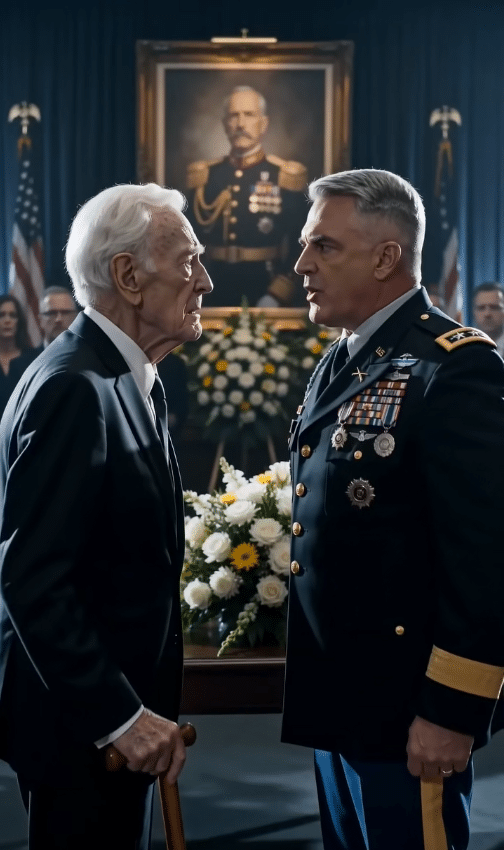
A six-year-old boy stood beside a memorial table, his small hands trembling. A glass had slipped from his fingers, spilling water near the flowers arranged beneath a large portrait of a decorated general.
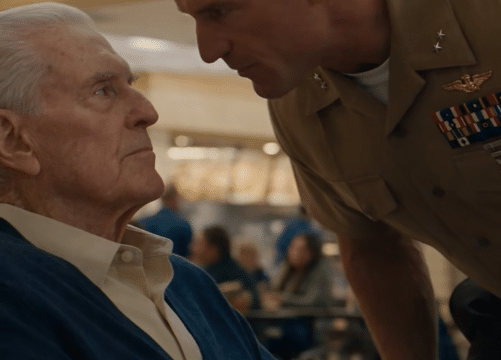
Standing beside him was an elderly man with white hair, dressed in a black suit and holding a wooden walking cane.
He looked at the spill, then gently placed a hand near the boy’s shoulder.
“He’s six. It was an accident.”
The Major General standing in front of them showed no sympathy.
At fifty-two, General Richard Caldwell had built his reputation on discipline, authority, and an almost obsessive intolerance for anything he considered disorderly. His decorated uniform carried the weight of his position, and he expected everyone in the room to recognize it.
This was not an ordinary gathering.
The reception was being held after the funeral of a senior military general. Black drapes covered the walls, wreaths surrounded the memorial portrait, and officers in dress uniforms stood beside grieving families.
Caldwell believed the child had disrupted an important military event.
But the elderly man believed something else entirely.
A funeral was supposed to be a place where people remembered the dead, not a place where a frightened child was made to feel ashamed.
Caldwell stepped closer.
Then, without warning, he grabbed the old man’s wooden cane and violently threw it aside.
Before anyone could react, his fist struck the elderly man’s cheek.
The old man staggered.
Caldwell followed with a forceful two-handed shove, sending him backward onto the carpet beside the memorial table. His elbow scraped against its base as he fell.
The little boy screamed.
Several guests recoiled. An officer near the wreaths instinctively stepped forward but stopped when Caldwell turned toward the crowd.
The elderly man slowly lifted his head.
His cheek was swelling, and a faint trace of blood appeared at the corner of his mouth.
Caldwell looked down at him.
“Being old doesn’t make you important.”
Nobody spoke.
And nobody in that room yet understood that the man lying beside the memorial table was connected to the very person whose portrait stood above them.
But the old man was about to make one phone call.
And the general who had just humiliated him would soon wish he had never entered that room.
Act II
His name was Arthur Bennett.
He was seventy-eight years old, a retired civilian, a widower, and a man who had spent most of his life staying away from military ceremonies.
There was a reason.
The large portrait above the memorial flowers belonged to his son, General Daniel Bennett.
Daniel had been one of the most respected senior military leaders of his generation. He had spent decades serving his country, earning decorations, leading soldiers, and building a reputation for integrity that extended far beyond his immediate command.
But to Arthur, none of those achievements mattered as much as the little boy who used to run through their backyard wearing an oversized baseball cap.
Daniel had been a devoted son.
He called his father every Sunday, even during the busiest periods of his career. When he married and eventually became a father himself, he made sure his children understood that their grandfather was the foundation of their family.
Arthur had never been impressed by rank.
He remembered the years when Daniel was young, when money was tight and the boy’s ambitions seemed much bigger than their little house.
He remembered helping him prepare for military academy applications, staying awake during long nights, and waiting anxiously for letters.
He remembered the first time Daniel came home in uniform.
And he remembered the last conversation they had.
Daniel had died unexpectedly while still serving, leaving behind a grieving family and a military community struggling to accept the loss.
The funeral had brought together officers from across the country. Some had served under him for decades. Others had known him only through his reputation.
But Arthur had come for one reason.
To say goodbye to his son.
He had brought his great-grandson, six-year-old Noah, because Daniel had always wanted the boy to understand the importance of family.
Arthur had promised Noah that they would visit the memorial portrait together.
He had promised to tell him stories about the man in the photograph.
Instead, a senior officer had turned an innocent accident into an excuse for public cruelty.
General Caldwell had no idea who Arthur was.
He had seen an elderly man with a walking cane and a child who had spilled water.
In his mind, that was enough to justify treating them as an inconvenience.
But there was another reason Caldwell should have been careful.
Daniel Bennett’s legacy was not limited to the medals displayed at his funeral.
He had left behind something far more important: a command culture built around accountability, dignity, and the belief that authority meant protecting people rather than intimidating them.
And Arthur knew exactly what his son would have thought about what had just happened.
Act III
Arthur lay beside the memorial table for several seconds.
His breathing was unsteady, and the pain in his cheek made it difficult to move comfortably.
Noah stood a short distance away, crying quietly.
Arthur looked at the boy first.
He wanted to reassure him, but his own body needed a moment to recover.
Finally, he reached for the edge of the table and began to steady himself.
His wooden cane was lying several feet away.
Nobody had dared pick it up.
Caldwell adjusted his uniform and watched him with obvious impatience.
The general seemed more concerned about restoring order to the reception than about the elderly man he had just knocked down.
Arthur carefully wiped the faint trace of blood from his mouth.
Then he reached into his jacket and retrieved his phone.
Caldwell frowned.
“Who are you calling?”
Arthur ignored him.
He made the call.
His voice was quiet, but completely certain.
“Memorial Hall. Main entrance. Three minutes.”
He ended the call.
Caldwell stared at him for a moment before giving a contemptuous shake of his head.
“This is a funeral, not your personal army.”
A few guests lowered their eyes.
Others exchanged uneasy looks.
One retired officer standing near the memorial portrait had recognized the seriousness in Arthur’s expression. He had seen that particular calmness before, although he could not immediately place where.
Arthur said nothing more.
He was not interested in arguing.
He had not called anyone to rescue his pride.
He had called because the incident needed to be addressed properly, and because he knew the people who had loved his son would never accept what had happened in that room.
Noah moved closer.
Arthur gently took the child’s hand.
Then he looked up at Daniel’s portrait.
For a moment, the expression on his face changed.
The anger disappeared.
What remained was grief.
He had come to remember his son, and now he was sitting on the floor with an injured face while his great-grandson watched a decorated officer behave in a way Daniel would have despised.
Caldwell mistook the silence for helplessness.
He turned toward the other guests, expecting them to return to the reception.
But nobody moved.
The room felt different now.
The memorial portrait seemed to watch over everything.
And somewhere beyond the main entrance, military vehicles had begun arriving.
Three minutes were almost over.
Act IV
The main entrance opened.
Two military aides entered quickly, their expressions serious.
The conversations that had barely resumed stopped immediately.
Then a senior military figure appeared behind them.
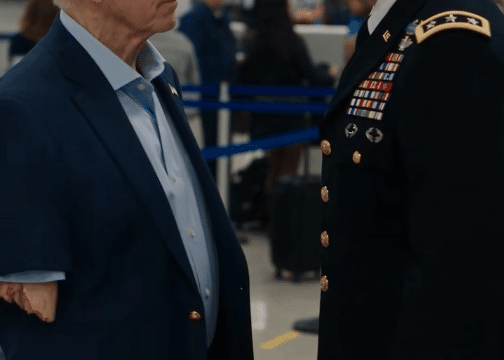
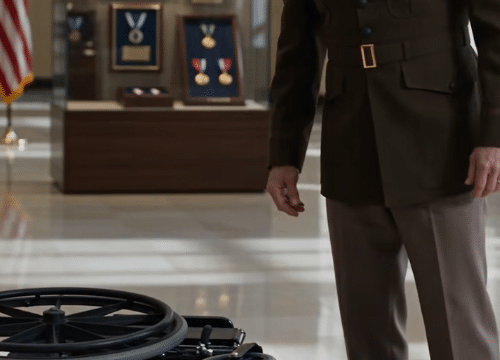
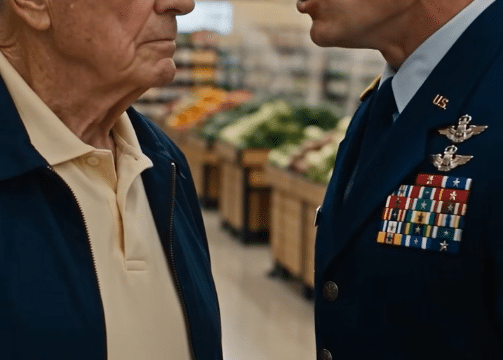
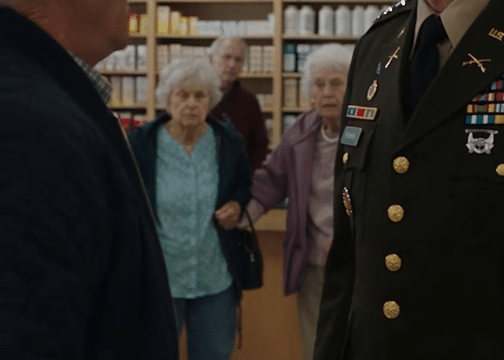
The first visible details were the decorated shoulder boards, followed by a dense rack of medals and ribbons. The camera remained focused on the uniform, formal trousers, and polished military boots.
The figure moved with unmistakable authority.
Officers throughout the hall began straightening their posture.
One senior commander immediately turned toward the entrance.
Another quietly stepped away from the memorial table.
Caldwell noticed the movement.
His expression changed.
He had spent years attending ceremonies where the arrival of senior command officials was carefully announced. He knew what it meant when military aides entered a room with that level of urgency.
But why were they here?
He looked toward Arthur.
The elderly man was now standing, supported by his recovered cane. His cheek remained swollen, but his posture was dignified.
Noah stood beside him.
Neither appeared surprised.
The senior figure continued forward.
The aides moved aside as the decorated officer advanced toward the memorial area.
Caldwell’s eyes followed every step.
Then he looked at the large portrait above the wreaths.
General Daniel Bennett.
He looked back at Arthur.
Something was beginning to make sense.
The elderly man’s resemblance to the man in the portrait had been obvious to anyone who had known the family.
The white hair.
The shape of the face.
The familiar expression.
But Caldwell had never bothered to look closely.
He had never asked the man’s name.
He had never considered that the quiet old visitor might be more than an ordinary guest.
Now, the approaching senior figure was moving directly toward him.
Not to greet Caldwell.
Not to inspect the memorial arrangements.
But toward Arthur and the little boy standing beside him.
The general’s arrival had transformed the atmosphere.
Every officer in the hall seemed to understand that something significant was happening.
Caldwell’s face began to lose its color.
He looked at the decorated uniform again, then at Arthur.
A terrifying possibility was forming in his mind.
The man he had thrown to the floor might be the closest living connection to the very general whose funeral he had attended.
And if that was true, Caldwell had not simply disrupted a memorial reception.
He had assaulted the father of a fallen military hero.
In front of witnesses.
Beside his son’s portrait.
Act V
The senior military figure approached the memorial table.
Arthur stood quietly beside Noah, holding his wooden cane.
The decorated shoulders remained visible as the figure moved closer. The aides maintained their positions, and the officers around the room watched in absolute silence.
Caldwell could no longer maintain his composure.
His shoulders stiffened.
His mouth opened slightly.
He looked toward the memorial portrait one more time.
Then he looked at Arthur.
The pieces had finally connected.
Arthur Bennett was not an ordinary guest.
He was Daniel Bennett’s father.
The father of the fallen general whose service had brought the entire military community together.
The little boy was Daniel’s great-grandson.
And the senior figure entering the room was clearly someone whose arrival commanded the immediate attention of the military establishment.
Caldwell’s confidence collapsed.
He had spent the evening acting as though his rank gave him permission to decide who deserved respect.
Now, he could barely understand why the highest levels of command were arriving at a funeral reception where he had just assaulted an elderly man.
He swallowed.
His eyes shifted between Arthur and the approaching figure.
Then, in a voice stripped of its earlier arrogance, he finally asked:
“Why is command coming here…?”
Nobody answered him.
Arthur did not raise his voice.
He did not point at Caldwell or demand that anyone punish him.
Instead, he gently placed a hand on Noah’s shoulder and looked toward his son’s portrait.
For him, that was what mattered.
Daniel had spent his life believing that leadership was measured not by how many people feared you, but by how many people could trust you.
Caldwell had forgotten that distinction.
He had mistaken an old man’s age for insignificance, a child’s accident for disrespect, and his own uniform for unlimited authority.
But the greatest humiliation was still waiting.
Because the witnesses in that room had seen everything.
They had seen the cane thrown aside.
They had seen the punch.
They had seen the old man fall beside the memorial table.
And they had heard the words spoken over him.
No amount of rank could erase those memories.
Arthur had come to his son’s funeral to honor a life built around service.
Instead, he had exposed the difference between a man who wore the uniform with honor and a man who used it to frighten others.
That day, the fallen general’s father reminded an entire room of officers that a person’s importance is never measured by the stars on their shoulders.