Act I
“It’s trash day. Whatever’s in there stays in there.”
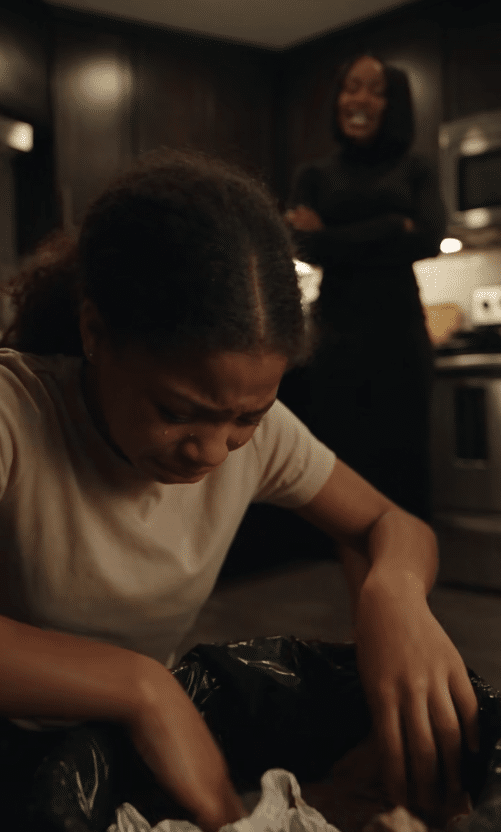
Nia barely heard the words at first. She was kneeling on the kitchen floor, both hands trembling as she searched through the trash, pushing aside crumpled paper and discarded packaging while tears slipped down her cheeks.
Her stepmother stood over the open bin with her arms crossed, dressed in a long-sleeve black dress. Her glossy bob was perfectly in place, her expression cold enough to make the warm kitchen feel suddenly unfamiliar.
Nia had come looking for one thing.
“My mom’s bracelet was on my dresser!”
The old silver bracelet had been there when she left that morning. It was simple, worn smooth in places, with a clasp that sometimes caught if she didn’t fasten it carefully. It wasn’t valuable enough to attract attention in a jewelry store, and it had never been meant to impress anyone.
But it was the last piece of her mother that Nia could hold in her hands.
Her stepmother glanced toward the trash as if the entire matter were too trivial to deserve another thought.
“That old thing? It fell. I threw it out.”
Nia stopped searching for a moment.
She looked up, disbelief breaking through her tears. Her stepmother had not misplaced the bracelet. She had seen it, decided it didn’t belong, and thrown it away.
“You had no right!”
The words came out louder than Nia expected. For once, she didn’t swallow her anger or apologize for making the room uncomfortable.
Her stepmother’s arms tightened across her chest.
“This is my house. I decide what’s trash.”
Nia looked back into the bin.
The woman had turned a memory into garbage and then defended the decision as though she had simply cleaned a room. There was no acknowledgment of what the bracelet meant, no hesitation, not even the smallest sign that she understood why a fourteen-year-old girl was crying on the kitchen floor.
Nia reached deeper into the trash.
Her fingers shook so badly that she struggled to move anything without knocking it back into the bin. She could feel her heart racing, each second stretching as she searched for the familiar silver shape.
She had already lost her mother.
She couldn’t bear the thought of losing the one thing that still made her feel close to her.
Then, beneath a crumpled piece of packaging, something caught the light.
A thin silver curve.
Nia pulled it free.
But finding the bracelet wouldn’t erase what her stepmother had just revealed about how little she valued its meaning.
Act II
Nia held the bracelet in both hands, staring at it as though she needed to make sure it was real.
It was old and simple, its silver surface dulled by years of wear. A small mark near the clasp was familiar to her, as was the slight bend in one link. She had seen those details so many times that she could recognize the bracelet without looking closely.
Her mother had worn it in photographs.
She had kept it carefully after her mother’s death, sometimes taking it out when the house felt too quiet or when a memory surfaced so suddenly that it hurt to breathe. The bracelet had become part of the way she remembered her: not as a story other people told, but as someone who had been present in her life, someone whose touch and warmth had once been real.
Nia pressed it against her chest.
“It’s all I have left of her…”
Her voice broke on the final word.
For a moment, the kitchen was quiet except for the rustle of the trash bag and Nia’s uneven breathing. The overhead light fell across the bracelet, making its imperfections visible: the worn links, the modest clasp, the little scratches that time had left behind.
Her stepmother looked at the girl on the floor without softening.
“Sentimental junk. You’re fourteen, not four.”
Nia lowered her head.
The insult hurt, but the contempt behind it hurt more. Her grief was being treated as childishness, as though growing older should mean becoming willing to discard every object connected to someone she had loved.
Nia was fourteen. She understood that people died. She understood that a bracelet could not bring her mother back, could not answer the questions that remained, and could not make the empty places in the house disappear.
That was precisely why she treasured it.
It couldn’t replace her mother.
It could only remind her that she had once been here.
Nia brushed a piece of debris from the silver links with her thumb. Her hands were still trembling, and tears continued to fall, but she held the bracelet carefully, shielding it from the trash as though someone might reach over and take it away again.
Her stepmother made no move to help.
There was no apology, no acknowledgment that the bracelet had been placed on Nia’s dresser for a reason. The woman stood with her arms crossed, certain that the matter was settled because she had declared it settled.
Nia stayed on the floor.
She had recovered the bracelet, but she could not recover the feeling of safety she had lost when she watched her stepmother throw it away. A home was supposed to be the one place where a child didn’t have to defend every memory, every photograph, every small connection to a parent she had lost.
Now even that felt uncertain.
Then heavy footsteps sounded from the entrance.
Marcus had just come home.
He stepped into the kitchen wearing his dark-brown suit, his shoulder-length dreadlocks resting against his shoulders. He expected to find an ordinary evening waiting for him. Instead, he saw his daughter kneeling beside an open trash bin, crying as she clutched something silver against her chest.
He stopped.
“What’s happening?”
Nia looked up at him.
For the first time since she had entered the kitchen, she had someone to tell who might understand why this mattered.
“She threw away Mom’s bracelet.”
Marcus’s eyes moved to the object in her hands.
And then his expression changed.
He recognized that bracelet immediately—not merely as something that had belonged to Nia’s mother, but as something he had given her himself.
Act III
For a moment, Marcus didn’t speak.
He stood looking at the silver bracelet in Nia’s hands, and the years seemed to collapse into a single memory.
It had never been expensive. He had not chosen it because it was fashionable or because it would attract attention. He had chosen it because it reminded him of the woman he loved, and because he wanted her to have something she could wear every day without needing a special occasion.
The bracelet had been there before Nia was born.
Before the late-night feedings, before school mornings, before family photographs that now carried a painful weight. Before life had changed in ways he had never imagined when he first fastened the clasp around his wife’s wrist.
He remembered the bracelet as it had looked then, its silver brighter and its links newer. But he remembered something else more clearly: the way his wife had held out her arm to show it to him, smiling at how simple it was.
She had worn it often.
Over time, the shine had faded. The bracelet had collected scratches, and the clasp had become a little stubborn. None of that had diminished what it meant.
After she died, the bracelet had become one of the few things that still carried the texture of their shared life. Nia had held onto it because she had inherited more than an object. She had inherited a memory that belonged to both her parents.
Marcus lowered his gaze to his daughter.
She was still on the floor, her eyes red, her hands curled protectively around the bracelet. She looked so young in that moment, not because she was behaving like a child, but because she had been forced to defend something she should never have needed to explain.
Marcus understood the grief in her face.
He also understood that this had not been an accident that could be dismissed with a shrug. His wife had seen the bracelet, thrown it away, and then watched Nia search through the trash for it.
He looked toward the woman standing beside the bin.
Then he spoke, his voice quiet and heavy with recognition.
“I gave her that bracelet. Before you were born, Nia.”
Nia looked at him.
She had known the bracelet belonged to her mother. She had known it was old, and that it carried memories from a time before she could remember much for herself. But hearing her father explain that he had chosen it for her mother gave the object another layer of meaning.
It wasn’t just a piece of jewelry her mother had owned.
It was a piece of their love.
Something her father had placed in her mother’s hands long before Nia entered the world, something that had survived years of ordinary life and then the devastating absence that followed.
Nia’s fingers closed around the bracelet.
Marcus watched her hold it, and the sight seemed to strike him harder than the mess on the floor or the open trash bin. His daughter had been left to recover this small piece of her mother alone, crying while someone else stood by and called it junk.
Beside them, his wife finally began to understand what her casual cruelty had exposed.
“Marcus, I didn’t know—”
Her voice was smaller now.
But Marcus did not let her finish.
The bracelet’s history had changed the room—and his response made it clear that he would not accept another lie about what had happened.
Act IV
“You knew exactly whose it was.”
Marcus’s words were quiet, but there was no uncertainty in them.
He remained in the kitchen, his attention fixed on his wife. He didn’t raise a hand or move toward her in anger. Instead, he looked down at Nia, who was still kneeling beside the trash bin, holding the bracelet against her chest.
That was the image he could not ignore.
His daughter had been crying on the floor over something that had belonged to her mother, while the woman who had thrown it away stood nearby insisting that she had the right to decide what counted as trash.
His wife had tried to explain it as ignorance.
But the bracelet had not been hidden in some forgotten box or buried among objects no one had touched for years. It had been on Nia’s dresser. Nia had immediately known where it was supposed to be, and her stepmother had admitted that she had picked it up and thrown it away.
She might not have understood every memory attached to it.
She had understood enough to know it belonged to Nia.
Marcus didn’t need to shout to make that distinction clear.
He lowered himself toward the floor, bringing himself down to Nia’s level. He did not tower over his wife or turn the moment into a display of rage. His attention was on the girl who had been left to search through the trash for a connection to her mother.
Nia watched him kneel beside her.
The movement seemed to loosen something in her chest. Until then, she had been the only person in the room treating the bracelet as something precious. Her stepmother had dismissed it. She had called Nia childish for grieving. She had used ownership of the house as an excuse to decide what another person’s memories were worth.
Now Marcus was beside her, looking at the bracelet as though its meaning needed no explanation.
He held out his hand.
Nia carefully placed the bracelet in his palm.
For a moment, he examined the familiar silver links. The years had left their marks, but the bracelet was still whole. It was still the same modest gift he had once chosen for his wife, the same object that had accompanied her through the life they had shared.
He remembered the clasp.
He remembered fastening it for her.
And now he was sitting on the kitchen floor beside their daughter, holding the same bracelet while she watched him through tear-filled eyes.
His wife stood nearby, silent.
The trash bin remained open. A few pieces of discarded paper lay scattered around it. The ordinary kitchen light made the scene look almost painfully mundane, as though this were simply another household disagreement.
But it was not about cleaning.
It was about whether Nia was allowed to keep something that connected her to her mother. It was about the difference between deciding where an object belonged and deciding that another person’s grief had no value.
Marcus brought the bracelet closer to Nia’s wrist.
She held still, watching his hands.
He gently positioned the silver links, preparing to fasten the familiar clasp. His movements were careful, as though the object deserved the same tenderness he remembered giving it years ago.
Nia’s tears continued to fall, but she did not look away.
For the first time that night, she did not have to search for the bracelet or defend why she wanted it.
Her father was returning it to the place where it belonged.
And when Marcus reached for the clasp, he made a promise that left no room for anyone else to decide the bracelet’s fate.
Act V
Marcus fastened the bracelet around Nia’s wrist.
His fingers moved carefully over the small silver clasp, securing it without forcing the old metal. The bracelet settled against her skin, worn and understated, exactly as it had always been.
Nia looked down.
For several seconds, she said nothing. She simply turned her wrist slightly, watching the familiar links catch the kitchen light.
It was still the same bracelet.
The scratches remained. The silver was still dulled by years of wear. It had not become more valuable because her stepmother had thrown it away, and it had not become less meaningful because someone had called it junk.
Its value had never depended on what anyone else thought of it.
Marcus kept his hand near her wrist for a moment, making sure the clasp was secure. He looked at his daughter, seeing the tears on her face and the relief beginning to emerge beneath them.
Then he spoke.
“It stays on her wrist. Forever.”
Nia swallowed, staring at the bracelet.
The words did not bring her mother back. They did not undo the moment she had spent kneeling in the trash, afraid that the last tangible link to her mother might be gone. They could not erase the way her stepmother had spoken about her grief as if it were an inconvenience.
But they gave the bracelet back its place.
It would no longer be something Nia had to hide or defend alone. Her father had recognized it, remembered its history, and fastened it around her wrist himself.
The old silver rested against her skin.
Nia slowly closed her fingers around it, feeling the familiar shape beneath her thumb. Her face remained wet with tears, but she was no longer searching through the trash.
Marcus stayed kneeling beside her.
He did not stand over his wife in anger. He did not turn the moment into a threat or announce what would happen next. His attention remained on Nia and the bracelet secured around her wrist.
Behind them, the trash bin stood tipped open.
The kitchen had gone quiet.
Nia looked at the bracelet once more, holding her wrist close as though she could feel the years inside its worn links: the mother she missed, the father who had given it to her, and the memories that could not be discarded simply because someone else failed to understand them.
Marcus’s hand rested briefly beside hers.
The clasp held.
And for that moment, the bracelet was exactly where it belonged.
Hard cut.