Act I
“Aren’t I in the family photo?”
Nia stood behind a camera mounted on a tripod, holding the remote while warm lights illuminated the living room backdrop. Her stepmother had carefully arranged Marcus, Ava, and Caleb in coordinated outfits, adjusting their positions until everyone stood exactly where she wanted them.
Everyone except Nia.
The fourteen-year-old wore a cream blouse that matched the family’s chosen colors. Her curly black hair was tied into a neat low ponytail, and she watched the others gather in front of the camera with a quiet, searching expression.
Her stepmother didn’t turn around.
“Someone has to take it.”
Nia glanced at the tripod. The camera was stable, the framing was already set, and the timer was available. There was no reason she couldn’t join the portrait.
“The camera has a timer.”
Her stepmother stepped between Nia and the backdrop, blocking her path with an almost casual movement.
“The picture looks cleaner without you.”
The words landed softly, without a raised voice or a dramatic gesture. That made them worse. Nia had not been told that there wasn’t enough room, that the arrangement needed changing, or that they would take another photograph afterward.
She had been told that the family picture would look better without her.
Across the room, Ava’s smile disappeared. Caleb looked toward his sister, then back at the camera. Marcus remained in position, apparently unaware of the full exchange.
Nia lowered the remote.
She did not argue. She did not ask her stepmother to repeat herself.
But the camera was still recording the room’s arrangement, and the photograph had not yet been taken.
Then someone returned to the living room and heard the words that were never meant to be challenged.
Act II
The family portrait had been her stepmother’s idea from the beginning.
For days, she had talked about coordinated clothing, flattering lighting, and a backdrop that would make the living room look like a professional studio. She wanted a polished photograph suitable for framing, one that would make the family appear close, elegant, and perfectly put together.
She had selected the outfits herself.
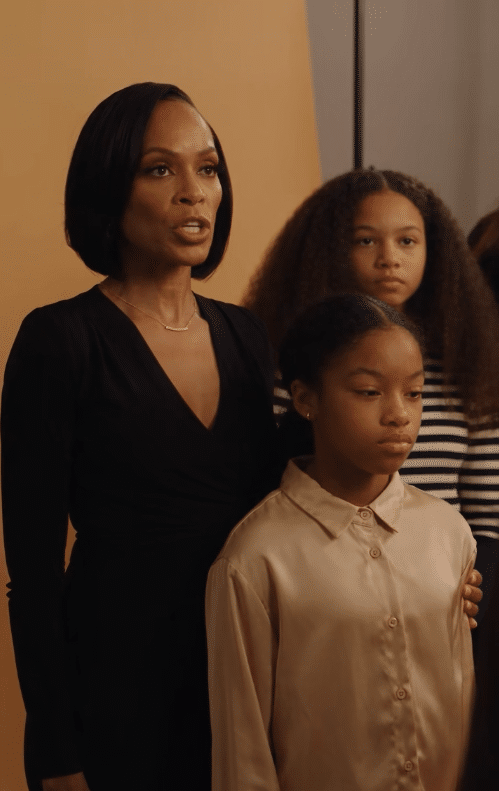
Marcus wore his dark-brown tailored suit with a beige shirt and brown tie. Ava stood in her black-and-white striped top, her long curls arranged carefully around her shoulders. Caleb wore his black hoodie, positioned beside them beneath the warm lights.
Nia had followed the instructions too.
Her cream blouse fit the color scheme. Her hair was neat. She had even helped prepare the camera and position the tripod before being told to stand behind it.
Yet when the time came to take the photograph, her stepmother had assigned her a different role.
She would operate the remote.
She would make sure everyone else looked good.
And she would remain outside the image that was supposed to represent their family.
Nia looked at the empty space beside Ava. There was enough room for her. The backdrop was wide, the camera was positioned correctly, and the timer would give her plenty of time to join the group.
Her stepmother knew all of that.
The problem was never the camera.
It was the person her stepmother did not want inside the frame.
Nia held the remote between both hands, trying to understand how an ordinary family portrait had become another moment in which she was expected to accept less than everyone else.
Then the photographer returned from the hallway.
He had stepped away briefly to retrieve a gear bag, leaving the camera setup undisturbed. As he came back into the living room, he heard the final words of the exchange.
“The picture looks cleaner without you.”
He paused.
Marcus turned toward the sound of the photographer’s footsteps, then looked at Nia standing alone behind the tripod. His expression shifted from polite anticipation to confusion.
He had expected the photograph to include everyone. That was what a family portrait meant to him: a single image in which the people who belonged together stood side by side.
He looked at his stepdaughter.
Then he looked at his wife.
“Why would Nia be excluded?”
His wife turned immediately, her expression softening as she faced him. The coldness she had shown Nia vanished beneath a polished, reassuring smile.
“She refused to match us.”
Nia looked down at her cream blouse.
Ava stared at her mother.
The accusation was so easily disproved that, for a moment, nobody seemed to know how to respond. Nia was dressed in the coordinated colors. She had followed the plan. She had prepared herself for the photograph just as everyone else had.
Her stepmother had not simply left her out.
She had now offered a reason that placed the blame on Nia herself.
Marcus looked from one girl to the other.
Before he could ask another question, Ava stepped away from the backdrop and reached for Nia’s hand.
She had decided she would not let the lie stand.
Act III
Ava pulled Nia gently toward the backdrop.
The movement was small, but it changed the arrangement of the room. Instead of standing behind the camera, Nia was now beside the people she had been ordered to photograph.
Ava glanced at her mother’s carefully chosen outfits, then at Nia’s cream blouse.
“She is matching us.”
The statement left no room for the excuse that had just been offered.
Nia stood beside her sister, still composed, though her eyes had grown more guarded. She had not asked Ava to defend her. She had not demanded that Marcus take her side.
Ava had seen what was happening and chosen to speak.
Her stepmother’s smile tightened.
For a moment, the room seemed to wait for her to offer another explanation. She could have said the photograph needed a different arrangement. She could have admitted that she had spoken cruelly. Instead, she glanced toward the camera, as if the equipment itself might provide a way to move the conversation along.
The photographer remained beside his gear bag.
He had no personal stake in the family’s disagreement. He had been hired to take a photograph, not to choose sides in a household argument. But he had heard the exclusion directly, and he was now looking at the family with the professional concern of someone who had discovered that the requested composition was not what he had assumed.
He stepped toward his laptop.
The booking details were still open in his email.
Marcus watched him, uncertain why a photographer would need to consult a booking message during a family portrait. His wife, however, seemed to recognize the possibility before anyone else did.
Her gaze followed the photographer’s hand toward the screen.
The photographer opened the original booking email and read through the written instructions. He scrolled once, then stopped.
The room had grown quiet enough that the small click of the laptop trackpad seemed unusually loud.
He looked at the email again to ensure he had understood it correctly.
Then he turned the screen slightly toward Marcus.
The instruction was written in plain language. It did not mention a lighting problem, a limited frame, or an outfit that clashed with the others.
It specifically directed the photographer to remove Nia from the final image.
The photographer looked at the stepmother who had sent the request. His expression remained neutral, but his next words carried the weight of a fact that could no longer be dismissed as a misunderstanding.
“This was your written request.”
Nia’s eyes moved toward the screen.
Marcus stopped looking at the photographer and turned toward his wife.
The accusation about mismatched clothing had already fallen apart. Now there was a written instruction that revealed the exclusion had been arranged before the family ever gathered beneath the lights.
It had not been a spontaneous decision made in the middle of the room.
Someone had planned it in advance.
And Caleb had found something that showed just how far that planning had gone.
Act IV
Caleb stepped forward holding the printed shot plan.
The ten-year-old had been quiet throughout the exchange, watching the adults move around the living room and listening as each explanation changed. He had noticed the papers near the photographer’s equipment and recognized the page that showed how the portrait was supposed to be composed.
He held it up.
The plan displayed the intended framing, the positions of the family members, and the instructions for the final image. Beside Nia’s place, a red line had been drawn through her face.
It was not a mark made by an accidental fold or a stray pen stroke.
Someone had crossed her out.
Nia stared at the page.
She had already heard that she made the photograph look less clean. She had already been told that she refused to match everyone else. She had already watched her stepmother defend the exclusion as though Nia herself had created the problem.
Now the printed plan made the intention visible.
The photographer had received a written request to crop Nia out.
The shot plan had her face crossed out in red.
And the explanation offered in front of Marcus had blamed Nia for a choice made before the portrait began.
Ava stood beside her sister, her expression caught between anger and disbelief. Caleb kept holding the page, his small hands steady despite the tension in the room.
Marcus took in the details one by one.
He looked at the red line across Nia’s face, then at the laptop displaying the email. The camera remained fixed on its tripod, pointed at the backdrop where the portrait was supposed to happen.
Everything had been prepared for a family photograph.
The lights were arranged. The outfits coordinated. The positions chosen. The photographer hired.
And somewhere within those preparations, a decision had been made to remove one child from the image while preserving the appearance of a complete family.
Marcus looked at Nia.
She was still wearing the blouse that matched the others. She had been ready to stand with them. Instead, she had been handed a remote and told to take their picture.
Her stepmother had not merely forgotten to include her.
She had assigned Nia the task of producing the very photograph from which she had been deliberately excluded.
The cruelty of that detail seemed to settle over Marcus as he studied the printed plan.
Nia did not need to explain what the red line meant. She did not need to tell him how it felt to stand outside the frame while everyone else was arranged inside it.
The paper made the decision plain.
His wife stepped backward, her polished expression beginning to fail. She looked toward the photographer, then at the printed page in Caleb’s hands.
No explanation came.
Marcus turned fully toward her.
The portrait remained unfinished. The camera’s timer had not been activated, and nobody had taken their places for the final shot.
For the first time, the question was no longer whether Nia belonged in the photograph.
It was why her stepmother had made a plan to erase her before the family even arrived.
Act V
Marcus faced his wife.
The warm lights cast a soft glow over the backdrop, the coordinated outfits, and the camera waiting on its tripod. Everything still looked ready for a beautiful family portrait.
But the room no longer felt like a place where everyone had been invited to belong.
Caleb held the printed shot plan in front of him. Ava remained beside Nia, refusing to leave her standing alone again. The photographer waited quietly, his laptop still open to the booking email that confirmed the written request.
Marcus looked at the red line crossing Nia’s face.
Then he looked at the woman who had told him that Nia refused to match the family.
The evidence was unmistakable. Nia’s outfit matched. The camera had a timer. The photographer had received explicit instructions to crop her out, and the printed plan showed that someone had taken the time to cross out her face.
This had been arranged before anyone stepped in front of the backdrop.
Nia stood quietly beside Ava. Her expression was restrained, but she no longer looked toward her stepmother as though she were waiting for permission to enter the frame.
The photographer had verified the written request. Ava had challenged the lie. Caleb had produced the marked plan.
The truth no longer depended on whether Nia could persuade someone to believe her.
Marcus’s expression hardened as he looked at his wife. He had arrived expecting an ordinary family photograph, something to preserve a happy moment. Instead, he had discovered that the image had been designed to exclude a child who was standing right there, dressed to match everyone else.
His wife took another small step backward.
The smile she had worn when Marcus entered was gone. So was the easy confidence with which she had blamed Nia for refusing to cooperate.
She looked at the laptop, then at the printed plan, then at Marcus.
Her lips parted.
No answer came.
Marcus held her gaze, waiting.
“You planned to erase her before we arrived?”
His question hung unanswered beneath the warm lights.
Nia stood beside her sister. Caleb still held the paper. The camera remained steady, aimed at a family portrait that had not been taken.
And her stepmother stood exposed in the middle of the scene she had tried so carefully to control.
For the final half-second, she could only stare back at Marcus, speechless.
Hard cut.