Act I
The water hit her face before anyone in the equipment yard understood how far the lieutenant colonel was willing to go.
“Who gave you permission to touch my layout?”
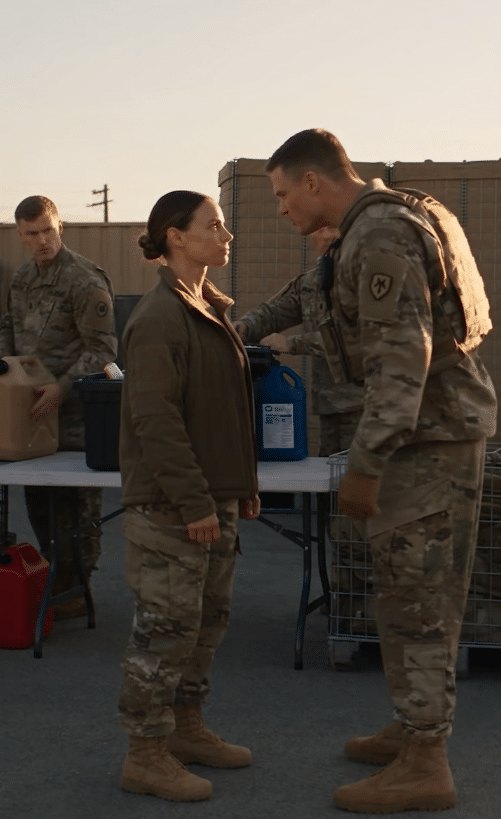
Lieutenant Colonel Daniel Mercer stood beside a folding table crowded with equipment manifests, fuel allocations, and vehicle deployment maps. At forty-one, he had built his reputation on absolute control. Soldiers moved when he ordered them to move. Officers adjusted their plans when he entered a room. And nobody corrected him in front of his subordinates without paying for it.
The woman standing opposite him showed no sign of backing down.
She was thirty-five, dressed in a clean OCP field uniform beneath a plain tactical jacket. Her dark-brown hair was secured in a neat low bun, and her tan boots were dusty from walking through the staging area. Nothing about her appearance announced importance. Her rank was difficult to read, and she carried no visible entourage.
That was precisely why Mercer had underestimated her.
She had been inspecting the yard when she noticed fuel containers positioned dangerously close to electrical equipment and a cluster of vehicles assigned to a route that would funnel them through an overcrowded staging lane. She had moved several markers on Mercer’s layout to prevent a foreseeable disaster.
Mercer had interpreted the correction as a challenge.
“Someone who doesn’t want this place catching fire.”
Her answer was calm, almost clinical.
For a moment, the surrounding soldiers seemed to wait for Mercer to reconsider. A few glanced at the fuel cans. Others studied the woman, wondering why someone without an obvious command role was speaking to a lieutenant colonel as though the facts mattered more than his temper.
Mercer looked at the corrected layout, then at her.
His face tightened.
He snatched up a dirty equipment-cleaning bottle and flung its water directly into her face.
She blinked against the sudden splash but remained standing. The bottle struck the ground when he threw it aside, bouncing once across the hard surface.
Then Mercer slapped her.
The blow snapped her head to one side. Her cheek reddened almost immediately, swelling beneath the harsh afternoon light. A faint trace of blood appeared at the corner of her mouth.
Before she could fully recover, he drove a fist into her stomach.
Her body folded sharply at the waist. The air left her lungs, and she dropped to one knee, one hand pressed against her abdomen as she fought to breathe. Her other hand caught her weight against the concrete.
Around them, soldiers froze.
Nobody stepped forward. Nobody reached for Mercer’s arm. The only sounds were the distant rumble of tactical vehicles, the rattle of equipment, and the woman’s controlled, painful attempt to draw another breath.
Mercer looked down at her with contempt.
“Field trash doesn’t lecture officers.”
She raised her eyes to him.
There was pain in her face, but no pleading. No frantic apology. No desperate attempt to explain why she had touched his precious layout.
Instead, she studied him with the same unnerving attention she had given the staging area.
And as her jacket shifted against her collar, something Mercer had never noticed became visible.
The sergeant major standing several yards away saw it first.
His expression changed so suddenly that the soldier beside him stopped moving.
He recognized the scar. And he knew the woman standing on one knee might be the last person Mercer should ever have touched.
Act II
Sergeant Major William Harlan had spent thirty-six years learning the difference between a soldier who looked dangerous and one who had actually survived something extraordinary.
At fifty-six, Harlan had little patience for theatrical displays of authority. He had served alongside officers who could silence a room without raising their voices, and he had watched men with impressive reputations crumble when a mission stopped following the plan.
Mercer belonged to a different category.
He was good at controlling people when they were afraid of disappointing him. He understood inspections, reporting chains, and the small rituals through which ambitious officers established dominance. He could make a private feel insignificant with a glance and make a junior lieutenant apologize for a mistake that had never happened.
What he had never learned was restraint.
Harlan had watched the assault without intervening physically. The violence had happened too quickly, and the shock of seeing a senior-looking stranger attacked in front of an entire staging team had left the yard momentarily motionless.
But then he saw the woman’s left shoulder.
Her collar had shifted during the fall, exposing part of a large Y-shaped burn scar that ran from below her neck toward her left shoulder. It was not a small mark that could be mistaken for an ordinary training injury. The branching pattern was distinctive, irregular, and unmistakable to someone who had heard the original account.
Harlan’s mouth went dry.
Years earlier, during a period of advanced field training, he had heard an instructor describe Operation Red Corridor. The briefing had not been designed to inspire anyone. It had been a grim discussion about a mission that had gone wrong, a team trapped in a burning environment, and the extraordinary cost of getting survivors out.
The account included details that never appeared in the public summaries.
One was the scar.
A survivor had been described as having a severe Y-shaped burn running from the base of the neck toward the left shoulder. The injury had become part of the account because it was one of the few physical details that could distinguish the survivor from the others involved in the operation.
Harlan had never met that person.
He had simply remembered what the instructor said next: if the story ever came up again, do not assume the official summary tells you everything.
Now the scar was directly in front of him.
The woman shifted her weight and slowly brought one foot beneath herself. Her breathing remained guarded, and one hand still pressed against her stomach. Yet her gaze stayed fixed on Mercer, not in defiance for its own sake, but with a steady, assessing focus that seemed entirely at odds with the position he had forced her into.
Mercer mistook her silence for surrender.
He adjusted his tactical vest and glanced around, checking whether the watching soldiers had understood who was in charge. A few quickly looked away. Others remained rigid, their discomfort growing more obvious with every second.
He had humiliated her in front of them, and he expected that humiliation to settle the matter.
But Harlan was no longer watching Mercer’s performance.
He was staring at the scar.
The old account had included no photograph he could recall. No name had been repeated often enough to become familiar. There had only been a survivor description, a mission designation, and the unmistakable warning that some military histories were incomplete because the people who knew the full truth were not eager to tell it.
Harlan stepped closer, stopping well short of the woman.
He did not touch her. He did not try to pull her upright. He simply looked from the scar to her face, and the years seemed to fall away from his expression.
When he finally spoke, his voice carried a seriousness that made the nearest soldiers turn toward him.
“Colonel… look at her left shoulder.”
Mercer glanced over his shoulder, irritated.
“What?”
Harlan did not repeat himself.
He did not need to.
His eyes remained fixed on the exposed scar, and his posture had changed. The casual confidence of an experienced senior enlisted leader had disappeared. In its place was something closer to disbelief, edged with a respect he had not shown anyone that afternoon.
Mercer followed his gaze.
For the first time since the confrontation began, he looked at the woman rather than at the authority he believed he possessed over her.
He saw the scar.
Then he saw Harlan’s face.
And he realized the sergeant major was not reacting to an injury.
He was reacting to a history Mercer had never bothered to learn.
Act III
“It’s a burn. So what?”
Mercer delivered the words with a scoff, as though the explanation were beneath him.
He wanted the yard to laugh with him. He wanted Harlan to look embarrassed for interrupting. Above all, he wanted the woman to understand that nothing she carried on her body could change the fact that Mercer was the colonel and she was, in his eyes, an obstacle.
But the laughter never came.
Harlan remained motionless.
The soldiers near the equipment cages had stopped pretending to be busy. A young specialist stared at the ground, his jaw clenched. Another soldier looked from the scar to Harlan, trying to understand why the sergeant major—who rarely showed emotion in public—seemed to be looking at a ghost.
The woman slowly straightened as much as her injured abdomen allowed.
She did not hurry. She did not make a show of overcoming the pain. She simply refused to remain folded over because Mercer wanted her to.
Her cheek was swollen, and her breathing remained shallow. Yet when she spoke, her voice was level.
“Ask what was burning around me.”
The words landed differently from an accusation.
There was no boast in them, no demand that Mercer recognize her, and no attempt to frighten him with an impressive title. She had offered him a question, and the question carried a weight that her rank insignia never could.
Mercer’s expression held for another second.
Then the smallest crack appeared in it.
He knew enough about the military to understand that some operations were discussed in detail, while others were reduced to a few lines in official records. He had heard instructors refer to missions that became cautionary examples, and he had watched senior officers abruptly change the subject when someone asked about the wrong incident.
Operation Red Corridor meant nothing specific to him at first.
That was what made Harlan’s reaction so unsettling.
The sergeant major had not asked for identification. He had not demanded a name or checked the woman’s uniform. He had seen one scar, and something in him had immediately changed.
Mercer glanced back at the woman.
She offered no further explanation.
The silence became unbearable because he could no longer control what it meant. If he continued mocking her, he risked proving that Harlan’s alarm was justified. If he backed down, every soldier in the yard would know that he had used violence against someone whose history frightened a man who had served for decades.
So he chose the only response his pride could manage.
He lifted his chin.
“Whatever happened before, it doesn’t give you authority over my staging area.”
The woman looked at him for a long moment.
She could have answered with a rank. She could have reached into her jacket and produced identification that would have ended the argument in seconds. She could have demanded that everyone present stand at attention.
She did none of those things.
Instead, she glanced toward the fuel containers and the misplaced equipment markers. The original hazard was still there, waiting beneath Mercer’s wounded pride.
“Your staging area,” she said, quietly enough that he had to listen, “was the reason I stopped you.”
Mercer’s mouth tightened.
He had been given an opportunity to reconsider. He had ignored it. He had been given another chance to look at the evidence before him. He had dismissed that, too.
Harlan understood the danger of the moment better than anyone else in the yard. It was not simply that Mercer might have attacked someone important. It was that the woman had shown remarkable restraint even after being struck, kicked, and publicly degraded.
Her control did not look like fear.
It looked like discipline.
Harlan remembered the instructor’s account of Red Corridor describing a person who had continued functioning under conditions that should have made coherent thought impossible. The details were sparse, but the central point had been repeated: the survivor had remained focused on getting others out, even when the environment itself became lethal.
Harlan had never known whether that person returned to service.
He had never heard a definitive account of what happened afterward.
And now he was looking at someone whose scar matched the description precisely.
Mercer watched the sergeant major’s face and felt his own confidence begin to drain away. He had expected Harlan to reinforce his authority, perhaps by ordering the woman to stand aside or by reminding her that the colonel controlled the exercise.
Instead, Harlan looked at her as though she had earned a kind of respect that could not be demanded, purchased, or assigned by a chain of command.
For the first time, Mercer wondered whether he had made a mistake he could not undo.
Then the woman’s calm expression made him realize that the scar was only the first thing he had failed to understand.
Act IV
The yard had changed, though nothing around them had moved.
The tactical trucks remained lined up beside the equipment cages. The fuel containers were still too close to the staging equipment. The paperwork lay where Mercer had left it. Even the afternoon light continued to fall across the concrete in the same hard, indifferent angles.
But the soldiers were no longer watching a subordinate being punished for challenging a colonel.
They were watching a colonel discover that his authority had limits.
Mercer tried to reclaim the moment by turning toward Harlan.
“Sergeant Major, do you have something to add?”
It was meant to sound like an order. Instead, it sounded like a man asking for reassurance while pretending he did not need it.
Harlan held his gaze for a fraction of a second, then looked back at the woman.
He did not answer Mercer’s question.
That refusal was more damaging than an argument would have been. Harlan was a career soldier who understood protocol, and he had spent decades navigating the difficult balance between respecting command and protecting the people entrusted to it. He did not ignore a colonel casually.
If he was willing to let the question hang unanswered, it meant he believed something more important than Mercer’s pride was at stake.
The woman took a careful breath.
Pain tightened her features briefly, but she refused to let it dictate her next movement. She rose from her knee and stood upright, keeping one hand close to her abdomen. Her posture was not perfect; the blow had left her guarding her breathing. But she was on her feet, and she did not look away.
Mercer found himself stepping back half a pace.
He seemed to notice what he had done only after his heel moved. His jaw tightened, and he planted his boots as though he could reverse the retreat by force of will.
“You should have identified yourself,” he said.
It was the first time he had tried to make the confrontation her responsibility.
The woman studied him.
“You should have checked the hazard.”
A few soldiers exchanged glances. No one smiled. The moment was too serious for that, and the woman’s injury made any easy satisfaction feel misplaced.
Mercer opened his mouth, but no immediate response came.
He had spent the encounter treating respect as something owed to him automatically. The woman had treated it as irrelevant to the practical problem in front of her. She had corrected a dangerous setup, explained why, endured his violence, and returned to the original issue without asking anyone to admire her.
That was what unsettled him most.
She was not trying to win a public argument.
She was still trying to prevent the accident that had brought her to the table in the first place.
Harlan finally moved—not to intervene in the assault, which was already over, but to position himself where he could see both the woman and the staging layout. His eyes flicked once more to the scar, then returned to her face.
He looked as though he wanted to ask a dozen questions.
He asked none.
The woman gave him a nearly imperceptible nod. It was not a greeting, and it was not a confirmation of identity. It was simply an acknowledgment that he had seen what he had seen.
Mercer caught the exchange.
That tiny gesture frightened him more than an argument could have. Harlan had not been given an explanation, yet he seemed to understand enough to remain silent. The woman had not announced who she was, yet she had no need to force recognition from him.
Their restraint created a space Mercer could not enter.
He began searching his memory for anything useful: a briefing, an instructor’s warning, a senior officer who had mentioned Red Corridor in passing. He remembered fragments about a disastrous operation, an extraction under extreme conditions, and a survivor whose injuries had become part of a story passed between generations of soldiers.
Nothing gave him certainty.
But the absence of certainty no longer comforted him.
The woman’s eyes returned to the fuel containers.
“Move the fuel away from the electrical equipment,” she said. “Then correct the vehicle route.”
It was not a dramatic command. It was a practical one.
Yet the soldiers nearest the layout immediately began looking toward the markers and the vehicles. They had heard the original correction. They had seen Mercer respond with violence instead of checking whether she was right.
Now they waited to see whether he would make the same mistake again.
Mercer looked at the layout.
For one brief moment, he seemed ready to refuse simply because the suggestion had come from her. Then he noticed Harlan still watching him, and he understood that every second of delay was making the situation worse.
His face had gone pale beneath the afternoon sun.
He had wanted to teach a stranger her place.
Instead, he had exposed his own.
And when the name of Operation Red Corridor finally connected with the scar, Mercer understood why Harlan had gone silent.
Act V
The name came back to him in fragments.
Red Corridor.
A training room. A senior instructor speaking in a measured voice. A warning that the most important stories in military service were not always the ones printed in award citations or repeated at ceremonies.
Mercer had never paid much attention to those lessons. He preferred measurable authority: rank, command assignments, decorations, and the ability to make a room obey. Stories without names or clear conclusions seemed like distractions from the business of leadership.
Now he wished he had listened.
He looked at the woman’s shoulder again, but she had adjusted her jacket. The scar was no longer fully visible. There was no patch, medal, or document to confirm what Harlan believed he had recognized.
There was only the woman herself.
She stood with her weight carefully balanced, protecting her injured abdomen without allowing the pain to bend her again. Her cheek was swollen, and a faint trace of blood remained at the corner of her mouth. She looked nothing like the triumphant figure Mercer might have expected if the story were simply a legend about a celebrated officer.
She looked like someone who had survived something terrible and had no intention of turning survival into a performance.
That made the possibility harder to dismiss.
Harlan stood rigidly beside the equipment table. He did not salute, announce her rank, or explain the story to the watching soldiers. The recognition remained his alone, held behind a disciplined silence.
But the silence itself had become an answer.
Mercer thought of every choice he had made since the woman first touched his layout. He could have asked why she had moved the markers. He could have checked the route. He could have ordered the equipment repositioned and then reviewed the disagreement privately.
Instead, he had thrown water into her face.
He had slapped her hard enough to swell her cheek. He had struck her stomach and forced her to one knee. Then he had called her field trash while his own soldiers watched.
The realization did not arrive as one clean moment of remorse. It came as a series of humiliating details he could no longer push aside.
The discarded bottle near his boots.
The soldiers who would not meet his eyes.
Harlan’s expression, still grave and almost disbelieving.
And the woman, who had every reason to expose him, choosing instead to direct attention back to the hazard.
She had not needed to threaten his career. She had not even needed to tell him who she was.
He had supplied the evidence against himself.
Mercer tried to speak, but the words failed him. His throat tightened, and he glanced at Harlan again, searching for some sign that the sergeant major might restore the old order of things.
There was none.
Harlan remained attentive to the woman, waiting without crowding her. His respect was quiet, almost solemn. It carried none of the exaggerated admiration Mercer might have expected from a story about a military legend.
That was what made it convincing.
The woman shifted her stance, wincing slightly as the movement pulled at her injured abdomen. Then she looked at the staging layout once more.
The work still needed to be done.
A soldier finally moved toward the fuel containers. Another began checking the vehicle assignments. Their movements were careful at first, then more decisive as they recognized that the practical problem had never been about Mercer’s pride.
The colonel watched them obey the correction he had refused to consider.
No one cheered. No one mocked him. The yard offered no dramatic applause and no convenient speech that could turn his behavior into a misunderstanding.
There was only the truth of what had happened, witnessed by people who would remember it.
Mercer looked at the woman again.
He wanted to ask whether she had been at Red Corridor. He wanted to know how she had survived, why Harlan recognized the scar, and what other details of the story he had never been told.
But he could not make himself ask.
Because if the answer was yes, then he had done something far worse than disrespect a stranger.
He had attacked someone whose history had become a warning to the very people who trained soldiers like him.
The woman held his gaze for one final moment. There was no triumph in her expression. No satisfaction at seeing his fear. Only a quiet disappointment that he had needed violence before he was willing to question himself.
Then she turned back toward the equipment table.
Mercer remained where he stood, surrounded by the men whose respect he had tried to command and the silence he had earned instead.
His voice finally emerged, barely more than a breath.
“Red Corridor…?”
The name sounded different now.
Not like a forgotten operation. Not like an old training story.
Like a door opening onto a history he had never understood—and a mistake he could never pretend he had not made.
And for the first time in his career, Lieutenant Colonel Daniel Mercer had no idea what to say next.