Act I
The whiskey hit her face before anyone at the officers’ bar could understand what was happening.
Amber liquid splashed across the woman’s black dress and ran down her cheek. The Lieutenant Colonel standing over her barely glanced at the mess. He was thirty-eight, broad-shouldered, impeccably groomed, and so accustomed to being obeyed that he seemed personally offended by the fact that she had not moved when he told her to leave.
“This table is for officers.”
The woman looked up at him from her seat.
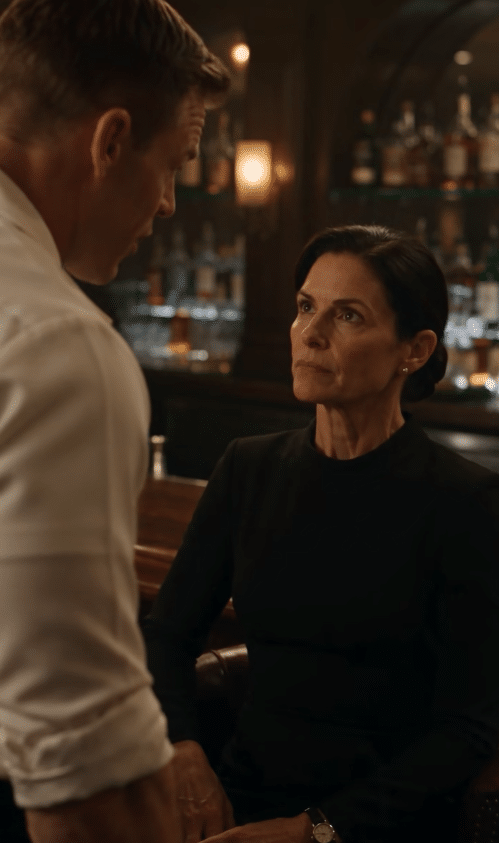
Her black hair was gathered into a low bun, and a silver watch rested against her wrist. She wore a simple long-sleeved black dress and dark heels, with none of the visible insignia or decorations that might have encouraged him to treat her differently. She had been sitting quietly near the end of the dark wooden counter, enjoying the relative peace after a formal military event.
“I’m comfortable here.”
Her answer was calm enough to make him feel that she had dismissed him.
The Lieutenant Colonel’s name was Andrew Cole, and he had spent years cultivating a particular reputation among the people around him. He liked to be seen as decisive, influential, and impossible to challenge. At formal events, he made certain that junior officers noticed his rank. At social gatherings, he expected people to recognize his importance before he had to explain it.
The woman had done neither.
Cole glanced at her dress, her watch, and the empty space beside her. He decided she was an officer’s wife who had wandered into a place where she did not belong.
That assumption gave him permission, in his own mind, to treat her however he pleased.
He picked up his whiskey glass.
For an instant, a few nearby officers seemed to believe he intended to take another drink. Then Cole threw the whiskey directly into the woman’s face.
The liquid struck her eyes and cheek. She flinched, blinking against the sting, as he brought the glass down hard against the floor. It shattered with a sharp crash that silenced the nearest tables.
Several patrons turned.
Cole stepped toward her and slapped her across the face.
The sound cracked through the room.
Her head turned with the force of the blow. Her cheek reddened and began to swell, while a thin trace of blood appeared at the corner of her mouth. Before she could fully straighten, Cole drove a powerful punch into her stomach.
The woman folded forward as the air left her lungs.
She dropped painfully beside the chair, one hand bracing against the floor while the other moved toward her abdomen. Her breathing became shallow and strained. She remained conscious, fighting through the sudden pain without crying out or pleading with him.
Around them, the bar froze.
A young officer near the leather chairs half rose, then stopped. Two men at the counter exchanged alarmed glances. Nobody physically intervened as Cole stood above the woman, apparently satisfied that he had made his point.
He looked down at her with a contemptuous smile.
“Learn where spouses belong.”
The woman slowly lifted her face.
Whiskey clung to her hair. Her cheek was swelling, and the corner of her mouth was marked with a faint line of blood. Yet there was no panic in her eyes, no desperate attempt to appease him.
Cole mistook her silence for defeat.
He had no idea that someone behind the bar had just recognized her face.
And the name that man was about to whisper would turn the entire room against Cole’s arrogance.
Act II
The bartender had been watching the confrontation from behind the dark wooden counter.
His name was Walter Hayes. He was sixty-six, gray-haired, and moved with the deliberate economy of someone whose body had learned the difference between wasted motion and necessary action. He wore a black bartender’s shirt beneath a dark apron, and he had spent enough years around military officers to recognize the many faces authority could wear.
He knew the loud ones.
He knew the insecure ones.
And he knew the rare people who never needed to announce their authority because everyone who mattered already understood it.
For most of the evening, Hayes had paid little attention to the woman in black. She had ordered a drink, chosen a quiet seat, and kept to herself. She had not attempted to join the conversations at the officers’ tables or draw attention from the people celebrating their careers.
There had been nothing theatrical about her presence.
That was why it took Hayes a moment to understand what his eyes were telling him.
When Cole threw the whiskey, the woman turned toward the bar. The movement brought her face fully into the amber light.
Hayes stopped wiping a glass.
He looked again.
The years had changed her. Her hair was different, and the lines around her eyes were deeper than they had been the last time he had seen her. But the expression was unmistakable: composed under pressure, watchful without appearing nervous, and utterly unwilling to let another person’s temper dictate her decisions.
Hayes felt an old memory rise with startling clarity.
He had not seen her in years. Not in person, at least. But he had heard stories from men who returned from demanding assignments with their voices lowered and their usual bravado stripped away. He had heard instructors refer to a certain woman with an odd mixture of respect and caution.
Some people had called her ruthless.
Others had called her a lifesaver.
The nickname had survived both descriptions.
The Undertaker.
Hayes had never liked the name. It sounded cruel, almost theatrical, and it failed to capture what the people who knew her had actually meant. They had used it for someone who could dismantle a failing operation, expose a weak commander, or bring an apparently unstoppable opponent to the end of their influence.
She did not threaten people into submission.
She made their excuses useless.
Hayes remembered a retired officer telling him that the nickname had begun during a period when several promising military careers had collapsed after their owners underestimated the woman responsible for evaluating them. Some had been removed from positions they were unfit to hold. Others had lost the protection of powerful friends when their failures could no longer be hidden.
The woman had not needed to shout.
She had simply made sure the truth reached the people who could act on it.
Over time, the stories grew. Every generation of instructors seemed to know someone who had trained under her, served beside her, or watched a confident officer walk into a room believing himself untouchable and leave with that confidence permanently altered.
Hayes had never assumed he would see her again.
Now she was on the floor of his bar, hurt and drenched in whiskey, while a Lieutenant Colonel congratulated himself on putting an apparent spouse in her place.
The sight made Hayes feel cold.
He looked at Cole, then at the broken glass scattered across the floor. He saw the officers who had witnessed the assault and the way their faces had changed. He saw the woman struggling to draw a comfortable breath without allowing the pain to control her expression.
She had not told Cole who she was.
She had not used her history as a shield.
And even now, she seemed more interested in keeping herself composed than in making him understand what he had done.
Hayes set the glass in his hand on the counter.
His fingers remained on its rim for a moment, as if he needed the familiar weight to steady himself.
Then he looked directly at the woman.
The nickname rose to his lips before he could stop it.
But when he finally spoke, it came out less like a label and more like the name of someone he had never expected to see alive and standing in front of him again.
Act III
“Undertaker…”
Hayes barely raised his voice.
He did not need to.
The single word crossed the short distance between the counter and the table, and the effect was immediate.
A retired Colonel sitting near the leather chairs turned so sharply that his chair scraped against the floor. He was seventy, silver-haired, and dressed in a dark blazer over a pressed shirt. He had been listening to another veteran recount an old deployment when the nickname reached him.
Now he stood rigidly beside his chair.
The officers nearest the bar noticed his reaction. One of them stopped reaching for his drink. Another lowered his glass without taking a sip. Across the room, a conversation ended in the middle of a sentence.
The change was subtle but unmistakable.
Nobody laughed at the nickname.
Nobody asked Hayes to repeat it.
Cole noticed the silence and looked around, irritated that the attention had moved away from him. He had expected the room to admire his dominance, or at least accept his version of the encounter without question.
Instead, the older men were looking at the woman.
Hayes had not explained anything. He had not announced a rank, recited a record of service, or claimed that the woman possessed any special authority. He had simply spoken two syllables of a name, and experienced people had reacted as though an old warning had suddenly become real.
Cole did not understand.
He only understood that he was losing control of the room.
He straightened his shirt and looked down at the woman again, trying to recover the superiority that had seemed so effortless moments earlier. His gaze lingered on her plain dress, her silver watch, and the lack of any visible insignia.
He wanted the nickname to be a joke.
He wanted the veterans’ reaction to be an embarrassing misunderstanding.
Most of all, he wanted the woman to remain exactly what he had decided she was: someone without the standing to challenge him.
So he laughed.
“What kind of stupid nickname is that?”
The words landed badly.
Hayes did not respond. The retired Colonel remained standing, his expression fixed on the woman with a seriousness that made Cole’s laughter sound increasingly hollow. Around them, the younger officers watched the exchange without speaking.
The woman shifted carefully beside the chair.
Her stomach still hurt. She could feel each guarded breath catch against the place where Cole had struck her, and the side of her face throbbed beneath the swelling. Whiskey had soaked the front of her dress, leaving the fabric cold against her skin.
She did not pretend that none of it mattered.
But she refused to let the pain become a performance for Cole.
She raised her eyes to him.
“One your instructors still whisper.”
The Lieutenant Colonel’s smile weakened.
The words had been delivered quietly, almost conversationally. Yet they reached deeper than a threat could have. She had not told him that she outranked him. She had not claimed to control his future or promised that someone would come to punish him.
She had made a simple observation about the people who had taught him.
Cole had spent years listening to instructors describe standards, discipline, judgment, and the consequences of failure. He had probably dismissed some of their older stories as exaggerated accounts of another era. Military institutions were full of legends, and most legends became less impressive when examined closely.
But he recognized something in the way Hayes had said the nickname.
The bartender had not sounded amused.
He had sounded stunned.
And the retired Colonel, a man whose own years of service had earned him the respect of everyone nearby, had stood as if he had suddenly found himself in the presence of someone he could not casually address.
Cole looked from one veteran to the other.
He wanted an explanation.
Neither man offered one.
The silence forced him to confront the one possibility he had been trying to avoid: the nickname was not famous because it sounded intimidating. It was famous because the people who knew its history still remembered what happened when its bearer entered a room.
The woman watched him make the connection.
Her expression did not change.
She had given him no reason to fear her when she first sat at the table. She had simply wanted to enjoy a quiet evening without being treated as an intruder. When he challenged her, she had answered calmly.
Then he had chosen to humiliate her.
Now the room was beginning to understand the difference between her restraint and his cruelty.
And Cole was discovering that the stories his instructors had whispered were not stories he could laugh away.
Act IV
The retired Colonel did not sit down.
That, more than anything, unsettled Cole.
The older man had been comfortable moments earlier, leaning back in his chair with a drink in hand. He had not been involved in the argument, and nothing about the evening had suggested that he intended to draw attention to himself.
Now he stood with his shoulders squared, looking toward the woman as though every casual assumption in the room had suddenly become dangerous.
Cole knew the man by reputation. Most people in the bar did.
He was the sort of retired officer whose opinions carried weight because he had never needed to demand it. He spoke infrequently, avoided empty displays, and had little patience for people who used rank to cover poor judgment.
If he recognized the woman, Cole reasoned, there had to be some explanation.
Perhaps she had once served in a demanding unit. Perhaps she had been involved in a celebrated training program. Perhaps the nickname belonged to someone else, and the resemblance had fooled Hayes.
Cole reached for any possibility that would restore the world to the shape he preferred.
But the woman’s words remained in his mind.
One your instructors still whisper.
His instructors.
He remembered a senior trainer who had once interrupted a class to warn them that confidence was not the same as competence. The instructor had spoken about people who could recognize a bad decision before it became a disaster, and about leaders who mistook the willingness of others to obey them for proof that they were right.
There had been a name attached to that lesson.
Not spoken loudly. Not written on the board. It had been mentioned in passing, followed by a brief pause and a warning that the story was not to be reduced to a joke.
Cole had been younger then, eager to prove himself, and more interested in the careers of officers who had advanced than in the reasons others had failed. He had not asked questions.
Now the memory returned with an uncomfortable sharpness.
He looked at the woman’s face.
She was older than the image he remembered from the story, but the eyes were the same. He recalled the way his instructor had described them: steady, observant, and almost impossible to read when a person began making excuses.
Cole had never met the woman from the story.
He had never expected to.
He had certainly never imagined that she might be sitting quietly in an officers’ bar, wearing a plain black dress, while he threw whiskey in her face and struck her in front of a room full of witnesses.
He glanced at Hayes.
The bartender remained behind the counter, his expression grave. There was no triumph in his face, no satisfaction at seeing Cole’s confidence crack. He looked like a man who had watched an old chapter of military history open in a place where it should never have been reopened.
The retired Colonel’s attention had not shifted.
Neither had the woman’s.
Cole suddenly became aware of the broken glass on the floor, the whiskey spreading across the boards, and the people who had witnessed the assault. A few moments earlier, he had believed the room would protect him through habit. People knew his rank. They knew his confidence. They knew the social rules that often encouraged subordinates to look away when a powerful officer behaved badly.
But those rules had depended on everyone agreeing that he was the person whose judgment mattered most.
That agreement was gone.
No one had ordered the room to turn against him. No one had threatened him. Nobody had announced that the woman was more powerful than he was.
The truth had emerged through recognition alone.
Cole looked back at the woman.
She was still beside the chair, carefully managing her breathing. Her cheek had swollen further, and a faint mark remained at the corner of her mouth. Yet she carried herself with the same controlled dignity she had shown before he touched her.
She had not demanded that anyone stand for her.
She had not asked Hayes to tell the story.
She had not even used the nickname until he forced the room to hear it.
That was what finally frightened Cole. The woman was not trying to impress him. She was not playing a game of status. She had no need to manufacture an image of herself, because the people who recognized her already knew what the name meant.
He had mistaken her quietness for permission.
He had mistaken her lack of visible rank for a lack of standing.
And he had mistaken the absence of an immediate response for proof that there would be no consequences.
Cole’s face lost its color.
The retired Colonel remained motionless, his expression carrying the weight of recognition. Hayes stood behind the counter, watching with careful attention. Around them, the younger officers waited, no longer looking to Cole for direction.
The woman slowly lifted her chin.
She did not smile.
There was no need.
The man who had thrown whiskey into her face had begun to understand that he had assaulted someone whose name had outlived the circumstances that created it. Someone whose reputation had been preserved not by publicity, but by the memories of people who had served, trained, and survived alongside her.
Cole opened his mouth, then closed it.
For the first time that evening, he had no insult ready.
Only a question he was almost afraid to ask.
Act V
The bar remained silent.
No one rushed forward to explain the nickname. No one delivered a speech about the woman’s career or listed the people whose respect she had earned. The room did not need a history lesson to understand that something had changed.
Hayes still watched her from behind the counter, his expression caught between disbelief and a deep, quiet respect.
The retired Colonel stood beside his chair, shoulders rigid, as if the years had briefly fallen away and he were facing a person he had once believed belonged only to memory.
Cole noticed all of it.
He also noticed what was missing.
The woman had not asked anyone to defend her. She had not pointed at the broken glass or demanded that the witnesses describe what he had done. She had not threatened to ruin his career or insisted that his rank be stripped from him.
She had not even raised her voice.
That restraint made it impossible for him to dismiss her as someone seeking revenge.
She was simply allowing him to understand the situation he had created.
Cole looked down at the floor, where the shattered remains of his glass lay among the spreading whiskey. The scene seemed absurdly small compared with the realization taking shape in his mind. A few minutes earlier, the glass had been a prop in his display of power. He had thrown the drink because he believed humiliation would force the woman to accept the place he had assigned her.
Instead, the act had exposed him.
The whiskey on her dress was no longer evidence that he controlled the room. It was evidence of how carelessly he had used his position against someone he had never bothered to understand.
He remembered the instructors who had spoken of the Undertaker.
They had never described her as a person who shouted the loudest or demanded obedience from everyone around her. They spoke of judgment. Of precision. Of an ability to identify the exact weakness in a plan or a leader and force it into the open.
Cole had assumed those stories belonged to another generation, to a military world that no longer existed.
Now he understood why the name had survived.
The woman’s reputation had not depended on her being physically imposing, publicly celebrated, or instantly recognizable. It had depended on what happened when people underestimated her and discovered, too late, that she had been paying attention all along.
She had noticed the mistake in his behavior long before he noticed the mistake in his assumptions.
And she had never needed to tell him who she was.
The woman placed one hand against the chair and shifted carefully, still guarding her injured abdomen. Her face remained composed, though the swelling in her cheek was unmistakable. She did not attempt to hide the pain or turn it into a spectacle.
Her gaze settled on Cole.
He could not tell whether she was angry with him, disappointed in him, or simply assessing what kind of man he had revealed himself to be. That uncertainty was worse than any shouted accusation.
He wanted to return to the beginning of the evening, before the whiskey had left his hand, before the glass had shattered, before the first blow had made every excuse impossible.
He wanted to tell himself that he had misunderstood her.
But he had not misunderstood anything she said.
She had been comfortable at the table. She had refused to move simply because he ordered her to. She had done nothing to justify what followed.
The humiliation had been his choice.
And now the truth was visible to everyone who mattered.
The retired Colonel remained standing. Hayes did not look away. The younger officers watched Cole with an expression that held no admiration, only the sober recognition of people who had seen a senior officer abandon his own standards in public.
The woman did not offer him an escape.
She did not need to.
Cole finally understood that the nickname was not a threat she had invented for the occasion. It was a name carried by years of experience, by difficult decisions, and by the memories of people who knew what she was capable of when circumstances demanded it.
His instructors had whispered it because they remembered.
Hayes had spoken it because he recognized her.
And Cole had mocked it because he had no idea what it meant.
Now the realization settled over him, heavier than the silence around the bar. His eyes widened, his breathing grew shallow, and every trace of the confidence he had displayed at the beginning of the evening disappeared.
He stared at the woman in black, unable to reconcile the quiet figure beside the chair with the legend he had spent years hearing about without ever believing he would encounter.
His voice came out thin, almost disbelieving.
“You trained them…?”