Act I
“Teach your kid some manners.”
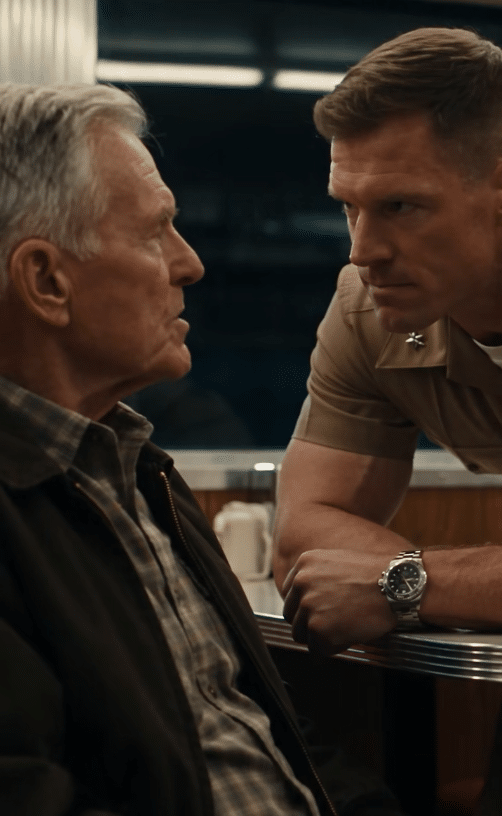
Brigadier General Daniel Cross stood beside Booth Six, his expensive watch glinting beneath the diner’s harsh fluorescent lights. His charcoal jacket was immaculate, his expression openly hostile, and his attention fixed on an older man sitting quietly with a ten-year-old girl.
A glass of soda had spilled across the floor near the booth. Daniel’s twenty-year-old son stood a few feet away, his hands tucked awkwardly into his pockets, avoiding his father’s eyes.
Everyone who had been watching knew who had caused the spill.
Daniel didn’t care.
The girl, Emily, had been telling her grandfather about a school project when the drink went over. She had immediately pulled her legs away from the spreading liquid, startled by the crash of the glass against the table edge. She had done nothing to provoke anyone, but Daniel had already decided that someone needed to be humiliated.
And the old man looked like an easy target.
He wore a flannel shirt beneath a dark canvas jacket, khaki trousers, and scuffed brown boots. His short silver hair and weathered face suggested a lifetime outdoors, not the kind of man Daniel expected to find among the powerful people who populated his professional world.
There were no medals on his chest. No insignia on his shoulders. No entourage waiting outside.
Just an older man, a little girl, and two plates of diner food.
Daniel leaned closer.
“Teach your kid some manners.”
The old man looked at the spilled drink, then at Daniel’s son.
Finally, he raised his eyes to the officer.
“You should start with yours.”
The words were quiet, almost conversational.
But they struck Daniel harder than an insult shouted across the room would have. A few veterans at the counter stopped eating. A waitress holding a coffee pot paused beside a table, sensing that the disagreement had become something more dangerous than a complaint about a spilled drink.
Daniel’s son looked down.
He knew his father’s temper. He had seen it at home, in parking lots, and during arguments that began over nothing and ended with everyone else apologizing.
He also knew the spill had been his fault.
“Dad,” he started, “I—”
Daniel silenced him with a glance.
The old man placed a protective hand near Emily’s shoulder, keeping her safely inside the booth. He did not stand to challenge Daniel, and he did not raise his voice. He simply waited, as though he expected an adult to recognize an obvious mistake and correct it.
Daniel mistook that patience for weakness.
He had spent years watching people react to his rank, and he had begun to believe that the authority attached to his uniform followed him everywhere—even when he wore civilian clothes.
Tonight, he intended to make sure everyone in the diner remembered who he was.
He just had no idea whose silence he was about to break.
Act II
Daniel reached across the table and grabbed a plate covered in gravy.
Before the old man could move, the Brigadier General flung the gravy across his face and chest. Brown sauce splashed against the flannel shirt and dark jacket, staining the fabric and dripping onto the booth seat.
Emily recoiled into the corner of the booth.
Her grandfather immediately shifted toward her, putting his body between the child and Daniel. He was more concerned about keeping her out of reach than about the food soaking his clothes.
Daniel slammed the plate onto the diner floor.
It shattered with a sharp crack.
A woman at the counter gasped. The waitress stepped backward, her coffee pot trembling in her hand. Several customers turned fully toward the booth, but no one moved between the two men while Daniel continued his attack.
He punched the old man hard across the cheek.
The older man’s head turned with the impact. His cheek reddened and began to swell, and a thin trace of blood appeared at the corner of his mouth.
Before he could regain his balance, Daniel drove a hard kick into his stomach.
The old man folded forward, losing his breath. He stumbled backward and fell painfully beside the booth, bracing himself with one hand as his shoulder and hip struck the floor.
For a moment, he remained there, breathing hard.
His face showed the pain. One arm guarded his stomach, and he took a careful breath before attempting to move. But he was conscious, alert, and still watching Emily.
“Grandpa?”
The girl’s voice was barely audible.
He looked toward her, signaling with his eyes that she should stay where she was. He would not allow Daniel to turn her fear into another weapon.
Daniel stood over him.
“Old men should know when to stay quiet.”
The contempt in his voice seemed to fill the little diner.
He glanced around, expecting the customers to avert their eyes. He had learned that most people would rather pretend they had seen nothing than risk angering someone powerful.
But the expressions around the room were changing.
The veterans at the counter were no longer simply uncomfortable. They were watching Daniel with the hard, focused attention of people who understood the difference between a man who could fight and a man who chose to attack someone who posed no threat.
Daniel’s son looked sick.
“Dad, stop,” he said, his voice breaking slightly.
Daniel turned toward him.
His son fell silent.
That single glance revealed more about their relationship than any argument could have. The young man had learned to fear his father’s displeasure long before he had learned how to stand up to it.
The old man slowly pushed himself upright.
He did not curse. He did not beg. He did not threaten Daniel with consequences he could not yet see.
He wiped the faint trace of blood from the corner of his mouth, then steadied himself against the booth. His breathing remained guarded, and his hand stayed near his stomach.
Daniel watched him with a smug, almost impatient expression.
He expected the old man to leave.
He expected the frightened granddaughter to follow, and the diner to return to its coffee, late-night breakfasts, and quiet conversations.
Instead, the old man reached into his jacket and took out his phone.
Something about the movement made Daniel pause.
There was no frantic fumbling. No trembling fingers. No hurried attempt to find a contact while pleading for help.
The man looked at the screen, made a call, and lifted the phone to his ear.
Then he spoke six words that Daniel could not understand.
Not because they were complicated.
Because they sounded like an order from someone who expected it to be carried out.
Act III
“Mason Diner. Booth Six. Five minutes.”
The old man ended the call.
That was all.
No name. No explanation. No mention of his injuries or the man standing over him. He did not even look at Daniel while he put the phone away.
He simply returned his attention to Emily.
Daniel stared at him.
For a moment, the Brigadier General seemed unsure whether to laugh or become angry again. The old man had just been assaulted in front of a room full of witnesses, yet he had made a phone call as casually as someone arranging a ride home.
Daniel had seen people call the police. He had seen men threaten lawsuits, claim connections, and promise to ruin someone’s career.
This was different.
The old man had offered no threat at all.
Daniel decided that meant there was nothing to fear.
“Call your whole retirement club.”
He laughed at his own joke, looking toward the counter to see whether anyone would join him.
Nobody did.
The silence irritated him. He straightened his jacket and checked his expensive watch, trying to make the gesture look casual. His son remained near the end of the booth, staring at the broken plate.
“Who did you call?” Daniel demanded.
The old man did not answer.
He was watching Emily instead, making sure she remained safely seated. The girl’s eyes were wet, but she was not crying. She looked at her grandfather’s swollen cheek, then at the stains covering his clothes.
He gave her a small, reassuring nod.
That gesture unsettled Daniel in a way the man’s words had not. Even after being struck and kicked, the old man’s attention was still on someone more vulnerable than himself.
Daniel had built his life around the assumption that power meant getting other people to respond to you.
This man seemed to operate by an entirely different rule.
Daniel took a step back and folded his arms.
“Five minutes,” he muttered, glancing toward the windows. “What are you expecting? A parade?”
His son finally looked at him.
“Dad, you need to leave.”
Daniel’s face tightened.
“You want to take his side?”
“I’m saying you hit him.”
“You saw what happened.”
“I saw you throw his food on him. I saw you punch him.”
The words came out before the young man could stop himself.
Daniel stared at his son, and for a moment the diner seemed to hold its breath again. The younger man had spent years learning when to speak and when to disappear. Now, for the first time that evening, he was looking directly at his father without immediately lowering his eyes.
Daniel turned away rather than answer him.
He had spent his career cultivating an image of discipline, confidence, and command. He believed people obeyed because they understood his authority.
He had never seriously considered that some of them obeyed because they were afraid.
Outside, headlights swept across the diner windows.
Daniel barely glanced up at first.
A vehicle had turned into the parking lot. Then another set of lights appeared behind it, followed by more.
Within seconds, the quiet roadside diner was filled with the sound of engines slowing in coordinated succession.
Daniel’s smile began to fade.
Through the glass, military vehicles were pulling into the lot.
Not a couple of off-duty soldiers in private cars. Not a group of retirees meeting for coffee.
A disciplined convoy was arriving in formation.
And it was stopping directly outside Booth Six.
Act IV
The first vehicle came to a halt beneath the diner’s weathered sign.
Another followed. Then another.
Their headlights swept across the windows before the engines settled into a low, steady rumble. Doors opened in quick succession, and uniformed personnel moved with the controlled precision of people who had been given a clear assignment.
Inside the diner, conversations died.
The waitress slowly set down her coffee pot. A veteran near the counter rose from his stool, staring through the glass. Even the customers who had not witnessed the assault understood that this was no ordinary late-night arrival.
Daniel stepped toward the window.
“What the hell is this?”
Nobody answered.
The central vehicle stopped closest to the entrance. Its door opened, revealing a polished shoe touching the pavement, followed by a decorated dress-uniform shoulder and a torso covered in ribbons and medals.
The camera never showed the officer’s face.
It did not need to.
The figure stepped out with measured confidence. Other personnel moved around the vehicle, maintaining their positions as the senior officer began walking toward the diner.
Daniel stared through the glass.
At first, he looked annoyed. Then he looked confused.
Finally, something changed in his expression.
His posture stiffened. His lips parted slightly, and his eyes tracked the decorated figure moving toward the entrance. His mind began racing through the names of senior officers he had encountered during his career, searching for the one person whose presence could explain the sudden arrival of an entire convoy.
The old man remained beside Booth Six.
He had not stood to watch the vehicles. He had not smiled at the sight of the uniforms or looked toward the door with anticipation.
He simply sat near Emily, his clothes stained with gravy, his cheek swollen, his breathing still careful.
He had made his call.
Now he waited.
Daniel turned away from the window and looked at him again.
For the first time, the older man’s ordinary clothing seemed almost impossible to reconcile with the scene outside. The flannel shirt, the canvas jacket, the brown boots—Daniel had treated those details as proof that the man was insignificant.
But no one brought a disciplined military convoy to a roadside diner because an insignificant person had asked for help.
The thought struck him with cold force.
He tried to reconstruct the last five minutes. The calm reply. The refusal to retreat. The phone call that contained no threat and no explanation.
And now the decorated senior officer was walking directly toward Booth Six.
Not toward Daniel.
Toward the old man.
Daniel’s son watched his father’s expression collapse. Whatever recognition was forming in the Brigadier General’s mind, it was powerful enough to erase the confidence he had worn like a second uniform.
The diner door opened.
The senior officer entered, but the framing remained tight: decorated shoulders, ribbons, hands, polished shoes crossing the floor. The face stayed beyond view.
The nearby veterans straightened instinctively.
No one announced a title. No one explained the connection. No one needed to introduce the old man to the room.
The senior figure moved directly toward Booth Six.
Daniel’s breathing grew shallow.
He had spent the evening believing that his current rank made him untouchable. He had attacked an older man because he assumed the man lacked the power to answer him.
Now he was looking at someone he recognized—and realizing that his own authority might not be enough to protect him from the consequences.
His face drained of color.
He took half a step backward.
The senior officer continued forward.
And suddenly, Daniel knew exactly why the old man had needed only six words to make the call.
Act V
The room seemed to narrow around Daniel.
The convoy remained outside, its personnel positioned with quiet discipline. Inside, the senior officer moved past the tables without acknowledging the watching customers, heading straight for Booth Six.
Daniel could no longer pretend that the arrival was a coincidence.
He knew the bearing. He knew the decorations. He knew the significance of a senior officer appearing in person rather than sending someone else to handle a matter that could have been addressed over the phone.
But the most frightening part was not the number of vehicles outside.
It was the direction in which the officer was walking.
Straight toward the man Daniel had just knocked to the floor.
The old man raised his eyes as the figure approached. There was no theatrical smile, no triumphant gesture, no effort to make Daniel suffer longer than necessary.
He looked tired.
He looked hurt.
And he looked entirely certain that he had made the right call.
Emily remained safely beside him, watching the decorated uniform approach. Her grandfather shifted slightly to give her more room in the booth, still placing her comfort ahead of his own injuries.
That small movement seemed to expose Daniel more completely than the convoy had.
He had attacked a man who had done nothing wrong. He had frightened a child. He had silenced his own son with a glance. And he had done all of it because he believed no one in that diner could make him answer for his behavior.
Now every witness had seen the truth.
The veterans at the counter had watched the assault. The waitress had seen the plate shatter. Daniel’s son had admitted what happened. The old man had called for help without threatening anyone or using his identity to avoid what came next.
There was no mystery about who had started the violence.
There was only the mystery of who Daniel had chosen to hurt.
The senior officer stopped beside Booth Six.
The camera remained below the shoulders. Medals glimmered beneath the diner lights, and polished shoes stood beside the broken plate. One hand moved briefly at the officer’s side, then settled again.
Daniel looked up.
Recognition completed itself.
Whatever calculation had been running behind his eyes disappeared. His mouth opened, but the words he had prepared—his excuses, his explanation, the familiar insistence that he had been disrespected—failed before he could speak them.
He had once believed that rank was a shield.
Now he understood that rank could also be a responsibility, and that the higher a person rose, the less acceptable it became to use authority as an excuse for cruelty.
The old man did not have to explain who he was.
The convoy had already answered the only question that mattered: someone with the power to respond had taken his call seriously.
Daniel glanced toward the window, then back at the unseen senior officer. His hands had gone rigid at his sides. The arrogance that had carried him into the diner was gone, replaced by the dawning realization that the next few minutes could alter the course of his career.
He looked once more at the older man.
The gravy-stained jacket. The swollen cheek. The guarded hand near his stomach.
And the calm eyes that had never once begged him to stop.
Daniel had mistaken restraint for helplessness.
He had mistaken age for weakness.
Most disastrously, he had mistaken the absence of visible rank for the absence of power.
Now, with the senior officer standing just beyond the edge of the frame, Daniel could no longer convince himself that he had attacked a nobody.
His face tightened. His breath caught.
“No… not him.”