Act I
“I didn’t touch that tray.”
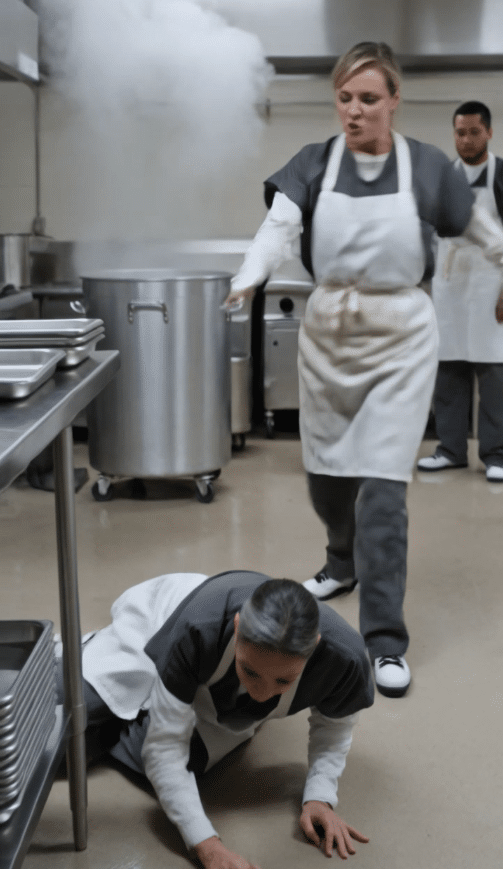
Margaret Ellis stood beside the stainless-steel kitchen table, one hand gripping its edge as spilled food slid across the wet floor. Metal trays clattered against one another, steam rose from the enormous cooking pots, and dozens of inmates turned toward the commotion.
Across from her, Denise Walker wore the satisfied expression of someone who had just made a problem disappear.
“Trash. You’ll say you dropped it.”
Margaret stared at her, struggling to understand how a tray that had been sitting safely on the table could suddenly become her responsibility. At fifty-four, she had spent enough time inside the prison to know that the truth did not always protect the person who spoke it. But she also knew that confessing to something she had not done could create consequences she might never escape.
“I didn’t touch it,” she repeated.
Denise stepped closer.
The forty-three-year-old inmate was one of the kitchen’s unofficial power brokers. She had a broad build, a stained apron, and the kind of confidence that came from years of watching other people surrender simply to avoid becoming her next target. She controlled small privileges among the kitchen workers, demanded extra portions, and had developed a habit of blaming weaker inmates whenever something went wrong.
Most people knew better than to challenge her.
Margaret had learned to keep her head down, arrive on time, and complete every assigned task carefully. Her salt-and-pepper hair was always tied neatly away from her face, and she treated the kitchen’s rules with almost excessive attention. She counted trays, wiped down surfaces, and checked her work before moving to the next station.
She had no interest in Denise’s unofficial hierarchy.
That morning, she had been arranging meal trays when Denise deliberately bumped the table. The metal surface shuddered, and one loaded tray slid sideways, spilling its contents onto the floor.
It happened too quickly for anyone nearby to react.
Then Denise began shouting.
She accused Margaret of being careless and demanded that she admit responsibility before a supervisor could investigate. The anger in her voice sounded convincing, but the urgency beneath it was harder to miss.
Margaret glanced at the scattered food.
Several portions appeared to be missing from the trays nearby.
She had noticed the discrepancy earlier, though she had assumed someone had miscounted during preparation. Now, with Denise insisting that she had caused the spill, Margaret began to understand why the older woman wanted the incident settled so quickly.
If the supervisor treated the spill as an ordinary kitchen mistake, nobody might examine the missing portions.
If Margaret confessed, the blame could end with her.
“I won’t say I dropped it when I didn’t,” Margaret said.
For an instant, Denise’s expression hardened.
She had expected fear. She had expected excuses, perhaps even an apology. She had not expected a quiet woman who rarely challenged anyone to refuse her directly.
“Do you think anybody here cares what you say?” Denise asked.
Margaret kept one hand on the table.
“I know what happened.”
Denise leaned in until Margaret could smell the stale coffee on her breath.
“Then you can learn what happens when you make things difficult.”
She stepped close and drove one hard, deliberate kick into Margaret’s chest.
Margaret lost her grip on the table and fell beside the metal trays. Her forearm struck the table edge, leaving a thin trace of blood on her skin. For a moment, the noise of the kitchen seemed to recede beneath the shock of the impact.
She tried to draw a steady breath.
Before she could regain her footing, Denise delivered exactly two more hard kicks into her back and side.
Margaret curled in pain, trying to protect herself while avoiding the scattered trays around her. Her apron twisted beneath her, and the wet floor made it difficult to find a stable position.
The kitchen workers froze.
One woman covered her mouth. Another took a hurried step backward. Even the supervising staff member near the serving station seemed momentarily stunned by the sudden violence.
Denise stood over Margaret, breathing hard.
“Kitchen mistakes belong to weak hands.”
She looked around as if daring anyone to disagree.
No one moved.
Then the kitchen door slammed open with a metallic crash that cut through the clanging pots.
A man in a navy inspection jacket entered beside the warden. His food-control identification badge caught the overhead light, and his eyes went straight to the spilled tray.
He did not rush toward Denise.
He did not touch her.
He simply stopped, studied the scene, and let the silence spread.
“That tray just spilled everything,” he said.
Denise’s expression changed.
The food service manager had not arrived to settle an ordinary dispute over a mess on the floor.
He had come to investigate a problem that someone had been trying very hard to keep hidden.
And the tray Denise had deliberately knocked over might have exposed far more than she ever intended.
Act II
Margaret Ellis had spent most of her adult life being the person others depended on.
Before prison, she worked in the cafeteria of a regional hospital in Ohio. She arrived before sunrise, prepared food for patients who could not tolerate ordinary meals, and learned to recognize the quiet details that made a difficult day easier for someone else.
She remembered which patients needed their trays cut into smaller portions. She knew who would ask for extra tea and who was too embarrassed to request help. When new workers struggled, Margaret showed them the routine without making them feel foolish.
The work was not glamorous, but she took pride in it.
Her life outside the hospital had been less orderly.
After a period of financial strain and family trouble, Margaret made a serious mistake involving money she was entrusted to manage. She had convinced herself that she could correct the problem before anyone noticed. Instead, the situation worsened, and her attempts to conceal it made the consequences more severe.
She was convicted and sent to prison.
Margaret did not pretend she had been blameless. She had broken trust, and she understood why people had been hurt. The hardest part was accepting that her intentions had not erased the damage.
Inside prison, she made a decision.
She could not undo what she had done, but she could control how she behaved from that point forward.
She followed instructions, took work assignments seriously, and tried to become someone whose word could be trusted. The kitchen suited her because its routines were familiar. Food preparation demanded attention, timing, and care. A careless count could leave someone without a meal, and a missed sanitation step could create problems far beyond the kitchen.
Margaret believed that doing the work properly mattered, even when no one was watching.
Denise Walker had a different philosophy.
She had been assigned to the kitchen long enough to learn its weak points. She knew which workers were afraid to complain, which supervisors were too busy to investigate every discrepancy, and how quickly a small mistake could become a disciplinary issue for someone with less influence.
Over time, she had turned those observations into a system.
She demanded portions from other workers, calling them the price of keeping the peace. She took items that were supposed to be distributed according to established counts, then used intimidation to discourage questions. If a discrepancy appeared, she searched for someone who could be pressured into accepting the blame.
The system worked because every individual incident seemed small.
A missing portion could be blamed on a counting error. An extra snack could be described as a misunderstanding. A frightened worker who denied knowing anything might appear suspicious simply because she was nervous.
Denise knew that people often judged confidence before evidence.
She had built her reputation around that fact.
Margaret had noticed inconsistencies in the kitchen for several weeks. Portions sometimes disappeared between preparation and distribution. Counts changed after certain workers handled the trays, and the people who asked questions tended to become targets of Denise’s anger.
Margaret did not immediately report what she suspected.
She was cautious about accusing anyone without proof. She also understood that prison kitchens were busy environments where honest mistakes could happen. She began keeping careful notes of the counts assigned to her station and making sure her own records matched the trays she prepared.
It was a quiet form of self-protection.
Denise noticed.
One afternoon, she asked Margaret why she was checking the numbers twice.
“Because the counts need to be right,” Margaret answered.
Denise laughed.
“It’s prison food. Nobody’s running a restaurant.”
“People still need their meals.”
The answer irritated Denise more than an argument would have.
To her, Margaret’s carefulness looked like judgment. She assumed that the older woman was gathering information to make herself look better or to get someone else into trouble.
Denise began assigning Margaret the least convenient tasks. She criticized her pace, mocked her habit of checking trays, and warned other workers not to trust someone who acted as if she were better than the rest of them.
Margaret continued working.
She did not consider herself better. She simply knew what it felt like to lose the trust of others and did not want to repeat the same mistake by becoming careless with responsibilities that affected people beyond herself.
Then the missing portions became more frequent.
Denise grew increasingly aggressive about preventing anyone from examining them. She began using the threat of retaliation to keep workers quiet, especially those who handled the trays closest to her station.
The morning of the assault, she deliberately bumped the table after noticing Margaret checking the count.
The spilled tray gave her a convenient distraction.
She could accuse Margaret of carelessness, insist that the incident required an immediate confession, and discourage a closer look at what was missing.
She believed the commotion would cover her tracks.
But she had overlooked one important change in the kitchen.
The prison’s food service program had recently begun a more detailed review of portion counts, waste reports, and distribution discrepancies. The review was not designed to punish workers for every accidental spill. Its purpose was to determine whether food was being handled properly and whether the recorded quantities matched what was actually prepared and served.
The food service manager, Thomas Hale, had already found irregularities in the records.
Several reports showed unexplained differences between prepared portions and distribution totals. Some discrepancies were small. Others appeared repeatedly around the same work shifts.
Hale had asked for supporting records and planned an inspection with the warden.
He had not yet identified the person responsible.
Then the incident in the kitchen gave him a scene that demanded immediate attention.
The tray lay overturned on the floor.
Margaret was injured beside it.
And Denise, who had been trying to force a confession from the woman who kept the counts, was suddenly standing in front of the very person investigating the missing food.
Act III
Thomas Hale had worked in institutional food service for more than twenty years.
He had managed school kitchens, hospital meal programs, and correctional facilities where thousands of meals had to be prepared under strict rules. He understood that food service was not simply about cooking. It required accurate inventory, consistent portion sizes, sanitation, and reliable records.
In a prison, those responsibilities carried particular weight.
Inmates had limited choices about what they ate, and the people preparing their meals had a duty to follow established standards. Food could not be treated as a private reward for the powerful or as a resource to be taken from those too frightened to object.
Hale had seen honest errors before.
He knew that a tray could spill, a count could be entered incorrectly, or a delivery could arrive short. Such problems required investigation, but they did not automatically imply wrongdoing.
The pattern he had been reviewing was different.
The same kinds of discrepancies kept appearing. The explanations varied, but the records did not always support them. Some workers seemed to know more than they were willing to say, and several incidents had been dismissed without enough documentation to establish what happened.
Hale had requested a closer review of the relevant logs and distribution procedures.
The warden had agreed to accompany him during an inspection of the kitchen.
Neither expected to walk into an assault.
When the door opened, Hale saw Margaret on the floor and the tray scattered beside her. He noticed the thin trace of blood on her forearm, the workers standing rigidly around the station, and Denise positioned above the woman she had attacked.
The scene told him that this was no longer merely an inventory problem.
He looked at the tray again.
“That tray just spilled everything.”
His words were deliberate.
He was not claiming that a single spill proved every suspected act of theft. He was acknowledging that the incident had brought several questions together in one place: the missing portions, the pressure on Margaret to confess, the violence used when she refused, and the kitchen’s apparent fear of challenging Denise.
The warden ordered the immediate response to the assault to begin. Margaret needed medical assessment, the area had to be secured, and the witnesses would need to provide their accounts through the appropriate process.
Hale asked that the tray and the surrounding records be preserved for inspection.
Denise stared at him.
“Spilled what?”
She sounded offended, as if he had accused her of something ridiculous.
Hale did not answer immediately.
Instead, he asked the supervising staff member to explain what had happened before he entered. The staff member hesitated, then began describing the spill and Denise’s demand that Margaret take responsibility.
Other workers were asked what they had observed.
Their fear was obvious. Several glanced toward Denise before speaking, as though they expected her to punish them later for saying anything that contradicted her story.
That reaction was itself important.
Hale had come looking for discrepancies in food records. Now he was seeing signs that the people working under the kitchen’s informal hierarchy might not feel safe reporting them.
He turned to Denise.
“Why did you need her to confess before anyone checked the count?”
Denise’s mouth tightened.
“She dropped the tray.”
“Margaret says she didn’t touch it.”
“She always has an excuse.”
“That isn’t an answer.”
Denise looked toward the scattered portions and then back at Hale. Her confidence depended on controlling the conversation, but the manager was not arguing with her about who deserved respect. He was asking specific questions that could be checked against records and witness statements.
She tried to shift the focus.
“Kitchen mistakes happen. You can’t make a whole investigation out of a spilled tray.”
“Agreed,” Hale said. “A spill by itself isn’t proof of anything.”
For the first time, Denise looked less certain.
Hale continued.
“But the missing portions were already under review. So were the discrepancies in the records. And now we have an assault connected to an attempt to force another worker to accept blame.”
He gestured toward the tray.
“The spill is evidence of what happened here. The records will tell us what happened before it.”
Denise’s face lost color.
She had expected the tray to end the questions. Instead, it had become a reason to examine the surrounding events more closely.
Hale instructed staff to preserve the relevant meal counts, preparation sheets, waste reports, and distribution logs. Any available camera footage would be reviewed according to prison policy, and the statements of the workers present would be documented.
No one was asked to invent a story.
No one was promised that a particular person would be punished before the evidence had been examined.
That restraint made the situation more dangerous for Denise, not less.
She could no longer rely on a dramatic argument to drown out the details. The investigation would depend on records, observations, and whether the explanations matched.
Margaret was helped away from the kitchen station and sent for medical assessment.
As staff approached, she tried to push herself upright, but pain in her chest and back forced her to stop. She looked at the scattered trays, then at the people standing around her.
“I told her I didn’t touch it,” she whispered.
A staff member reassured her that her statement would be recorded.
Margaret nodded, though she still looked frightened.
For weeks, she had been trying to avoid a confrontation. Now she was injured, the kitchen had been disrupted, and everyone had witnessed what Denise could do when challenged.
But the inspection had changed one crucial fact.
Margaret was no longer the only person insisting that something was wrong.
The manager had questions of his own.
And the answers would not depend on Denise’s willingness to provide them.
Act IV
The investigation did not end with the kitchen door closing behind Margaret.
The assault and the food discrepancies were handled as related but distinct matters. One concerned the deliberate violence against an inmate. The other concerned whether food portions had been improperly taken, whether the records accurately reflected distribution, and whether workers had been pressured to conceal discrepancies.
Keeping the inquiries separate was essential.
A person could not be found responsible for missing food simply because she had assaulted someone. Nor could the assault be dismissed because the food records eventually turned out to contain an ordinary mistake.
Each question required evidence.
Medical staff documented Margaret’s injuries and arranged follow-up care. Her forearm had a superficial scrape from striking the table edge, leaving only a thin trace of blood. The examination also recorded her complaints of pain in her chest, back, and side.
Margaret remained conscious and was able to describe what had happened.
Her account was consistent with what the kitchen workers had seen: Denise had deliberately bumped the table, demanded that Margaret take the blame, and attacked her after she refused to lie.
The supervising staff member’s statement provided another account of the confrontation. The other workers were interviewed individually so they could describe what they had witnessed without having to speak in front of Denise.
At first, several gave short answers.
They were afraid.
Denise had spent months teaching them that challenging her would make their own lives harder. Some had lost portions they were supposed to receive. Others had been threatened with blame for mistakes they had not made. A few admitted they had remained silent because they did not want to become the next person she targeted.
Once the interviews were conducted separately, the accounts began to reveal a clearer pattern.
Workers described being pressured to hand over extra portions. They recalled unexplained differences in the meal counts and instances when Denise had insisted that someone else had made an error before the records were checked.
These statements did not, by themselves, settle every question about the missing food. Investigators still had to compare the accounts with the kitchen records and available footage.
But they gave the discrepancies context.
Hale reviewed the preparation sheets, inventory totals, and distribution logs. He examined which workers had been assigned to the relevant stations and whether the recorded quantities matched the meals prepared.
Some discrepancies had straightforward explanations. A spill, a damaged tray, or a counting error could account for a difference in a particular shift.
Others required closer scrutiny.
The review also examined whether reports had been completed properly and whether staff had dismissed complaints without documenting them. The goal was not to create a convenient villain. It was to establish what had happened and identify any weaknesses that had allowed the problem to continue.
The warden oversaw the institutional response and ensured that the assault was referred through the appropriate disciplinary procedures.
Denise was removed from her kitchen assignment while the relevant matters were reviewed. She could no longer use her position among the kitchen workers to influence the immediate situation or approach Margaret as though nothing had happened.
For Denise, that loss of control was more unsettling than an argument.
She had always assumed that people would stay quiet if she made the cost of speaking seem high enough. Now the records were being examined by people she could not intimidate, and the witnesses were being heard separately.
She tried to insist that the kitchen had always operated this way.
But routine did not make misconduct acceptable.
If food had been taken improperly, the fact that it had happened repeatedly would not excuse it. If workers had been threatened, the fact that they had complied would not make their consent genuine.
And if Denise had assaulted Margaret to force her to accept blame, that act would have to be considered on its own terms.
The review did not produce an instant, theatrical verdict. There were interviews to complete, records to compare, and formal procedures to follow.
But the direction of the inquiry had changed.
Margaret’s refusal to confess had forced the incident into the open. The spilled tray had brought the food service manager to a scene he could not dismiss, and the records he was already reviewing gave him a reason to look beyond the surface explanation.
Meanwhile, Margaret faced a different kind of struggle.
She worried that the confrontation would make her seem difficult. She worried that her injury would keep her from returning to work and that her refusal to lie would somehow become another mark against her.
Those fears were familiar.
For much of her life, Margaret had believed that keeping the peace was the safest way to move through the world. Even after taking responsibility for her own past mistakes, she had sometimes confused accountability with accepting every accusation made against her.
The kitchen incident forced her to separate those ideas.
She could admit the wrong she had done in her own life without accepting responsibility for Denise’s choices.
She could respect prison rules without pretending that violence was an acceptable way to enforce them.
And she could tell the truth even when doing so frightened her.
When Margaret was cleared to return to her duties, she learned that the kitchen’s counting and reporting procedures were being reviewed. The changes were practical rather than dramatic: clearer documentation, more consistent checks, and a stronger expectation that discrepancies be reported instead of quietly assigned to whoever had the least power to resist.
No procedure could guarantee that no one would ever behave badly again.
But a system that relied on silence was being forced to confront its own weaknesses.
Hale continued to follow the evidence wherever it led.
And Denise, who had once used the kitchen’s confusion as cover, now faced a question she could not answer by intimidating another worker.
What would the records show when no one was allowed to change the story?
Act V
The final findings emerged gradually.
The review confirmed that the assault had occurred as described by Margaret and the witnesses. The disciplinary process addressed Denise’s violence through the prison’s established procedures, while the food service investigation assessed the missing portions and the irregularities in the kitchen records.
The two matters were documented separately, but together they revealed a troubling pattern.
Denise had used fear to control other workers, and that control had helped prevent concerns from being raised openly. The investigation identified weaknesses in how discrepancies had been reported and followed up, prompting changes intended to make the process more transparent.
The findings did not mean that every missing portion could be attributed to Denise. Investigators distinguished what the records established from what remained uncertain.
But Denise could no longer dismiss the entire matter as a harmless spill or a disagreement between inmates.
Her conduct had consequences.
The assault resulted in formal disciplinary action, and her kitchen assignment was not simply restored as though nothing had happened. The food service review also affected how her behavior and access to kitchen responsibilities were assessed.
There was no magical announcement that one sentence had canceled her future. Her sentence and any future release decisions remained matters for the proper authorities.
What changed was the evidence available to them.
Denise had wanted Margaret to confess because a confession would have made the problem easy to explain. An older worker had supposedly made a careless mistake, a tray had spilled, and a routine disciplinary response could have ended the matter.
Instead, Margaret had refused to accept a lie.
That refusal allowed the investigation to move beyond the convenient story Denise had tried to create.
For the first time in a long while, the kitchen workers saw that speaking honestly did not have to mean standing alone. They had watched Margaret get hurt while the room froze around her. They had also watched the warden and the food service manager take the incident seriously without promising an outcome before the facts were established.
It was not instant justice.
It was something less dramatic and more useful: a process that no longer depended entirely on the person with the loudest voice.
Margaret returned to work carefully.
For a while, every metallic clang made her tense. The sound of a tray sliding across a table brought back the moment she had fallen beside the counter. She found herself watching the people around her more closely, wondering whether another ordinary shift might suddenly turn dangerous.
She did not pretend the fear disappeared overnight.
But she also did not let Denise’s actions convince her that careful work was pointless.
When she returned to the tray station, she checked the counts as she always had. She followed the revised reporting procedures and made sure the numbers matched before signing off on her part of the work.
The difference was that she no longer felt she had to keep every concern to herself.
A supervisor reviewed the discrepancies she reported. When a count did not match, the issue was documented and checked rather than automatically blamed on the nearest worker. The process was still imperfect, but the expectation had changed: questions were to be answered with evidence, not threats.
One morning, a new kitchen worker made a counting mistake and began apologizing before anyone had accused her of anything.
Margaret noticed the fear in the younger woman’s face.
“Let’s check it again,” she said.
The worker looked surprised.
“You’re not going to report me?”
“If we find a mistake, we’ll correct it. If we don’t know what happened, we’ll find out.”
Margaret heard her own words as she spoke them.
They were simple, but they represented something she had struggled to understand herself. Responsibility was not the same as accepting blame for everything. Doing the right thing did not require a person to remain silent when someone else behaved wrongly.
The younger worker checked the numbers with her.
They found the error, corrected the count, and moved on.
No one was humiliated. No one was threatened. The kitchen continued running, and the next set of trays was prepared.
That ordinary moment meant more to Margaret than she expected.
It showed her that accountability could exist without cruelty.
She thought about the mistakes that had brought her to prison and the people who had suffered because of her decisions. She could not change those events, and she did not want to pretend that her own pain made them less serious.
But she could learn from them.
She could become more honest about what she had done, more careful with the responsibilities she was given, and more willing to speak when something was wrong.
Denise had treated weakness as an invitation to take what she wanted. Margaret had once treated silence as the safest way to survive. Both had believed, in different ways, that the person with the least power would simply have to accept what happened.
The investigation had challenged that belief.
It had not made prison gentle. It had not erased Margaret’s conviction or turned the kitchen into a place without conflict. It had shown that even in a tightly controlled institution, the difference between a cover-up and accountability could begin with one person refusing to repeat a lie.
Months later, Margaret remembered the food service manager’s words as clearly as she remembered the impact that had sent her to the floor.
“That tray just spilled everything.”
At first, she had thought he meant the scattered food.
Now she understood the deeper meaning.
The tray had exposed the pressure behind the forced confession. The forced confession had revealed how Denise used fear. And the investigation had shown that the missing portions were not merely a problem of arithmetic; they had become part of a system in which some workers believed they could take what they wanted and make someone else pay for it.
Denise had tried to make Margaret’s refusal look like weakness.
Instead, it became the point at which the story stopped belonging to Denise.
Margaret still carried the memory of the assault. She still had difficult days, and she still had to work toward a future that would not be simple when she left prison.
But she no longer believed that protecting her dignity required her to win every confrontation.
Sometimes it meant staying calm.
Sometimes it meant keeping an accurate record.
And sometimes it meant looking directly at someone who expected obedience and saying, quietly, “I didn’t touch that tray.”
Because the truth had not made Margaret invulnerable.
It had done something more important.
It had given the people responsible for investigating the problem a reason to look—and once they began looking, the woman who had counted on everyone else’s silence could no longer control what they found.