Act I
“I need that paper to graduate.”
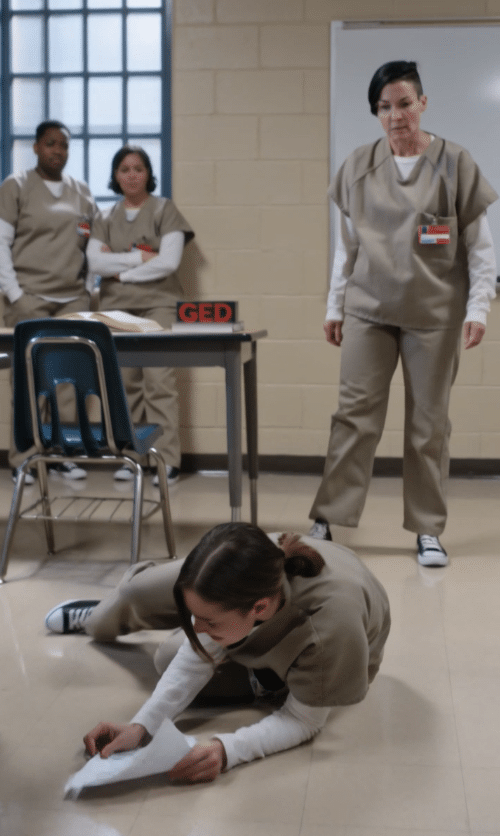
Emily Carter stood beside a bolted classroom desk, staring at the torn corner of her GED graduation essay in another woman’s hand. The teacher had praised the work only moments earlier, calling it one of the most thoughtful pieces submitted that semester. Now the paper was crumpled between the fingers of someone who seemed determined to destroy more than a few handwritten paragraphs.
Vanessa Reed smiled without warmth.
“Trash. You don’t get a future.”
The prison education classroom fell silent.
Muted daylight filtered through narrow security windows, illuminating the whiteboard at the front of the room. GED preparation books lay open across the desks. A few pencils rolled near the edge of a table, and the teacher stood motionless, caught between the instinct to intervene and the fear that one wrong movement might escalate the confrontation.
Emily was twenty-four, with brown hair tied low and a gray uniform that hung loosely from her thin frame. She held the remaining pages of her essay against her chest, staring at the torn corner Vanessa had just ripped away.
It was not an expensive piece of paper.
It was the result of months of work.
Emily had spent evenings studying after exhausting days inside the facility. She had rewritten paragraphs until the sentences made sense, checked spelling she once would have been too embarrassed to ask about, and learned how to organize her thoughts without assuming that every mistake meant she was incapable.
The essay was part of her final GED coursework. Graduation would not erase her conviction or guarantee a job when she was released, but it would give her something she had not possessed in years: evidence that she could finish what she started.
Her teacher had recognized that effort.
Vanessa had noticed it, too.
That was the problem.
Vanessa was thirty-five, with short black hair, a hard expression, and a reputation for resenting anyone who appeared to be moving forward. She had been in prison long enough to understand the daily routines and long enough to become bitter about the people who found ways to make those routines mean something.
She watched other inmates attend classes, earn certificates, and talk about their plans for life beyond the walls. Each small achievement seemed to irritate her. She dismissed students as pretentious, mocked anyone who studied during free time, and treated hope as a kind of foolishness.
In her mind, people who tried to improve themselves were pretending they were better than everyone else.
Emily had never claimed to be better than Vanessa.
She rarely spoke unless a teacher asked her a question. She kept her notes organized and avoided arguments. But when the teacher praised her essay, Vanessa had seen the admiration in the room and felt something tighten inside her.
She reached across the desk and snatched the paper.
Emily had barely reacted before Vanessa tore off one corner.
“Please,” Emily said, taking a step forward. “I need that paper to graduate.”
Vanessa held up the damaged essay.
“Graduate?” she repeated. “You think a piece of paper is going to turn you into somebody?”
Emily swallowed.
“I worked for it.”
“And you think that makes you special?”
“No.”
The answer was quiet enough that Vanessa almost seemed surprised by it.
Emily was not claiming that she deserved more than anyone else. She was asking to keep the work she had done.
Vanessa leaned closer.
“Then stop acting like you have something to look forward to.”
Emily reached for the torn corner after Vanessa let it fall. The small piece drifted to the floor beside a chair.
She bent down to pick it up.
Vanessa stepped away from a desk and drove one hard, deliberate kick into Emily’s upper back and shoulder.
Emily fell sideways against a chair. Her elbow struck the floor, leaving a thin trace of blood on the skin. For a moment, she could not understand how a classroom had become a place where she was afraid to move.
Before she could steady herself, Vanessa delivered exactly two more hard kicks into her back and side.
Emily curled in pain, breathing unevenly. She pulled the damaged essay against her chest, protecting the pages even as she struggled to sit upright.
Around them, students recoiled. Several covered their mouths. The teacher stood pale and rigid, while others stepped away from the desks, too frightened to intervene.
Vanessa looked down at Emily.
“Stay as broken as that paper.”
She seemed satisfied, as though she had finally restored the order she believed the teacher’s praise had disturbed.
Then the classroom door flew open and struck the doorstop with a sharp crack.
A man in a gray suit entered beside a parole board representative. The education program director wore an identification badge on his jacket, and his expression was so controlled that it made the sudden silence feel even heavier.
He looked at Emily on the floor.
Then he looked at the torn essay in her hands.
Finally, his eyes settled on Vanessa.
“You just tore up your own chance.”
Vanessa’s expression changed.
The confidence drained from her face, leaving confusion where contempt had been.
“My own chance?” she asked.
She had assumed the only future in danger was Emily’s.
She was about to discover that the director had not come to the classroom merely to admire a student’s essay.
He had come to evaluate something else entirely.
And Vanessa had just given him a reason to reconsider everything he thought he knew about her.
Act II
Emily Carter had not always believed that education could change her life.
Growing up in a small Pennsylvania town, she had been an average student who struggled to concentrate whenever trouble followed her home. Her mother worked long shifts at a care facility, and her father drifted in and out of her life, promising to do better before disappearing again.
Emily learned to hide embarrassment behind silence.
If she did not understand a lesson, she pretended she had not been listening. If she made a mistake, she laughed it off before anyone else could notice. When teachers encouraged her to ask for help, she nodded politely and hoped they would move on.
She was not unintelligent.
She had simply learned to associate needing help with being exposed.
As she got older, her life became increasingly unstable. She left school before completing the qualifications she needed, took temporary jobs, and fell in with people who offered quick solutions to problems that required patience.
Eventually, a series of bad decisions led to criminal charges and a prison sentence.
Emily did not tell herself that every consequence was unfair. She understood that she had made choices that hurt other people and that she could not undo them simply by regretting them.
But prison forced her to confront another truth.
If she spent every day believing that the worst thing she had done was the only thing she would ever be, she would have no reason to change.
The education program became her first serious attempt to challenge that belief.
At first, she enrolled because a staff member explained that completing the GED could improve her options after release. Emily imagined a certificate that might help her find a job, qualify for training, or convince an employer to look beyond the gaps in her education.
She did not expect to enjoy studying.
Then she discovered that she liked writing.
The first assignments were difficult. She struggled to organize her ideas and repeatedly erased sentences she thought sounded foolish. Her early essays were short, guarded, and filled with general statements that revealed little about what she actually believed.
Her teacher, Mr. Daniels, did not mock the work.
He asked questions.
What did Emily mean by a particular sentence? Why had she chosen one example instead of another? What did she want the reader to understand?
Slowly, she began to answer.
She learned that a rough first draft was not proof of failure. It was a place to begin. She learned to separate criticism of a paragraph from criticism of herself. Most importantly, she discovered that revising a piece of writing could be an act of patience rather than an admission of defeat.
Her graduation essay reflected that change.
It was about the difference between being defined by a mistake and being held accountable for it. Emily wrote about the temptation to use shame as an excuse to give up, and about how easy it was to confuse punishment with proof that a person could never become anything better.
She did not pretend that regret alone repaired the damage she had caused.
Instead, she argued that responsibility meant acknowledging the past while still doing the work required to build something different.
When Mr. Daniels praised the essay, he was not saying Emily had become a perfect person.
He was recognizing that she had learned to think carefully, express herself honestly, and complete a difficult task.
For Emily, that recognition mattered more than she wanted to admit.
She had spent years expecting people to look at her record and see nothing else. In that classroom, someone had read her words before judging the person who wrote them.
Vanessa Reed saw the same moment and interpreted it differently.
Before prison, Vanessa had once been an ambitious student herself. She had earned good grades in high school and believed she would eventually build a comfortable life. But after leaving school, she struggled with unstable relationships, money problems, and decisions that became harder to reverse the longer she avoided confronting them.
Over time, she began to resent people who seemed to recover from their mistakes.
She told herself that their success was temporary, that their plans were naive, and that anyone who spoke about the future was trying to impress somebody.
Prison hardened those beliefs.
Rather than enroll in classes, Vanessa mocked the people who did. She described educational programs as pointless distractions and insisted that a certificate would not change anyone’s life. When other inmates studied, she interpreted their concentration as arrogance.
Their efforts reminded her of possibilities she had stopped pursuing.
Emily’s essay brought that resentment to the surface because the teacher’s praise had given Emily something Vanessa could neither control nor dismiss: visible evidence of progress.
Vanessa could not make the essay poorly written simply by insulting its author.
So she tore the paper.
The act was small enough to perform in seconds, but its purpose was larger. She wanted Emily to feel that the future she was working toward remained subject to someone else’s permission.
When Emily bent to retrieve the torn corner, Vanessa escalated the humiliation into violence.
She expected the classroom to fall silent and remain silent.
In the past, that expectation had usually served her well.
But the education program was connected to a formal rehabilitation initiative that assessed more than academic performance. Staff also documented participation, conduct, and whether students demonstrated the ability to follow rules and work constructively with others.
Vanessa had enrolled in that initiative months earlier.
She had done so partly because she hoped it might strengthen her prospects for a future release review. She attended enough sessions to appear cooperative and had spoken confidently about wanting to make better choices.
The program director had been reviewing her progress.
He had not yet reached a final conclusion.
And now, after witnessing what happened in the classroom, he had a very different set of facts to consider.
Act III
The man in the gray suit was Daniel Mercer, director of the prison’s education and rehabilitation program.
Beside him stood Helen Brooks, a representative participating in a scheduled review of eligible program records for parole-related consideration. She was not there to make an instant release decision, and she had no authority to erase anyone’s sentence on the spot.
Her role was to examine relevant information, ask questions, and ensure that the records presented for review accurately reflected the circumstances.
The distinction mattered.
Rehabilitation programs were not supposed to be rewards for looking good in front of visitors. Their purpose was to help incarcerated people develop skills, demonstrate responsible behavior, and prepare for life beyond prison.
A GED certificate could be an important achievement, but it did not automatically establish that a person was ready for release. Likewise, one disciplinary incident did not automatically determine every future decision.
What mattered was the larger record.
Daniel Mercer had spent years working with incarcerated students who arrived convinced that their past had already decided everything about their future. He had watched people who initially refused to write a single paragraph gradually learn to complete assignments, accept criticism, and imagine practical goals beyond the prison walls.
He had also learned to be cautious.
Some students spoke beautifully about change but struggled to demonstrate it in their daily conduct. Others were quiet and awkward, yet steadily built habits that suggested genuine commitment.
The difference was rarely visible in a single speech.
It emerged over time.
Vanessa had been one of the students whose progress remained uncertain.
She attended sessions, completed some required work, and spoke about wanting a fresh start. On paper, those details looked promising. But there had also been concerns about her interactions with other inmates and her response to situations in which she did not get her way.
Those concerns had not been enough, by themselves, to settle the question of her progress.
Daniel had planned to discuss them during the review.
Then he arrived at the classroom and found Emily on the floor.
He saw the damaged essay and heard the room’s sudden silence. He did not need to know every detail of Vanessa’s history to recognize the immediate problem.
A student had been physically attacked after trying to protect her work.
The teacher confirmed that Emily had been praised for the essay before Vanessa seized it. Other students were present. The damage to the paper was visible, and the incident would be documented through the appropriate prison procedures.
Daniel turned toward Vanessa.
“You just tore up your own chance.”
He was referring to the opportunity Vanessa had been trying to establish through the rehabilitation program—not a guaranteed release date or a promise that one decision could control her entire sentence.
Vanessa looked at Helen Brooks, then back at Daniel.
“My own chance?”
Her voice had lost its sharpness.
Daniel did not raise his voice.
“We are here to review your progress. That includes how you respond when another person succeeds.”
Vanessa shook her head.
“She was acting like she was better than everyone.”
“Did she threaten you?” Helen asked.
Vanessa looked away.
“She was showing off.”
“By writing an essay?”
The question left Vanessa with no convincing response.
Emily remained seated near the chair, holding the pages against her chest. A staff member had begun arranging medical attention for her, and the teacher stood nearby, ready to provide an account of what he had witnessed.
Daniel approached Emily but stopped at a respectful distance.
“Are you hurt?”
“My elbow,” she answered. “And my back.”
“Medical staff will assess you. You don’t need to worry about finishing the paperwork right now.”
Emily looked down at the torn corner.
“I just wanted to turn it in.”
Daniel followed her gaze.
“We’ll make sure the damaged copy is documented. Your work can be preserved, and we’ll discuss what needs to happen for you to complete the assignment.”
Emily blinked, trying to hold back tears.
She had been so focused on keeping the essay intact that she had not considered what would happen if she could not.
The director did not promise that every deadline would disappear or that the assault would have no effect on her studies. He promised to review the situation and make sure the academic process did not treat the damage as Emily’s fault.
That was enough for the moment.
Helen Brooks asked the teacher to provide his account of the confrontation. She also made clear that the review would distinguish between verified facts and assumptions. Vanessa’s behavior needed to be assessed fairly, but fairness did not mean pretending that the assault was merely an argument between students.
Daniel then turned back to Vanessa.
“Your participation in this program is meant to demonstrate that you’re preparing for a different future,” he said. “That requires more than completing assignments when things are easy.”
Vanessa’s jaw tightened.
“So you’re saying I can’t get out because of this?”
“No,” Daniel replied. “I’m saying this incident will be documented and considered through the proper process. No one here is making a final decision about your release today.”
For a moment, Vanessa looked relieved.
Then he continued.
“But you should understand what the record will show. When another student received praise, you destroyed part of her work and assaulted her. That is directly relevant to the progress you claim to be making.”
The relief disappeared.
Vanessa had expected either a threat she could dismiss or a punishment she could argue against. Instead, Daniel was describing a record that would be examined by people who were not required to accept her version of events.
She glanced at Emily.
The younger woman was still holding the damaged essay.
For the first time, Vanessa seemed to realize that the paper had not been the real target. She had tried to break Emily’s belief that effort could lead somewhere, and in doing so, she had exposed her own inability to tolerate someone else’s progress.
The room remained silent.
And the formal review Vanessa had hoped would open a door to her future had suddenly become a much harder conversation.
Act IV
Medical staff examined Emily and documented her injuries.
Her elbow showed a superficial scrape with a thin trace of blood from striking the classroom floor. She remained conscious and responsive, though her back and side hurt after the kicks. Staff took her complaints seriously and arranged the appropriate follow-up rather than assuming she was fine because she could speak.
The torn essay was collected and documented as part of the incident record.
Daniel asked the teacher to retain any earlier drafts and notes that could help establish the state of Emily’s work before the confrontation. The teacher had seen the original essay and had already discussed its content with her. Those materials could help distinguish the damage Vanessa had caused from any academic issue that existed beforehand.
Emily was not required to prove her worth by pretending the assault had not affected her.
That was important because she immediately worried about graduation.
“I worked on it for weeks,” she told the teacher. “If I can’t turn it in, does that mean I fail?”
“No,” he answered. “We’ll review what happened and determine the appropriate way to handle the assignment. You aren’t responsible for someone else’s decision to destroy your work.”
Emily looked at him, unsure whether she was allowed to believe him.
For years, she had been accustomed to consequences arriving without much room for explanation. She expected a missed deadline to remain a missed deadline, even if the circumstances were beyond her control. She assumed that once a problem occurred, the person with the least power would have to absorb the loss.
This time, the people responsible for the program were treating the circumstances as relevant.
The classroom was secured while staff gathered statements and preserved the available evidence. Students were interviewed according to procedure, and the teacher provided an account of what he had seen before and after the assault.
Vanessa was separated from Emily while the incident was reviewed.
She tried to defend herself by saying that Emily had been acting superior. She insisted the essay was just a piece of paper and argued that the reaction was disproportionate.
But the facts did not support the idea that Emily had threatened her.
The teacher had praised the essay. Vanessa had taken it, torn a corner, and insulted Emily’s future. When Emily bent down to retrieve the torn piece, Vanessa had attacked her.
The sequence mattered.
It showed that the violence had not been an unavoidable response to danger. It followed a deliberate act of humiliation.
The prison’s disciplinary process would determine the appropriate consequences for the assault. The rehabilitation program would separately review what the incident revealed about Vanessa’s progress. Helen Brooks would consider the relevant information within the scope of her role, without treating a single event as an automatic decision about release.
That process offered no instant verdict on Vanessa’s future.
It did, however, remove the comfortable fiction that she could describe herself as a changed person while treating another inmate with cruelty whenever she felt threatened.
Vanessa’s earlier participation in the program was not erased. The work she had completed remained part of her record. But neither could the incident be ignored simply because she had once spoken convincingly about rehabilitation.
The review would have to consider both.
Over the next several days, Daniel met with the education staff to ensure that Emily’s academic progress was accurately recorded. The damaged essay was not treated as a failed assignment. Her earlier drafts, classroom participation, and the teacher’s observations helped establish the work she had completed before the assault.
Emily was given an opportunity to revise the damaged section and submit the final version through the program’s established process.
She did not receive a special grade simply because she had been attacked.
She received a fair opportunity to complete the work she had already been doing.
That difference mattered to her.
When she returned to class, the bolted desks looked exactly as they had before. The whiteboard carried a new lesson, and the narrow windows still let in muted daylight. But Emily felt every pair of eyes as she entered.
Some students offered her small nods. Others looked away, embarrassed that they had stood frozen during the assault.
Emily did not blame them for being frightened. She knew how quickly fear could take control of a room.
Still, she had to fight the urge to sit at the back and stop participating.
The torn essay had become a reminder of the worst moment in the classroom. For several nights, she could hear Vanessa’s words whenever she opened her notebook.
You don’t get a future.
At first, the sentence followed her into every assignment. She would write a paragraph, pause, and wonder whether there was any point in finishing it. She caught herself looking at the blank space on the page as if the future were something that could be taken away by a person who hated seeing her try.
Then she remembered what her teacher had said.
She was not responsible for someone else’s decision to destroy her work.
She read the essay again and began repairing the damaged section.
It was not easy. She had to rewrite several sentences and reconsider a paragraph that no longer flowed properly. The process took longer than she expected, and the final version was not identical to the original.
But it was hers.
Daniel continued reviewing Vanessa’s conduct alongside the other relevant information about her program participation. He did not treat her as irredeemable, nor did he pretend the assault was insignificant. If Vanessa wanted to demonstrate change, she would have to begin by acknowledging what she had done without blaming Emily for provoking it.
That was the test she had never anticipated.
Not whether she could talk about a better future.
Whether she could accept responsibility when doing so cost her something.
Act V
The consequences came through formal channels rather than a dramatic announcement.
The prison’s disciplinary process addressed the assault, using the available evidence and witness accounts to determine the appropriate response. The education program documented how the incident affected Vanessa’s participation, and the information relevant to her broader rehabilitation assessment was handled through the proper review procedures.
No one declared that Vanessa’s release was automatically canceled.
No single person in the classroom had the authority to promise that outcome, and the process would not be fair if it treated one incident as a substitute for examining the full record.
But Vanessa’s claim that she was preparing for a different future had been seriously challenged.
Her progress would now have to be considered alongside her behavior when she felt jealous, embarrassed, or unable to control another person.
She could no longer rely on a polished explanation about wanting to change while ignoring the evidence of what she had done.
For the first time, Vanessa faced the possibility that her greatest obstacle was not the prison, her sentence, or the people who refused to admire her.
It was the way she reacted whenever someone else gave her a reason to feel small.
She had watched Emily receive praise and treated it as a personal insult. She had seen another inmate succeed at something difficult and decided that success needed to be destroyed.
Then, when the consequences arrived, she had acted as though she were the victim of an unfair process.
It was the same pattern that had shaped much of her life: resentment, retaliation, blame, and the insistence that other people were responsible for the choices she made.
The program director had not ruined Vanessa’s future by walking into the classroom.
He had witnessed a moment that revealed how much work remained.
Meanwhile, Emily returned to her studies.
She revised the essay, checked her grammar, and read it aloud quietly before submitting the final version. The teacher reviewed the work and confirmed that it met the program’s requirements.
When the graduation list was posted, Emily found her name.
She stared at it for several seconds.
There was no sudden transformation. Her prison uniform did not disappear. The walls remained locked, and her sentence remained real. She still had to face the consequences of her past and prepare for the practical challenges that would follow her release.
But she had completed the work.
On graduation day, the classroom was arranged for a modest ceremony. The students sat at their bolted desks while staff spoke about persistence, accountability, and the value of continuing to learn when progress felt slow.
Emily held her certificate with both hands.
She thought of her mother, who had worked extra shifts to make sure Emily had school supplies when she was younger. She thought of the years she had spent hiding her confusion because she was afraid of looking foolish. She thought of the torn essay on the classroom floor and the moment she had believed that a single act of cruelty might erase everything she had worked for.
Then she looked at the certificate again.
It did not declare her innocent.
It did not promise that the world outside would be kind.
It did not erase the people she had hurt or the choices she wished she could make differently.
It proved that she had finished something difficult.
After the ceremony, Emily wrote a letter to her mother.
She described the graduation, the teacher’s remarks, and the certificate she had received. She admitted that the assault had frightened her more than she had expected. She also told Diane that she had nearly given up on the essay afterward, not because she no longer cared about it, but because Vanessa’s words had sounded like the doubts Emily had carried for years.
Then she wrote what she had learned.
I used to think that changing my life meant proving I had never been the person who made those mistakes. Now I think it means being honest about who I was and still doing the work to become someone better.
She paused, then added another sentence.
Someone else can tear up my paper. They don’t get to decide whether I finish.
When the letter was sent, Emily folded the copy of her essay into her notebook. The torn corner had been replaced with a revised passage, and the final pages carried small corrections in the margins.
She kept them anyway.
They reminded her that progress did not always look clean. Sometimes it meant repairing something after another person had damaged it. Sometimes it meant continuing even after humiliation had made the next step feel impossible.
Vanessa’s own future remained uncertain. Her sentence and any release consideration would be governed by the relevant authorities and the full record of her conduct. If she wanted to demonstrate genuine change, she would have to do more than insist that the system had treated her unfairly.
She would have to confront the truth of that classroom.
She had not attacked Emily because the essay was dangerous.
She had attacked her because the essay represented hope—and Vanessa could not bear to see hope in someone she had decided was beneath her.
The director’s words had not been a curse.
They were a warning.
“You just tore up your own chance.”
Vanessa had assumed the warning referred to a document, a certificate, or a place in a program. She had believed her future depended on appearing successful in front of the people who evaluated her.
But rehabilitation was never supposed to be a performance.
It was the difficult work of accepting responsibility, learning to respond differently, and understanding that another person’s progress did not diminish your own chance to change.
Emily had learned that lesson through the pages she rewrote.
Vanessa would have to decide whether she was willing to learn it through the consequences of her actions.
Months later, Emily still remembered the sound of the classroom door flying open. She remembered the sudden silence, the director’s cold expression, and Vanessa’s frightened question.
But the memory that mattered most was quieter.
It was the moment she sat at her desk with the damaged essay in front of her and picked up her pencil again.
Nobody had promised her an easy future.
Nobody had told her that her past no longer mattered.
She had simply decided that the work was worth finishing.
And that decision, made in a prison classroom with bolted desks and narrow windows, became something Vanessa could never tear out of her hands.
Vanessa had tried to destroy Emily’s future by tearing up a piece of paper. Instead, she exposed the one truth she had spent years avoiding: the person who still had the most important work to do was herself.