Act I
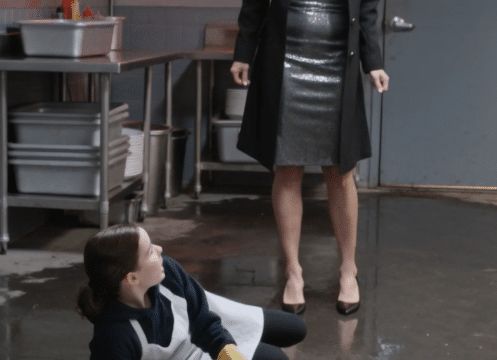
The first cookie box had barely stopped shaking when the wealthy woman kicked thirteen-year-old Lily Carter in the chest.
Lily fell beside the little folding table, her blue jacket scraping against the pavement as several neatly packed boxes rattled toward the edge. One struck the ground. Another tipped sideways, its cardboard lid popping open just enough to expose the cookies she had spent the previous evening helping her mother bake.
For a moment, Lily could not seem to understand what had happened.
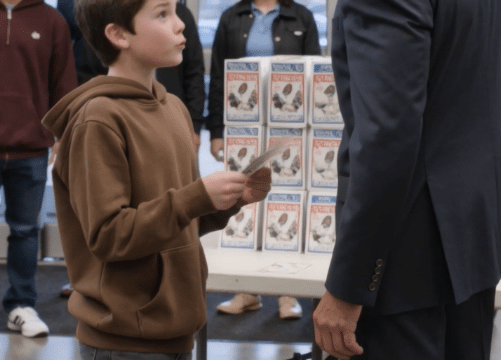
She had been standing outside an upscale American supermarket, selling cookies for a school fundraiser. The automatic doors slid open behind her, shoppers wheeled their carts past the entrance, and the afternoon sun reflected off the polished black car parked near the curb.
All Lily had done was place one box a little too close to the shopping-cart path.
Now she was on the pavement, clutching her chest and staring up at a woman who looked as though she had never once been told to move out of someone else’s way.
The woman wore a tailored black coat, high heels, and a designer bag that rested against her hip. She was thirty-seven, impeccably dressed, and furious over an inconvenience so small that another person might have solved it with a polite request.
Lily tried to push herself upright.
“I can move the boxes back.”
Her voice was small, but she was making an effort to sound calm. She could already imagine what her mother would say if she learned that Lily had argued with a customer or caused trouble outside the store.
The woman stared at her.
“Trash. This is begging with cookies.”
The words landed before Lily could answer.
She reached toward the nearest box, desperate to prevent the cookies from spilling across the pavement. The woman stepped closer and kicked her twice more, once in the back and once in the side.
Lily curled inward, trying to protect herself while reaching for the cardboard box. A thin red mark appeared on her palm where it had scraped the ground.
The cookies were still there.
That was the terrible thing her frightened mind kept returning to. Even while she struggled to breathe through the pain, she was worried about the boxes, the fundraiser money, and the possibility that she had ruined something her classmates were counting on.
The woman looked down at her as if Lily’s concern proved how ridiculous she was.
“Move your little scam away from my store.”
Around them, the entrance had gone strangely quiet.
A shopper froze with one hand on her cart. A door attendant stood near the sliding doors, staring in disbelief. Several people covered their mouths, but no one immediately stepped between the woman and the girl on the pavement.
Lily looked toward them.
She did not ask for help. She barely seemed capable of speaking.
Then the supermarket’s main doors opened again.
A gray-suited man hurried outside, moving so quickly that the employees near the entrance turned toward him. He saw the scattered cookie boxes, the frightened child, and the woman standing over her.
His expression changed.
He rushed forward and delivered one sharp slap across the woman’s face before stepping between her and Lily.
The sound snapped through the stunned entrance.
The woman stumbled backward, one hand flying to her cheek.
The man did not continue the confrontation. He turned toward the little table, looked at the school fundraiser sign, and then faced the woman with an expression colder than anger.
“That little box brings more people here than your money does.”
The woman stared at him.
For the first time, she seemed unsure of where she stood.
She looked at the cookie boxes, then at the gray suit, then at the man who had emerged from the supermarket as though the entire building belonged to him.
“Her box?”
It was barely a question.
But behind those two words lay the beginning of a truth that would change everything she thought she knew about money, influence, and the little girl she had just tried to crush.
Because the cookies on that table were not simply cookies.
And the man standing between Lily and her attacker had a reason to care about them that went far beyond the price of a box.
Act II
Lily Carter had never imagined that a school fundraiser could become the most frightening afternoon of her life.
At thirteen, she was used to being the person who noticed what needed doing before anyone asked. She helped her mother carry groceries, kept track of the household shopping list, and made sure her younger brother, Ben, finished his homework before he turned on the television.
Their family did not have much money.
They lived in a small apartment on the second floor of an aging building, where the hallway smelled faintly of laundry detergent and the kitchen window rattled when the wind came from the west. Lily’s mother, Denise, worked long shifts as a nursing assistant at a rehabilitation center, often returning home with tired feet and a smile she had to work to maintain.
Denise never told her children they were poor.
She told them that money was tight, that some things would have to wait, and that a family could still build a good life without buying everything it wanted.
Lily understood the difference.
She had learned to recognize the moment when her mother studied a bill a little longer than usual. She knew why Denise compared grocery prices and why a broken appliance sometimes remained broken for weeks. She also knew her mother had turned down extra shifts to attend school meetings and family dinners, even when accepting them would have made the next month’s rent easier.
Denise had taught Lily that helping was a form of love.
So when Lily’s school announced a fundraiser to support its after-school programs, she volunteered immediately.
The school was trying to preserve its music club, art supplies, and tutoring sessions after a reduction in local funding. Teachers had already begun stretching what they had, asking families to donate used materials and finding creative ways to keep students involved.
Lily loved the art room.
It was the one place where she could spend an hour creating something without thinking about money. She painted little landscapes, decorated greeting cards, and sometimes drew pictures for the younger children who visited her mother’s workplace during family events.
When she learned that the fundraiser would help keep the program open, she wanted to do more than hand over a few dollars.
Her mother suggested cookies.
They spent the previous evening in their small kitchen, mixing dough, lining trays, and packing the finished cookies into simple cardboard boxes. Denise had found a reliable recipe that produced a generous batch without requiring expensive ingredients. Lily decorated the labels with small hand-drawn stars and wrote the school’s name beneath them.
She was proud of those labels.
They were not professional. A few of the stars leaned sideways, and one box had a tiny smudge where the ink had not dried before Lily closed the lid. But each one looked cheerful, and she imagined someone carrying a box home to share with their family.
They had made the cookies together.
That mattered more to her than the money.
The school had arranged for a few student volunteers to sell the boxes outside participating local businesses. The supermarket was one of the most promising locations because of its steady stream of customers. Its management had approved the small table, provided a designated space near the entrance, and asked the volunteers to keep the cart path clear.
Lily had checked the arrangement twice before the lunch rush.
She placed the sign upright, stacked the boxes neatly, and left enough room for customers to pass. But the entrance became busier than expected, and one box gradually shifted toward the edge of the table.
That was when Victoria Hale arrived.
Victoria was a familiar face in certain circles of the city. She attended charity galas, supported several cultural organizations, and lived in a neighborhood where the lawns were trimmed by professionals and the houses rarely appeared to need repairs.
She was not the owner of the supermarket, but she was an important customer who had spent years cultivating the impression that her presence should be treated as an event.
Her money had given her access to rooms where people listened when she spoke. Over time, she had begun to confuse being listened to with being right.
That afternoon, she was already irritated. Her shopping trip had taken longer than expected, and she was distracted by messages on her phone. As she approached the entrance, she noticed the cookie table narrowing the path beside the carts.
A reasonable person would have asked Lily to move the box.
Victoria did not ask.
She decided that the girl was not merely in the way but had no business being there at all.
And when Lily tried to cooperate, Victoria interpreted her politeness as weakness.
What happened next was not a misunderstanding.
It was a choice.
Yet neither woman knew that the man who had just intervened had been watching the supermarket’s community programs closely for years—and that Lily’s small fundraiser was connected to a decision he had been struggling to make.
Act III
The man in the gray suit was Daniel Mercer, the fifty-five-year-old founder and owner of Mercer Markets, the regional supermarket chain that operated the store.
He had built the company from a single neighborhood grocery business into a network of supermarkets across several states. He still visited individual stores without much advance notice, preferring to see how employees treated customers when they were not expecting a corporate inspection.
Daniel believed a supermarket was more than a place to sell groceries.
For many families, it was where the week began and ended. It was where parents calculated what they could afford, where older customers stopped to speak with familiar cashiers, and where neighbors crossed paths even when they had little else in common.
He had seen his own mother count coins at a grocery counter when he was young.
His father had died while Daniel was still in high school, leaving his mother to raise two children while working long hours. The family had lived above a small shop, and Daniel remembered the embarrassment of hearing adults discuss whether his mother could afford to keep their account open.
One store manager had quietly helped them through a difficult winter.
He never announced what he was doing. He simply made sure Daniel’s mother could buy groceries until her next paycheck arrived.
Years later, when Daniel opened his own store, he asked himself what kind of business he wanted to build.
He could not promise that every customer would become wealthy or that every family would avoid hardship. But he could create places where people were treated with dignity, regardless of how much they spent.
As the chain grew, he established a community program that supported local schools, food banks, and neighborhood organizations. Store managers could approve small events, offer designated spaces for fundraisers, and connect schools with suppliers willing to donate materials.
The program was not a publicity stunt.
Daniel rarely appeared in photographs with the recipients. He preferred to measure its success by whether the art room remained open, whether a school could afford new instruments, or whether a community center had enough food for the weekend.
He had also been considering a much larger commitment.
Several months earlier, a coalition of local schools had approached Mercer Markets about helping preserve after-school programs across the region. The proposal would require a substantial financial commitment, and Daniel had asked his team to evaluate how the funding could reach the schools most in need.
He wanted the decision to be based on genuine community benefit, not on which organization had the most influential board members.
That afternoon, he had been reviewing the latest proposal in the supermarket’s back office when he heard the commotion near the main doors.
At first, he thought a shopping cart had collided with the cookie table.
Then he saw Victoria kick Lily.
He was moving before he fully understood what he had witnessed.
His decision to slap Victoria was impulsive and inappropriate. He would later have to acknowledge that he had allowed anger to dictate his response, just as he expected everyone else in his company to do when a situation became difficult.
But the anger itself had a clear source.
He had watched a grown woman attack a child who was trying to raise money for her school.
And when he looked at the fundraiser sign, he recognized the name of the school coalition that had been discussed in his office that morning.
The cookie box was connected to a cause he already knew.
The girl was not someone he had met before. He did not know her family, her grades, or the details of her life. He had no secret personal connection to her.
What he knew was enough.
She was a child doing something constructive for her school, and Victoria had treated her as though poverty made her fair game.
Daniel turned to the nearest employee and asked for emergency services to be contacted. He also asked the store manager to preserve any available security footage and make sure the witnesses’ information was recorded.
Then he looked back at Victoria.
“That little box brings more people here than your money does.”
He was not claiming that one fundraiser could save the entire school system. He was making a point about the people who gave a community its life.
Victoria had spent years measuring importance by purchasing power. Daniel was telling her that the school, the volunteers, the families, and the teachers were part of the reason her supermarket had customers in the first place.
The woman stared at him.
“Her box?”
Daniel’s expression did not soften.
“The fundraiser,” he said, indicating the sign. “The school. The people who come here because they want to support their neighbors.”
For a moment, Victoria looked almost offended by the explanation.
She seemed to believe that a child’s fundraiser could not possibly be relevant to her. Surely a few cookie boxes were insignificant beside the money she spent in the store.
But Daniel had spent his career learning how businesses survived.
A supermarket could advertise low prices, build a beautiful entrance, and fill its shelves with every brand customers wanted. Yet if the surrounding community stopped trusting it, the business would lose something that no marketing budget could replace.
Lily’s table represented a relationship between the store and the neighborhood.
Victoria had attacked that relationship without understanding what she was doing.
And Daniel was about to make sure the entire company responded in a way that reflected its actual values.
Act IV
When the first responders arrived, Lily was still sitting on the pavement beside the cookie table.
She had stopped trying to collect the boxes. A store employee had placed a folded jacket beneath her head while another employee cleared space around her. The thin mark on her palm had been cleaned, but she was frightened and hurting, and nobody assumed she was fine simply because she could answer questions.
Daniel remained nearby while the responders assessed her.
Victoria stood several feet away, her designer bag hanging from one hand. The initial shock had begun to harden into indignation.
“This is unbelievable,” she said. “I came here to shop, and now I’m being assaulted because I asked someone to move a box.”
Daniel looked at her.
“You didn’t ask.”
She opened her mouth, then closed it.
“You attacked a thirteen-year-old girl,” he continued. “People saw it. The cameras may have recorded it. The police will have the opportunity to review the evidence.”
Victoria’s eyes narrowed.
“Do you have any idea how much I spend at your stores?”
It was the wrong question.
Daniel had heard versions of it from people who assumed that money created a private set of rules. Some believed a large account entitled them to insult cashiers. Others expected employees to ignore harassment because the person responsible bought expensive products or knew a member of management.
Daniel had never wanted Mercer Markets to operate that way.
“Your spending doesn’t give you the right to hurt someone,” he said.
Victoria looked toward the store manager, expecting him to intervene on her behalf. The manager did not move. He had watched the incident unfold and had already begun gathering the names of employees who could provide statements.
Then Victoria turned back to Daniel.
“You hit me.”
“Yes,” he replied. “And my actions will be addressed through the appropriate process. That doesn’t change what you did to Lily.”
His answer deprived her of the argument she had been preparing.
He was not claiming that ownership gave him permission to strike customers. He was not asking the police to ignore his behavior. He was separating his own decision from hers, insisting that both would be judged on their own merits.
Victoria had expected power to protect her.
Instead, she was standing before a man who refused to treat it as a defense.
A police officer arrived and began speaking with the witnesses. Several shoppers had seen the assault directly, and at least one had recorded part of it on a phone. Store employees provided the information they had collected, while the manager arranged for the relevant security footage to be preserved.
The footage would not replace witness accounts or determine every legal question on its own. But it could help establish what had happened around the entrance.
Victoria’s face changed as she realized how many people had seen her.
She had not been humiliated in a private argument. She had chosen to attack a child in front of a crowd, and the people who had watched her do it were now being asked to explain what they had witnessed.
The consequences would not be decided by Daniel alone.
Law enforcement would assess the assault. Any claims involving his own physical intervention would be subject to separate review. Mercer Markets would examine the incident under its policies, and the store would cooperate with the authorities.
Daniel also instructed his management team to review how the entrance had been arranged. If the table narrowed the cart path, they would adjust its placement. A preventable inconvenience should be corrected without putting a child at risk.
That simple distinction mattered.
Lily’s box could be moved.
Her school could be consulted about the fundraiser setup.
The supermarket could make the entrance safer.
None of those things justified violence.
As the responders prepared to take Lily for further evaluation, she looked toward the boxes scattered beside the table.
“Are the cookies okay?” she asked quietly.
The question made Daniel pause.
She had just been attacked, and she was still thinking about the fundraiser.
An employee knelt beside the table and carefully gathered the closed boxes, setting aside any that had been damaged. Nobody asked Lily to help. Nobody told her that she needed to finish the job before she could leave.
Daniel crouched a short distance away, keeping enough space that she would not feel surrounded.
“The boxes can wait,” he told her. “You come first.”
Lily looked at him, unsure whether she believed him.
She had spent the afternoon trying to solve a problem that was never hers to solve. She had tried to move the box, apologize, protect the cookies, and keep the situation from getting worse.
Now, at last, someone was telling her that she did not need to earn the right to be cared for.
Victoria watched from behind the officers.
She had wanted the table removed because it inconvenienced her shopping trip. She had wanted the girl to disappear because she believed the fundraiser was beneath the dignity of the store.
Now the store’s owner was standing beside that same table, making sure the girl received help.
And the sign that had seemed so insignificant to Victoria was becoming the most important thing in the entire scene.
Because Daniel was no longer looking at the cookie boxes as merchandise.
He was looking at the people they represented.
Act V
Denise Carter reached the hospital before Lily had finished her initial evaluation.
She arrived straight from work, still wearing her nursing assistant’s uniform, her hair pulled back and her face pale with fear. When she saw her daughter sitting on the examination bed, she crossed the room and wrapped her in a careful embrace.
Lily began crying only then.
Until that moment, she had tried to be brave. She had answered the responders’ questions, watched the adults move around her, and repeatedly asked whether the school would still receive the fundraiser money.
But when her mother held her, she no longer had to pretend that she was not frightened.
Denise listened as Lily described the attack. Her expression tightened when she heard the woman’s insults, and she closed her eyes when Lily explained that the customers had stood watching.
She did not tell her daughter to be stronger.
She did not tell her that some people were simply cruel and that she would have to learn to live with it.
She held her and told her that none of it had been her fault.
The medical team evaluated Lily and monitored her symptoms. The incident was reported to the appropriate authorities, and the available evidence was collected for review. The family would have to deal with the practical and emotional aftermath, but they would not have to do it while pretending the assault had been a harmless misunderstanding.
Meanwhile, Daniel Mercer returned to the supermarket with a decision to make.
He could not undo what had happened at the entrance. He could not erase the image of Lily on the pavement, and he could not turn his own impulsive slap into the kind of measured intervention he wished he had made.
What he could do was ensure that the company responded responsibly.
He asked his team to preserve the evidence, cooperate with the investigation, and review the incident under the company’s conduct policies. He also made it clear that the school fundraiser would not be canceled because one customer had complained about it.
The table would be repositioned to keep the entrance clear.
The volunteers would receive better guidance about where they could stand.
And the school would be contacted directly so that its students would not be left wondering whether their fundraiser had caused the trouble.
Daniel also returned to the proposal he had been reviewing before the attack.
The school coalition had asked Mercer Markets to help preserve after-school programs threatened by funding cuts. The request included music, art, tutoring, and other activities that gave students somewhere safe and constructive to spend their afternoons.
The proposal had been under review for weeks.
Daniel had been weighing how much the company could commit, how the money should be distributed, and how the program could be protected from becoming a short-lived publicity campaign.
The incident did not magically answer every financial question.
But it reminded him why the decision mattered.
Lily had been standing outside his store because she wanted to help preserve a place where children could learn and create. She had not been asking for charity for herself. She had been selling cookies to support a community that had given her something valuable.
The fundraiser had brought people together around a modest goal.
And a woman with far more money than Lily’s family could imagine had decided that goal was beneath her.
Daniel could not use Lily’s suffering as an excuse to bypass the company’s review process. Nor did he want to turn her into a symbol without asking what her school actually needed.
So the company completed its assessment, consulted the participating schools, and announced a substantial community grant to help sustain the after-school programs. The support was distributed through a transparent process, with the schools determining which approved needs required the most urgent attention.
Lily’s school received support for its art program and tutoring sessions.
There was no extravagant check presented to Lily in front of cameras. No promise that she would never have to worry about money again. No instant transformation in which her family suddenly lived in a mansion.
Instead, the art room remained open.
Students continued painting after the final bell. The music club kept meeting. Teachers had additional supplies, and children who needed extra help with their assignments could continue attending tutoring sessions.
For Lily, that was the real victory.
She returned to school when she was ready, surrounded by friends who had heard what happened and wanted to know how she was feeling. Some were angry. Others were simply relieved to see her back.
Her teacher kept the fundraiser sign in a drawer for a while, not because she wanted to hide it, but because she wanted Lily to have the choice to return to the activity without feeling that the entire school was watching her.
A few weeks later, Lily asked whether she could help with another fundraiser.
Denise hesitated.
She wanted her daughter to feel safe. She did not want Lily to believe she had to return to the place where she had been hurt just to prove she was brave.
But Lily explained that she still wanted to help the school.
“I don’t want her to decide what I can do,” Lily said.
Denise studied her daughter’s face.
Then she nodded.
They agreed that Lily would participate only if she felt comfortable, and that the school would arrange an appropriate space with adults nearby. The decision belonged to Lily, not to the woman who had attacked her.
The next fundraiser took place in the school’s courtyard.
The table was decorated with paper stars, and the cookie boxes carried fresh labels in Lily’s familiar handwriting. Her classmates took turns helping, and teachers stopped by to buy cookies and ask about the art projects they had been working on.
Nobody treated Lily as a spectacle.
She was simply a student doing something for her school.
As for Victoria Hale, the aftermath was not decided by the supermarket owner’s anger or by a dramatic speech. Investigators reviewed the evidence, witnesses provided their accounts, and the assault proceeded through the appropriate legal channels. Mercer Markets also reviewed her conduct under its policies, without claiming that Daniel could personally dictate the outcome of a criminal investigation.
Her money could pay for legal advice.
It could not make the witnesses disappear.
Nor could it change the basic facts of the encounter.
A thirteen-year-old girl had offered to move a box.
A grown woman had responded with violence.
And a crowd had seen the difference between the two.
Daniel also had to answer for his own response. The company made clear that he was expected to follow the same standards of conduct it applied to others, regardless of his position. He had acted out of anger, but anger did not make his slap beyond scrutiny.
That, too, became part of the lesson.
Accountability could not mean demanding consequences only for the person who had first done wrong. It had to mean examining every action honestly, even when the person responsible held power.
Months later, Lily visited the supermarket with her mother.
The automatic doors slid open, and the familiar entrance came into view. Shopping carts rattled across the floor. Employees greeted customers. Near the side of the entrance, a small community noticeboard displayed information about school events and local fundraisers.
Lily paused to read it.
There was no photograph of her, no headline describing what she had endured, and no attempt to turn her pain into advertising. The noticeboard simply offered space for the neighborhood to share what it was doing.
She liked it that way.
Before leaving, she stopped near the customer service desk to thank the employees who had helped that afternoon. The store manager greeted her warmly and asked whether her school program was going well.
Lily smiled.
“The art room is still open.”
It was a simple answer, but it carried the meaning of everything that had happened.
The cookie box had never been valuable because it was expensive. It had been valuable because a child had spent her evening helping her mother prepare it, because a school was trying to protect its programs, and because a community had decided that its children deserved more than whatever remained after the bills were paid.
Victoria had seen a small box narrowing a shopping-cart path.
Daniel had seen a connection between a business and the community that sustained it.
Lily had seen a chance to help.
And when the moment came to decide whose perspective mattered, the truth did not belong to the person carrying the most expensive bag.
It belonged to the people who understood that a community was not built by money alone, but by the care people were willing to give one another.
The cookies were ordinary.
The girl selling them was ordinary, too: a student with a blue jacket, a family budget to worry about, and a desire to make her school a little better.
But ordinary did not mean unimportant.
And no amount of wealth could make cruelty look like strength once everyone had seen what it really was.
Victoria had tried to make a little girl feel small because she believed the world was arranged to protect people like her.
Instead, her own actions revealed how small her understanding of the world had become.
The box had never been a scam.
It had been a child’s attempt to help.
And that was worth far more than she had ever imagined.