Act I
“The sidewalk is closed. I live here.”
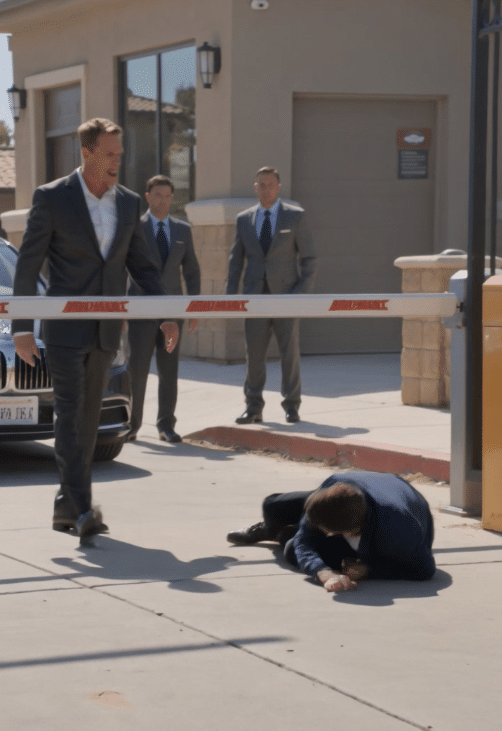
Daniel Hayes stood beside the vehicle barrier, one hand raised in a quiet attempt to explain himself. He wore a navy jacket over a plain white T-shirt, faded jeans, and sneakers damp from the morning rain. Behind him, orange construction barriers blocked the community’s main sidewalk, leaving pedestrians with no easy way around the entrance.
A black luxury sedan had stopped just beyond the gate.
Its driver’s door swung open, and a man in a dark gray suit stepped out, his silver watch catching the cold morning light. His name was Richard Caldwell, a forty-nine-year-old resident who had spent years cultivating the reputation of a man nobody in the community should inconvenience.
He glanced at Daniel, then at the narrow space beside the gate arm.
“Trash. People like you sneak through gates.”
Daniel blinked.
“I’m not sneaking anywhere. The sidewalk is closed, and I live here.”
Richard looked him up and down, searching for something in his appearance that would justify his contempt. Daniel had no luxury car, no tailored suit, and no obvious sign of wealth. His clothes were ordinary, his hair was slightly damp, and he looked like someone who had spent the morning dealing with an inconvenience rather than someone who expected the world to rearrange itself around him.
Richard had already decided what that meant.
He had been waiting at the entrance for nearly two minutes. The guard had stopped traffic while checking a delivery vehicle’s authorization, and a line of expensive cars had begun forming behind him. Richard considered the delay an insult.
Then Daniel had appeared beside the barrier.
To Richard, the two things belonged together. Someone had inconvenienced him, and here was a man he believed he could blame.
“I live in this community,” Daniel repeated. “My car broke down this morning. I’m walking home.”
Richard gave a short, disbelieving laugh.
“Then use the proper entrance.”
“This is the pedestrian entrance. The walkway is under repair.”
“That’s not my problem.”
“I didn’t say it was.”
The answer was calm, but Richard heard defiance in it.
He stepped closer until Daniel had to lean back slightly to maintain his space. Behind them, the guard remained inside the booth, watching through the glass. Several residents sat in their cars with their windows raised, waiting for the barrier to open.
Richard pointed toward the road beyond the gate.
“People like you think a little gap means you can go wherever you want.”
Daniel glanced at the construction fencing.
“There’s nowhere else to walk.”
Richard’s expression hardened.
He was a senior executive at a property investment firm, a man accustomed to negotiating contracts where every person in the room understood the importance of his time. He had grown used to people apologizing when he frowned and changing their plans when he complained.
Daniel did neither.
He did not insult Richard or threaten him. He simply refused to admit he was doing something wrong when he was following the only safe route available.
That was enough to make Richard lose control.
He moved directly in front of Daniel and delivered a forceful kick into his chest.
Daniel staggered backward and fell beside the metal gate arm. His forearm scraped the pavement, leaving a thin trace of blood on his skin. The impact drove the breath from his lungs, and for several seconds, he could do little more than struggle to breathe.
The barrier’s warning light flashed above him.
Richard stepped closer.
Daniel tried to turn away from the gate mechanism, afraid he might be struck by the moving arm if the system activated. He raised one hand, not to threaten Richard, but to protect himself.
Richard kicked him twice more, striking his back and ribs as he tried to move clear of the barrier.
A woman inside a waiting car covered her mouth.
The security guard stepped away from his desk, then stopped at the booth door, visibly uncertain. Other residents watched through windshields, their expressions shifting from confusion to disbelief.
Richard stood over Daniel, breathing hard.
“Crawl back outside the gate.”
The words seemed to hang in the air longer than the attack itself.
Daniel looked up at him, stunned less by the pain than by the sheer absurdity of what had happened. He had been walking home. He had explained the closed sidewalk. He had apologized for passing near the vehicle entrance.
And now he was on the ground, being told that he did not belong in the place where he lived.
Richard straightened his jacket as if the confrontation had been nothing more than an unpleasant business exchange.
Then a car behind his sedan opened.
A tall man in a black suit and dark overcoat stepped out. He was fifty-seven, silver beginning to show at his temples, and carried himself with the quiet confidence of someone who did not need to announce his authority.
His name was Alexander Sterling.
Most residents knew him as the developer who had built the community. Fewer knew that he still controlled the company responsible for its management, its long-term development agreements, and several decisions affecting the future of the entire property.
Alexander crossed the entrance without looking at Richard’s car.
He went straight to Daniel and placed himself between the injured man and the person who had attacked him.
Then he turned toward Richard.
“He’s the one deciding who stays behind that gate.”
Richard’s expression faltered.
He looked at the gate, then at Daniel on the pavement.
For the first time that morning, he seemed unsure of his own position.
“Who stays?”
He had thought he was the man who decided who belonged.
He had no idea that the person he had just kicked might have far more influence over that decision than he did.
And Alexander Sterling was about to explain why.
Act II
Alexander did not answer Richard immediately.
He crouched beside Daniel, asked whether he could breathe comfortably, and told the security guard to call emergency services. His voice remained controlled, but the look in his eyes had changed when he saw the blood on Daniel’s forearm.
“Don’t try to stand yet,” Alexander said.
Daniel nodded, still holding his side.
Richard took half a step backward.
“Alexander, this is being blown out of proportion.”
Alexander looked up.
“You kicked him while he was on the ground?”
“He was interfering with the entrance.”
“The entrance?”
“He came through the gate while cars were waiting.”
“The pedestrian route is closed,” Alexander replied. “Where exactly was he supposed to go?”
Richard glanced at the construction barriers.
For the first time, he seemed to notice them.
“They should have made a better arrangement.”
“That’s a fair complaint to raise with management. It is not permission to assault someone.”
The security guard finally came out of the booth. He looked shaken, but Alexander directed him to keep the vehicle barrier stationary and preserve the camera recordings. The guard immediately returned to the control panel.
Residents began stepping out of their cars.
A man in a blue jacket offered Daniel his coat. Another resident called out that she had seen the entire incident. The woman who had covered her mouth was now standing beside her open car door, visibly angry with herself for not moving sooner.
Richard watched the scene gathering around him.
He was used to being recognized at community meetings, where residents often asked his opinion about landscaping, security upgrades, and property values. He liked being considered a person who understood how the community worked.
But this was different.
Nobody was asking him what had happened.
They were looking at the man on the ground.
Alexander stood and faced Richard.
“You’ll stay here until the police arrive.”
“You can’t detain me.”
“I’m not detaining you. I’m asking you not to leave before the incident is documented.”
Richard’s jaw tightened.
“You don’t give me orders.”
Alexander’s expression remained unreadable.
“Then consider it a courtesy. The cameras will tell us what happened either way.”
That silenced him.
The gate had several cameras, including one mounted above the guard cabin and another aimed toward the pedestrian entrance. Richard had never paid much attention to them. He assumed they were there to discourage outsiders from entering and to protect the expensive vehicles moving through the community.
He had not considered that they might record the behavior of the people who lived inside.
Daniel lay still while waiting for the ambulance. The pain in his chest made every breath uncomfortable, and he was struggling to understand how an ordinary morning had turned into something he would remember for the rest of his life.
He had lived in the community for three years.
He was not one of its wealthiest residents, but he had never hidden that fact. He rented a modest townhouse on the eastern side, worked as a project consultant, and preferred spending money on travel and books rather than expensive cars.
He knew some neighbors by name and others only by sight.
Richard belonged to the second group.
They had passed each other in the clubhouse and near the mailboxes, exchanging the occasional nod. Richard had once complained loudly about delivery drivers using the wrong lane, and Daniel remembered the way he had spoken to the guard who tried to explain the routing system.
Still, Daniel had never imagined that the man would attack him.
He turned his head toward Alexander.
“Why did you say that?”
Alexander understood immediately.
“About the gate?”
Daniel nodded.
Alexander glanced at the construction fencing, then at the guard cabin.
“Because this entrance is part of a decision that hasn’t been finalized.”
Daniel frowned.
“What decision?”
Alexander looked toward the waiting cars.
“Not here. You need medical attention first.”
It was not an answer, but it was enough to make Daniel realize that the confrontation had touched something larger than a dispute over pedestrian access.
The construction work was not merely a routine sidewalk repair. The community had been undergoing a review of its access points after a series of safety complaints. Some residents wanted stricter vehicle controls. Others wanted safer pedestrian routes, better emergency access, and a clearer separation between people walking and cars entering the property.
Richard had been one of the loudest voices demanding stricter control.
He argued that the community’s value depended on exclusivity. In meetings, he spoke about protecting property prices and keeping unauthorized people away. He had pushed for new access procedures and stricter enforcement at the gates.
He rarely mentioned that those measures could also affect residents who did not drive, contractors who worked on the property, or visitors who depended on accessible routes.
Alexander had listened to all sides.
He had not yet made the final decision.
Now he stood beside the very gate Richard had spent months trying to make more restrictive, watching an ambulance approach from the main road.
Richard looked at Daniel again.
“You should have waited for the proper route.”
Daniel’s expression tightened.
“I was walking home.”
“You could have waited.”
“For how long? The sidewalk is closed.”
Richard spread his hands, as if the answer should have been obvious.
“Then you call someone.”
Daniel stared at him.
He could have called a rideshare. He could have asked a neighbor for help. He could have waited in the rain.
But none of those possibilities changed the fact that he had been walking along an open route when Richard decided to hurt him.
Alexander heard the exchange.
“Stop,” he said.
Richard fell silent.
There was something in Alexander’s voice that made the word sound less like a request and more like the end of a discussion.
When the ambulance arrived, the paramedics examined Daniel and helped him onto a stretcher. Before they loaded him into the vehicle, Daniel looked back toward the entrance.
Alexander was standing beneath the security camera.
Richard stood several feet away, suddenly alone despite the crowd.
The gate remained open.
For the first time, the person who had demanded control over it seemed unable to control anything.
But the question Alexander had raised was still unanswered.
What exactly had not been finalized?
And why did the developer believe Daniel had a say in the answer?
Act III
The first person to explain the situation was not Alexander.
It was the community’s security director, who arrived shortly after the ambulance left and began collecting statements from the residents who had witnessed the assault.
He asked for the gate footage to be preserved, confirmed the construction barriers had been installed according to the current safety plan, and requested a copy of the maintenance notice that had closed the sidewalk.
Richard listened with increasing irritation.
“This is ridiculous. The man was in the vehicle lane.”
“The pedestrian access beside the gate was open,” the security director replied. “The marked sidewalk is closed for repairs.”
“Then the arrangements were inadequate.”
“That can be reviewed separately.”
Richard gave a bitter laugh.
“Everyone is suddenly an expert.”
The security director did not respond.
The footage was clear. Daniel had approached the gate slowly, kept to the available pedestrian space, and attempted to explain why he was there. Richard had exited his car, blocked his path, and attacked him.
No interpretation of the construction plan could change what the cameras showed.
By the afternoon, the incident had been reported to the appropriate authorities. Witness statements were being collected, and management had initiated its formal review of Richard’s conduct under the community’s rules.
Alexander requested a meeting with the management board.
The meeting had already been scheduled for the following week, but the assault changed its urgency. The board had been preparing to decide whether to approve a proposed redesign of the entrance, along with changes to pedestrian access and security enforcement.
Richard had been lobbying hard for the redesign.
He wanted the gate to become more restrictive, with fewer pedestrian access points and tighter control over who could pass through the vehicle entrance. He argued that the changes would protect residents and preserve the community’s exclusive character.
He had described the proposal as a matter of safety.
But some residents had questioned whether it was really about safety or about making the community feel less accessible to anyone who did not fit Richard’s idea of a resident.
Alexander had never accepted Richard’s argument without examining the details.
The developer had created the community decades earlier, when the surrounding land was still mostly open fields and low-rise housing. The original plan had included landscaped walking paths, accessible routes, and a shared green corridor connecting the homes to a small park beyond the main entrance.
Over time, security upgrades had altered the entrance. Additional barriers were installed, vehicle lanes expanded, and the pedestrian path became increasingly narrow.
The sidewalk closure was meant to correct one of those problems.
The repairs were part of a larger accessibility and safety project designed to separate pedestrian traffic from vehicles. The work had temporarily reduced the available walking space, but the long-term plan was intended to make the entrance safer for everyone who used it.
Richard had objected to parts of the plan.
He wanted the pedestrian route moved farther from the main entrance, even if that meant a longer walk for residents on the eastern side. He also favored stricter rules for anyone approaching the vehicle barrier.
Daniel’s townhouse was on that eastern side.
He had attended one community meeting months earlier, where residents discussed the proposed changes. He had spoken briefly about the need for a direct pedestrian route, especially for people who walked to the clubhouse, used public transportation, or did not own a car.
He had not made a dramatic speech.
He had simply pointed out that a gated community still needed to be a place people could move through safely on foot.
Alexander remembered that comment.
He also remembered Daniel staying afterward to help an older resident understand the proposed route changes.
What Richard did not know was that Daniel had been invited to participate in a small resident advisory group reviewing the entrance redesign. The group included residents from different sections of the community, representatives from management, and a safety consultant.
Daniel had been selected because of his professional experience coordinating infrastructure projects and reviewing operational risks.
He had never advertised the role.
It was unpaid, and he did not consider it a status symbol. He had agreed because the original plan was confusing, and he believed a few practical adjustments could make it work better.
The advisory group had identified several concerns, including the temporary sidewalk closure, the placement of the barrier, and the need for an accessible alternative during repairs.
Their recommendations had been submitted to the board.
The final approval was still pending.
And Alexander was the person responsible for determining whether the developer would authorize the proposed changes before they were formally adopted by the community’s management structure.
That was the truth behind his words at the gate.
Daniel was not the developer.
He did not own the community or have unilateral authority over its rules.
But he was one of the people helping determine which proposal would be recommended, and Alexander had made it clear that the residents’ safety findings would carry significant weight in the final decision.
Richard had mistaken Daniel’s modest appearance for insignificance.
He had no idea that the man he attacked was involved in reviewing the very access policy he wanted to control.
More importantly, Daniel’s position did not give him power to punish Richard for what had happened.
It gave him a responsibility to ensure that the entrance design worked for everyone.
The distinction mattered.
When Alexander explained Daniel’s role to the board, he did not present it as a secret identity or a financial surprise. He explained that Daniel had contributed practical recommendations and that the assault made the need for safe, fair access impossible to ignore.
Then he made a separate point.
“The decision about the entrance must be based on safety, accessibility, and the evidence. It cannot be based on anyone’s anger or social position.”
The board members agreed.
The next morning, Richard received notice that the proposed access changes would be reviewed in light of the incident and the existing safety concerns. His request for immediate restrictions would not be approved without further assessment.
He read the notice twice.
Then he called Alexander.
“You’re using this incident to undermine me.”
“No,” Alexander replied. “I’m reviewing the facts.”
“You know how much I’ve contributed to this community.”
“I know what you’ve contributed. I also know what the cameras recorded.”
Richard went quiet.
For years, he had believed that influence meant being the person who spoke the loudest in a room. He had mistaken access to wealthy people for authority over them, and financial success for the right to decide who deserved respect.
Now the man he had treated as an intruder had become central to the decision he cared about most.
But the real reversal had not yet arrived.
Because Alexander had one more document to present, and it would reveal just how far Richard’s behavior had carried him beyond the limits of his own authority.
Act IV
The management board convened three days later.
Richard arrived in his dark gray suit, carrying a folder of his own notes. He had spent the previous evening preparing arguments about the entrance, the security delays, and the need to preserve property values.
He intended to make the assault sound like an unfortunate misunderstanding.
He would explain that he had been frustrated, that Daniel had entered an area where vehicles were moving, and that the construction arrangements had created confusion. He would point out that nobody wanted an unsafe entrance.
He would avoid the part where he had called Daniel trash.
He would avoid the kicks.
And he would certainly avoid the sentence he had delivered while Daniel was lying on the pavement.
Crawl back outside the gate.
When the meeting began, Alexander asked the board to review the security footage before hearing anyone’s interpretation of the incident.
The room fell silent as the recording played.
Daniel approached the gate.
Richard exited his car.
The two men spoke briefly.
Richard blocked Daniel’s path.
Then the attack unfolded exactly as the witnesses had described it.
Nobody spoke when the recording ended.
Richard looked down at his folder.
“The situation was more complicated than it appears.”
A board member turned toward him.
“What part of the recording is inaccurate?”
Richard lifted his head.
“I was concerned about the safety of the entrance.”
“Then why did you kick him?”
Richard opened his mouth, but no answer came.
Alexander let the silence continue.
It was not necessary to humiliate Richard in return. The footage had already established the difference between his stated concern and his actual behavior.
The board then reviewed the temporary pedestrian arrangements, the construction notice, and the recommendations from the resident advisory group.
The findings were straightforward.
Daniel had used the available pedestrian route. The sidewalk closure had been properly posted, though the temporary route needed clearer markings. There was no evidence that Daniel had deliberately interfered with vehicle traffic or attempted to bypass security.
The board approved additional signage, a safer pedestrian passage during construction, and a review of the barrier’s timing so that residents on foot would not be forced to share an unnecessarily narrow space with moving cars.
The measures were practical rather than punitive.
They addressed the problem that had existed before Richard arrived.
Then Alexander placed another document on the table.
It was the current governance and management agreement for the community, including the developer’s reserved authority over major access changes until the planned safety review was completed.
Richard scanned the page.
“What is this?”
“The agreement that defines how the entrance redesign can be approved,” Alexander said. “The developer retains final approval over the major changes until the review is complete. The resident advisory group provides recommendations, and the board evaluates the operating rules.”
Richard frowned.
“You’re saying Daniel makes the decision?”
“No. I’m saying the decision is not yours to make alone.”
Alexander turned the page toward him.
“Daniel’s recommendations are part of the review because he was selected to represent residents affected by the pedestrian route. Your preferences are also part of the record. Neither gives you the right to decide who belongs here, and neither gives you permission to assault someone.”
The room remained quiet.
Richard had spent months speaking as though the gate were an extension of his personal authority. He had assumed that because he owned an expensive home and had influence among certain residents, he could dictate how others moved through the community.
But the agreement did not grant him that power.
The entrance was governed by documented rules, shared responsibilities, and decisions made through an established process.
He was a resident.
An influential one, perhaps.
But still a resident.
Alexander looked directly at him.
“You told Daniel to crawl outside the gate. You treated him as if he had no right to be here. The fact is that he lives here, he was using the available route, and he was contributing to the review that would make that route safer.”
Richard’s face reddened.
“This is a personal attack.”
“No,” Alexander said. “The assault was personal. This is accountability.”
The board then reviewed the actions available under the community’s rules. The incident had already been referred to the appropriate authorities, and the management company would cooperate with the investigation. Separately, the board began the formal process for determining whether Richard’s conduct violated the community’s resident standards.
No one claimed that a board decision could replace the legal process.
No one pretended that losing influence over the entrance was an adequate consequence for physical violence.
The matters were kept separate, exactly as they should have been.
Richard was asked to provide a written response to the incident and was informed that his conduct would be considered under the established procedures. His proposal for immediate access restrictions remained on hold while the independent safety review continued.
He sat motionless, staring at the document.
For the first time, he understood the danger of assuming that the person in front of him had no power simply because he looked ordinary.
Daniel’s authority had never depended on an expensive car or a prestigious address. His role came from his experience, the confidence of the people who had selected him, and the quality of the work he had done.
Richard had not known any of that when he attacked him.
But even if Daniel had been a visitor, a delivery driver, or someone who had no connection to the community, the assault would have been just as wrong.
That was the part Richard still struggled to face.
He wanted the revelation to be the story.
He wanted everyone to remember that the man he had kicked was connected to an important decision, because that made his mistake easier to explain as a failure of judgment.
The truth was harder.
He should not have needed to know Daniel’s role to treat him like a human being.
When the meeting ended, Alexander stopped Richard before he reached the door.
“Do you understand what I meant at the gate now?”
Richard looked at him.
Alexander spoke slowly.
“The person you attacked was helping decide how this entrance should work. But you were wrong before you knew that. No one needs a title to deserve basic respect.”
Richard had no answer.
Outside the boardroom, the community carried on with its ordinary afternoon. Cars moved through the entrance. Residents walked along the temporary path. Workers adjusted the construction barriers according to the revised plan.
The gate still stood where it had always stood.
But its meaning had changed.
It was no longer merely a symbol of exclusivity or the dividing line Richard believed he could use to separate important people from everyone else.
It was a shared entrance, governed by rules that applied to every resident.
And Richard had finally learned that being on the inside did not place him above them.
Act V
Daniel returned to the community the following week.
He was still recovering from the assault, moving more carefully than before, but he insisted on walking home from the car drop-off rather than asking someone to meet him at the entrance.
The temporary pedestrian route had been widened and clearly marked. Reflective signs directed people away from the vehicle lane, and a guard stood near the barrier to ensure that cars did not cross the pedestrian path while people were passing.
Daniel stopped to read one of the new signs.
A maintenance worker approached and asked whether the route was clear enough.
“Much better,” Daniel said. “People shouldn’t have to guess where they’re supposed to walk.”
The worker nodded and returned to his task.
There was nothing dramatic about the exchange.
No crowd gathered. No one applauded. Nobody announced that the man walking home had helped influence the changes.
Daniel preferred it that way.
He had joined the resident advisory group because he believed shared spaces should work for the people who used them. He had not joined to gain influence over his neighbors or to settle disputes.
The assault had made the work more personal, but it had not changed its purpose.
He still wanted the entrance to be safer for everyone.
A few days later, Alexander invited him to review the revised pedestrian plan. Daniel examined the diagrams, asked about the turning radius near the barrier, and suggested moving one sign so it would be visible before pedestrians reached the narrow section.
Alexander listened.
They discussed the issue for twenty minutes, making notes and comparing the plan with the conditions on the ground.
Nothing in the meeting resembled the dramatic confrontation at the gate.
There was no threat, no public humiliation, and no attempt to prove who was more important.
There was simply a problem, a set of facts, and two people trying to solve it.
Before Daniel left, Alexander thanked him for continuing to participate.
“You would have every reason to step away from this,” he said.
Daniel considered that.
“I thought about it.”
“What changed your mind?”
Daniel glanced toward the window, where residents were walking along the new path.
“If I leave because someone treated me badly, the next person still has to use that entrance. I don’t want the problem to remain just because I’m tired of dealing with it.”
Alexander nodded.
“That is why your input matters.”
Daniel shook his head slightly.
“My input matters because the route needs to work. Not because of what happened to me.”
Alexander smiled faintly.
“That distinction is worth remembering.”
The formal proceedings concerning Richard continued separately. The security footage and witness statements remained part of the record, and the appropriate authorities would determine the consequences of the assault. The community’s review of his conduct proceeded under its own rules.
Richard was not publicly stripped of his home or magically erased from the community. Real accountability did not require an implausible overnight transformation.
But his influence had changed.
Residents who had once accepted his complaints without question began asking for evidence and practical solutions. The board expected him to follow the same procedures as everyone else. His views could still be heard, but his wealth no longer made them the final word.
For a man who had built his identity around being obeyed, that was a difficult adjustment.
One evening, Richard encountered Daniel near the entrance.
The construction barriers had been removed, and the repaired sidewalk was fully open. Cars rolled through the gate in orderly intervals, while pedestrians used the separate walkway without having to squeeze beside the vehicle arm.
Daniel was heading toward the eastern side of the community when Richard approached from the opposite direction.
For a moment, neither man spoke.
Richard’s silver watch caught the light beneath his sleeve. His suit was immaculate, his shoes polished, his expression carefully controlled.
Daniel remembered the morning he had been knocked to the pavement.
He remembered the pain in his chest, the scrape on his arm, and the humiliation of being told to leave a place where he had every right to be.
Richard looked as though he wanted to say something.
“I—” he began.
Then he stopped.
An apology, if one came, would have to be more than a way to restore his reputation. Daniel had no interest in offering Richard an easy escape from the consequences of what he had done.
He waited.
Richard lowered his eyes.
“I was wrong to do that.”
The words were quiet, and they did not erase anything.
Daniel studied him for a moment.
“Yes,” he said. “You were.”
Richard looked up, perhaps expecting a lecture, an insult, or a declaration of victory.
Daniel gave him none.
“You could have asked me to move. You could have called security. You could have waited ten seconds. There were a hundred things you could have done.”
Richard said nothing.
“But you chose to hurt me,” Daniel continued. “And the fact that you didn’t know who I was doesn’t make that choice any less wrong.”
Richard’s face tightened.
For a moment, Daniel thought he might argue again.
Instead, Richard nodded once.
It was not a complete redemption. A single apology could not restore trust, and neither man pretended otherwise.
Daniel continued on his way.
He did not feel triumphant.
He felt relieved that the encounter had ended without another confrontation, and he felt certain that the community’s procedures should continue regardless of whether Richard ever became a better person.
Behind him, the gate opened for another car.
A pedestrian approached from the sidewalk, carrying a grocery bag. The guard waited until the person had crossed safely before allowing the next vehicle through.
It was a small adjustment, almost invisible amid the daily movement of the community.
But it represented the outcome Daniel had wanted all along.
A gate could protect a neighborhood without humiliating the people who entered it. Security could coexist with accessibility. Property values could matter without becoming an excuse to treat ordinary people as disposable.
And authority could be exercised without cruelty.
Alexander had said Richard was not the one deciding who stayed behind the gate.
The statement had sounded like a threat when Richard first heard it.
Now its deeper meaning was clear.
No single resident had the right to decide who deserved dignity. The community’s rules existed to protect shared interests, not to turn wealth into permission for abuse.
Daniel had never needed to be secretly powerful to deserve respect.
He had needed only to be a person walking home.
And that was the truth Richard had failed to see until the entire entrance was watching.
The gate had never been his to rule.
It belonged to a community.
And the measure of that community was not how effectively it kept people out, but whether the people inside could remember how to treat one another.