Act I
“The shelf number was wrong.”
Arthur Bennett stood beside a row of numbered storage racks in the cold basement of an upscale condominium, holding a small cardboard box against his gray coat. His brown pants were creased from years of wear, and his low shoes had left faint marks on the concrete floor. He looked like an ordinary older man trying to finish an ordinary chore.
Then a hand snatched the box from him.
“What the hell do you think you’re doing?”
Arthur turned toward the man blocking his path. He recognized him as Daniel Whitmore, a wealthy resident who lived several floors above and carried himself as though the entire building had been constructed for his convenience.
Daniel wore a black sweater, spotless white pants, and a gold watch that caught the fluorescent light. His expression was already full of accusation.
Arthur glanced at the box, then at the storage rack behind him.
“The shelf number was wrong,” he repeated calmly.
Daniel pulled the box closer to his chest and inspected its label as if he expected to discover evidence of a crime. Behind him, the storage room stretched into narrow aisles lined with metal shelves, plastic bins, holiday decorations, and expensive belongings hidden behind ordinary doors.
A security camera watched from the ceiling.
Daniel either forgot it was there or assumed it would never matter.
“Trash,” he spat. “Old thieves always have excuses.”
Arthur’s face tightened.
“I’m not stealing anything. I was moving it to the correct shelf.”
“That’s what thieves say.”
“Please look at the labels.”
Arthur pointed toward two adjacent storage sections. A white sticker marked one unit number, while the box carried another. The difference was small enough to escape someone in a hurry, but obvious once the numbers were compared.
Daniel did not look.
He had already decided what he was seeing.
For months, Arthur had noticed little administrative problems throughout the building. Packages delivered to the wrong floor. Storage labels that did not match the inventory. Maintenance notices placed on the wrong doors. Most residents complained about such things and went on with their lives.
Arthur preferred to correct what he could.
At sixty-four, he had spent much of his life believing that small mistakes became expensive when everyone assumed someone else would fix them. He had worked long enough to know that the person who noticed a problem was often the person best positioned to prevent it from becoming worse.
That morning, he had come downstairs to retrieve a box of old family documents. While checking the shelves, he had spotted several items filed under the wrong unit numbers.
One belonged to a neighboring storage space.
Another carried the number associated with Daniel’s unit.
Arthur had been moving the misplaced box back to its proper location when Daniel appeared.
It should have taken less than a minute to resolve.
Instead, Daniel tightened his grip on the cardboard.
“Put your hands where I can see them.”
Arthur stared at him.
“My hands?”
“You heard me.”
“This is ridiculous.”
The words came out quietly, but they were enough to make Daniel step closer.
A woman standing near the far shelves stopped sorting through a plastic container. Two other residents, both carrying storage bins, turned toward the argument. Their faces showed uncertainty, but none approached.
Daniel seemed to draw confidence from their silence.
He was used to people backing down when he raised his voice. In the building’s private elevator, he had interrupted conversations without apology. At residents’ meetings, he treated questions as challenges and disagreements as personal insults.
He had learned that money could make people hesitate.
Sometimes, that hesitation looked enough like respect to satisfy him.
Arthur shifted the box slightly.
“I’m trying to help you.”
Daniel’s expression twisted.
“Help me? You touch my storage again and you’ll find out what happens.”
“It’s not your box.”
That was the moment Daniel lost control.
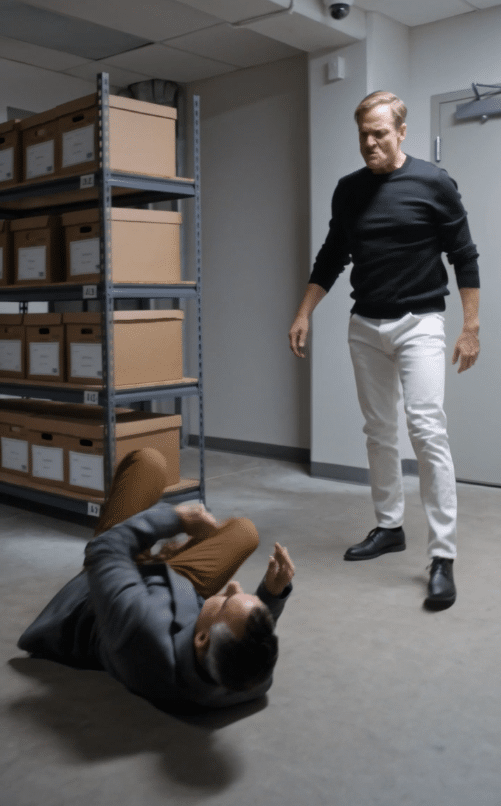
He stepped directly in front of Arthur, squared his shoulders, and delivered a forceful kick into the older man’s chest.
Arthur fell beside the shelving, striking the concrete with one arm. The box slipped from his hands, and its contents shifted inside. A thin trace of blood appeared along his forearm where it scraped against the rough floor.
For a second, he seemed unable to draw a full breath.
Then Daniel stepped closer.
Arthur tried to point toward the shelf label, still attempting to explain what had happened.
Daniel kicked him twice more, striking his back and ribs as the older man curled protectively around himself.
A resident gasped.
Someone covered her mouth.
Another person stepped backward, nearly knocking a plastic storage tub from a lower shelf.
Daniel stood over Arthur, his breathing sharp and angry.
“Touch my storage again and you’ll regret it.”
Arthur looked up at him, stunned by the violence that had erupted from such a trivial disagreement.
He had not tried to take anything.
He had not threatened Daniel.
He had been correcting a mistake.
Yet the man in the expensive watch seemed convinced that the assault was justified simply because he had decided Arthur did not belong near his belongings.
Then the basement door opened.
The building manager hurried into the storage room carrying an official storage map and a printed error sheet. His gray suit looked immaculate against the concrete walls, but his expression was anything but composed.
He moved between Daniel and Arthur first, shielding the older man while checking whether he was conscious.
Then he opened the map directly in front of Daniel.
“He was correcting the mistake your unit made.”
Daniel stared at the paper.
His eyes moved from the manager’s finger to the numbered shelf.
The color drained from his face.
“My unit?”
For the first time since entering the basement, Daniel Whitmore looked frightened.
Because the error on that page was not merely a misplaced label.
It was the beginning of a problem he had spent months insisting could not possibly be his fault.
And the man he had just attacked might be the only person who had noticed it before the consequences became irreversible.
Act II
The building manager, Michael Reeves, had managed the condominium for eleven years. He knew which residents complained about the temperature, which owners argued over parking spaces, and which people expected maintenance workers to drop everything whenever they called.
He also knew that storage problems were rarely as simple as they appeared.
The basement had been reorganized several months earlier after a water leak damaged part of the old storage system. Contractors had moved shelving, maintenance staff had updated the inventory, and the management office had issued new labels for dozens of units.
Most of the changes had gone smoothly.
A few had not.
Michael had received scattered complaints about boxes appearing in the wrong places. At first, the discrepancies seemed minor. A set of winter tires listed under one unit but stored under another. Holiday decorations assigned to the wrong shelf. A locked cabinet whose inventory did not match the records.
Each problem had been corrected individually.
But Arthur had noticed something more systematic.
He had begun comparing the printed labels with the official map, not because anyone had asked him to, but because the numbering did not make sense. He recognized that several shelves had been relabeled in the wrong sequence after the renovation.
Rather than accuse anyone, he had written down the discrepancies and sent them to the management office.
Michael had not initially understood the significance.
The first report had looked like a routine correction from a conscientious resident. The second had included photographs. The third had identified a pattern across several adjacent units.
That was when Michael ordered a full audit.
The results were not yet complete.
Now, standing in the basement beside an injured resident, he could see that the audit had become much more urgent.
“Call emergency services,” he instructed one of the witnesses. “And preserve the camera footage.”
Daniel shook his head.
“Hold on. This is my private storage area.”
“It is a shared basement, and the labels are part of the building’s official inventory.”
“Then he should have called management instead of touching my property.”
Michael looked at him with disbelief.
“He did call management. His report is what prompted the audit.”
Daniel fell silent.
Arthur was breathing carefully, one hand pressed against his chest. Michael crouched beside him and asked him to remain still until medical help arrived.
Arthur nodded, though the humiliation on his face seemed almost as painful as the impact.
He had lived in the condominium for six years. He had never considered himself particularly important, and he had never expected anyone to thank him for reporting a mislabeled shelf.
He certainly had not expected to be attacked for it.
“I wasn’t trying to cause trouble,” he murmured.
Michael’s expression softened.
“I know.”
Daniel heard the exchange and gave a sharp, disbelieving laugh.
“You know him?”
Michael did not answer immediately.
He was looking at the error sheet.
The page showed a series of mismatched shelf numbers, along with notes about the units affected. One entry had been highlighted in yellow. Another had a handwritten notation beside it, indicating that the contents required verification before any items were moved again.
Daniel’s unit number appeared in both places.
“What does that mean?” Daniel demanded.
“It means the inventory has been wrong for longer than we thought.”
“Then fix it.”
“We are fixing it.”
“Good. And tell him to stay away from my things.”
Michael slowly raised his eyes.
“Mr. Whitmore, he was moving your box to the correct location.”
Daniel’s jaw tightened.
“You’re taking his side?”
“I’m telling you what the records show.”
Around them, the residents remained quiet. The same people who had watched the assault were now looking at Daniel differently. His gold watch, expensive clothes, and confident posture no longer seemed impressive. They seemed painfully irrelevant.
One witness had already started giving her account to the emergency dispatcher. Another was explaining where the security camera pointed.
Daniel noticed.
“You’re all acting like I committed some terrible crime,” he said. “I caught someone messing with my property.”
Nobody responded.
Michael stood and placed the error sheet on top of the storage map.
“You didn’t catch him stealing. You attacked a resident who was correcting an inventory error.”
Daniel’s face reddened.
“He was touching my things.”
“And you kicked him.”
The directness of the statement silenced the room.
For the first time, Daniel looked toward Arthur rather than the people watching him. The older man was still on the floor, waiting for help, his gray coat twisted beneath one shoulder.
Daniel did not apologize.
He looked away.
Michael knew that response well. Some residents could admit a mistake once it became undeniable. Others treated every correction as a personal defeat, then searched for someone weaker to blame.
Daniel had always belonged to the second group.
But this time, the consequences extended beyond a damaged relationship between neighbors.
The storage audit had uncovered a discrepancy that could affect insurance records, property claims, and the chain of custody for belongings stored in the basement. Michael had been preparing to notify the condominium board when the incident occurred.
The highlighted entry on the map concerned Daniel’s unit.
It was not proof that Daniel had done anything wrong.
Not yet.
But it showed that the mistake was connected to his storage allocation, and that Arthur’s efforts to correct it had uncovered something the building could no longer ignore.
When the paramedics arrived, Michael stepped aside so they could assess Arthur. He remained nearby while the witnesses gave their statements, making sure the camera footage would be preserved before anyone could claim the system had malfunctioned.
Daniel stood alone beside his shelving.
For the first time, the basement felt smaller than he remembered.
And when Michael finally turned back to him, he was carrying a second document—one that had not been included in the original storage audit.
It bore Daniel’s unit number.
It also carried a date from months before Arthur had ever touched the box.
Act III
The second document was an inventory acknowledgment.
It had been signed when the basement storage areas were reorganized, confirming that each resident had checked the new allocation and reported any discrepancies.
Daniel recognized the form immediately.
He had signed it without reading the attached inventory.
At the time, he had been impatient. The management office had sent several notices about the reorganization, and Daniel had regarded them as administrative noise. He had instructed an assistant to move a few personal items, signed the acknowledgment, and assumed the building would handle everything else.
Now Michael placed the document beside the official map.
“Your unit number appears on the correction request,” he explained. “The shelf where this box was stored was assigned to another unit in the updated inventory. The label was wrong, and the box was misplaced during the reorganization.”
Daniel frowned.
“So the building made a mistake.”
“Yes.”
“Then why are you showing me this?”
“Because the correction was reported weeks ago. We couldn’t verify it until we checked the original allocation records.”
Michael pointed to a line near the bottom of the page.
Arthur had included the relevant shelf numbers in his report. He had also noted that one of the affected boxes contained documents that appeared to belong to a different storage unit.
The discovery had prompted management to compare the physical labels against the original plans.
That comparison revealed that the basement reorganization had shifted several storage assignments by one position along a row. Some boxes had been placed in the wrong locations, while their owners’ names remained correctly listed in the digital inventory.
The result was a dangerous mismatch.
Someone searching for their property might find it under a neighbor’s shelf number. Someone moving a box to the location printed on its label might unknowingly place it in the wrong unit. And if a dispute arose, the records could make an innocent person appear to have removed something that did not belong to them.
That was exactly what had happened to Arthur.
He had followed the label.
Then he had noticed the discrepancy.
Then he had tried to correct it.
Daniel had interpreted the entire sequence as theft.
“You should have waited for management,” Daniel insisted.
“He reported it to management,” Michael replied.
“But he still moved the box.”
“Because the label was wrong, and he was trying to prevent the problem from getting worse.”
Daniel glanced at the document again.
The manager’s tone had become increasingly formal. This was no longer a private disagreement that could be settled by demanding an apology or threatening a neighbor.
The incident had been witnessed by multiple residents. The security system had recorded the basement aisle. Arthur had suffered visible injuries and was receiving medical attention.
The building would have to document the assault, cooperate with the appropriate authorities, and review its procedures for handling property disputes.
And the inventory error would have to be corrected.
Daniel tried to shift the focus.
“What was in the box?”
Michael looked at him carefully.
“That is not the issue right now.”
“If it was my property, I have a right to know.”
“If it was your property, the records will establish that. If it wasn’t, the records will establish that too.”
Daniel’s mouth tightened.
He had expected Michael to defend the building, perhaps to blame a careless employee or promise that the matter would be handled quietly. Instead, the manager was treating the assault and the inventory discrepancy as separate issues that both required formal attention.
Daniel could not bully the paperwork into changing its meaning.
Michael unfolded the official storage map completely.
The highlighted shelf was not the only one marked for review. Three nearby assignments had been flagged, each with a reference to Arthur’s original report.
The older man had not simply noticed one wrong number.
He had uncovered a pattern.
Michael explained that the management office had begun tracing the affected boxes back to their original assignments. Until that process was complete, residents would be asked not to relocate disputed items themselves. Staff would verify the contents against the inventory and document each correction.
Daniel stared at the map.
“How long has this been going on?”
“Since the reorganization.”
“And nobody told me?”
“The notices went to every unit.”
Daniel looked down at the signed acknowledgment.
He remembered the email. He remembered clicking through the notice because he had been preparing for a business trip. He remembered signing the paper without looking at the list of shelf numbers.
He had been so certain that the building’s administrative details were beneath his attention that he had failed to notice the mistake in his own unit’s records.
Then he had attacked the man who did notice it.
The realization did not make him remorseful immediately.
It made him defensive.
“You’re making me sound responsible for the whole mess.”
“I’m not,” Michael said. “I’m explaining what the records show.”
“Then explain why that man was touching my things.”
“Because he was correcting the mistake your unit made.”
The sentence hung between them.
It was the same explanation Michael had given at the beginning, but Daniel could no longer dismiss it as a vague accusation. The map, the acknowledgment, the error sheet, and Arthur’s report all pointed to the same conclusion.
The box had been misplaced because the storage assignment was wrong.
Arthur had noticed.
Daniel had not.
And when the older man tried to fix the problem, Daniel had chosen violence instead of checking a single number.
But the most uncomfortable discovery was still ahead.
When Michael compared the original allocation record with the signed acknowledgment, he found that the misplaced box was connected to a much older set of documents—records the building had been trying to locate for months.
They were not valuable because of their contents.
They were valuable because they could establish who had been responsible for a costly decision made during the basement renovation.
And Arthur’s report had just led management directly to them.
Act IV
By the following morning, the condominium board had been notified of the assault and the storage discrepancy.
The security footage was preserved. Witness statements were collected, and the incident was referred for appropriate follow-up. Arthur received medical care, while Michael began a formal review of the basement inventory and the procedures that had allowed the labels to become mismatched.
Daniel expected the building to focus on the administrative error.
Instead, the board focused on two separate questions.
How had the storage assignments become incorrect?
And why had a resident been physically attacked while trying to correct them?
The first question required records.
The second required accountability.
The building’s maintenance contractor had provided an initial report after the renovation. It showed that the shelves had been moved to accommodate repairs, but the final numbering had been transferred from an outdated plan.
The mistake was not Daniel’s alone.
It had originated in the reorganization process, then persisted because the physical labels and the digital inventory had not been properly reconciled. Residents who signed the acknowledgment had confirmed receipt of the notice, but that did not mean every allocation had been verified correctly.
Michael made that distinction clear during the board review.
Daniel had not caused the labeling error simply by signing the form.
But neither could he claim that the error justified his actions.
The board reviewed the camera footage, which showed Arthur carrying the box toward the correct shelf. It showed Daniel grabbing it, confronting the older man, and then kicking him to the ground.
The sequence left little room for the story Daniel had tried to tell.
Arthur had not threatened him.
He had not attempted to conceal the box.
He had not fled when challenged.
He had pointed toward the shelf label and tried to explain the discrepancy.
Daniel had responded with deliberate violence.
The footage also showed the witnesses standing back in shock. Their hesitation was understandable, but the board made clear that residents should contact emergency services and building security immediately if a similar incident occurred again.
The meeting was not a public spectacle. The board did not turn the footage into entertainment or use Arthur’s injuries to shame Daniel for the benefit of the other residents.
It treated the evidence as evidence.
That made the process more difficult for Daniel, not less.
There was no dramatic argument he could win by speaking louder. No single person he could intimidate into changing the record. No accusation he could redirect toward Arthur to make the physical assault disappear.
The building’s attorney advised that the board document its findings, cooperate with the authorities, and avoid prejudging any separate legal issues. The storage error would be corrected through the established process, while the assault would be handled independently.
Daniel’s expensive belongings remained his belongings.
His unit remained his unit.
But his status in the building no longer insulated him from scrutiny.
As the audit continued, the misplaced box was identified as belonging to another resident. It contained old financial papers and personal documents that had been stored away during the renovation. Nothing suggested that Arthur had tried to take or exploit them.
His report had helped the building locate the box and establish why it had been assigned to the wrong shelf.
The original records also clarified the responsibility for the labeling error. A contractor had used an outdated numbering diagram, and the management office had failed to catch the discrepancy during the final inspection.
The building acknowledged that failure and arranged for a complete verification of the affected storage spaces.
Michael apologized to the residents whose belongings had been misplaced.
He also apologized to Arthur.
“We should have caught this earlier,” he told him. “You reported the problem, and we should have made sure it was resolved before you had to deal with it yourself.”
Arthur listened from a chair in the management office, his arm bandaged and his movements still cautious.
“I wasn’t trying to get anyone in trouble,” he said. “I just didn’t want somebody to think their property was missing.”
“That is exactly why we should have listened more carefully.”
For Arthur, the apology mattered.
Not because he wanted to be praised, but because he had spent much of his life doing work that rarely attracted attention. He had been the person who checked a number twice, returned a misplaced item, or noticed when a detail did not match the record.
Most of the time, nobody knew he had done anything.
He was comfortable with that.
What hurt was being treated as dishonest simply because he looked like someone who could be dismissed.
Daniel had looked at his gray coat, his old shoes, and his age and decided he was an easy target. He had never considered that the older man might be more familiar with the building’s procedures than he was.
The board did not need to reveal a secret fortune or an impressive title to establish Arthur’s credibility.
The evidence was already there.
His report was dated before the confrontation.
His photographs showed the mismatched labels.
The storage map confirmed the discrepancy.
And the camera footage showed what happened when he tried to explain it.
Daniel had attacked the person who was helping solve a problem, then tried to use that same problem as an excuse.
When Michael delivered the board’s findings, Daniel sat stiffly in his chair, his gold watch resting beside the paperwork.
He had wanted the matter to end with an apology from Arthur.
Instead, he was required to answer for his own conduct, while the building formally acknowledged the administrative failure that had triggered the dispute.
He could contest the records if he found evidence they were wrong.
He could seek advice about the consequences of the assault.
What he could not do was erase what the camera had captured.
And when he finally looked at the original storage map again, the question that had haunted him since the basement confrontation returned.
If the box had never belonged on his shelf, why had he been so certain that everything near him belonged to him?
Act V
Arthur returned to the basement several weeks later.
He wore the same gray coat, the same brown pants, and the same low shoes. The storage shelves had been relabeled, and new inventory sheets were fixed beside the aisles. A notice explained that management had completed a review of the affected units and invited residents to report any remaining discrepancies.
Arthur stopped in front of the shelf where the confrontation had begun.
The numbers were finally correct.
He checked the label once, then moved a small box into its proper place.
Nothing dramatic happened.
No one applauded.
No manager rushed in carrying a folder.
The basement was quiet except for the low hum of the ventilation system and the distant closing of an elevator door.
Arthur stood for a moment, looking at the shelves.
He had never wanted to become the center of a dispute. He had not set out to expose anyone or prove that he was more knowledgeable than his neighbors. He had simply noticed a mistake and tried to prevent it from causing trouble for someone else.
That was how he had approached most things in life.
He had spent thirty years working in commercial facilities management, where a misplaced number could send a repair crew to the wrong location or leave an important inspection incomplete. He had learned that accuracy was rarely glamorous, but it often prevented far larger problems.
After retiring, he had moved into the condominium to be closer to his daughter and grandchildren. He enjoyed the quiet routine, the occasional visit from family, and the freedom to spend his days without rushing from one obligation to another.
He did not miss the office politics.
He did not miss the meetings.
But he still believed in doing a job properly.
That was why the storage discrepancy had bothered him.
He knew what could happen when a small error was ignored long enough. A missing item could become an accusation. An accusation could become a dispute. And a dispute could hurt someone who had done nothing wrong.
He had tried to stop that chain of events before it began.
Instead, he had become its first victim.
The memory still unsettled him. He sometimes caught himself glancing toward the basement entrance when he heard footsteps behind him. He had not expected to feel nervous in a place he had used without incident for years.
Recovering meant more than waiting for his injuries to heal.
It meant rebuilding the simple confidence of moving through his own home without wondering whether another person might decide he did not belong.
Michael understood that.
When Arthur finished checking the shelf, the manager approached with a copy of the completed audit summary.
“We’ve corrected all the affected labels,” he said. “The board also approved a new verification process. No more relying on a single printed diagram after the shelves are moved.”
Arthur read the first page.
“That should help.”
“It should have happened before.”
Arthur looked up.
Michael continued, “You gave us enough information to find the problem. We should have acted faster.”
“You did eventually.”
“After you had to deal with something no resident should ever have faced.”
Arthur folded the document and handed it back.
He was not interested in making Michael feel worse. The manager had acknowledged the failure and taken steps to correct it. That was what mattered now.
But before leaving, Arthur asked one question.
“Has the other resident received his things?”
“Yes. The box was returned to its proper owner, and the remaining storage assignments were verified.”
“Good.”
That was all Arthur wanted to know.
The property had been returned.
The records had been corrected.
The building had learned something from the mistake.
He turned toward the elevator.
Behind him, the shelves stood in neat rows, each number matched to the right unit. The camera remained in place overhead, quietly recording the room as it had always done.
Only now, the residents knew what that camera might mean.
Daniel had not escaped the consequences of the assault. The building documented its findings, cooperated with the authorities, and followed its established procedures. The board also made clear that intimidation and violence would not be tolerated in shared spaces, regardless of a resident’s wealth or position.
There was no magical reversal in which Arthur suddenly became the richest man in the building.
There was no secret inheritance, no hidden title, no dramatic announcement that he owned the condominium.
Arthur did not need any of those things.
His dignity had never depended on possessing power over Daniel.
It depended on the fact that he had done the right thing when a mistake needed correcting—and that the truth remained the truth even when a wealthier man tried to shout it down.
The building manager’s map had not revealed a hidden king in the basement.
It had revealed something much more uncomfortable.
Daniel’s confidence had been built on assumptions. He assumed that expensive belongings made him more important. He assumed that an older man in ordinary clothes was probably dishonest. He assumed that if he accused someone first, everyone else would accept his version of events.
Every one of those assumptions failed.
Arthur’s quiet report exposed the storage error.
The official map established what had happened.
The security footage documented the assault.
And the residents who had once stood frozen in the aisle now understood that silence could leave an innocent person alone when they needed help most.
One afternoon, a neighbor approached Arthur near the elevators and thanked him for reporting the storage problem.
“I heard you were only trying to help,” she said.
Arthur gave a small shrug.
“The number was wrong.”
She smiled sadly.
“I know. It’s hard to believe something so small could lead to all that.”
Arthur considered the question.
“The number wasn’t the problem,” he said. “The problem was that someone decided he knew what had happened before he bothered to look.”
The neighbor grew quiet.
Then she nodded.
It was the simplest explanation, and perhaps the most important.
A mislabeled shelf could be corrected.
A misplaced box could be returned.
An administrative mistake could be investigated, documented, and prevented from happening again.
But contempt was harder to repair.
It began when a person decided that another person’s appearance told him everything he needed to know. It grew when he mistook wealth for authority and authority for permission. And it became dangerous when nobody challenged him before he crossed a line.
Daniel had looked at Arthur and seen an old man he believed he could humiliate without consequence.
He had not seen a retired professional who understood the value of careful records. He had not seen a neighbor who was trying to protect other people’s property. Most importantly, he had not seen another human being deserving of the same basic respect he demanded for himself.
The building’s official map had corrected the shelf numbers.
The investigation had corrected the record.
But the lesson was much harder to ignore.
Arthur had been trying to put one box in the right place. Daniel had been so certain that the world revolved around him that he never thought to check whether he was the one standing in the wrong place.