Act I
“Trash. Coupons do not belong in this line.”
The insult rang through the express checkout lane of one of the most expensive organic supermarkets in the city. Conversations stopped. A cashier froze with a coupon between her fingers, and several customers turned toward the woman in the simple green jacket standing beside a shopping cart filled with groceries.
The woman being insulted was named Sarah Mitchell. She was thirty-three, with short brown hair, tired eyes, jeans, and white sneakers that had seen more school cafeterias than shopping malls. In one hand, she held a carefully organized stack of coupons. In the cart, she had whole-grain bread, apples, peanut butter, oatmeal, milk, and other basic groceries.
Nothing about her appearance suggested wealth.
That was apparently enough for the blonde woman standing behind her to decide she didn’t belong.
The customer, a forty-six-year-old woman named Vanessa Whitmore, wore a pristine white coat, designer sunglasses pushed onto her head, and high heels that clicked impatiently against the polished floor. Her handbag rested on the crook of her arm like a badge of rank.
She had arrived with only a few items, yet she had already checked her watch three times while the cashier verified Sarah’s coupons.
“Is this really necessary?” Vanessa demanded. “Some of us have places to be.”
The cashier glanced nervously at Sarah, then back at the register. “I’m sorry, ma’am. I just need to confirm these are valid for the school pantry purchase.”
Sarah kept her voice steady.
“These are for the school pantry.”
She said it without pride or defensiveness. It was simply the reason she was there.
Vanessa gave a sharp laugh.
“Of course they are.”
Sarah turned just enough to face her. “The store approved this program. Everything is documented.”
“I don’t care what the store approved.” Vanessa leaned closer, her expression twisting with contempt. “People who need coupons should know when they’re holding everyone else up.”
The words stung, but Sarah had heard versions of them before. She had learned that people who had never watched a child pretend not to be hungry could mistake a charity purchase for a personal failure.
She turned back to the cashier.
“Please take your time,” she said. “I know you have to check each one.”
That calm response seemed to make Vanessa angrier.
She had expected an apology, perhaps an embarrassed retreat. Instead, Sarah had calmly explained herself and returned to the task at hand.
Vanessa stepped forward.
“Shop somewhere else if you can’t afford to pay like everyone else.”
Sarah’s fingers tightened around the remaining coupons.
“These aren’t for my groceries,” she replied. “They’re for children who need breakfast and lunch.”
Vanessa stared at her as though the explanation had made the offense worse.
Then she said the words that would soon become impossible for her to take back.
“Shop where poor people wait.”
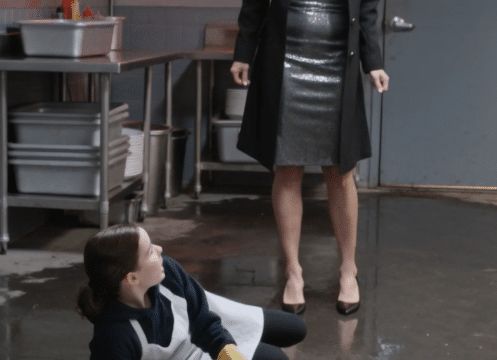
She was still standing directly behind Sarah when she took a hard step forward and drove one powerful kick into Sarah’s back.
Sarah fell beside the shopping cart and checkout counter. Her elbow struck the floor, leaving a thin trace of blood as the cart rattled and the groceries shook in their bags. The coupons slipped from her hand and scattered across the white tile.
Before Sarah could recover, Vanessa stepped close and delivered exactly two more kicks, one into Sarah’s back and another into her rib side.
A customer gasped. Another covered her mouth. The cashier stood rigid behind the register, staring at the woman on the floor.
Vanessa looked down at Sarah.
“Shop where poor people wait.”
No one had moved to help.
The coupons lay scattered between the checkout counter and Sarah’s hand, their bright little discount labels suddenly looking absurdly fragile against the polished floor.
Then a door opened behind the registers.
The management office had just emptied into the checkout lane.
And the woman stepping out of it recognized the coupons before she even looked at the person who had dropped them.
Act II
Sarah Mitchell had never considered herself a hero.
If anyone had asked her what she did for a living, she would have said she coordinated a school food program. She would probably have mentioned the paperwork, the delivery schedules, the donations that arrived late, and the occasional refrigerator that stopped working at the worst possible time.
She would not have mentioned the children who quietly took extra apples home for younger siblings.
She would not have described the boy who used to tell teachers he wasn’t hungry because he had learned that pretending was easier than admitting there was no breakfast at home.
And she certainly would not have told strangers that she had spent years building a program that helped hundreds of families get through weeks when the money simply ran out.
Sarah worked with public schools, neighborhood food pantries, and local businesses to supply nutritious groceries to children whose families needed support. Some students relied on school meals during the week but had very little food available on weekends. Others came from households where an unexpected bill could mean choosing between groceries, electricity, and transportation.
The program did not ask families to prove their suffering in public.
Its goal was to make food available without making children feel ashamed of needing it.
Sarah had joined the work after spending several years as a school counselor. She had seen how hunger changed a classroom. Children who struggled to concentrate were often labeled difficult. Students who became withdrawn were assumed to be disinterested. Some grew irritable. Others learned to smile and say everything was fine.
Sarah began keeping a small box of snacks in her office.
At first, she bought the food herself.
Then a teacher contributed granola bars. A parent brought canned soup. A local bakery donated bread at the end of each week. Soon, Sarah was coordinating a network of informal donations that became too large to manage without a proper system.
She approached grocery stores, community organizations, and food distributors. Some agreed to help. Others politely declined. A few offered donations that looked generous in advertisements but came with restrictions that made the food difficult to distribute.
Sarah kept going.
She learned how to negotiate, track inventory, calculate nutritional needs, and build reliable partnerships. She learned which foods could be stored safely, which deliveries were likely to arrive late, and how to stretch a limited budget without reducing the quality of what children received.
Eventually, her work attracted the attention of Evergreen Market, an upscale organic supermarket chain known for its carefully curated products and affluent customers.
Evergreen’s founder, Eleanor Brooks, had spent decades building the company around the idea that good food should be treated as something valuable. The stores sold organic produce, responsibly sourced pantry staples, and specialty items that were often beyond the reach of families on tight budgets.
Eleanor had also grown increasingly uncomfortable with the gap between the company’s public message and the reality outside its doors.
The chain donated food, but the donations were inconsistent. Some stores offered generous surplus boxes while others discarded perfectly usable products because no one had organized a reliable pickup system. Customers could round up their purchases for charity, but few knew exactly where the money went.
Eleanor wanted something more substantial.
When Sarah approached Evergreen with a proposal for a school pantry partnership, she expected a meeting with a community-relations manager. Instead, her plan eventually reached Eleanor herself.
Sarah didn’t ask for a publicity campaign.
She asked for predictable deliveries, affordable staples, and a transparent way to stretch donated funds. She proposed a system in which participating schools could use approved grocery credits and coupons to purchase food that met their actual needs, rather than accepting whatever happened to be left over.
Eleanor was impressed by the practical details.
Sarah had brought spreadsheets, school enrollment estimates, sample menus, and a list of the foods children were most likely to eat. She understood that a pantry filled with unfamiliar ingredients could look generous on paper while leaving families with nothing they knew how to prepare.
Most importantly, she understood dignity.
“We don’t want a child to feel like the food is a favor they have to earn,” Sarah had told Eleanor during their first meeting. “We want them to know it’s there because they belong to the community.”
Eleanor had sat quietly for several seconds after hearing that.
Then she asked Sarah to help build the program.
Over the next three years, the partnership expanded beyond anything Sarah had imagined. Evergreen introduced a dedicated school-pantry credit system, trained store employees to process the purchases, and worked with local schools to coordinate recurring orders.
The coupons were not ordinary discount slips Sarah had collected from newspapers. They were part of a controlled purchasing system funded through the chain’s community program, designed to make approved groceries available to participating schools.
Every coupon had a purpose.
Every transaction was recorded.
And every dollar could be traced.
Sarah still came to the store herself when she needed to confirm inventory or collect an order that couldn’t wait for the next scheduled delivery. She wore comfortable clothes because she spent long days carrying boxes, checking pantry shelves, and meeting school staff. She didn’t have an assistant to handle the small errands, and she didn’t consider herself too important to stand in a checkout line.
That morning, she had come to purchase the final items for a school pantry serving several elementary schools nearby.
The order included basic breakfast foods and shelf-stable supplies for families who would be collecting groceries before the weekend. A delayed delivery had left the pantry short, and Sarah had arranged an approved pickup to keep the shelves stocked.
She had expected a minor inconvenience.
She had not expected to become the target of a stranger’s contempt.
Vanessa Whitmore knew nothing about Sarah’s work. She knew nothing about the children, the schools, or the program that had turned a handful of grocery credits into a reliable source of food for families who needed it.
She saw coupons.
She saw a woman who looked ordinary.
And she decided that ordinary people should know their place.
What Vanessa did not know was that the person who had helped create Evergreen’s largest community program was now lying on the floor of one of its stores.
And the woman who owned the entire chain had just walked out of her office.
Act III
Eleanor Brooks was fifty-six years old, with silver hair, a black suit, and the composed expression of someone who had spent a lifetime making difficult decisions without needing to announce them.
She had been reviewing a quarterly report in the management office when the noise from the checkout lanes reached her. At first, she thought it was an argument about pricing. Then came the sound of a cart striking the counter, followed by a sharp gasp that made her rise from her chair.
When she opened the door, she saw the scattered coupons.
She recognized the green-and-gold markings immediately.
Then she saw Sarah on the floor.
Eleanor’s face changed.
She crossed the checkout area quickly, stopping beside Sarah before turning toward Vanessa. The scattered coupons lay between them, and the charity pantry sign behind the register announced the very program Vanessa had just insulted.
Eleanor looked from the coupons to the sign.
Then she spoke.
“Those coupons built our biggest program.”
The sentence was quiet, but it seemed to drain the air from the room.
Vanessa stared at her.
For the first time since the confrontation began, she appeared uncertain about who held the authority in the conversation.
Eleanor was not a store manager. She was not an employee who could be bullied into making an exception. She was the founder and owner of Evergreen Market, the woman whose signature appeared on the chain’s largest charitable commitments and whose decisions determined how its stores operated.
But Eleanor did not begin by asking Vanessa for her name.
She looked down at Sarah.
“Sarah, can you hear me?”
Sarah nodded faintly, one arm held close to her body.
“I’m sorry,” she whispered. “The groceries—”
“Don’t worry about the groceries,” Eleanor said immediately. “We’re worried about you.”
A staff member finally hurried forward after Eleanor instructed the store manager to call emergency services and secure the checkout area. Another employee was directed to preserve the security footage and keep the coupons and transaction records exactly as they were found.
Eleanor then turned back to Vanessa.
“What happened here?”
Vanessa straightened, instinctively returning to the posture that had served her so well in other confrontations.
“She was holding up the line,” she said. “I asked her to move, and she started arguing.”
Eleanor looked at the cashier.
The cashier swallowed hard. “Sarah was explaining the coupons. She didn’t argue with her.”
Vanessa’s mouth tightened. “I didn’t ask you.”
“That is enough,” Eleanor said.
She did not raise her voice. She didn’t need to.
Vanessa looked toward the other customers, searching for someone willing to confirm her version of events. But the expressions around her had changed. The customers who had frozen in shock were no longer merely watching an uncomfortable dispute.
They had witnessed an assault.
And the owner of the chain was standing beside the woman who had been attacked.
“Those coupons are part of our school pantry program,” Eleanor continued. “Sarah helped design it. She worked with our team to build the purchasing system, and she has spent three years making sure children receive food they can actually use.”
Vanessa blinked.
“Her coupons?”
The question escaped before she could stop it.
Eleanor regarded her steadily.
“Yes. Her work helped turn those coupons into a program that now supports schools across our region.”
Vanessa glanced at the floor again.
The coupons no longer looked like cheap pieces of paper. They were evidence of a system she had never bothered to understand, one that helped families obtain groceries without forcing them to plead for charity at a checkout counter.
But Eleanor’s explanation was not the most important part of what was happening.
Sarah had not earned the right to be safe because she had helped build Evergreen’s biggest program. She had not become worthy of respect because the owner recognized her.
She had deserved both before Eleanor walked through the door.
That was precisely why Eleanor’s next words were directed at Vanessa rather than the watching customers.
“You attacked someone in my store because you decided she was beneath you.”
Vanessa’s cheeks flushed.
“You don’t know the whole story.”
“I know what I saw when I came out here. And I will review the footage and hear the witnesses before making any further decisions.”
Vanessa looked toward the checkout counter, where the screen still displayed Sarah’s incomplete transaction. The cashier had stopped scanning the groceries. The line behind them had fallen silent.
A moment earlier, Vanessa had believed that the slow checkout gave her the right to humiliate someone.
Now every second she had spent shouting seemed to belong to the record.
Eleanor stood beside Sarah, the scattered coupons at her feet, and waited for Vanessa to answer.
For the first time, the wealthy shopper had nothing to say.
But she still did not understand how much the truth was about to cost her.
Act IV
The store manager arrived with the security supervisor just as the medical responders entered the checkout area.
Sarah was conscious, but the fall and the kicks had left her shaken and in pain. The responders assessed her injuries and prepared to take her for further medical evaluation. Eleanor stayed nearby, making sure that Sarah’s care took priority over the groceries, the register, and the growing crowd.
Vanessa watched the activity with mounting irritation.
“This is ridiculous,” she muttered. “I came here to buy a few things.”
Eleanor turned toward her.
“And Sarah came here to make sure children had food for the weekend.”
“That doesn’t give her the right to hold up an entire line.”
“No,” Eleanor replied. “And it certainly doesn’t give you the right to attack her.”
Vanessa glanced at the security supervisor. “You need to explain that I was provoked.”
The supervisor did not argue with her. He simply asked her to remain where she was while the incident was documented and the appropriate authorities were contacted.
The request appeared to offend her more than anything Eleanor had said.
“Do you know who I am?” Vanessa demanded.
Eleanor’s expression remained composed.
“No. But your name will be recorded along with the witness statements and the footage.”
It was the first time Vanessa seemed to realize that her identity might not be the most important fact in the room.
She had expected the usual sequence: an argument, a complaint, perhaps a manager offering a discount to calm everyone down. She had assumed that money could turn an unpleasant incident into a private inconvenience.
But Evergreen’s community program was governed by written policies, and its stores had clear procedures for violence and harassment. Eleanor had no intention of making an exception simply because the customer wore expensive clothes or appeared accustomed to getting her way.
The security supervisor began collecting witness information.
The cashier described the argument over the coupons. A customer near the refrigerated section confirmed that Vanessa had insulted Sarah before the attack. Another shopper said she had watched Vanessa deliver the follow-up kicks while Sarah was on the floor.
Vanessa interrupted repeatedly.
“They’re making it sound worse than it was.”
No one answered.
The security footage would speak for itself.
Eleanor asked the manager to preserve the full recording, including the moments before the confrontation. She also instructed the staff to retain the transaction logs, which showed that Sarah’s coupons were valid and had been approved for the school pantry purchase.
There would be no rumor that Sarah had misused the program.
There would be no suggestion that she had been trying to obtain personal discounts.
And there would be no opportunity for anyone to claim that the store had misunderstood why she was there.
The facts were simple.
Sarah had been making an authorized purchase.
Vanessa had become impatient.
Vanessa had insulted her, then assaulted her.
Everything else was an attempt to distract from those facts.
When Sarah was ready to be moved, Eleanor leaned close enough for her to hear.
“The groceries will be taken care of. You don’t need to worry about the pantry.”
Sarah looked toward the cart.
“The children are expecting them tomorrow.”
“They will have them tomorrow.”
“Please make sure the order stays the same. There are allergy requirements for one of the schools.”
Even now, Sarah was thinking about the children.
Eleanor felt a tightness in her chest. She had met many people who spoke passionately about charity when cameras were present. Sarah was the kind of person who remembered the allergy requirements when she was hurt, frightened, and surrounded by strangers.
“I’ll make sure,” Eleanor promised.
As the responders prepared to escort Sarah out, Vanessa took a step toward the manager.
“I expect this store to apologize for how I’ve been treated.”
The manager stared at her in disbelief.
Eleanor answered before anyone else could.
“You will be asked to leave the premises once the necessary procedures have been completed. Your conduct will be reviewed, and the incident will be handled through the appropriate channels.”
“You can’t ban me for an argument.”
“This was not an argument.”
Vanessa looked around for support. She found none.
The customers who had once seemed intimidated by her were now watching with quiet, unmistakable disapproval. The cashier had stopped looking at the floor. The security supervisor stood close enough to make clear that Vanessa would not simply walk away and resume shopping as though nothing had happened.
Then Eleanor said something that made the final piece fall into place.
“Evergreen’s school pantry program is not a publicity campaign. It exists because families deserve access to food without humiliation. Sarah helped us build a system that protects that dignity. What happened here is the opposite of everything we stand for.”
Vanessa’s face went pale.
The coupons had not merely been valid.
They had represented one of the most important initiatives in the company’s history. Sarah had helped build the process that allowed the program to expand without losing accountability, and Eleanor had trusted her judgment enough to make it a cornerstone of Evergreen’s community work.
Vanessa had attacked the person who helped make that possible, in a store owned by the woman who had championed it.
Yet even then, Eleanor did not threaten to destroy Vanessa’s life or promise a theatrical revenge.
She did not need to.
The footage, the witnesses, and the documented transaction were enough to ensure that the incident would not disappear into a quiet corporate apology.
The consequences would follow the evidence.
And Vanessa was finally beginning to understand that no amount of money could make the evidence stop existing.
Act V
The school pantry received its groceries the following morning.
The store manager arranged for the approved order to be packed and delivered on schedule, including the allergy-safe items Sarah had been so worried about. A second employee accompanied the delivery to confirm that every item matched the pantry’s requirements.
Eleanor personally reviewed the report before the shipment left.
She also made sure the store followed the proper process for documenting the assault, cooperating with the investigation, and addressing the safety of its employees and customers. Vanessa was barred from returning to the store while the matter was reviewed, and the incident was referred to the appropriate authorities.
Her conduct had consequences beyond the checkout lane. Her employer was notified where appropriate, and the investigation proceeded on the basis of the available evidence rather than the status she claimed.
There was no magical moment in which everyone suddenly forgot what had happened. Sarah still needed time to recover. The witnesses still had to provide statements. The store still had to answer difficult questions about why so many people had frozen instead of intervening.
But the truth was no longer in danger of being rewritten by the loudest person in the room.
Sarah returned to the pantry several days later.
She wore her familiar green jacket, though she moved more carefully than usual. The shelves were stocked, the delivery records were complete, and a group of volunteers were preparing bags of groceries for families scheduled to collect them that afternoon.
One of the volunteers, a retired teacher named Mrs. Lawson, approached her with a worried expression.
“We heard what happened,” she said. “You don’t have to be here today.”
Sarah looked around the pantry.
A stack of breakfast cereal waited beside boxes of oatmeal. Apples filled a crate near the door. On a table, volunteers were sorting pantry staples into bags sized for different households.
“I wanted to make sure the delivery arrived,” Sarah said.
Mrs. Lawson touched her arm gently, careful not to press against the injured area.
“It did. Eleanor called herself to check.”
Sarah smiled faintly.
“Good.”
For a moment, she stood quietly in the middle of the room, listening to the soft sounds of people working. There were no polished marble floors here, no designer handbags, and no line of impatient shoppers measuring one another’s worth.
There were only people doing their best to make sure someone else had enough.
A little boy arrived with his mother later that afternoon. He looked at the grocery bags and then at Sarah.
“Are these for us?”
“They are,” Sarah told him.
He looked into the bag and spotted a package of oatmeal.
“My dad makes this when it’s cold.”
Sarah crouched slightly so she could meet his eyes.
“Then I hope you have a lot of warm mornings.”
The boy grinned and hurried back to his mother.
It was a small moment, almost invisible from the outside. But it was the reason Sarah had spent years building the program. Not because she wanted recognition, not because she expected wealthy business owners to praise her, and certainly not because she wanted to become the center of a public controversy.
She wanted children to have food.
She wanted parents to walk into a pantry without feeling that every person watching them was deciding what they deserved.
And she wanted the process to work reliably enough that no family had to depend on someone’s mood or generosity to get through the week.
A few weeks after the incident, Eleanor invited Sarah to Evergreen’s headquarters to discuss the future of the school pantry program.
Sarah arrived with her laptop and a folder of updated figures. She had identified several improvements to the coupon system, including clearer labels for cashiers, better training materials, and a faster verification process that would reduce delays during busy shopping hours.
Eleanor listened carefully as Sarah explained the changes.
When the meeting ended, she closed the folder and looked across the table.
“I want you to know that what happened in the store was unacceptable. Not because of your role in our program, but because no one should be treated that way.”
Sarah held her gaze.
“Thank you.”
“I’ve also been thinking about the people who watched it happen.”
Sarah looked down briefly.
“So have I.”
Eleanor did not defend the bystanders. She did not pretend that fear was an excuse for silence. Instead, she explained that Evergreen would review its employee response procedures and provide clearer guidance for dealing with violence in public areas.
The goal was not to turn every customer into a security officer. It was to ensure that staff knew how to call for help, protect people at risk, and avoid leaving a victim isolated while everyone waited for someone more powerful to arrive.
Sarah agreed that the changes mattered.
Then she returned to the subject she had brought to the meeting.
“The coupon system still needs work,” she said. “If we make the verification process clearer, we can reduce the wait without making the program harder for schools to use.”
Eleanor smiled.
“That’s why I asked you here.”
Sarah was not promoted into some glamorous position or transformed into a symbol overnight. Her work continued to involve spreadsheets, deliveries, phone calls, and the thousand small details that made a community program dependable.
But the partnership grew stronger. Evergreen expanded the pantry initiative to additional schools, improved its training for checkout employees, and created a more reliable process for approved community purchases.
The coupons that Vanessa had dismissed became part of a larger network serving more families.
And Sarah continued to use them without apology.
As for Vanessa, the phrase she had spoken in the checkout lane remained at the center of the incident: Shop where poor people wait.
It had revealed more about her than she intended.
She had believed that the people who needed assistance should be kept out of sight. She had mistaken financial comfort for moral authority and inconvenience for an excuse to humiliate another human being.
She had seen Sarah’s coupons and concluded that Sarah was beneath her.
She had never considered that the woman in the green jacket might have built something valuable, because she had never believed value could exist without the outward signs of wealth.
That was her mistake.
But the deeper lesson was not that Sarah deserved respect because the supermarket owner recognized her. It was not that a person should be treated kindly because they might secretly be influential, connected, or important.
Sarah deserved respect when she stood in line with coupons.
She deserved respect when she wore worn sneakers.
She deserved respect when the cashier needed extra time to verify a purchase.
And she deserved respect even if no owner had ever heard her name.
One morning, Sarah returned to Evergreen to collect another school pantry order. The express lane was busy, and a young cashier paused to verify her coupons.
“I may need another minute,” the cashier said apologetically.
Sarah smiled.
“That’s okay. Take your time.”
The cashier checked the codes, confirmed the authorization, and continued scanning the groceries. No one complained. No one demanded that Sarah leave. The line moved at its own pace, and the world did not collapse because a transaction required a little patience.
Behind the register, the school pantry sign remained where it had always been.
Sarah gathered the approved coupons and tucked them into her folder.
Then she pushed the cart toward the exit, carrying groceries that would soon become breakfasts, packed lunches, and dinners in homes where every little bit mattered.
She did not look like a millionaire.
She did not look like an executive.
She looked like a woman going to work.
And that was enough.
Because the true measure of a person had never been the price of her coat, the weight of her handbag, or the speed with which she could pay at a checkout counter.
It was what she chose to do when someone else needed help.
Vanessa had used her privilege to make a vulnerable person feel small.
Sarah had used her time, patience, and determination to help thousands of people feel less alone.
One woman had mistaken money for importance.
The other had built something that mattered.
And when the coupons finally lay scattered across the supermarket floor, the truth was waiting among them: the value of what Sarah carried had never depended on what she could afford to buy for herself.