Act I
The elevator doors had barely opened when the executive decided the young woman standing in front of them had made a mistake simply by being there.
“Trash. Executive elevators are not for you.”
His voice cracked across the marble lobby of the glass-and-steel office tower, loud enough to turn heads and sharp enough to make several people slow their steps. A security guard looked up from his desk. Two employees near the reception counter exchanged uncomfortable glances. Even the elevator doors seemed to pause in their silent descent.
The woman in the black hoodie kept one hand near the badge scanner. Her blonde hair was tied back, her jeans were faded at the knees, and the sneakers beneath her were worn from years of walking between offices, server rooms, and testing facilities. A laptop backpack rested against her shoulders.
She looked nothing like the executives who crossed the lobby every morning in tailored suits and polished shoes.
That, apparently, was all the man behind her needed to know.
“I am authorized to test this elevator,” she said.
Her tone was calm. Not apologetic, not defiant. Just factual.
The man gave a short, contemptuous laugh. He was in his mid-forties, with slick black hair, a dark blue suit, a silver tie, and a leather briefcase that probably cost more than the laptop inside her backpack. He had the practiced expression of someone accustomed to having doors opened before he reached them.
“Authorized?” he repeated. “Do you have any idea who uses this elevator?”
She turned slightly, careful not to step away from the scanner. “Yes. That’s why I’m here.”
His face tightened.
The executive elevator was reserved for senior leadership and designated personnel. The access system had been undergoing a security upgrade, and the young engineer had arrived before the morning rush to run a final series of tests. Her technical badge was supposed to grant temporary access under controlled conditions.
The elevator had opened exactly as designed.
The executive behind her had interpreted that success as an insult.
“Take the service stairs,” he ordered.
She drew a breath. “Sir, if you would give me a moment—”
He didn’t let her finish.
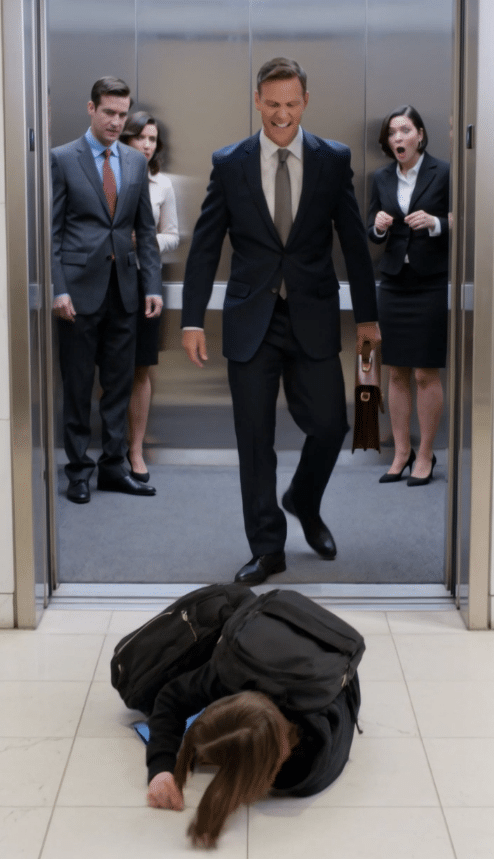
Standing directly behind her, he took a hard step forward and drove one powerful kick into her back.
She fell beside the elevator threshold. Her laptop backpack struck the white stone floor with a heavy slap, and one hand shot out to catch her weight. Pain flashed across her face as her forearm scraped against the marble, leaving a thin trace of blood.
For a moment, the lobby seemed to lose every sound except the hum of the elevator.
Then the man stepped closer.
He delivered exactly two more kicks, one into her back and the other into her rib side.
A woman near reception covered her mouth. Someone whispered, “Oh my God.” The security guard rose halfway from his chair but stopped, staring at the executive as if he couldn’t reconcile what he had just witnessed with the expensive suit and confident posture.
The young engineer curled instinctively around the pain, trying to breathe through it.
The man looked down at her.
“Take the service stairs.”
He said it as though he had merely corrected an employee who had used the wrong entrance.
No one moved to help her.
Then the elevator doors began sliding open again.
And the man who had just attacked her was about to discover that the most dangerous person in the lobby was not the woman on the floor.
It was the person stepping out of the elevator.
Act II
The young woman’s name was Claire Bennett.
She was twenty-five years old, and for the previous three years she had worked as a software engineer specializing in access-control systems, authentication protocols, and building security infrastructure. Her job required her to understand not merely how a door opened, but why it opened, who had permission to pass through it, and what happened when someone tried to force the system to make the wrong decision.
She had spent more nights in testing laboratories than she cared to count.
While other employees went home, Claire often remained in front of a wall of monitors, tracing obscure software failures that only appeared under unusual conditions. She had learned to distrust easy explanations. A green light did not always mean a system was secure. A successful login did not always mean the person behind it was legitimate.
And a badge that opened an executive elevator did not automatically mean the person holding it belonged in the executive suite.
Sometimes, it meant the system was doing precisely what it had been designed to do.
Claire had joined Meridian Tower’s security modernization project six months earlier. The building housed several major technology firms, a private investment group, and the headquarters of a rapidly growing software company called Northstar Systems. Its upper floors were accessible only through a network of integrated scanners, identity credentials, and elevator controls.
Northstar had invested millions in making the system difficult to manipulate.
Claire was responsible for testing the weakest points.
She was also the youngest engineer on the core project team, a fact that had made her an easy target for people who confused age with inexperience. She rarely wore expensive clothes, avoided corporate networking events, and didn’t know how to perform the little rituals that seemed to impress certain executives.
She preferred logs to small talk.
Her manager, Daniel Reeves, had once joked that Claire could identify a security vulnerability faster than she could identify the most senior person in a room.
Claire had laughed at that.
She had no idea how prophetic the joke would become.
The man who attacked her was Richard Voss, a senior executive at one of the companies leasing space in Meridian Tower. He had spent nearly two decades cultivating a reputation for efficiency, aggression, and an almost theatrical intolerance for anything he considered beneath him.
People called him decisive when he was in the room.
When he left, they used different words.
Richard believed the world functioned through visible hierarchies. A tailored suit meant authority. A leather briefcase meant importance. A young woman in worn sneakers meant someone who should be grateful to enter the building at all.
He had never asked what Claire did.
He had never read the notices about the elevator security trial.
And he had never bothered to check the names of the engineers whose credentials had been approved for that morning’s testing window.
He had simply watched Claire scan her badge and seen something he thought he had the right to punish.
The cruelest part was that Claire had not even been trying to take his place.
She had been trying to finish her work before the building filled with hundreds of people.
That morning’s test was the final stage of a months-long project. The executive elevator had been fitted with a new authorization module designed to prevent cloned badges, unauthorized overrides, and a vulnerability that had once allowed a compromised maintenance credential to reach restricted floors.
Claire had personally helped rewrite the logic governing temporary access.
Her badge was a technical credential, not a ceremonial privilege. It had been authorized, logged, and verified through the tower’s central security platform.
The system had opened the elevator because she belonged there.
Richard, meanwhile, had spent years believing that belonging was something he could determine by looking at someone.
As Claire lay on the floor, he still seemed convinced that the problem was hers.
He glanced toward the watching employees, expecting someone to agree with him. Perhaps a nervous laugh. Perhaps a guard rushing to remove the embarrassing obstacle from his path.
Instead, he saw faces turned toward him in disbelief.
For the first time, his certainty flickered.
He straightened his silver tie.
Then the elevator doors opened wider, and a gray-haired man in a black suit stepped into the lobby.
The man looked down.
He saw Claire’s fallen technical badge.
And the expression on his face changed.
Act III
The man stepping from the elevator was David Mercer, the fifty-three-year-old chief executive officer of Northstar Systems.
He was not the kind of executive who announced himself with a procession of assistants. He rarely raised his voice, rarely interrupted, and almost never made a public display of anger. Employees who worked closely with him knew that his quietest questions were often the ones that mattered most.
He had been inside the elevator during the final portion of Claire’s security test.
From the car, he had heard the shouting.
He had heard the impact.
And when the doors opened fully, he saw a young engineer on the floor beside the threshold, her backpack overturned and her technical badge lying near her outstretched hand.
David moved toward her first.
He didn’t look at Richard. He didn’t ask who had started the argument. He didn’t glance around to see which witnesses were important enough to notice.
He looked at Claire.
“Claire?”
She lifted her head with visible effort.
“I’m okay,” she managed, though the strain in her voice contradicted the words.
David’s jaw tightened. He turned toward the nearest security guard.
“Call emergency medical services. Preserve the lobby footage. No one deletes or overwrites anything from this incident.”
The guard finally moved.
David then stepped into the open elevator doorway, placing himself between Richard and the woman on the floor. The access scanner remained lit beside them, displaying the successful authorization from Claire’s badge.
Only then did he address the executive.
“This elevator only opened because of her.”
The sentence was quiet.
It was also the last thing Richard expected to hear.
He stared at David, then at the scanner, then at the badge on the floor. The arrogance that had carried him through the confrontation began to falter as his mind struggled to fit the scene into the hierarchy he understood.
“Because of her?” he repeated.
David did not answer immediately.
He bent to retrieve Claire’s badge, careful not to interfere with the evidence around it. The screen beside the elevator still displayed the test session identifier and the credential status: AUTHORIZED — SECURITY VALIDATION MODE.
Richard looked at the words without understanding their significance.
Claire did.
She had written the validation sequence that morning. The elevator’s temporary authorization depended on a chain of checks that she had spent months refining. The system was designed to permit approved technical personnel to test restricted access without granting them unrestricted access to every floor.
The elevator had opened because Claire had made the software recognize a valid credential.
And David Mercer knew exactly whose work he was looking at.
Three weeks earlier, the tower’s security team had discovered an attempted intrusion into a restricted network. Someone had tried to exploit an outdated maintenance credential to gain access to Northstar’s executive systems. The breach had been stopped, but the investigation revealed that the building’s old elevator authorization logic was less reliable than anyone had realized.
Claire had found the flaw.
Not a consultant with a polished presentation. Not an executive with a strategy deck. Claire had isolated the problem, reproduced it, and built the testing framework that allowed Northstar to verify the fix.
Her report had been the reason David approved the final security trial.
He had personally requested that she lead the last validation session because she was the one engineer who had insisted the system should be tested under realistic conditions rather than merely demonstrated under perfect ones.
That morning, she had been doing exactly that.
David knew she had arrived early. He knew her badge would open the elevator under the test protocol. He knew that without her work, the building’s most exclusive access system would still contain a vulnerability that could have exposed thousands of employees and confidential records.
Richard knew none of it.
He had seen a hoodie.
He had seen worn sneakers.
He had seen a woman who did not look powerful enough to challenge him.
And he had attacked her for standing where she had every right to stand.
David finally looked directly at him.
“Do you understand what you’ve done?”
Richard opened his mouth.
Nothing came out.
Behind him, the people who had watched in silence began to understand the scale of the mistake. The engineer he had dismissed as trash was not an intruder. She was not a lost visitor. She was not a low-level employee who had wandered into the wrong elevator.
She was the person who had made the elevator secure enough to open in the first place.
And the CEO was standing in the doorway because he trusted her work.
But David’s words carried a second meaning, one Richard had not yet fully grasped.
The elevator was only the beginning.
Act IV
The first person to break the silence was a receptionist named Monica Ellis.
“I saw the whole thing,” she said, her voice trembling. “He kicked her.”
Her statement seemed to unlock something in the room.
A man near the turnstiles stepped forward. A woman holding a coffee cup nodded sharply. The security guard returned with his radio in hand and immediately began coordinating assistance.
Until David had arrived, everyone had been watching Richard as if his title gave him permission to control the scene. Now they were watching him as if they had finally remembered that he was accountable for what he did.
Richard noticed the change.
“Hold on,” he said, raising a hand. “This is being blown out of proportion.”
David’s expression did not change.
“An employee was assaulted in the lobby of a building where she was authorized to work. That is not a misunderstanding.”
“She came at me with an attitude.”
“She explained that she was authorized.”
“She was blocking the elevator.”
“She was testing the elevator.”
Richard’s eyes darted toward the badge scanner, as though he hoped it might suddenly produce a different answer. “I didn’t know who she was.”
David’s voice grew colder.
“That is not a defense.”
The words settled over the lobby.
Claire had been helped into a seated position by medical responders. She was conscious, shaken, and in pain, with a thin trace of blood along her forearm. One responder asked her not to stand until they had assessed her injuries.
Her laptop backpack lay nearby, its contents still inside but the outer casing scuffed from the fall.
She watched David from the floor.
She had seen executives defend their own before. She had seen managers bury complaints because the person accused of misconduct brought in valuable contracts. She had seen companies issue carefully worded statements that said nothing at all.
She had not expected the CEO to put himself between her and the man who had hurt her.
But David wasn’t doing it because he had suddenly discovered that Claire mattered.
He was doing it because she had mattered before Richard entered the lobby.
Her work mattered. Her authorization mattered. Her right to be there mattered. The fact that Richard had failed to recognize any of those things did not make them less real.
“Mr. Mercer,” Richard said, lowering his voice, “I’m sure we can handle this privately.”
David looked at him for a long moment.
“Privately?”
Richard gave a strained smile. “There’s no reason to turn a small incident into a public spectacle. We both have companies to think about.”
A few feet away, Monica stared at him in disbelief.
A small incident.
Richard had kicked a woman to the floor, delivered two more kicks while she was down, and then ordered her to take the service stairs. Now he wanted the witnesses to pretend that the problem was the attention he had attracted.
David reached into his jacket and took out his phone.
“Security will preserve the footage. The witnesses will be interviewed. Your employer will be notified, and the incident will be documented through the appropriate channels.”
Richard’s face reddened.
“You can’t do that.”
“I just did.”
“You don’t even know the circumstances.”
“I know what I saw when the doors opened. I know what the witnesses are reporting. And I know what the access logs show.”
David glanced at the scanner again.
The system had recorded Claire’s credential, the authorization time, and the successful elevator release. It had done precisely what the security team had asked it to do. There was no unauthorized entry to investigate, no stolen badge, no malfunction to blame.
The only thing that had failed that morning was Richard’s judgment.
And that failure had been recorded in front of a lobby full of witnesses.
Richard looked toward the guard. “I’m a senior executive. You should be asking her why she was allowed to use that elevator.”
The guard did not answer.
David did.
“She was allowed to use it because her authorization was valid. The question now is why you believed that gave you the right to assault her.”
For the first time, Richard seemed to recognize that the people around him were no longer waiting for him to explain himself.
They were waiting to see what happened next.
He adjusted his briefcase, but his fingers had begun to shake. His earlier confidence had depended on the assumption that everyone would accept his version of events. Without that assumption, his expensive suit looked less like armor and more like a costume.
“I want my lawyer,” he muttered.
“You are entitled to seek legal advice,” David replied. “You are not entitled to erase what happened.”
The medical team continued assessing Claire. David asked one of his senior staff members to make sure she received whatever care she needed and that her project responsibilities were covered without pressure to return before she was ready.
He also made it clear that no one was to approach her for a statement on behalf of the company until she had been given the opportunity to receive medical attention and decide how she wanted to proceed.
Richard heard all of it.
The CEO was protecting the engineer’s right to make her own decisions, not taking control of her story for the sake of corporate image.
That distinction unsettled him more than anger would have.
He had expected David to be concerned about the elevator, the lobby, and the embarrassment of a public confrontation. Instead, David was treating the assault as the central issue and the security system as supporting evidence.
Then Claire spoke.
Her voice was weak, but clear enough that the nearest people turned toward her.
“The access system worked.”
David looked down at her.
She swallowed against the pain. “The authorization was correct. The elevator opened exactly when it was supposed to.”
For a brief moment, nobody said anything.
Even now, after what had happened, Claire was thinking like an engineer. She wanted the facts preserved. She wanted the system’s behavior documented accurately. She would not let Richard’s actions turn a successful security test into a false story about unauthorized access.
David nodded.
“I know,” he said. “And we’re going to make sure the record reflects that.”
Richard’s face drained of color.
Because now the incident was no longer just a confrontation between an executive and a young employee. It was a documented assault that had occurred during a legitimate security test, with the CEO as an immediate witness and the building’s own records confirming Claire’s authorization.
The story could not be rewritten by a confident voice in a tailored suit.
And for the first time in his career, Richard had no obvious way to make it disappear.
Act V
By the following morning, the video had become the subject of an internal investigation.
Meridian Tower’s security team preserved the lobby footage, the elevator access logs, and the relevant badge-scanner records. Witness statements were collected, and the incident was referred through the appropriate workplace and legal channels.
No one needed to exaggerate what had happened.
The footage showed Richard standing behind Claire, becoming angry over her use of the executive elevator, and attacking her. It showed her falling beside the threshold, her backpack striking the floor, and the two additional kicks that followed. It showed the bystanders freezing, then David Mercer stepping from the elevator and moving between them.
It also showed the scanner still lit beside the doorway.
Claire had been authorized.
Richard had been wrong.
And neither his job title nor the price of his briefcase could change those facts.
His employer placed him on leave while it reviewed the incident. Northstar suspended his access to restricted areas pending the investigation, and the tower’s management began reviewing its procedures for handling violence and misconduct in shared spaces.
The consequences did not arrive through a dramatic announcement or a sudden public humiliation. They came through records, interviews, policies, and decisions that Richard could not control simply by demanding that someone listen to him.
For Claire, the days that followed were quieter and more difficult.
The physical pain faded gradually, but the memory of the lobby stayed with her. She remembered the sound of her backpack hitting the floor. She remembered looking up at faces that seemed frozen behind invisible glass. Most of all, she remembered the terrible seconds when she realized that the people around her were afraid to intervene.
She had spent years designing systems that recognized the difference between legitimate access and unauthorized intrusion.
She had never imagined that a public lobby could become a place where people watched an obvious wrong unfold because the person committing it looked important.
David visited her after she had received medical care and was ready to discuss the project. He did not ask her to forgive Richard. He did not tell her that the company needed her to be strong, or suggest that the incident should be put behind her for the sake of everyone else.
Instead, he asked what she needed.
Claire thought about it.
“I want the test results preserved,” she said. “I don’t want anyone saying the elevator malfunctioned because of what happened.”
David nodded. “They won’t.”
“And I want the access system to remain under review. If there’s a flaw, we fix it. If there isn’t, we document that too.”
For the first time since the assault, a small, tired smile crossed her face.
“That part shouldn’t change just because someone made a scene.”
David returned the smile.
“No,” he said. “It shouldn’t.”
In the weeks that followed, Claire’s security report became the basis for the final approval of the elevator system. The vulnerability she had helped uncover was closed, and the testing framework she had developed was adopted for other restricted-access areas in the tower.
Her achievement was not transformed into a fairy tale. She did not suddenly become a celebrity or receive an office overlooking the city simply because she had been attacked. She remained an engineer, doing the careful, unglamorous work that kept people and information secure.
But something did change.
People who had once looked past her began asking about her work. Some apologized for the silence in the lobby. Monica, the receptionist, approached Claire one afternoon and admitted that she had frozen because she was afraid of what Richard might do if someone challenged him.
“I keep thinking I should have moved sooner,” Monica said.
Claire considered that before answering.
“I wish someone had,” she said. “But I understand being scared.”
She did not pretend the moment had been harmless. She did not absolve the people who had stood still. Yet she understood that fear could make ordinary people hesitate, especially when the person causing the fear appeared to have power over their lives.
What mattered now was whether they learned from it.
As for Richard, the investigation forced him to confront something he had spent years avoiding: the difference between authority and entitlement. He had treated his position as permission to decide who deserved dignity. When confronted with the consequences, he tried to make the issue smaller, then private, then someone else’s fault.
None of those attempts changed the record.
The man who had ordered Claire to take the service stairs was no longer able to dictate the terms of the conversation. His employer had to assess his conduct. Witnesses had spoken. Security footage existed. The CEO had seen the aftermath with his own eyes.
And Claire’s badge remained in the system as proof that she had belonged there all along.
One morning, several weeks after the incident, she returned to the executive elevator for another scheduled security check. She wore a black hoodie again, with her laptop backpack over one shoulder and her technical badge clipped securely near the strap.
The lobby was busy. Office workers crossed the white stone floor, the reception desk glowed beneath its lights, and the executive elevator waited behind its polished doors.
Claire scanned her badge.
The scanner flashed green.
The doors opened.
For a moment, she remembered Richard’s voice.
Executive elevators are not for you.
Then she stepped forward.
The elevator had never needed her to look powerful. It had needed her credentials to be valid, her work to be sound, and the system to recognize the truth.
That was the principle she had built into the software.
It was also the principle Richard had failed to understand.
Behind her, the lobby continued moving. People hurried toward meetings, checked their phones, and crossed paths without knowing anything about the engineer whose work had helped secure the building.
Claire entered the elevator and turned toward the control panel.
Before the doors closed, David Mercer appeared at the far end of the lobby. He caught her eye and gave her a small nod.
She returned it.
No speech was necessary.
The doors slid shut, carrying her toward the floors she had helped protect.
And somewhere beyond the polished stone and glass, the consequences of that morning continued unfolding—not because Claire had been secretly more deserving than Richard, not because she had possessed a title he failed to recognize, but because she had been a human being who deserved safety before anyone knew her name.
Richard had looked at her worn sneakers and decided she belonged beneath him.
The CEO had looked at the evidence and recognized the person standing in front of him.
The difference between those two judgments had changed everything.
And the most devastating part of the story was not that Richard had underestimated the woman he attacked.
It was that he had believed he needed to know who she was before he had any reason to treat her with respect.