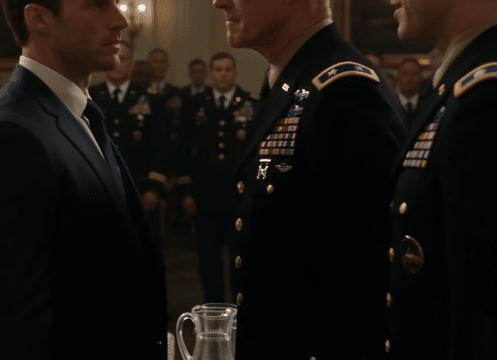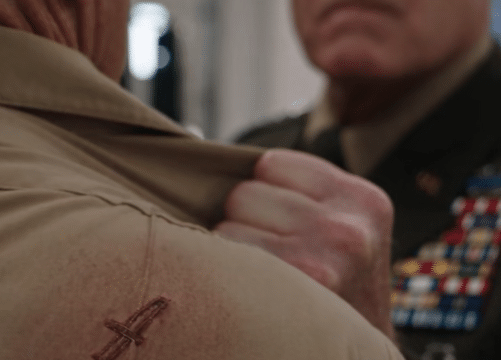
Act I
“General, she shut down your refuel.”
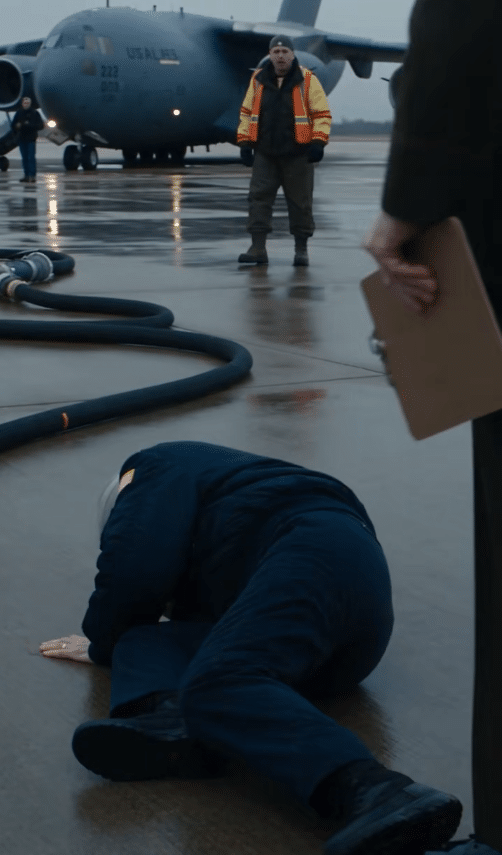
The Captain’s voice carried across the aircraft fuel point, where ground crews stood beside massive tankers and thick hoses snaked across the concrete beneath amber safety lights. An aircraft waited near the runway, its crew expecting a quick refuel and an on-time departure. Beside a leaking coupling stood an elderly woman in a dark civilian aviation jacket, holding an inspection tag.
The Brigadier General turned toward her.
“That coupling is leaking,” she said.
Her voice was calm, almost clinical. She pointed toward the connection, where a thin sheen of fuel had begun spreading across the fitting. The woman didn’t look at the General’s insignia or the impatient personnel gathered behind him. She looked at the leak.
The General saw something else entirely: an old civilian standing between him and his schedule.
“You grounded my aircraft over that?”
“It’s a safety issue,” she replied.
He stepped closer, his face tightening with contempt. At forty-seven, he had already learned how to make subordinates nervous with a glance. He expected the same instinctive submission from everyone, regardless of their job or experience.
The woman offered him no such satisfaction.
He snatched the inspection tag from her hand.
Then he slapped her across the face.
She staggered beside a safety cone, her cheek reddening almost immediately. Before she could regain her footing, he kicked her hard in the torso, then struck her again with two forceful kicks as she struggled on the concrete. Her inspection tag skidded away across the fuel-stained pavement.
The ground crew froze.
The woman remained conscious, breathing through the pain. A faint trace of blood appeared at her lip, but her eyes moved past the General toward the leaking coupling.
“Old inspectors don’t ground my aircraft,” he said.
He expected her to retreat. He expected an apology, perhaps even a frightened explanation about why she had dared to interfere with a senior officer’s plans.
Instead, she pushed herself upright without assistance.
Her hand pressed briefly against her sore torso. She collected herself, looked at the fuel connection again, and stood between the aircraft and the unresolved hazard.
The General’s expression darkened.
He had struck her to prove that he controlled the situation.
But the aircraft was still grounded, the coupling was still leaking, and the woman he had tried to intimidate was still refusing to move.
Then an older man in a civilian flight jacket stepped into view.
He looked at the woman’s face, stopped dead, and whispered two words as if he could hardly believe they belonged in the same sentence.
“Blue Viper…?”
The General turned toward him.
And for the first time, someone on that runway looked more frightened of the name than of the man wearing the stars.
Act II
Her name was Eleanor Hayes.
At sixty-eight, Eleanor had silver hair tied neatly at the back of her neck, a weathered face, and the kind of stillness that made her difficult to read. She wore no visible decorations, no rank insignia, and no uniform that announced the years she had spent serving her country.
To anyone passing through the airfield, she looked like a retired technical consultant who had stayed too long in a profession that demanded younger eyes and faster reflexes.
That assumption had followed her for years.
Eleanor rarely corrected it.
She had learned that people often listened more carefully to a warning when they believed it came from someone who had nothing to gain by giving it. She preferred to inspect the equipment, identify the problem, and let the evidence speak.
The fuel coupling had given her no reason to hesitate that morning. Its seal was compromised, and the leak required the connection to be secured before refueling could continue. The aircraft’s departure time didn’t change that reality.
Fuel didn’t care about rank.
Neither did fire.
The Brigadier General, however, had built his career around the belief that urgency justified pressure. He was responsible for aircraft schedules, operational readiness, and the performance of the people under his command. Delays reflected badly on him, and he had become accustomed to solving inconvenient problems by demanding that someone else remove them.
When the Captain reported that Eleanor had stopped the refuel, the General didn’t ask for the inspection findings.
He heard a subordinate describing an obstacle.
He saw a woman whose plain clothes suggested she lacked the authority to challenge him.
And when she refused to back down, he decided to make the disagreement personal.
What he didn’t know was that Eleanor had once worn three stars of her own.
She had been a lieutenant general and a combat pilot, a woman who had flown in conditions that reduced experienced crews to silence. Her career had included missions where the margin between a successful return and a memorial service was measured in seconds.
She had commanded people whose names she still remembered long after the paperwork had been filed away.
But Eleanor had never believed that past achievements entitled her to disregard present responsibilities. Retirement had changed her schedule, her wardrobe, and the way strangers addressed her.
It had not changed the rules of aviation safety.
That was why, even after the assault, she had kept looking at the coupling.
Her cheek throbbed. Her breathing remained shallow, and every movement reminded her of the General’s kicks. Still, she retrieved the inspection tag and examined the fuel connection from a safe distance.
The ground crew watched her in uneasy silence.
Some had recognized the danger before the General arrived. Others had noticed it only when Eleanor pointed it out. Now all of them understood that the problem had never been her attitude.
It was the leak.
And the officer who had attacked her was still standing between the aircraft and the truth.
Then the retired pilot who had spoken her old nickname took another step forward.
He had spent decades trying to forget certain sounds: alarms in a cockpit, warnings over a headset, and the sudden absence of a voice that should have answered.
He had never expected to see Eleanor Hayes again.
And he had certainly never expected to see her standing on a runway after a brigadier general had knocked her to the ground.
Act III
The retired pilot’s name was Frank Mercer.
He was seventy, with gray hair, a civilian flight jacket, and the posture of a man who still instinctively watched aircraft movements whenever he entered an airfield. He had once served alongside pilots whose names became stories in squadron lounges and whose accomplishments were discussed in careful fragments long after their service ended.
Frank was not a man who startled easily.
But the moment he recognized Eleanor, the years seemed to fall away from his face.
“Blue Viper…?”
He spoke the nickname quietly, almost cautiously, as if saying it too loudly might bring back something he had spent decades trying to put behind him.
Eleanor turned toward him.
For a fraction of a second, recognition passed between them. It was not the cheerful surprise of two old colleagues meeting at a reunion. It was the heavier look of people who remembered the same dangerous chapter of their lives—and knew that neither could tell the whole story in front of strangers.
Eleanor gave him the smallest nod.
Frank’s gaze dropped to the inspection tag in her hand, then moved to her swollen cheek.
His expression hardened.
The General noticed the exchange and gave an impatient laugh.
“Blue Viper? What is that supposed to be?”
Frank didn’t answer.
He continued looking at Eleanor, his face carrying a mixture of disbelief and respect. He seemed to be checking that the woman in front of him was real, that the name he remembered belonged to the same person who had just been struck down beside a safety cone.
A second officer had heard the nickname.
The Wing Commander, a forty-five-year-old aviation officer, had been standing near the aircraft with several members of the operations team. He turned sharply toward Frank.
“General… stop. Please.”
The words came out low and urgent.
The Brigadier General looked at him in disbelief.
The Wing Commander had worked under senior aviation leaders for years. He understood the difference between an old nickname and a name that could alter the temperature of an entire conversation.
He had heard stories about Blue Viper long before he had enough experience to understand them. The stories had arrived in pieces: a call sign mentioned by a veteran instructor, an account of a mission that ended differently than expected, a senior pilot going silent when someone asked who had flown the lead aircraft.
No one had ever given him the full history.
No one had needed to.
The name had survived because the people who knew it remembered what it meant to trust the person carrying it.
Now the Wing Commander was looking at Eleanor Hayes, and the stories were suddenly standing in front of him.
The General followed his gaze.
Then he laughed.
“Blue Viper? Her?”
The question was designed to make the others feel foolish. He wanted Frank to admit that he had mistaken an elderly consultant for someone from his past. He wanted the Wing Commander to remember who outranked whom.
But neither man smiled.
Eleanor wiped the trace of blood from her lip with the back of her hand. She didn’t look pleased by the recognition. She didn’t straighten her shoulders or attempt to reclaim the authority she had once possessed.
She simply looked at Frank.
“He didn’t question the name back then.”
The sentence landed with a weight the General couldn’t measure.
Frank lowered his eyes for a moment.
The Wing Commander went completely still.
And the General’s smile began to fade.
Because Eleanor hadn’t said that Frank remembered her.
She had said he had never questioned the name.
It was a distinction that suggested the nickname had once been more than a story, more than an affectionate label shared between old pilots.
It had been a fact accepted under circumstances where questioning it might have cost lives.
Act IV
The General’s confidence began to fracture in small, visible ways.
First, he looked at Frank, hoping the retired pilot would explain that this was all a misunderstanding. Then he looked at the Wing Commander, expecting a more reasonable account from an officer who still served under the military’s current chain of command.
Neither offered him one.
The fuel point had become strangely quiet. Engines continued humming in the distance, and a ground vehicle rolled slowly along the service road, but the people closest to the aircraft had stopped moving.
The Captain who had reported Eleanor now stood with his hands clasped in front of him. He no longer seemed eager to describe her as an obstacle.
The General tried to regain control.
“I’m waiting for an explanation.”
Frank looked at him.
“Then you should start by listening.”
The response was measured, not confrontational. Frank didn’t raise his voice or list Eleanor’s former ranks. He didn’t describe missions, awards, or the details of whatever had made Blue Viper a name that two generations of aviation personnel still remembered.
He simply refused to help the General dismiss her.
That refusal seemed to unsettle the officer more than an accusation would have.
The General glanced at Eleanor’s inspection tag, lying near the safety cone. He had kicked it away as if it were a meaningless piece of paper. Now he stared at it as though it might contain an answer.
Eleanor followed his gaze.
“The coupling still needs to be secured,” she said.
The General looked at her sharply.
“You’re still talking about the coupling?”
“It’s still leaking.”
No triumph. No threat. No attempt to use the sudden shift in attention to punish him.
She was speaking about the same danger she had identified before he touched her.
That was what made the moment unbearable.
He had assumed her insistence came from stubbornness, wounded pride, or a desire to demonstrate authority. He had never considered that she might simply be right.
The Wing Commander stepped forward, careful to keep his attention on the aircraft.
“General, we need to maintain the hold until the fuel team clears the connection.”
The statement was professional and unambiguous.
It was also exactly what Eleanor had been saying from the beginning.
The General looked from the Wing Commander to Frank. He was beginning to understand that he could no longer command the room into believing his version of events. Every person who had heard the nickname had reacted independently, and none of those reactions could be dismissed as Eleanor’s attempt to impress them.
He tried one final time to make the matter about rank.
“She’s a civilian consultant.”
Frank’s expression grew colder.
“She was a pilot before you knew what it meant to carry a crew home.”
The General’s mouth tightened.
Frank seemed to regret saying even that much. He glanced at Eleanor, who gave no sign that she wanted him to continue.
So he stopped.
The silence that followed was worse than a speech. It left the General alone with the question he had been avoiding: why would a retired pilot react with such reverence to a woman he had just treated as disposable?
The answer lay somewhere in the history behind that name.
And for the first time, the General appeared afraid to hear it.
He looked at Eleanor again. Her face was swollen, and she was still protecting her torso when she breathed. Yet her attention remained fixed on the aircraft’s fuel system, as if the General’s behavior had become a secondary concern.
He had tried to force her to choose between her dignity and her responsibility.
She had refused the choice.
Now the aircraft remained safely grounded, and the only person who had lost control of the situation was the man who had believed he owned it.
The Wing Commander spoke quietly to the fuel crew and directed them to secure the affected connection. Frank stayed near Eleanor, not crowding her, but close enough to help if her injuries made standing difficult.
The General watched them.
His authority had not vanished. His rank remained on his uniform.
But neither could erase what he had done—or explain why two experienced pilots looked at the woman he had attacked as though he had crossed a line that should never have been crossed.
Then the nickname returned to his mind.
Blue Viper.
He had laughed when he first heard it.
Now he could barely say it.
Act V
The aircraft did not refuel that morning until the fuel crew had secured the leaking connection and completed the required checks.
No schedule was important enough to justify gambling with a fuel leak. No rank could make a compromised coupling safe by demanding that people stop looking at it.
Eleanor remained nearby while the team worked, although Frank and the Wing Commander urged her to have her injuries assessed. She finally agreed after the immediate hazard had been addressed.
Before leaving the fuel point, she retrieved the inspection tag the General had kicked away.
She brushed dirt from its surface and handed it to the technician responsible for the inspection record.
The gesture was small, almost ordinary.
But the Captain watched her with a new expression. He had been the first to frame her actions as insubordination. He had helped turn a legitimate safety decision into a public confrontation, and he had stood silent when the General attacked her.
Now he seemed to understand how easily deference could become complicity.
The Wing Commander approached Eleanor after the crew had secured the area.
“Ma’am,” he said carefully, “I’ve heard that name for years.”
Eleanor gave him a tired look.
“Names travel farther than people do.”
He nodded, though he clearly wanted to ask more.
Frank remained beside them. He looked as if he had a hundred questions of his own, but he didn’t ask any of them while the ground crew was still working.
He knew Eleanor well enough to understand that she would speak when she was ready—or not at all.
The General stood several yards away.
For the first time, he seemed unable to decide whether approaching Eleanor would make matters better or worse. He had built the confrontation around the assumption that her apparent lack of status gave him permission to humiliate her.
Now the people around him knew that the assumption had been wrong.
Worse, they had watched him prove that he could be cruel even when the person in front of him was behaving responsibly.
He finally took a step toward her.
“General Hayes—”
Eleanor turned.
The title had come out awkwardly, as though he had only just realized there was a history behind the woman he had attacked. Her former rank was no longer a rumor he could laugh away. It was part of the truth he had refused to consider.
But Eleanor didn’t allow him to turn the encounter into a negotiation over status.
“You should be grateful the crew found the leak before that aircraft was cleared,” she said.
He swallowed.
It was not an absolution. She hadn’t forgiven him, and she wasn’t offering him a way to pretend the assault had been a misunderstanding.
She was reminding him what the entire confrontation had been about.
Safety.
Responsibility.
The lives of the people who depended on others to make the right decision, even when that decision delayed a schedule or irritated someone powerful.
The General looked down at the concrete.
Eleanor held his gaze for another moment, then turned toward Frank and the Wing Commander. She did not demand an apology in front of the crew. She did not tell them what punishment he deserved. She left the consequences to the proper authorities and the evidence everyone had witnessed.
That restraint unsettled him more than revenge would have.
He had been prepared to fight someone who wanted his position.
He had not been prepared to face someone who cared more about the aircraft’s safety than about reclaiming her own importance.
As Eleanor walked away, Frank fell into step beside her.
“Never thought I’d hear that name on a flight line again,” he said quietly.
She looked toward the aircraft.
“Neither did I.”
He waited, hoping she might explain what had happened to the people who once knew her as Blue Viper.
She offered nothing more.
Behind them, the General remained beneath the amber safety lights, surrounded by officers who had seen his authority fail at the precise moment his character was exposed.
The nickname had not made Eleanor dangerous.
It had reminded everyone that she had once been trusted with responsibilities the General could scarcely imagine—and that she had carried those responsibilities without needing to announce them.
He had seen an older woman and assumed she was powerless.
He had heard a safety warning and mistaken it for defiance.
And when he struck her, he believed he was teaching her a lesson about rank.
Instead, two generations of pilots had recognized the name he mocked, and he had learned too late that some reputations did not need medals on display or stars on a collar.
They lived in the memories of the people who had trusted you when the stakes were real.
The General watched Eleanor disappear toward the operations building.
His lips parted, but the words seemed to catch in his throat.
“Blue Viper…?”
This time, it wasn’t a joke.
It was the sound of a man finally understanding that the quietest person on the runway might be the one whose judgment had mattered most all along.