Act I
The flag was already rising when the young soldier began to sway.
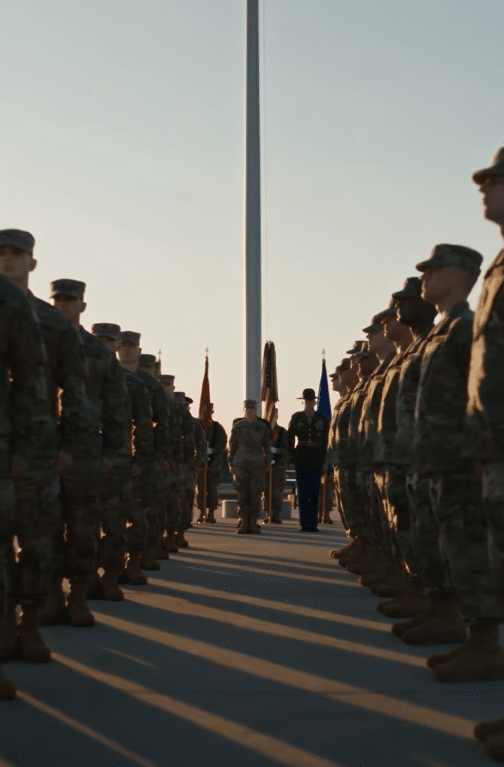
Rows of troops stood rigidly across the concrete, boots aligned beneath the pale morning sun. The color guard held position near the flagpole, and for several seconds, nobody moved.
Then one soldier’s face went white.
His knees weakened.
A woman three places away noticed immediately.
She was thirty-three, composed, and wearing a neat olive uniform beneath a patrol cap. She watched the formation the way experienced soldiers watched a room—not for appearances, but for the person who might need help before anyone else noticed.
She stepped slightly out of position.
“He is about to collapse, Colonel.”
The Colonel turned.
His expression wasn’t concerned.
It was offended.
The ceremony had been perfect until she interrupted it.
“You don’t interrupt my flag ceremony for weakness.”
The young soldier swayed again.
The woman looked at him.
Then back at the Colonel.
“He needs to come out.”
The Colonel took a step toward her.
Around them, the formation remained frozen.
Nobody wanted to become the next person noticed.
The Colonel’s voice dropped.
“You will stand where you’re told.”
She didn’t argue.
She didn’t raise her voice.
She simply remained where she was.
The Colonel crossed the distance between them.
Then his hand struck her face.
The slap cracked through the morning air.
Her patrol cap flew off and landed on the concrete beside the flagpole.
Her head turned with the impact.
For one second, her eyes closed.
Then she straightened.
She didn’t lower her head.
She didn’t step backward.
The Colonel stared at her as though waiting for fear to appear.
It didn’t.
Instead, she looked past him toward the pale-faced soldier still standing in formation.
The Colonel had just humiliated her in front of an entire formation.
But when she bent to retrieve her cap, something else slipped free from beneath her collar.
A black metal dog tag struck the concrete.
A senior officer near the color guard saw it.
His face changed instantly.
“Colonel… look down.”
The Colonel didn’t.
He had no idea that the next thing he refused to see would become the reason he wished he had never raised his hand.
Act II
Military ceremonies were built on precision.
Every movement had a place.
Every uniform had a standard.
Every command had a response.
But beneath all of that discipline was another responsibility that mattered just as much.
People came first.
The young soldier had been trying to hide what was happening to him.
His face had gone pale.
His breathing was uneven.
His knees were beginning to buckle.
Most of the formation hadn’t noticed.
She had.
That was why she moved.
Not because she wanted attention.
Not because she wanted to challenge the Colonel.
Because she understood something the Colonel had forgotten.
A ceremony could be restarted.
A soldier falling unconscious in formation could not simply be ignored.
The Colonel saw only the interruption.
He had spent years building a reputation around control.
Morning ceremonies were visible.
Senior officers watched.
Junior soldiers watched.
Visitors watched.
And the Colonel wanted everything to look perfect.
Her warning threatened that image.
So he turned a safety concern into an act of defiance.
Then he slapped her.
The sound traveled farther than he expected.
Several soldiers flinched.
One lowered his eyes.
Another swallowed hard.
Nobody moved.
The woman slowly retrieved her patrol cap.
Her cheek was beginning to redden.
Her eyes were slightly tight from the pain.
But her posture remained straight.
She looked toward the young soldier again.
He was still struggling to remain upright.
The woman took one controlled breath.
Then she put her cap back on.
The Colonel watched her.
“Are you finished?”
She didn’t answer.
She was listening to the soldier’s breathing.
The Colonel stepped closer.
“You embarrassed this ceremony.”
Her gaze finally returned to him.
“No.”
Her voice was quiet.
“You did.”
The Colonel’s jaw tightened.
He wanted to punish the sentence.
But something stopped him.
Not compassion.
Not regret.
It was the presence of the senior officer near the color guard.
The older man hadn’t moved since seeing the dog tag.
He was staring at the concrete.
At the black metal resting beside the flagpole.
His expression was unlike anything the Colonel had seen from him before.
The officer looked pale.
Almost frightened.
And the Colonel still didn’t understand why.
He looked down.
For the first time, he noticed the dog tag.
Act III
The dog tag was almost completely black.
Not shiny.
Not polished.
Not the kind of identification tag most soldiers wore on display.
It looked old.
The edges were worn smooth.
A tiny engraved code sat across the metal, but the morning light caught it at an angle that made the characters impossible to read.
The Colonel stared at it.
“What is that?”
Nobody answered.
The senior officer near the color guard remained rigid.
His eyes stayed fixed on the tag.
He had recognized something.
Not the woman’s face.
Not her uniform.
The object.
The history attached to it.
The woman picked up her patrol cap.
The chain of the dog tag remained loose against her collar.
She noticed the senior officer looking.
Their eyes met.
Neither spoke.
The Colonel saw that exchange.
“What’s wrong with you?”
The senior officer finally looked at him.
“Colonel… look down.”
The Colonel gave a humorless laugh.
“I don’t look down for people beneath me.”
The sentence hung in the morning air.
The senior officer’s expression tightened.
Several older officers nearby suddenly became very still.
One lowered his eyes.
Another quietly stepped back.
The Colonel noticed.
His confidence remained, but something beneath it had begun to crack.
He looked at the woman.
“You carrying some old piece of metal doesn’t change anything.”
She touched the dog tag.
Her fingers closed around it.
“You should.”
The Colonel frowned.
She looked directly into his eyes.
“You should. That’s where your mistake is.”
Silence.
The young soldier was finally being guided away from the formation by another service member.
But nobody was watching him anymore.
Every older officer nearby was watching the Colonel.
And every one of them seemed to know something he didn’t.
The Colonel looked at the dog tag again.
He remembered seeing symbols like that years ago.
Not on ordinary soldiers.
Not in ordinary circumstances.
His memory offered fragments.
A command briefing.
An old photograph.
A voice giving an order without needing to repeat it.
A name that had once carried extraordinary weight.
But the pieces wouldn’t connect.
Not yet.
The woman remained silent.
She didn’t tell him who she was.
She didn’t explain the code.
She didn’t tell him why the senior officer had gone pale.
That made it worse.
Because whatever the dog tag meant, she clearly didn’t need to use it.
The Colonel had already made his mistake.
The only question was whether he understood it before the room did.
Act IV
The flag continued moving overhead.
Slowly.
Silently.
Its colors caught the early sunlight while the formation stood in uncomfortable stillness.
The ceremony had become secondary.
The Colonel could feel the eyes around him.
He hated that.
He had been the person controlling the ceremony.
Now he was the only person who didn’t understand what everyone else seemed to recognize.
“What’s the code?”
The woman said nothing.
“I asked you a question.”
She remained calm.
The senior officer answered instead.
“Don’t.”
The Colonel turned toward him.
“Don’t what?”
The older man’s voice was almost a whisper.
“Keep going.”
The Colonel stared.
That wasn’t an order.
It was a warning.
And coming from a senior officer who had spent decades in uniform, it carried more weight than the Colonel wanted to admit.
He looked back at the woman.
There was no fear in her face.
Only pain.
Her cheek was still red from the slap.
But her breathing was steady.
Her shoulders were square.
She looked like someone who had been struck and immediately decided that the person who struck her was no longer worth emotional energy.
The Colonel couldn’t understand it.
Most people reacted to his rank.
She reacted to responsibility.
The senior officer reacted to something else entirely.
Memory.
The Colonel glanced toward the dog tag again.
The woman noticed.
“You finally see it.”
His eyes narrowed.
“See what?”
“Your mistake.”
She released the tag.
It settled against her uniform.
The tiny code remained unreadable.
But now the Colonel was studying it differently.
The senior officer had gone silent.
The older personnel near the color guard had lowered their eyes.
The atmosphere had changed without a single rank being announced.
The Colonel’s mind searched through old military stories.
There had been commanders whose identities were rarely discussed outside official circles.
People who had left service quietly.
People whose authority had once extended far beyond what their uniforms showed.
And some of them had carried identifying objects that were never meant for ordinary inspection.
The Colonel’s stomach tightened.
He looked at the woman again.
Thirty-three.
Young enough, he thought, to make the possibility impossible.
But then he remembered something else.
Military history didn’t always belong to the people who looked old enough to have written it.
Sometimes history survived in what people carried.
A scar.
A photograph.
A medal.
A dog tag.
A code.
The woman adjusted her collar.
The black metal disappeared beneath the fabric.
The Colonel’s confidence had almost completely vanished.
But the meaning remained hidden.
Act V
The ceremony never resumed.
Not immediately.
The young soldier was safe.
The color guard remained in place.
And the Colonel stood beneath the flag with an expression no one would have recognized ten minutes earlier.
He had entered the morning believing rank placed him above everyone around him.
He had slapped a soldier because she interrupted his ceremony to protect another soldier.
He had expected obedience.
Instead, he had created a silence he could no longer control.
The woman stood several feet away.
Her patrol cap was back in place.
Her cheek was still red.
She looked composed.
Almost impossibly composed.
The senior officer remained near the color guard.
He hadn’t explained the tag.
He hadn’t said the name behind the code.
He hadn’t even approached her.
He didn’t need to.
His reaction had already told the Colonel that the dog tag was not an ordinary piece of military identification.
The Colonel looked toward the concrete.
The tag was no longer there.
The woman had hidden it beneath her collar again.
He stared at the place where it had fallen.
His mind raced.
The code.
The older officers.
The sudden silence.
The warning.
And her strange certainty that his mistake had been looking down on the people beneath him.
He slowly looked at the senior officer.
The older man lowered his eyes.
That tiny gesture hit harder than any spoken explanation.
The Colonel turned back.
The woman was watching him.
She didn’t smile.
She didn’t threaten him.
She didn’t announce a rank.
She simply stood there with the same steady expression she had worn before the slap.
The Colonel looked at her collar.
For the first time, he seemed afraid of what might be hidden beneath it.
His lips parted.
His voice came out almost soundless.
“That tag…?”