Act I
The military SUV had barely stopped before the garage seemed to belong to someone else.
It blocked half the entrance, its dark windows reflecting the harsh afternoon light. Behind it, ordinary customers waited with their pickups lined up along the oil-stained concrete, some of them watching the uniformed men with growing irritation.
The Major General stepped out as though the entire garage had been waiting for him.
His Captain approached the mechanic’s bay, then returned with an expression somewhere between disbelief and amusement.
“General, he says the other cars were here first.”
The elderly mechanic didn’t even look up at first.
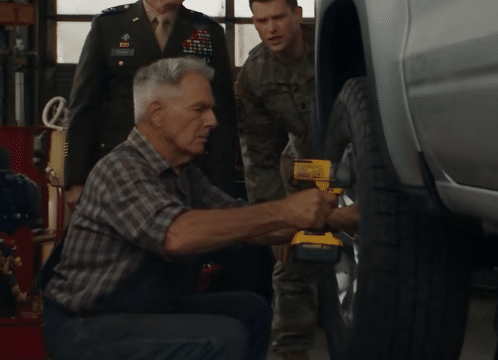
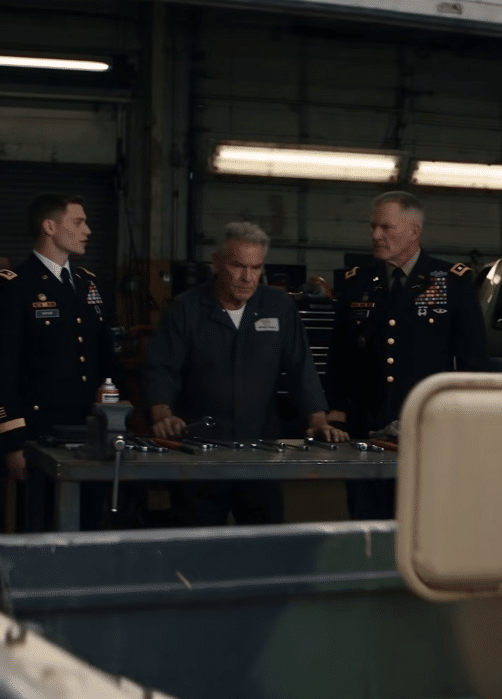
At seventy, he moved more slowly than the younger men around him, but there was nothing weak about him. His silver hair was short, his dark blue work shirt was stained with grease, and his hands carried the marks of decades spent repairing machines.
He finally glanced toward the General.
“They were. You wait behind them.”
The Captain’s eyebrows lifted.
The General’s jaw tightened.
Nobody spoke to him that way.
Not because the mechanic had been rude.
He hadn’t.
That was precisely what made it worse.
There had been no apology. No nervous smile. No attempt to flatter a man wearing stars on his shoulders.
Just a rule.
The General walked into the work bay.
“Do you know who you’re talking to?”
The mechanic picked up his wrench.
“Yes.”
“And you’re still making me wait?”
“They were here first.”
The Captain stepped aside.
The General stared at the old man’s back.
Then he knocked the wrench from his hand.
It struck the concrete with a sharp metallic crack.
The mechanic bent down, picked it up, and stood again.
The General stepped backward.
Then he kicked.
The force of the blow drove the elderly man into the metal workbench. Tools rattled violently across its surface before he dropped beside the cabinet.
Several customers gasped.
For a second, the mechanic didn’t move.
Then one hand pressed against the concrete.
He drew in a painful breath.
And stood.
The General looked down at him.
“Grease monkeys don’t make generals wait.”
The mechanic said nothing.
He simply picked up his wrench.
As he did, his sleeve slid higher than before.
An old scar appeared across his forearm.
Beside it sat a tiny black eagle.
A retired Sergeant Major holding a coffee cup saw it.
The cup stopped halfway to his mouth.
His face lost all color.
And suddenly, the man who had just attacked an old mechanic wasn’t the only person in the garage who looked afraid.
Act II
The Sergeant Major had been waiting nearly twenty minutes for his own truck.
He had spent most of that time looking through his phone and drinking coffee.
He hadn’t cared about the General’s arrival.
Until he saw the scar.
Then he stopped caring about his truck entirely.
The mark was small.
A black eagle no larger than a thumbnail, positioned beside an old scar that looked nothing like an ordinary accident.
The Sergeant Major knew that combination.
He had spent his life around military men.
He knew the difference between a souvenir tattoo and a mark that carried a history nobody discussed casually.
He set his coffee down.
The General turned toward him.
“What?”
The Sergeant Major didn’t answer immediately.
His eyes remained fixed on the mechanic’s exposed forearm.
Then he looked at the General.
“General… I think you’ve done enough.”
The garage went quiet.
The General frowned.
“Stay out of this.”
The Sergeant Major didn’t move.
He looked older than the mechanic, but his posture had suddenly changed. His shoulders were square, his expression rigid, and the casual veteran who had been waiting for his pickup was gone.
The Captain noticed.
His earlier confidence disappeared.
The General glanced at the mechanic.
The old man was still holding the wrench.
He wasn’t threatening anyone.
He wasn’t even angry.
He was simply standing there, breathing through the pain and waiting for the next decision.
The General scoffed.
“It’s an old tattoo.”
The Sergeant Major’s face tightened.
He didn’t correct him.
That silence was more unsettling than an argument.
The mechanic slowly pulled his sleeve down.
The General watched.
“What’s so special about it?”
No answer.
The Sergeant Major looked at the old man again.
For a fraction of a second, recognition passed between them.
Not familiarity.
Something deeper.
The kind of recognition that comes from a memory buried under decades of military history.
The mechanic gave him the slightest nod.
The Sergeant Major looked away.
The General saw it.
He didn’t understand it.
But he understood that something had just happened without his permission.
The Captain leaned toward him.
“Sir, he’s just a mechanic.”
The Sergeant Major turned sharply.
“Don’t call him that.”
The Captain froze.
The General’s eyes narrowed.
The mechanic remained silent.
And that silence began to make the General wonder who had been standing in his way all along.
Act III
The General had expected fear.
He had expected the old man to apologize.
Instead, the mechanic walked back toward the vehicle on the lift.
He checked the repair.
Picked up a loose tool.
And continued working.
The General stared after him.
“You think this is over?”
The mechanic didn’t turn.
“The cars were here first.”
The Captain looked at his commander.
Then at the Sergeant Major.
The atmosphere had changed completely.
The General could feel it.
The garage workers weren’t looking at him anymore.
They were looking at the old man’s wrist.
The Sergeant Major finally spoke again.
“You really don’t recognize it?”
The General turned.
“Recognize what?”
The Sergeant Major stopped himself.
His answer seemed to catch somewhere in his throat.
“Nothing.”
“Then why did you tell me to stop?”
The older veteran looked at the mechanic.
The mechanic’s expression remained unreadable.
“Because I’ve seen that mark before.”
The General folded his arms.
“Where?”
The Sergeant Major didn’t answer.
The old scar seemed to bother him more than the tattoo.
That was what made the General look closer.
The scar wasn’t clean.
It wasn’t decorative.
It looked like something earned under circumstances that had never been meant for a garage.
The General’s eyes returned to the tiny eagle.
A strange feeling passed through him.
He had seen eagles like that before.
Not on uniforms.
Not on ordinary military insignia.
Somewhere else.
Years ago.
The memory refused to form completely.
A name hovered just beyond reach.
The General dismissed it.
He had spent too many years surrounded by people who exaggerated old stories.
He was a Major General.
The man in front of him was an elderly mechanic.
That was all.
At least, that was what he wanted to believe.
The mechanic finally looked directly at him.
“Old enough that he still remembers it.”
The General stared.
The Sergeant Major’s eyes dropped.
The Captain swallowed.
Nobody explained what the tattoo meant.
Nobody named the unit.
Nobody revealed the old man’s past.
But the General suddenly understood something important.
The Sergeant Major wasn’t frightened of the tattoo.
He was frightened of the person connected to it.
And that person was standing right in front of him.
Act IV
The General took another look at the mechanic.
For the first time, he noticed details he had ignored.
The man’s posture.
The way he held the wrench.
The way he watched the vehicle instead of the people surrounding him.
Even after being kicked into a workbench, his first instinct had been to protect the repair he was responsible for.
There was discipline in that.
Not garage discipline.
Military discipline.
Old discipline.
The Captain seemed to notice it too.
“Sir…”
The General silenced him.
He looked at the Sergeant Major.
“Tell me what that eagle means.”
The veteran’s expression hardened.
“I can’t.”
“You can’t?”
“I said I can’t.”
The mechanic remained silent.
He didn’t need to defend himself.
He didn’t need to invoke a former rank.
Whatever power had once belonged to him, he had deliberately left it outside the garage.
The General, however, was still trapped inside the world of rank.
He had assumed the stars on his uniform gave him permission to decide who mattered.
Now an old scar was challenging that assumption.
The General looked at the mechanic’s hands.
Grease-covered.
Steady.
Unshaking.
He looked at the man’s face.
No fear.
No pleading.
Just an almost unsettling calm.
The Sergeant Major had stopped looking at the General entirely.
He was watching the mechanic with something close to respect.
That was when the General’s certainty began to collapse.
He remembered an old story from his early career.
A commander who had disappeared from public military life.
A decision during an operation that had saved people but angered powerful officers.
A symbol associated with that commander.
An eagle.
He couldn’t remember the face.
He couldn’t remember the name.
But the pieces were beginning to align.
The mechanic lowered his sleeve.
The eagle disappeared.
The General stared at the empty space where it had been.
He suddenly wanted to see it again.
Not because he wanted proof.
Because he was afraid he already knew what it meant.
The Sergeant Major saw the realization beginning.
His expression said only one thing.
Don’t ask.
But the General couldn’t stop himself.
He looked at the old mechanic.
And for the first time since arriving, he wasn’t looking at a civilian.
He was looking at a mystery that outranked his assumptions.
Act V
The garage remained frozen around them.
The hydraulic lift hummed softly.
A wrench rolled across the concrete and stopped beneath a tire.
Outside, the military SUV waited exactly where the General had left it.
Inside, the man who had demanded immediate service suddenly seemed unwilling to take another step.
The mechanic stood beside the workbench.
His breathing had steadied.
His cheek remained composed.
His back clearly hurt from the impact, but he refused to let the pain dictate his posture.
He looked at the General without anger.
That almost made the moment worse.
Because anger would have been understandable.
The old man offered none.
The Sergeant Major remained several feet away, silent.
The Captain looked between the two veterans, finally realizing that he had no idea what conversation he had just helped start.
The General looked again at the mechanic’s sleeve.
Then at the Sergeant Major.
The veteran’s expression answered nothing.
The General’s mind raced through old commands and forgotten faces.
He had spent years climbing the same hierarchy.
He knew the names of generals.
He knew the famous commanders.
He knew the stories that were printed in official histories.
But there were other stories.
The ones passed quietly between veterans.
The ones that survived because someone remembered.
The tiny eagle on the mechanic’s wrist belonged to one of those stories.
The old scar belonged to another.
Together, they pointed toward a past the General had never expected to find in a greasy repair shop.
The mechanic picked up his wrench again.
He turned back toward the vehicle.
No announcement came.
No uniform appeared.
No one revealed his identity.
The Sergeant Major simply watched.
The General finally looked at him.
The veteran’s face remained pale.
And suddenly the General understood that the question wasn’t whether the old man remembered the past.
It was whether the General himself had once been part of it.
His voice dropped.
“He remembers you…?”