Act I
The recruit was going under.
Not dramatically. Not yet.
He was still visible between the buoys, moving through the cold training water with the other swimmers. But his rhythm had changed, one arm lagging behind the other as he struggled to keep his head above the surface.
On the wooden training dock, a 34-year-old soldier noticed immediately.
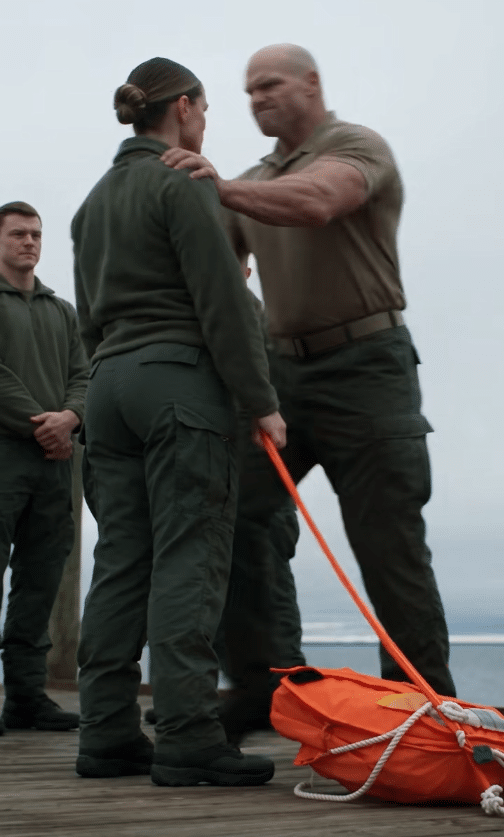
She stood with a rescue line in her hands, brown hair pulled into a high bun, navy training jacket zipped against the gray wind. Her eyes never left the recruit.
The assistant beside her glanced at the water and smirked.
“She’s scared of a little water drill.”
The training officer heard him.
He was forty-nine, physically imposing, dressed in a military polo and tactical pants. To him, the drill wasn’t simply a swim exercise.
It was a test of toughness.
And he hated anything that looked like hesitation.
The woman tightened her grip on the rescue line.
“That recruit is cramping. Pull him out now.”
The officer turned toward her.
For a moment, the wind was the only sound.
The recruit’s movements in the water became more uneven.
The woman looked back toward him.
“Pull him out,” she repeated.
The officer stepped closer.
He didn’t look at the struggling swimmer.
He looked at her.
The rescue line suddenly disappeared from her hands as he yanked it away and threw it onto the wooden dock.
Then he shoved her hard.
His force drove her shoulder and torso into the dock edge. Her shoulder struck a wooden post, and she slid dangerously toward the water before catching the low railing.
Pain crossed her face.
But her eyes immediately went back to the recruit.
The officer stood over her.
“You don’t protect weakness. You drown it out.”
She pulled herself upright.
She didn’t beg.
She didn’t apologize.
She didn’t even look at him.
She looked at the water.
Then her jacket shifted from the impact.
A small symbol appeared beneath her collarbone.
The young lifeguard saw it.
And the expression on his face changed so quickly that the officer noticed.
Act II
The lifeguard tightened his grip around the rescue buoy.
He had been watching the drill from only a few yards away, ready to respond if needed.
Now he was staring at the woman’s collar.
His face had gone pale.
The assistant noticed.
His own confidence disappeared.
The woman seemed not to care that the symbol was exposed.
She was still watching the recruit.
The swimmer had stopped making forward progress.
Cold water slapped against his shoulders as he tried to regain his rhythm.
The training officer finally glanced toward him.
“Get back in formation,” he ordered.
The lifeguard didn’t move.
The woman did.
She stepped toward the edge of the dock, one hand touching her shoulder where the impact had landed.
The pain was obvious.
Her posture wasn’t.
She remained steady.
Controlled.
Focused.
The officer looked at her with contempt.
“You heard me.”
The lifeguard finally spoke.
“Sir… look at her collar.”
The words were quiet.
Almost cautious.
The officer’s eyes narrowed.
The lifeguard’s face made no sense to him.
Why would a tiny mark beneath a soldier’s collar matter?
Why would a young military lifeguard suddenly look frightened by it?
The officer glanced down.
The symbol was small.
Almost tattoo-like.
Partly hidden beneath the edge of the jacket.
Nothing about it seemed threatening.
Nothing about it explained the reaction.
He looked back at the lifeguard.
“I’m looking at the coward she’s protecting.”
The insult hung over the dock.
The woman slowly turned her head.
The recruit was still struggling in the water.
She saw him.
Then she saw the officer.
Her expression didn’t change.
But the lifeguard’s silence had already told her something.
The officer just hadn’t understood what.
And the symbol beneath her collar was about to turn a routine training dispute into something far more dangerous for him.
Act III
The woman reached down and picked up the rescue line.
Her shoulder protested as she moved.
She ignored it.
The recruit was still the priority.
The officer watched her with growing irritation.
“You’re making a spectacle of yourself.”
She didn’t answer.
She simply kept her eyes on the water.
The lifeguard remained beside the buoy.
His attention moved between the symbol and the officer.
He clearly knew something.
But he wasn’t saying it.
That silence began to irritate the officer more than the original disagreement.
The woman finally looked directly at him.
Her voice was quiet.
“Then you’re looking in the wrong direction.”
The officer stared at her.
The wind pushed at the loose edge of her jacket.
For one brief moment, the symbol beneath her collarbone was fully visible.
The lifeguard looked away.
The assistant swallowed.
Several soldiers on the dock stiffened.
Nobody explained the mark.
Nobody named it.
Nobody told the officer why a symbol so small could silence an entire group of trained adults.
The officer took another step.
Then stopped.
Something about the mark bothered him.
Not because he recognized it immediately.
Because he almost did.
It carried the shape of something institutional, something old, something associated with a story that had never been told to him directly.
He looked at the woman again.
She was still holding the rescue line.
Still watching the recruit.
Still refusing to let the officer’s aggression distract her from the actual emergency.
And suddenly, the insult he had thrown at her sounded different.
Coward.
Weakness.
Protection.
He had used those words because he believed toughness meant refusing to stop.
But she had stopped because someone was in trouble.
The distinction was becoming impossible to ignore.
The officer’s confidence began to fracture.
He looked at the symbol again.
This time, more carefully.
And somewhere behind his anger, an old memory began to move.
Act IV
The recruit finally reached the dock.
The rescue line tightened.
The lifeguard moved into position.
The woman kept her hand steady despite the pain in her shoulder.
The training officer said nothing.
His attention was no longer on the drill.
It was on her collar.
The tiny symbol seemed almost insignificant beneath the gray daylight.
Yet everyone around him was behaving as though it carried a weight he couldn’t see.
The assistant who had mocked her earlier wouldn’t meet her eyes.
The lifeguard stood rigidly near the buoy.
Several personnel had shifted farther back along the dock.
The woman remained exactly where she had been.
She wasn’t celebrating.
She wasn’t demanding that anyone acknowledge her.
She was simply doing her job.
That was what unsettled the officer most.
If the symbol had been meant to intimidate him, she would have explained it.
Instead, she left him to recognize it himself.
The officer looked at her face.
Then the mark.
Then the water.
His mind began connecting fragments.
A designation.
An old incident.
A name he had heard years earlier.
A story about a person who had been expected to follow an order and had instead protected someone who couldn’t protect himself.
The details were incomplete.
But the feeling was unmistakable.
He knew that symbol belonged to something larger than this dock.
His breathing changed.
The woman noticed.
She said nothing.
The lifeguard noticed too.
Still, he remained silent.
The officer’s authority was intact on paper.
His uniform hadn’t changed.
His rank hadn’t changed.
But the room around him no longer responded to that rank the same way.
Everyone had seen what happened.
Everyone had seen who stayed focused on the recruit.
And now everyone was waiting for the officer to understand what the woman already knew.
The mark wasn’t a warning.
It was a history.
And somehow, that history had found its way beneath her collar.
Act V
The wind swept across the water.
The buoys rocked gently against the waves.
The recruit was safely back on the dock, surrounded by the other personnel.
But nobody was celebrating.
The training officer stood completely still.
His eyes remained fixed on the small symbol.
The woman stood several feet away.
Her shoulder was still sore from the impact.
She showed it only in the slight stiffness of her posture.
There was no fear in her expression.
No plea.
No need to prove herself.
She had already done that.
The lifeguard looked at the officer once, then lowered his gaze.
The assistant stood silently near the railing.
The same man who had laughed at her concern couldn’t seem to look at her anymore.
The officer slowly looked toward the water.
Then back at the symbol.
Something in his face had changed.
The cruel certainty was fading.
The anger was still there, but underneath it was something colder.
Recognition.
He remembered enough to know that the mark was not meaningless.
He remembered enough to understand that the woman standing in front of him was connected to a story far beyond this training exercise.
But he didn’t know the whole story.
Not yet.
And that uncertainty was suddenly more frightening than any confrontation.
The woman said nothing.
The lifeguard said nothing.
The dock fell silent.
The officer’s eyes stayed locked on the symbol beneath her collarbone.
His voice came out barely above a whisper.
“That symbol…?”