Act I
The barber shop went silent before anyone understood why.
Under the harsh fluorescent lights, a young recruit sat rigidly in the barber chair, a cutting cape wrapped around his shoulders. Clippers buzzed beside his ear while several soldiers waited along the wall, pretending not to watch.
The Sergeant Major stood behind the chair.
He was a large man with a spotless uniform, a cold expression, and the kind of presence that made younger soldiers straighten their backs without being told. Tonight, discipline had become something uglier.
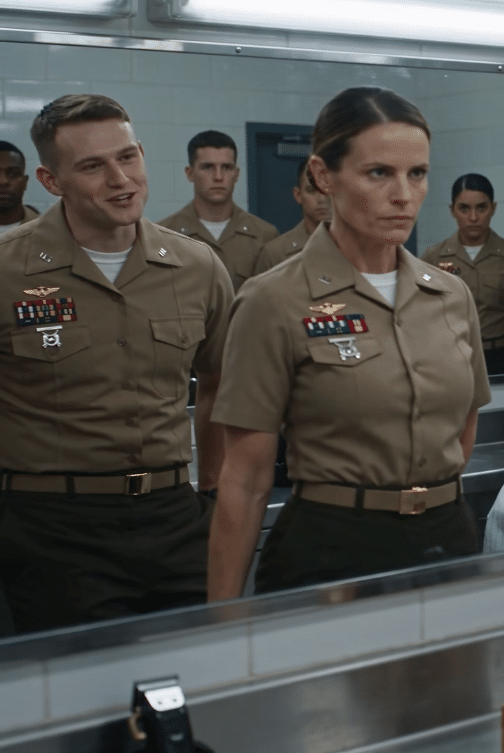
A 26-year-old soldier leaned against the long mirror and smirked toward the woman standing nearby.
“She thinks she can tell us what respect looks like.”
The woman didn’t react to the sarcasm.
She was thirty-nine, brown hair tied into a low bun, olive button shirt tucked into tactical pants. She had been watching the recruit’s face rather than the Sergeant Major’s rank.
Then she spoke.
“You don’t shave a recruit’s head to humiliate him.”
The words were quiet.
That was precisely why they landed so hard.
The Sergeant Major turned toward her as if she had struck him first.
Around the room, nobody moved.
The young recruit lowered his eyes.
The barber kept one hand around his clippers.
The Sergeant Major stepped toward the counter and knocked the barber’s tool box onto the floor.
Razors, combs, and spare clippers scattered across the tile.
Then came the slap.
It cracked through the small room.
The woman stumbled backward into the barber chair, one hand catching the edge before she could fall. Her cheek reddened, and there was a tiny trace at the corner of her mouth.
But when she straightened, her eyes were still steady.
The Sergeant Major looked down at her.
“Soft hearts don’t build soldiers. They ruin barracks.”
Nobody answered.
Then something rolled quietly across the floor.
A small black coin had slipped from the fallen tool box.
It spun once beneath the fluorescent lights before coming to rest beside the barber’s shoe.
The old barber looked down.
And all the color drained from his face.
Act II
The barber stopped breathing for a second.
His clippers were still in his hand, but they had become completely still.
The young soldier who had been mocking the woman noticed the change.
His smirk disappeared.
The Sergeant Major didn’t notice either reaction.
He was still staring at the woman, apparently satisfied that he had restored the hierarchy of the room.
But the woman wasn’t looking at him.
She was looking at the recruit.
The young man remained in the chair, shoulders tight beneath the cutting cape.
She had stepped into the confrontation because she recognized something the Sergeant Major apparently didn’t.
There was a difference between discipline and humiliation.
One was supposed to make a soldier better.
The other simply made someone smaller.
And she had refused to let the distinction disappear.
The Sergeant Major interpreted that refusal as softness.
He had probably done so many times before.
In his world, questioning a senior order was weakness. Protecting a junior soldier was interference. Compassion was something people indulged in until real pressure arrived.
But the woman didn’t look compassionate now.
She looked controlled.
Her cheek burned.
Her breathing was measured.
And her attention had already shifted toward the black coin lying on the floor.
The barber finally lowered his clippers.
His eyes remained fixed on the object.
“Sergeant Major… don’t kick that.”
The words were barely louder than a whisper.
The room changed instantly.
The Sergeant Major glanced toward the coin.
Then toward the old barber.
The barber’s face told him something was wrong.
But the Sergeant Major had spent too long believing that fear belonged to other people.
He gave a dismissive look.
“It’s junk on my floor.”
The barber said nothing.
Neither did the young soldier.
That silence should have warned him.
Instead, he mistook it for submission.
He had no idea that the thing he had called junk had been sitting quietly inside that old tool box for years.
And now it had rolled into the middle of the room at exactly the wrong moment.
Act III
The woman slowly stepped away from the barber chair.
Pain still showed in the way she moved.
But there was no hesitation.
She bent slightly, not to pick up the coin, but to look at it.
Its surface was worn almost smooth.
Only a tiny symbol remained visible.
Something old.
Something deliberate.
Something the barber clearly recognized.
The Sergeant Major saw the hesitation around him and became irritated.
“What?” he demanded.
Nobody answered.
The young soldier who had mocked her earlier looked at the coin and then at the woman.
Whatever confidence he had started the confrontation with was gone.
The woman finally looked at the Sergeant Major.
Her voice remained calm.
“No. It was placed there for men like you.”
The words hit differently from her first objection.
The Sergeant Major’s expression hardened.
Then he looked down.
Really looked.
The black coin wasn’t military currency in any ordinary sense.
It wasn’t something that belonged among spare combs and razor blades.
The tiny symbol had been deliberately preserved despite years of wear.
And suddenly, the Sergeant Major noticed something else.
The barber wasn’t afraid of the coin.
He was afraid of what it represented.
The Sergeant Major’s eyes narrowed.
“Placed there?”
He said the words as if testing them.
The woman didn’t answer.
She simply stood there.
The recruit remained silent in the chair.
The young soldier by the mirror had taken one step away from the counter.
The fluorescent lights hummed overhead.
Somewhere beneath the floor, pipes vibrated softly.
Nothing dramatic happened.
No one shouted.
No one announced a secret.
Yet the atmosphere had completely changed.
The Sergeant Major was no longer the only person who controlled the room.
For the first time, everyone seemed to be waiting for him to understand something.
And the more he stared at that tiny symbol, the less certain he became that he wanted to know.
Act IV
The mirror gave him nowhere to hide.
His reflection stood behind the woman, still wearing the same uniform, still carrying the same rank.
But the confidence in his face was disappearing.
He looked at the coin again.
The tiny symbol was unmistakably deliberate.
A mark placed there long before tonight.
The barber’s reaction suddenly made sense.
So did the woman’s words.
“It was placed there for men like you.”
Not men like him personally.
Men like him.
Men who believed rank gave them permission to humiliate.
Men who confused fear with respect.
Men who thought a recruit could be broken into obedience by stripping away his dignity.
The Sergeant Major’s jaw tightened.
The woman didn’t move.
Her cheek was still red.
A faint trace remained at the corner of her mouth.
But she was standing.
That seemed to bother him more than the injury itself.
He had expected her to become smaller after the slap.
Instead, she appeared almost impossibly composed.
The old barber slowly bent toward the coin but stopped before touching it.
He looked at the woman.
She gave him no instruction.
She didn’t need to.
Whatever history lived inside that black object was something the room already seemed to understand without saying aloud.
The young soldier who had started the mockery lowered his gaze.
He wasn’t laughing anymore.
The recruit in the chair watched the woman with something close to disbelief.
Moments earlier, everyone had been watching the Sergeant Major.
Now, no one wanted to look at him.
His authority hadn’t disappeared.
Something more unsettling had happened.
Its meaning had changed.
The Sergeant Major stared at the symbol until his breathing became noticeably slower.
Then his eyes lifted toward the woman.
There was recognition beginning there.
Not complete recognition.
Not yet.
But enough to make the arrogance in his face crack.
The black coin had not appeared by accident.
It had been waiting.
And somehow, tonight, it had found the right floor.
Act V
The room became unbearably quiet.
The Sergeant Major stood beneath the fluorescent lights, staring at the old black coin.
The mirror behind him reflected every face except the one he wanted to understand.
The woman remained still.
She didn’t demand an apology.
She didn’t explain the symbol.
She didn’t tell him who had placed the coin there or why it had been hidden inside the barber’s tool box.
That silence carried more weight than an accusation.
The Sergeant Major’s eyes moved from the coin to the barber.
The old man’s face remained pale.
Then back to the woman.
She was still hurt.
Still standing.
Still completely unafraid.
The young soldier who had mocked her earlier looked as though he wished he had never spoken.
Even the recruit seemed to understand that whatever had just happened was larger than a barber shop argument.
The Sergeant Major slowly crouched his gaze toward the floor.
The coin lay between them.
A tiny symbol.
An old object.
A piece of history nobody was willing to explain.
His expression changed again.
The brutality drained away first.
Then the certainty.
Then the arrogance.
What remained was unease.
He looked at the coin as though a memory had begun moving somewhere in the back of his mind, but he couldn’t yet force it into focus.
The woman said nothing.
The barber said nothing.
No one rescued her.
No one needed to.
The Sergeant Major finally understood that the question wasn’t whether the coin belonged on his floor.
The question was why someone had deliberately put it there.
His eyes widened.
The mirror caught the change.
For the first time that night, the man who had demanded respect looked uncertain of his own position.
His voice came out low.
“Placed there…?”