Act I
The crate hit the concrete floor with a violent crack.
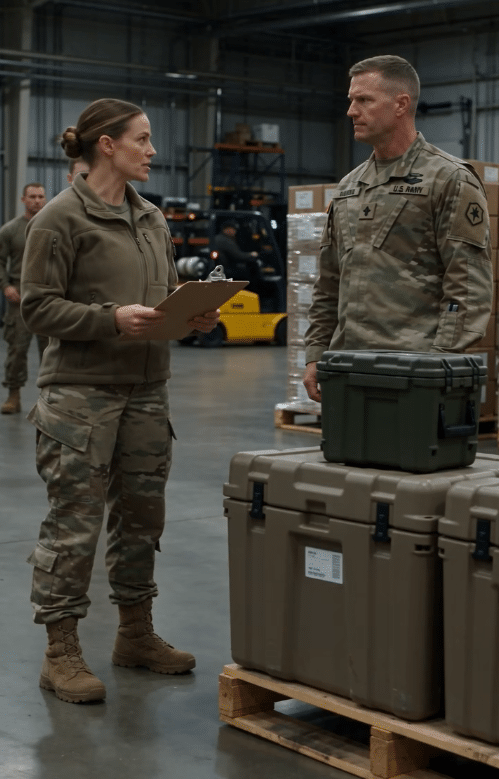
Metal equipment spilled across the supply depot, sliding beneath pallets and into the marked forklift lane. A barcode scanner beeped once, then fell silent.
Every soldier nearby froze.
The logistics officer standing in the middle of the chaos didn’t.
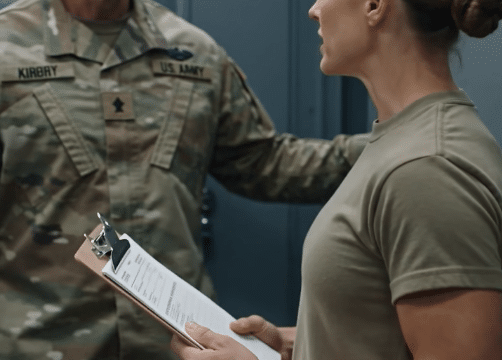
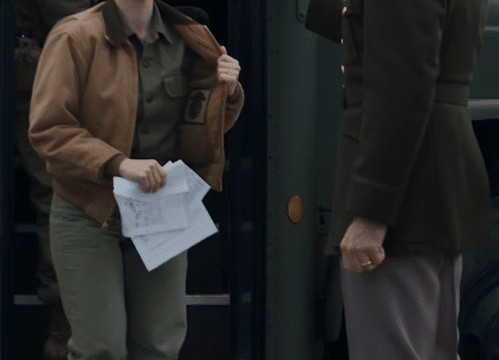
She was thirty-five, dressed in an ordinary olive field jacket and tactical pants, her brown hair pulled neatly back. In one hand, she held an inventory sheet. In the other, she held the item code that had stopped the entire operation.
She looked at the supply chief.
“This crate doesn’t match the manifest.”
The words were calm.
That was what made him angry.
The 47-year-old chief stood in a dark uniform with his name patch perfectly visible. He was accustomed to people stepping aside when he walked through the depot.
He looked at the crate.
Then at the woman.
“You’re holding up my operation over paperwork?”
“The code is wrong.”
“I said move it.”
She didn’t.
The depot suddenly felt smaller.
Forklift lanes stretched between stacks of wooden pallets. Equipment shelves rose toward the harsh industrial lights. Soldiers who had been checking inventory moments earlier now stood perfectly still, pretending not to watch.
The chief stepped closer.
“You’re going to release that crate.”
“No.”
One word.
Quiet.
Final.
His expression hardened.
He had expected hesitation.
Instead, she had given him a direct refusal in front of his own personnel.
Then his boot slammed into the side of the crate.
The container toppled.
Equipment scattered across the concrete.
The woman immediately bent down, trying to keep the manifest from being crushed beneath the debris and prevent loose equipment from spilling farther into the forklift lane.
The chief stepped forward again.
His boot drove into the fallen crate.
The impact shoved the crate into her legs.
She lost her balance and fell face-first beside a wooden pallet.
Her palm scraped against the concrete.
A thin trace of blood appeared.
But even as pain flashed across her face, her fingers tightened around the item code.
She wouldn’t let go.
The chief looked down at her.
“Paperwork rats don’t stop real operations.”
Nobody moved.
Nobody spoke.
Then the woman slowly opened her scraped hand.
And beneath the harsh depot lights, something tiny appeared near the edge of her palm.
A number.
The young inventory soldier holding the barcode scanner saw it.
His face drained of color.
Because he knew that number.
And suddenly, the crate wasn’t the most dangerous thing in the room.
Act II
The woman pushed herself upright.
Her palm stung.
Her knees hurt from the impact.
Her inventory sheet was dirty.
But the item code was still in her hand.
That was the only thing that seemed to matter.
The supply chief stared at her with open contempt.
“You’re done.”
She looked at the scattered equipment.
“No.”
His eyes narrowed.
“What did you say?”
She carefully gathered the manifest.
“I said the shipment isn’t cleared.”
He laughed.
It was the kind of laugh designed to make everyone else uncomfortable.
“Do you know how many shipments I’ve moved through this depot?”
“Yes.”
“Then you should know better than to challenge me.”
“I know exactly what I’m doing.”
The young inventory soldier remained beside the pallet, barcode scanner hanging loosely in his hand.
He wasn’t listening to the argument anymore.
He was staring at her palm.
The number was small.
Almost invisible.
Four digits.
Tattooed close to the edge of the hand where most people would never notice it.
But he had seen that number before.
Not on a supply form.
Not on a personnel badge.
In a restricted logistics training file.
The number had been attached to an oversight designation.
A designation that didn’t belong to ordinary warehouse personnel.
The young soldier swallowed.
He looked at the chief.
Then back at the woman.
She noticed him watching.
Their eyes met.
She said nothing.
Neither did he.
That silence told him something.
She knew he had recognized it.
The chief didn’t.
He stepped over the scattered equipment and stood directly in front of her.
“Give me the code.”
She kept her hand closed.
“No.”
His jaw tightened.
“You’ve already caused enough trouble.”
“I prevented an unauthorized release.”
“You prevented my operation.”
“I prevented a shipment from leaving without a matching manifest.”
The difference was everything.
But the chief didn’t care.
He had spent years learning how to turn procedure into something that served his authority.
The woman understood procedure differently.
To her, the manifest wasn’t a piece of paper.
It was a record.
A chain of responsibility.
A promise that someone, somewhere, had verified what was inside that crate.
If the number didn’t match, the shipment stopped.
No matter who wanted it moved.
The young soldier finally spoke.
“Chief… wait. Her hand.”
The chief turned sharply.
“What about it?”
The soldier hesitated.
His face had gone pale.
The chief followed his gaze toward the woman’s palm.
But before he could see clearly, she closed her hand.
The chief scoffed.
“I don’t care about her hand.”
And that was when the young soldier realized the chief had no idea how close he was to losing everything.
Because that number wasn’t a random mark.
It was a door.
And the woman was holding the key in plain sight.
Act III
The number had been assigned years earlier.
Only a handful of people knew what it meant.
It belonged to an internal command-level audit system created after a major equipment scandal nearly brought down an entire procurement chain.
Shipments had disappeared.
Manifests had been altered.
Codes had been duplicated.
Crates had been moved under emergency authority and somehow never appeared where they were supposed to appear.
The military had eventually created a small oversight group to track irregularities that normal inventory systems couldn’t catch.
The people assigned to that group were given numerical identifiers.
Not names.
Numbers.
The idea was simple.
If someone found a discrepancy that looked too dangerous to report through ordinary channels, the number created a direct path to command oversight.
The system was supposed to be nearly invisible.
Most soldiers never knew it existed.
The chief certainly wasn’t supposed to know about it.
But he had encountered one of those numbers before.
Years ago.
He just hadn’t seen one recently enough to recognize it immediately.
The woman stood slowly.
Her face was calm.
She wiped the dirt from her jacket.
Then she looked at the crate.
“Don’t move anything.”
The chief laughed again.
“You don’t give orders here.”
She looked at him.
“I just did.”
The soldiers around them stiffened.
The chief’s smile disappeared.
“You’re a logistics officer.”
“Yes.”
“You work for me.”
“No.”
The answer came so naturally that several soldiers exchanged glances.
The chief stepped closer.
“Excuse me?”
She held up the inventory sheet.
“You supervise this depot.”
He stared at her.
“That means I supervise you.”
She shook her head.
“You supervise inventory operations. You don’t control independent verification.”
Something shifted in the room.
The young soldier understood now.
The woman wasn’t simply protecting a manifest.
She was protecting a chain of accountability that existed above the depot.
The chief still didn’t understand.
Or perhaps he understood enough to become angry.
“You’re making this much bigger than it needs to be.”
“No.”
She looked at the crate.
“You already did that.”
The chief followed her gaze.
A shipping label had torn loose when he kicked the container.
Underneath it was another number.
Not the same one.
But close enough to raise another question.
The young soldier noticed it too.
He looked at the woman.
She gave him the smallest nod.
The chief saw the exchange.
“What are you two hiding?”
Nothing.
She picked up the damaged manifest.
Then she looked directly at him.
“You will when that number reaches command.”
The words were quiet.
The chief stopped breathing for a second.
The young soldier lowered his scanner.
The entire depot seemed to freeze.
Because the chief finally understood that the woman hadn’t been bluffing.
She hadn’t needed to call anyone.
She hadn’t needed to threaten anyone.
The number itself was enough.
And suddenly, he remembered every shipment he had pushed through without proper verification.
Every time someone had told him to wait.
Every time he had overridden a discrepancy.
Every time he had told a junior soldier that paperwork didn’t matter.
His face remained controlled.
But his confidence was beginning to crack.
And the woman could see it.
Act IV
The chief looked at her palm again.
“Where did you get that number?”
She didn’t answer.
“Who authorized you?”
Silence.
“Who do you report to?”
Still nothing.
The young soldier took one slow step backward.
Other inventory personnel began doing the same.
Nobody wanted to be standing between the chief and whatever was coming next.
The woman looked around the depot.
At the scattered equipment.
At the damaged crate.
At the dirty manifest.
Then at the forklift lane.
“Everything stops here.”
The chief shook his head.
“No.”
She raised her eyes.
“Yes.”
“You can’t shut down a depot.”
“I can stop one shipment.”
She looked at the crate.
“And if that shipment isn’t what the manifest says it is, the next question is why.”
The chief’s expression tightened.
He suddenly looked less interested in humiliating her and more interested in the crate.
That didn’t escape anyone.
The young soldier noticed.
So did the woman.
She stepped toward the container.
The chief moved instinctively to block her.
She stopped.
For a moment, they stood face-to-face.
Then she opened her scraped hand.
The tiny number was visible again.
The young soldier stared at it.
The chief did too.
This time, he recognized it.
His face changed.
Not dramatically.
Not all at once.
Just enough.
His eyes fixed on the number.
His mouth tightened.
His shoulders stiffened.
The woman watched him realize what he was looking at.
The chief knew.
He knew exactly what the number meant.
He also knew that if the woman entered that number into the command oversight system, the shipment would no longer belong to him.
Neither would the investigation that followed.
The arrogance returned for one last attempt.
“You’re bluffing.”
She said nothing.
“You don’t have that authority.”
She remained silent.
“You’re just trying to scare me.”
Still nothing.
Then she reached toward the manifest.
The chief looked at the paper.
Then at the crate.
Then at her palm.
And for the first time, he understood why she had refused to let him take the equipment.
She wasn’t afraid of losing her position.
She was afraid of allowing something to disappear.
That was a completely different kind of courage.
The barcode scanner beeped again.
The sound echoed through the depot.
The young soldier looked down at its screen.
A mismatch.
The code on the crate didn’t match the manifest.
Exactly as she had said.
The chief heard the beep.
His face went still.
The woman closed her hand.
“You should have checked before you kicked it.”
The chief’s eyes lifted toward hers.
For a moment, neither moved.
Then she turned away.
The room followed her with its eyes.
The chief remained beside the fallen crate.
And everyone knew the balance of power had changed.
But the final realization had not yet fully reached his face.
That came only when he looked at the number one more time.
Act V
The depot became unnaturally quiet.
The forklifts were still.
The inventory soldiers were still.
Even the harsh industrial lights seemed to hum louder than before.
The woman stood beside the damaged crate, holding the manifest in one hand and the item code in the other.
Her palm was still scraped.
A thin trace of blood remained near the base of her hand.
But she didn’t seem to notice anymore.
The chief did.
He stared at the injury.
Then at the number beside it.
The mark wasn’t decoration.
It wasn’t a personal tattoo.
It was an authorization trail.
A direct line to people who did not answer to him.
People who could open the records he had assumed were safely buried inside the depot’s system.
He suddenly remembered all the times he had called paperwork an inconvenience.
All the times he had pressured junior personnel to move equipment before verification.
All the times someone had questioned a code and he had told them to stop wasting his time.
The woman hadn’t stopped him because she was timid.
She had stopped him because she knew exactly what would happen if the wrong crate left the building.
The young inventory soldier finally understood the rest.
The number wasn’t just connected to command oversight.
It meant the woman herself was part of the oversight mechanism.
She had been watching.
For longer than anyone realized.
The chief’s eyes met hers.
He wanted to say something.
An apology.
An order.
A threat.
Anything that could restore the balance.
Nothing came.
The woman simply placed the manifest on the top of the pallet.
Then she looked at the scattered equipment.
“Log everything.”
The young soldier immediately nodded.
The others followed.
The chief didn’t object.
He couldn’t.
Because the moment he did, he would be making the situation worse.
The woman turned away from him.
Her dirty gloves weren’t visible because she wasn’t wearing any.
Her scraped palm was.
And somehow, that tiny injury said more than all the ribbons on his uniform.
She had been knocked down.
She had been humiliated.
She had been told that paperwork didn’t matter.
Yet she had never surrendered the one thing that mattered.
The record.
The proof.
The truth.
Behind her, the chief stared at the number.
His face had lost its arrogance.
His eyes widened slightly.
His lips parted.
His breathing became shallow.
Because now he understood the question he should have asked before touching the crate.
Who was she?
And why did command already know her number?
He stared at the mark one last time.
“That number…?”