Act I
The room went silent before anyone understood why.
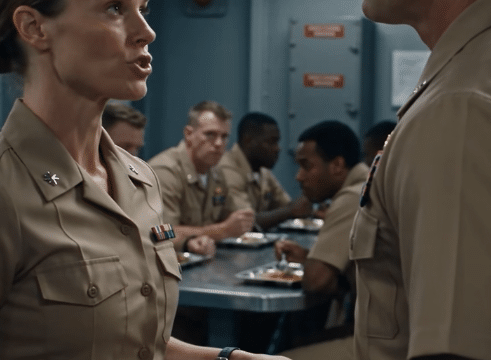
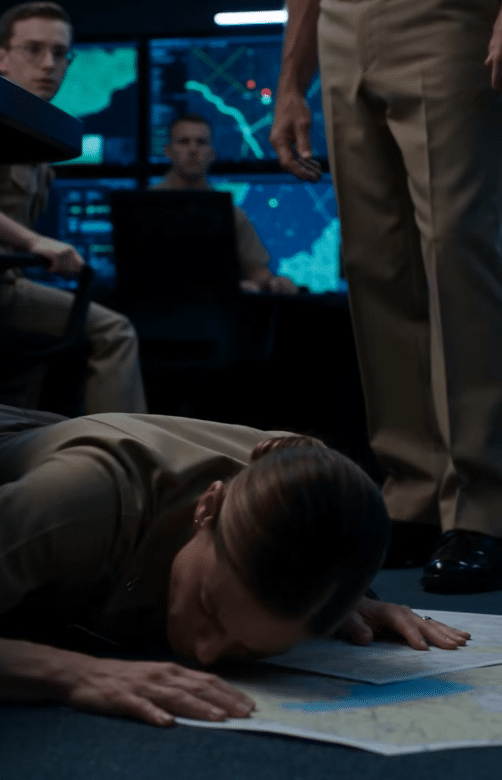
The war room was built for decisions that could move entire units. Long tables stretched beneath cold white lights, covered with folded maps, tablets, marked routes, and handwritten notes. Behind the officers, radar monitors pulsed with quiet blue light.
At the head of the table sat Colonel Richard Voss, a decorated officer with a reputation for never being questioned twice.
Across from him stood a thirty-six-year-old officer named Elena Ward.
She looked almost forgettable.
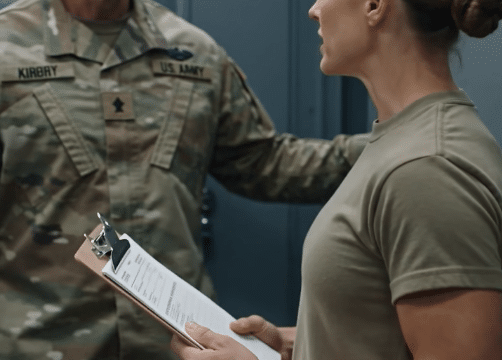
Her brown hair was tied low. Her olive uniform carried no visible decoration that demanded attention. She held a military tablet against her side and a packet of maps in both hands.
But her voice was steady.
“That route will expose the entire unit.”
Voss stared at her.
For a second, nobody moved.
Then his expression hardened.
He reached across the table, snatched the maps from her hands, and threw them across the room.
Paper scattered over the floor like fallen leaves.
Elena bent down to collect them.
That was when Voss moved.
His leg hooked sharply against hers.
Elena lost her balance and crashed onto the floor. Her shoulder struck the metal leg of the briefing table, and her tablet skidded several feet away.
A few officers flinched.
No one stood.
Voss looked down at her as if she were an inconvenience that had finally been dealt with.
“Stay on the floor. Strategy belongs to officers who matter.”
Elena’s face tightened from the pain, but she didn’t plead.
She didn’t curse him.
She simply breathed once, slowly, and looked toward the maps beneath his boots.
Something had slipped free from the pile.
Something that had not been there a moment earlier.
A thin black card.
And one young analyst at the far end of the room had just seen it.
He went pale.
But he wasn’t looking at Elena.
He was looking at the tiny silver symbol in the corner of that card.
And suddenly, the analyst seemed more afraid of what the Colonel might do next than of what he had already done.
Because the thing lying beneath the maps wasn’t supposed to exist inside that room.
Act II
The analyst’s name was Noah Reed.
He was twenty-eight, thin, quiet, and usually invisible in the way good analysts often were. His job was to notice what commanders overlooked, compare what people said with what the data showed, and remain silent unless the facts demanded otherwise.
He had spent most of the morning watching the route projections on the radar screens.
The route Voss had chosen looked efficient.
On paper.
It cut nearly forty minutes from the planned movement window and avoided a secondary checkpoint.
But Elena had noticed something buried in the terrain data.
A narrow valley.
A dead communications zone.
A ridge that would block emergency extraction.
If the unit entered through that corridor and the opposing force anticipated their movement, the soldiers would have almost nowhere to maneuver.
Elena hadn’t challenged Voss because she wanted attention.
She had challenged him because the numbers were wrong.
That distinction had never mattered to Voss.
To him, a junior officer disagreeing in front of other people was not professional caution.
It was disrespect.
And Voss had built his career around one simple principle: nobody questioned the man sitting at the head of the table.
He had humiliated officers before.
He had ended careers with a sentence.
He had turned disagreements into disciplinary records and mistakes into permanent stains.
But Elena had never reacted the way he expected.
She didn’t argue emotionally.
She didn’t raise her voice.
She simply returned to the evidence.
That had made her dangerous.
Not because she outranked him.
She didn’t.
Not because she carried medals that could silence the room.
She didn’t.
Her danger came from something Voss had underestimated completely.
She was willing to put the truth on paper.
And that morning, she had done exactly that.
The report beneath the maps wasn’t a routine tactical objection.
It was an attached risk assessment documenting the consequences of approving the route.
Elena had prepared it because she knew that if the route was approved anyway, someone would later need to answer for it.
The room remained frozen after her fall.
Elena slowly pushed herself upright.
Her shoulder hurt badly enough to make her pause.
Still, she reached for the nearest map.
That’s when the black card slid another inch across the floor.
Noah saw it clearly.
A matte-black rectangle.
No name.
No rank.
No printed explanation.
Only a tiny silver symbol in the corner.
His face drained of color.
He stood halfway before stopping himself.
“Colonel… maybe don’t step on that.”
Voss turned toward him.
The room seemed to shrink around them.
“I step on whatever enters my room.”
Noah said nothing.
He couldn’t.
Because there were certain symbols that every analyst working around classified command structures learned to recognize.
Not officially.
Not through ordinary training.
They were the kind of markings passed quietly from one cleared briefing to another.
A symbol that meant the person carrying it did not necessarily answer to the officer currently giving orders.
And if Noah was right, then the card was not merely a credential.
It was a warning.
Voss looked down at it.
Then back at Noah.
He smiled.
It was the kind of smile people used when they believed they had already won.
But Elena had finally risen.
She adjusted the sleeve over her injured shoulder.
Then she looked directly at him.
Her voice was almost gentle.
“Then you just stepped into the wrong report.”
Something changed in the room.
Not loudly.
No alarm sounded.
No door opened.
Nobody announced a new authority.
Instead, one officer quietly lowered his eyes.
Another stopped reaching for his phone.
And Noah took one small step backward.
The Colonel noticed.
For the first time, he looked uncertain.
He had spent years controlling rooms like this. He had never realized that one of them could already be documenting him.
Act III
The black card remained between them.
Elena didn’t pick it up.
She didn’t need to.
That was what confused Voss most.
He had expected her to scramble for it, explain it, or use it as some desperate attempt to reclaim authority.
Instead, she simply stood there.
Calm.
Almost impossibly calm.
Voss glanced at the silver symbol again.
His confidence weakened by a fraction.
Noah noticed.
So did everyone else.
The black card had no readable name.
No title.
No obvious insignia.
But Elena’s presence beside it suddenly made the entire scene look different.
The plain uniform.
The absence of decorations.
The refusal to identify herself through rank.
For weeks, officers had assumed Elena Ward was simply a staff officer assigned to strategic review.
They had seen her arrive early.
They had seen her leave late.
They had watched her work through folders nobody else wanted to touch.
She never demanded recognition.
She never asked to sit at the head of the table.
She never corrected people for the sake of appearing intelligent.
She only spoke when something was wrong.
And that was why Voss had misunderstood her.
Elena wasn’t trying to rise through the chain of command.
She had been assigned to observe it.
Months earlier, a classified review had begun after a series of operational plans contained suspiciously similar errors.
Routes were being altered after approval.
Risk assessments were disappearing from final packets.
Warnings were being removed from official records.
Nothing was dramatic enough to trigger an immediate investigation.
That was what made it dangerous.
Someone had learned how to make bad decisions look like ordinary mistakes.
Elena had been brought in to trace the pattern.
She had followed signatures.
Compared timestamps.
Recovered archived versions.
Matched digital records against physical copies.
And eventually, she found something no one expected.
Several tactical routes had been approved despite documented warnings from officers on the ground.
Each time, the warning disappeared from the final record.
The same chain of authorization appeared nearby.
Voss’s name wasn’t always at the end.
But it appeared often enough.
Elena had never accused him.
She had simply recorded what she found.
That was why she had refused to approve the route that morning.
Not because she was insubordinate.
Because she knew exactly what happened when dangerous decisions were allowed to become someone else’s problem.
The report under the maps contained the latest evidence.
And the black card was connected to the authority reviewing it.
Noah knew that.
The others were beginning to understand it.
Voss did not.
Not yet.
He stepped closer to the card.
His polished boot stopped just beside it.
Noah instinctively backed away.
Voss noticed.
“What?” he demanded.
Noah couldn’t answer.
Because the symbol had suddenly become unmistakable.
He had seen it once before.
In a restricted archive.
On the cover of a case file that had disappeared from the system the following morning.
The symbol belonged to a level of oversight that did not report through ordinary field command.
And if that card had been placed inside Elena’s report…
Then this meeting had never been about approving a route.
It had been an evaluation.
Voss’s evaluation.
Elena watched him realize the first piece.
She said nothing.
That silence was more frightening than an accusation.
Because the Colonel was beginning to understand that the woman he had just thrown to the floor might have entered the room with authority he could not order out of it.
Act IV
Voss tried to recover his posture.
He straightened his uniform.
Adjusted his cuff.
Looked around the room.
The gesture was almost convincing.
Almost.
He had spent too many years commanding people to surrender control after one moment of uncertainty.
So he did what men like him often did when authority began slipping away.
He pretended nothing had changed.
“Everyone back to the briefing.”
Nobody moved.
Voss looked toward Noah.
The analyst stared at the floor.
Not at Elena.
Not at Voss.
At the card.
The Colonel followed his gaze.
This time, he actually looked.
The silver symbol caught the fluorescent light.
His expression changed.
Only slightly.
But enough.
His eyes narrowed.
Then widened.
His lips parted.
He knew it.
Or at least he knew enough.
The arrogance in his face began collapsing under the weight of recognition.
Elena bent and picked up the military tablet.
Her shoulder protested, but she gave no visible sign beyond a brief tightening around her eyes.
She collected the maps one by one.
Every page had been scattered.
Every page except one.
The risk assessment.
It had landed face-up beneath Voss’s chair.
He looked at it.
Then at Elena.
Then at the black card.
For the first time since the meeting began, he seemed to understand that the physical humiliation had not destroyed her credibility.
It had strengthened the record against him.
He had attacked the person who was documenting the decision.
In front of witnesses.
Inside a secured command room.
After she had explicitly warned that his route could expose an entire unit.
There would be no way to erase that moment.
No way to rewrite the sequence.
No way to make the officers forget what they had seen.
And suddenly, every detail of his earlier behavior looked different.
The thrown maps.
The trip.
The insult.
The warning he ignored.
The card he almost stepped on.
All of it had become evidence.
Elena finally looked at him.
She didn’t smile.
She didn’t gloat.
There was no satisfaction in her expression.
Only exhaustion.
Because she knew what Voss still didn’t want to accept.
The report wasn’t there to punish him.
It was there because soldiers could die when commanders treated disagreement as disobedience.
That was the part Elena couldn’t forgive.
Not the insult.
Not the fall.
Not even the humiliation.
The idea that someone could use rank to silence the person trying to prevent a disaster.
Voss stared at the card again.
The room seemed colder.
One officer quietly lowered his hands from the table.
Another stepped away from the Colonel’s chair.
No one had given an order.
They didn’t need one.
The power had shifted without a sound.
Voss moved his boot closer.
Then stopped.
His breathing changed.
Elena saw it.
So did Noah.
The Colonel looked from the silver symbol to Elena’s face.
And for the first time, he wasn’t looking at a subordinate.
He was looking at someone whose report might survive him.
Then he saw the symbol clearly enough to understand exactly whose attention he had just attracted.
Act V
Voss stared at the black card.
His entire expression had changed.
The hard eyes were gone.
The clenched jaw had loosened.
His lips remained slightly parted as if the next command had become trapped somewhere between thought and speech.
The room disappeared around him.
For one terrible second, there was only that silver symbol.
A symbol attached to a level of oversight that could examine operational decisions, sealed records, command conduct, and the people who believed their rank placed them beyond scrutiny.
Voss looked at Elena.
She stood quietly with one hand resting against her injured shoulder.
There was no triumph in her face.
That made the moment worse.
She hadn’t beaten him through rank.
She hadn’t screamed.
She hadn’t threatened him.
She had simply refused to sign something she knew could put people in danger.
And when he tried to silence her, he had revealed exactly why the report needed to exist.
Noah finally understood the entire purpose of the morning.
The route had been a test.
The refusal had been documented.
The confrontation had become evidence.
And the black card had been placed where it could be found only if someone disturbed the report.
Voss had done the rest himself.
He had exposed the truth with his own hands.
Elena gathered the final sheet from the floor.
She placed it on the table.
The title was simple.
Operational Risk Assessment.
Beneath it was the route Voss had demanded.
Beside it were the documented reasons it should never have been approved.
Elena looked once around the table.
No one spoke.
The officers who had remained silent during her humiliation now looked at her differently.
Not because she suddenly appeared powerful.
Because they finally understood that she had been powerful in the only way that mattered in that room.
She had been willing to say no.
Voss’s eyes returned to the black card.
His voice came out barely above a breath.
“That card…?”
No one answered.
The camera would have stopped there.
On his face.
Not on Elena.
Not on the card.
Not on the witnesses.
Only Voss.
His arrogance had vanished completely.
His eyes widened.
His breathing became shallow.
And in that final instant, he finally understood the cruelest part of what had happened.
The woman he had ordered to stay on the floor had never been the person without power.
She had been the person carrying the record.
He had simply been arrogant enough to put himself inside it.