Act I
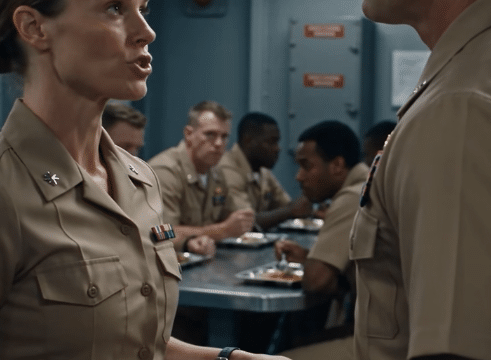
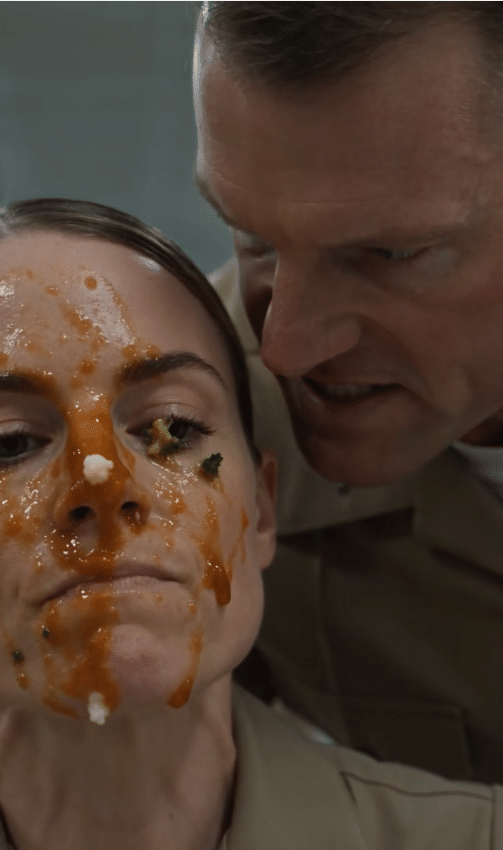
The Major’s hand was already tangled in her hair when the cafeteria went silent.
He stood behind her chair, one fist gripping the neat bun at the back of her head. In front of her sat an ordinary lunch tray: sauce, broccoli, mashed potatoes, and white rice arranged beneath the cold white lights of the military dining hall.
She had been sitting quietly.
That was apparently enough to offend him.
Without warning, he forced her face downward.
Her cheek struck the tray.
The food scattered.
Sauce smeared across her face. Rice stuck to her cheek and collar. A piece of broccoli rolled onto the table as the metal tray rattled loudly enough to make several nearby soldiers flinch.
Nobody moved.
The Major released her.
She slowly lifted her head.
For a second, the entire cafeteria seemed to expect tears.
Instead, they saw something else.
Her jaw was tight.
Her fingers had curled against the edge of the table.
But her eyes were calm.
Almost unnervingly calm.
The Major leaned over her.
“Get out of my sight, before I make this whole room remember where you belong.”
The words hung beneath the fluorescent lights.
A few younger soldiers stared at their trays.
An older soldier at the next table looked directly at the woman.
Then at the Major.
Then back at her.
Something about her expression bothered him.
Not because she looked frightened.
Because she didn’t.
The woman reached for a napkin.
Slowly.
She wiped the sauce from her eyes.
Then her cheeks.
Then her mouth.
She cleaned the rice from her collar and brushed the food from her uniform with careful, almost methodical movements.
The cafeteria remained silent.
She placed the dirty napkin on the table.
Then she looked down at her uniform.
Her right breast pocket was still closed.
Nobody noticed what was inside.
Nobody except perhaps the older soldier.
The woman slipped her hand into the pocket.
The Major watched her.
He seemed to expect another apology.
Instead, she pulled out a small object that caught the fluorescent light.
Silver.
An eagle.
The older soldier’s face changed instantly.
“Major… don’t.”
The Major turned toward him.
He didn’t understand the warning.
He only understood that someone had challenged his authority.
He straightened.
“Sit down. Nobody here outranks me at lunch.”
The woman said nothing.
She simply held the silver eagle between two fingers.
Then she brought it to her chest.
And pinned it onto her uniform.
The cafeteria seemed to lose its air.
Because the Major had spent the last minute humiliating someone he believed was beneath him—and now every experienced soldier in the room knew he had made a catastrophic mistake.
Act II
Military cafeterias had their own unwritten rules.
Everyone knew them.
Where junior enlisted personnel sat.
Where officers gathered.
Which tables belonged to senior command.
Who was expected to stand when certain people entered.
None of those rules were written on the walls.
They didn’t need to be.
The Major had built much of his authority around those invisible rules.
At forty-five, he was physically imposing, impeccably dressed, and accustomed to seeing people straighten the instant he approached.
He believed rank should be visible.
He believed respect should be immediate.
And he had developed a dangerous habit of treating hesitation as disobedience.
The woman had triggered that habit simply by remaining seated.
Her uniform was ordinary.
Her visible insignia suggested nothing unusual.
She had not jumped up when he approached.
She had not apologized.
She had not offered an explanation.
To him, that was disrespect.
He never asked why.
He simply acted.
That was how her face ended up in a lunch tray.
The humiliation had been public, deliberate, and designed to establish dominance.
But there was something the Major did not understand.
The woman had been watching him long before he touched her.
She had noticed the way junior soldiers went quiet when he passed.
She had noticed how older personnel avoided unnecessary arguments.
She had noticed the way people checked his insignia before deciding whether they were allowed to speak.
And she had noticed something else.
The Major cared deeply about visible hierarchy.
That made him predictable.
Her own authority was different.
It was not designed to be recognized by everyone.
It was designed to be recognized by the people who needed to know.
That was why the silver eagle had been kept inside her right breast pocket.
Not displayed.
Not announced.
Hidden.
The badge was small enough to disappear beneath the fabric.
But to the right person, it meant something very different from the ordinary insignia on her uniform.
The older soldier sitting nearby knew that.
He had been in the military long enough to recognize symbols that younger personnel had only heard about.
His reaction had not been surprise.
It had been fear.
He had seen the eagle.
And he knew what it represented.
The woman carefully adjusted the badge against her chest.
No dramatic gesture.
No raised voice.
Just a simple movement.
But suddenly, everyone was staring.
The younger soldiers who had watched the humiliation moments earlier now looked pale.
One had stopped halfway through lifting his fork.
Another slowly lowered his cup.
Nobody laughed anymore.
The Major noticed.
His eyes moved around the room.
He could feel his control slipping.
But instead of stopping, he doubled down.
That was the mistake.
Again.
He had been given a warning.
He had ignored it.
The older soldier lowered his gaze.
He knew there was nothing left to say.
Whatever happened next would belong to the woman and the Major.
And the silver eagle would speak for itself.
The badge had not changed her. It had only revealed that the cafeteria had never understood who was sitting at the table.
Act III
The woman had never needed to explain the badge.
That was precisely why it was powerful.
Military authority was not always a matter of visible rank.
There were assignments, commands, investigations, special authorities, and operational roles that did not announce themselves to an entire dining hall.
Some symbols existed precisely because most people were not supposed to understand them.
The silver eagle was one of those symbols.
The older soldier remembered seeing it years earlier.
He remembered the reaction of senior officers whenever one appeared.
Conversations stopped.
Doors opened.
Questions were answered differently.
Not because the person wearing the badge necessarily outranked everyone in the room in the traditional sense.
Because the badge represented authority that operated outside the ordinary social hierarchy.
And the woman had just placed it directly on her chest.
The Major stared at it.
His expression remained hard.
But his eyes were moving.
He looked at the badge.
Then at the woman.
Then at the older soldier.
The older soldier said nothing.
He didn’t need to.
The warning had already been given.
The Major had rejected it.
The woman picked up her napkin again and folded it once.
There was still a small streak of sauce near her collar.
She wiped it away.
Her movements were calm enough to make the Major’s earlier aggression look increasingly ridiculous.
He had expected her to become smaller.
She had become quieter.
He had expected fear.
He had gotten composure.
He had expected obedience.
Instead, she had placed a silver eagle over the exact uniform he had just treated as insignificant.
Around the cafeteria, older soldiers understood before the younger ones did.
The room had changed.
This was no longer about lunch.
It was no longer about whether she should have stood.
It was no longer even about the humiliation itself.
The Major had crossed a line before an audience.
And now that audience understood there were consequences beyond ordinary rank.
The woman finally looked directly at him.
Her expression contained no anger.
That somehow made it worse.
Anger would have given him something to fight.
She gave him nothing.
No shouting.
No accusation.
No demand for an apology.
Only certainty.
She reached up and straightened the silver eagle.
Then she spoke.
“I’ll leave, Major. But your command is leaving with me.”
The words were quiet.
They did not need to be louder.
Several older soldiers stiffened.
One young soldier looked at the Major as if seeing him for the first time.
The Major’s face changed.
Not completely.
Just enough.
His jaw tightened.
His eyes widened slightly.
His attention returned to the silver eagle.
The symbol was no longer a piece of metal.
It was a warning he had failed to understand.
And suddenly, his own words came back to him.
Nobody here outranks me at lunch.
He had said them with complete confidence.
Now they sounded absurd.
The woman stood.
She did not rush.
She simply straightened her jacket, adjusted the badge, and gathered herself.
The dirty napkin remained on the table.
So did the untouched remains of her lunch.
The Major watched her rise.
The cafeteria watched him watch her.
Nobody said anything.
Then his eyes locked onto the silver eagle again.
His lips parted.
He finally understood that the badge wasn’t decoration—and that his own command might be the first thing he was about to lose.
Act IV
The Major had spent years believing that authority was something you could see.
Bars.
Insignia.
Uniforms.
Boots.
Posture.
He had built his identity around those symbols.
The woman had just demonstrated that the most dangerous authority in the room could be the one nobody recognized.
She picked up her tray.
The movement was ordinary.
Almost painfully ordinary.
That was what made the moment so powerful.
She wasn’t celebrating.
She wasn’t threatening him.
She wasn’t even angry.
She simply behaved as though the cafeteria humiliation had already become irrelevant.
The Major, however, could not look away from the badge.
The older soldier finally stood.
Not to confront the Major.
Not to defend the woman.
He simply stood at attention.
That single movement traveled through the room.
Another soldier followed.
Then another.
Within seconds, older personnel across the cafeteria were standing straighter.
Younger soldiers noticed.
They followed.
The Major remained still.
For the first time, the room was not responding to his authority.
It was responding to hers.
And that difference was devastating.
The woman looked around.
The faces staring back at her were no longer amused.
Some were ashamed.
Some were frightened.
Others looked confused.
She had become the center of the room without asking for it.
The Major had created that center himself.
He had wanted everyone to see what happened when someone failed to respect him.
Instead, everyone had seen what happened when he failed to recognize someone else.
The woman moved toward the cafeteria exit.
Then stopped.
She looked back once.
Not at the soldiers.
At the Major.
There was no satisfaction in her expression.
Only a quiet finality.
The kind that comes when a decision has already been made somewhere beyond the room.
The Major’s eyes followed the silver eagle.
His mind raced through every interaction he had ever had with senior command.
Every briefing.
Every restricted meeting.
Every name he had heard spoken carefully.
He tried to connect the symbol to something he knew.
And then he remembered.
Not the woman’s name.
Not her title.
The eagle.
He had seen it once before.
Years ago.
On the uniform of an officer who had walked into a command briefing and caused an entire room of senior personnel to stand.
The Major had never understood why.
Now he was beginning to.
The woman had not needed to announce herself because people with the right experience already knew.
That was the difference.
Ordinary authority demanded recognition.
Real authority sometimes arrived quietly and waited to see who would make the mistake of challenging it.
The Major had made that mistake.
Publicly.
Physically.
And without hesitation.
The older soldier watched him carefully.
He knew the Major’s command could not simply continue as if nothing had happened.
The badge had changed the meaning of everything that came before it.
The humiliation.
The warning.
The defiance.
Even the food still scattered across the tray.
All of it was now part of the same story.
And somewhere outside the cafeteria, the machinery of command was already beginning to move.
The Major had thought he was controlling a lunchroom. He was about to discover that the lunchroom had become evidence.
Act V
The woman walked toward the exit.
Her face had been cleaned.
Her uniform was still marked from the tray.
The silver eagle remained pinned against her chest.
She did not hide it anymore.
Behind her, the cafeteria remained unusually quiet.
The Major stood beside the table.
He had not moved.
His polished boots were planted firmly on the floor, but his confidence was gone.
The older soldier looked at him once.
Then away.
There was nothing left to explain.
The woman had already said everything that needed to be said.
Your command is leaving with me.
It wasn’t a threat delivered in anger.
It was a statement.
And the Major knew it.
His command had always seemed permanent to him.
A position.
A title.
Something attached to his uniform.
But command was never truly owned.
It was entrusted.
And trust could disappear faster than rank insignia could be removed.
The woman reached the cafeteria doors.
She paused for half a second.
The cold white lights reflected off the silver eagle.
Every eye in the room caught that flash.
Then she walked through the doors.
The room remained frozen.
The Major finally looked toward the older soldier.
No explanation came.
No rescue.
No reassurance.
The older soldier simply sat back down.
Because he knew what the Major was beginning to understand.
The woman had not walked out defeated.
She had walked out carrying the authority he had unknowingly challenged.
The Major’s humiliation was not caused by the badge alone.
It was caused by the realization that the badge had been there the entire time.
He had simply never bothered to look closely enough.
The cafeteria slowly returned to movement.
Trays shifted.
Chairs scraped.
People began whispering in low voices.
But nobody forgot what they had witnessed.
A woman had been sitting quietly at a table.
A Major had decided she did not belong.
He had used his strength and rank to humiliate her.
She had cleaned her face.
Reached into her pocket.
And changed the entire room with a small silver eagle.
The older soldier looked once more toward the doors.
Then at the dirty napkin still lying on the table.
That napkin had been placed there by the woman after the humiliation.
The badge had come afterward.
One represented what the Major had tried to do to her.
The other represented what he had failed to see.
The difference between them was everything.
Outside, the woman continued down the corridor.
Her expression remained calm.
The silver eagle rested against her chest.
Behind her, an entire chain of command was beginning to shift.
Inside the cafeteria, the Major finally looked down.
His eyes caught the reflection of the silver eagle in the polished metal surface of the lunch tray.
His face went pale.
His mouth opened.
And the only words he could manage were barely audible.
“That eagle…?”
The room gave him no answer.
It didn’t need to.
For the first time that day, the Major understood that he had not humiliated a subordinate.
He had just challenged an authority he never should have touched.
And somewhere beyond those cafeteria doors, the woman carrying the silver eagle was already taking his command with her.