Act I
The tray hit the cafeteria floor with a metallic crash.
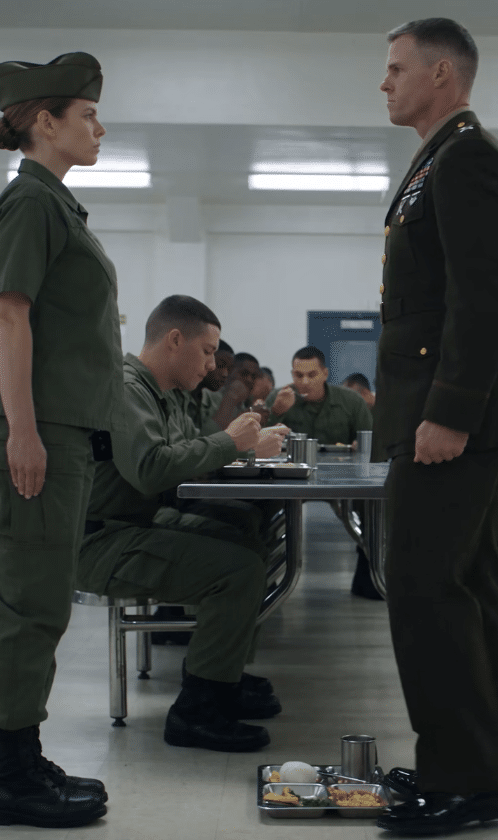
Food scattered across the pale tile, sliding beneath the stainless-steel tables as dozens of conversations died at once. The woman holding the empty tray remained perfectly still, her brown hair tucked beneath an olive patrol cap, her plain uniform looking no different from those worn by countless other soldiers in the room.
Beside the mess stood a senior officer in a crisp uniform and mirror-polished boots.
He looked down at the food.
Then at her.
“Pick it up. Now.”
The command was loud enough for everyone nearby to hear.
Nobody moved.
The woman slowly raised her eyes to his.
“You knocked it out of my hands.”
A few soldiers lowered their gazes. Others stared rigidly at their trays, suddenly fascinated by food they had stopped eating.
The officer’s jaw tightened.
He had expected an apology.
Instead, he had received a fact.
He stepped closer.
With the toe of his boot, he pushed the fallen tray farther across the floor.
It scraped loudly against the tile.
The humiliation was no longer accidental. It was a performance.
And everyone in that cafeteria knew exactly who was being forced to watch it.
Everyone except the one soldier who noticed something lying beside the spilled food.
Something black.
Something that didn’t belong on an ordinary soldier’s uniform.
And when he finally understood what he was looking at, his face changed.
Because the woman standing in front of the officer wasn’t nearly as powerless as she appeared.
But the officer hadn’t realized it yet.
And that was about to become his biggest mistake.
Act II
The cafeteria had been loud only moments earlier.
Forks scraped against trays. Chairs shifted across the floor. Soldiers talked in low voices between bites, enjoying one of the few ordinary moments in a day built around orders, schedules, and discipline.
Then the tray fell.
Now the room felt unnaturally small.
The woman stood at the center of it without moving.
Her uniform carried no flashy insignia that demanded attention. There was nothing about her appearance that suggested she had walked into the cafeteria expecting everyone to stand.
She looked ordinary.
That was exactly what the officer had assumed.
He was older, broader through the shoulders, and visibly accustomed to having people obey him before he finished speaking. His rank was easy to see. His posture announced authority before his mouth ever opened.
Hers did not.
That difference had apparently been enough.
The officer looked at the spilled meal again.
“Pick it up.”
This time, he didn’t need to shout.
The entire room was already listening.
The woman didn’t bend.
She simply watched him.
There was no anger in her expression.
No pleading.
No fear.
That calmness seemed to irritate him more than an argument would have.
He had expected the usual reaction to public humiliation: embarrassment, apology, retreat.
Instead, she stood there as though she were waiting for him to finish making a mistake.
The nearby soldiers noticed it too.
A young enlisted man sitting several feet away stopped chewing.
His eyes moved from the officer to the woman, then down toward the floor.
That was when he saw it.
A small black credential had slipped partially from beneath the edge of the fallen tray.
It was almost hidden among the spilled food.
At first, he thought it was nothing.
Then he saw the shape.
The finish.
The distinctive black casing.
And something about it made his stomach tighten.
“What is that?”
The words escaped before he could stop himself.
The officer glanced down.
The woman did too.
For the first time, the young soldier saw the smallest change in her expression.
Not fear.
Recognition.
She knew exactly what had fallen.
And suddenly the officer’s humiliation game didn’t feel quite so simple.
The soldier swallowed hard.
He had seen credentials before.
He had seen people carry authority that wasn’t displayed on their uniform every day.
But this was different.
He didn’t know exactly what it meant.
He only knew that someone important had just noticed it.
And the woman still hadn’t explained a thing.
That silence was becoming more intimidating than any rank insignia.
Yet the officer remained convinced he was in control.
He had no idea the room had already begun to change sides—not through rebellion, not through shouting, but through recognition.
And the next few seconds would reveal why.
Act III
The cafeteria noise disappeared almost completely.
No one announced that they should be quiet.
No one needed to.
The soldiers simply stopped talking.
The woman lowered herself just enough to retrieve the black credential.
She didn’t rush.
She didn’t hide it in panic.
She picked it up with the same deliberate calm someone might use to retrieve a set of keys.
Then she clipped it back inside her uniform.
The movement lasted only a second.
But the witness soldier saw enough.
The officer saw it too.
His eyes followed the credential.
For the first time since the tray hit the floor, uncertainty crossed his face.
It vanished almost immediately.
Pride rushed back in to cover it.
Whatever that object was, he seemed determined not to let anyone see that it had unsettled him.
He straightened his shoulders.
The woman stood.
And something about her posture changed.
She hadn’t grown taller.
She hadn’t raised her voice.
She hadn’t displayed another insignia.
But suddenly she no longer looked like someone standing beneath an officer’s authority.
She looked like someone who had been waiting for him to finish talking.
The young soldier at the table sat rigidly upright.
He knew that posture.
Not from this woman specifically.
From people who had spent years in rooms where decisions were made before ordinary soldiers ever heard about them.
The officer looked at her.
She looked at the tray.
Then back at him.
For several seconds, neither spoke.
The officer’s confidence was beginning to crack.
But he still didn’t understand why.
The woman had every opportunity to explain herself.
She could have revealed her position.
She could have demanded respect.
She could have called attention to the credential.
Instead, she did something far more devastating.
She gave him his own words back.
“Pick it up.”
The words were quiet.
Almost gentle.
But they landed harder than his original command.
The officer stared at her.
Around them, soldiers remained frozen.
No one laughed.
No one whispered.
No one dared turn the moment into entertainment.
The same order that had been used to humiliate her had become a mirror.
And suddenly the question wasn’t whether she would obey him.
The question was whether he had just ordered the wrong person.
Still, the black credential remained unexplained.
And that was the detail that made the silence unbearable.
Because if the credential meant what the witness soldier suspected, then the officer hadn’t merely embarrassed a subordinate.
He had publicly challenged someone whose authority had been hidden in plain sight.
And now every soldier in the room was waiting to see whether he understood it.
Act IV
The officer’s mouth opened.
Nothing came out.
For a man who had been so quick with commands, the silence was almost shocking.
His eyes moved briefly toward the woman’s uniform.
Plain olive fabric.
No dramatic display.
No obvious badge announcing who she was.
Then his gaze returned to her face.
She hadn’t moved.
That was what frightened him most.
There was no anger to fight against.
No emotional outburst he could dismiss.
Only complete control.
The young witness soldier looked from the woman to the officer and understood that the balance of the room had changed without anyone physically doing anything.
The officer had created the humiliation.
He had knocked the tray away.
He had pushed it with his boot.
He had ordered her to clean up a mess he had deliberately caused.
But now the same order was sitting between them.
Pick it up.
The officer’s eyes flicked toward the tray.
For the first time, his polished boot looked strangely out of place beside it.
A few seconds earlier, that boot had represented power.
Now it seemed to represent the exact moment he had crossed a line he didn’t understand.
The woman waited.
She didn’t threaten him.
She didn’t explain the credential.
She didn’t tell the room who she was.
She didn’t need to.
The witness soldier had already seen enough to become nervous.
The officer noticed that nervousness.
Then he noticed the way the other soldiers were sitting.
Straighter.
Quieter.
Watching him.
No one was rushing to defend the woman.
But no one was supporting him either.
That was worse.
Because the room had become an audience to something he could no longer control.
His expression shifted.
Arrogance gave way to calculation.
Calculation gave way to uncertainty.
And uncertainty finally became fear.
The woman looked once more at the tray.
Then at him.
Nothing about her expression changed.
But the officer suddenly seemed to understand that the black credential hadn’t fallen into view by accident in the story everyone was now imagining.
It had revealed something.
Not enough to explain everything.
Just enough to make him question everything.
Who was she?
Why had she been wearing an ordinary uniform?
Why had she allowed him to continue?
And most importantly—
How much had she already seen before he ever realized she was watching?
The room held its breath.
The officer looked down.
Then slowly back up.
And in that moment, the man who had demanded obedience seemed to realize that he might have been standing on the wrong side of the chain of command all along.
Act V
Nobody moved.
The spilled food remained scattered across the cafeteria floor.
The tray rested near the officer’s boot, exactly where he had pushed it.
The woman stood several feet away, perfectly composed.
The black credential was hidden again beneath her uniform.
Whatever it represented, she had no intention of explaining it.
Not yet.
The young soldier at the table kept his eyes on the officer.
He had witnessed the entire transformation.
At the beginning, the officer had seemed untouchable.
He had entered the confrontation with certainty, using rank and intimidation to make a public example of someone he believed couldn’t answer him.
Now he looked like a man who had suddenly discovered that appearances could be dangerously incomplete.
The woman hadn’t defeated him by shouting.
She hadn’t threatened him.
She hadn’t struck him.
She hadn’t even raised her voice.
She had simply refused to accept a lie.
And then she had returned his own command.
“Pick it up.”
Two words.
That was all.
But the meaning had changed completely.
The officer’s face tightened.
His mouth opened slightly.
For a heartbeat, the cafeteria seemed to disappear behind him.
The tables blurred.
The soldiers blurred.
Even the woman standing across from him seemed distant.
All that remained was the realization forming behind his eyes.
He had judged her by what he could see.
He had mistaken silence for weakness.
He had mistaken an ordinary uniform for an ordinary person.
And somewhere beneath that uniform was a credential that had made another soldier recognize something the officer had failed to notice.
Something important.
Something powerful.
Something that could change the entire meaning of what had just happened.
The officer stared at her.
His arrogance was gone.
In its place was confusion.
Then uncertainty.
Then unmistakable fear.
The cafeteria remained silent.
And the last thing anyone saw was his face as he finally understood that the woman he had ordered to the floor might have had the authority to question him all along.