Act I
The train doors were still open when the 74-year-old man lifted one hand and tried to stop the rush.
“Please let them exit first…”
He was standing beside the yellow platform line with a crutch tucked beneath one arm, his gray coat pulled tight against the cold air pouring through the station.
Passengers were trying to leave the train.
Others were already pushing forward to board.
It was a dangerous squeeze.
The elderly man wasn’t yelling. He wasn’t blocking the doorway. He was simply asking people to give the exiting passengers a few seconds of space.
The commuter in the black suit didn’t see it that way.
He looked at the old man with an expression of pure irritation.
“Trash. Don’t slow me down.”
Then his foot came forward.
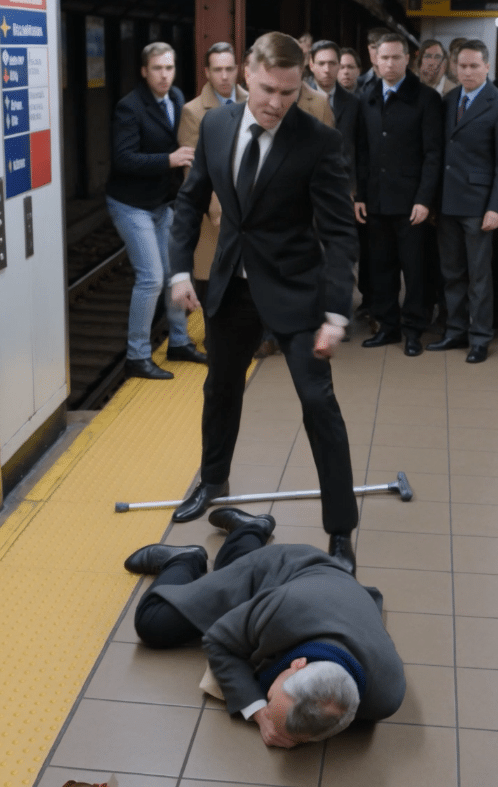
The kick struck the elderly man’s chest and knocked him hard onto the platform floor.
His crutch flew from his hand and clattered across the tile.
The paper bag he had been carrying tore open. Small belongings scattered near the yellow line as his elbow struck the platform, leaving a thin trace of blood.
For a moment, the station seemed to stop breathing.
The old man grimaced and curled inward, struggling to catch his breath.
The train’s warning chime continued.
Commuters stared.
Nobody moved.
The man in the black suit stood over him, wireless earbuds still in place, his expensive laptop bag hanging from one shoulder as though nothing important had happened.
Then he stepped closer.
Two more kicks landed against the elderly man’s back and side.
The old man recoiled, his face tightening with pain and fear.
People gasped.
Some covered their mouths.
Others stepped backward.
Still, no one intervened.
The bully looked down at the man with contempt.
“Crawl out of the way.”
Then something happened that had nothing to do with the passengers.
An employee elevator at the far end of the platform opened with a sharp metallic ding.
Two transit police officers stepped out.
And behind them came a man in a long black coat.
He looked toward the elderly passenger first.
Then toward the bully.
And suddenly, the entire platform was about to become a very different place.
Act II
The 74-year-old man had spent most of his life believing that crowded public places required one simple rule.
Look out for the person next to you.
He had learned it long before smartphones, electronic fare gates, and modern subway platforms.
He had learned it when people still held doors open for strangers without thinking about it.
That morning, he had been traveling across the city using his crutch, carrying a small paper bag with a few ordinary things inside.
Nothing about him suggested authority.
He wore an old gray coat.
A blue scarf.
Brown khakis.
Worn leather shoes.
To the impatient commuter, he probably looked like an obstacle.
That was the mistake.
The elderly man wasn’t trying to control anyone.
He had simply watched the crowd surge toward the open train doors and noticed what could happen if everyone pushed at once.
Passengers were stepping off.
People were stepping on.
The yellow line was only inches away.
One wrong movement could send someone into another passenger or toward the platform edge.
So he spoke.
Politely.
Briefly.
He asked the people entering to wait until the people leaving had space.
That should have been the end of it.
Instead, the man in the black suit took it personally.
He was thirty-five, sharply dressed, carrying an expensive laptop bag, with wireless earbuds in his ears and the unmistakable expression of someone who believed his time mattered more than everyone else’s.
He had been in a hurry.
Perhaps he had a meeting.
Perhaps he was already late.
Perhaps his frustration had been building before he ever reached the platform.
None of that explained what happened next.
A reminder about subway etiquette had become, in his mind, an insult.
And once he decided the elderly passenger had challenged him, the crowd became part of his calculation.
He could see people watching.
He could see them backing away.
He could see that nobody wanted trouble.
So he crossed a line that had nothing to do with the yellow paint on the floor.
The old man hit the ground.
His crutch went sliding.
The crowd fell silent.
And the bully became convinced that silence meant permission.
He didn’t know the station as well as he thought he did.
He didn’t know about the employee elevator.
He didn’t know who sometimes used it.
And he certainly didn’t know that the man walking out of it had spent years overseeing the transit system that surrounded them.
Because this wasn’t just another station employee arriving to deal with a disturbance.
It was the transit system director.
And he had seen enough.
Act III
The director’s first instinct was not anger.
It was protection.
He saw the elderly man lying beside the yellow line.
He saw the abandoned crutch several feet away.
He saw the scattered contents of the torn paper bag.
Then he saw the two officers move.
They stepped between the injured passenger and the attacker, creating a human barrier before the bully could move any closer.
The commuters immediately parted.
The train doors remained open.
The familiar sounds of the station seemed suddenly distant.
The director walked forward.
He didn’t need to ask which man had been attacked.
The answer was written across the platform.
The elderly passenger was still breathing hard, one arm held close to his body as he tried to gather himself.
The bully’s expression remained defiant.
He looked at the officers.
Then at the director.
Then at the train.
As if he were trying to understand why everyone had suddenly stopped moving.
The director looked around the platform.
Then he gave a single order.
“Shut this platform down.”
The effect was immediate.
The officers tightened their position around the elderly man.
Commuters stepped farther aside.
The normal rhythm of the station disappeared.
No boarding rush.
No crowd pressing toward the doors.
No one squeezing past the injured passenger.
The platform itself became a controlled scene.
And that was when the bully’s confidence began to fracture.
He had expected an argument.
Maybe a complaint.
Maybe a security guard asking him to leave.
He had not expected the entire platform operation to stop.
But the director hadn’t done it to make a dramatic point.
He had done it because the situation was no longer ordinary.
An elderly passenger had been knocked down beside an active platform edge.
There had been repeated violence.
There were witnesses everywhere.
And now the transit system had an official responsibility to secure the area.
The bully looked around.
Every face seemed different now.
The people who had watched silently before were no longer simply commuters.
They were witnesses.
The two transit police officers weren’t spectators.
They were there to control the scene.
And the man giving orders wasn’t another stranger who happened to dislike what he’d done.
He was the person with authority over the station’s operations.
Yet there was still something the bully didn’t understand.
The director had recognized the elderly man.
Not personally.
But professionally.
He had seen his name before.
Not because the old man was famous.
Not because he had special status.
Because he had been one of the passengers who repeatedly reported accessibility problems throughout the system.
Broken elevators.
Blocked pathways.
Unsafe crowding.
Poorly placed obstacles near boarding areas.
He had written letters.
He had attended public meetings.
He had complained when elderly and disabled passengers were forced to navigate conditions that younger, healthier commuters barely noticed.
He had never asked for special treatment.
He had asked for safer treatment.
That afternoon, the irony was impossible to miss.
A man who had spent years speaking up for vulnerable passengers had been attacked for trying to protect them.
And the person now standing between him and his attacker knew exactly how much that mattered.
But the biggest reversal had not happened yet.
The bully was still staring at the director.
And he still hadn’t understood what shutting down the platform really meant.
Act IV
The station had become unnaturally quiet.
A place built around movement had suddenly stopped moving.
The train remained at the platform, its open doors framing rows of confused passengers.
The yellow line ran beneath the harsh station lights.
The crutch lay several feet away.
And in the middle of it all stood a man who had believed he could force his way through anyone who slowed him down.
Now nobody was moving for him.
The transit police officers remained between him and the elderly passenger.
One officer stayed focused on the injured man while the other watched the bully carefully.
The director didn’t take his eyes off the attacker.
The bully’s face had changed.
At first, there had been anger.
Then annoyance.
Now there was calculation.
He was beginning to understand that he had made a terrible mistake.
Not because he had been rude.
Not because he had pushed past someone.
Because he had turned an ordinary disagreement into an incident that the entire transit system now had to document.
Every second mattered.
Every witness mattered.
The platform cameras mattered.
The officers mattered.
And the fact that the director himself had arrived before the situation ended mattered most of all.
The elderly man slowly reached toward his crutch.
He was still visibly shaken.
His breathing remained uneven.
His face carried the unmistakable pain of someone trying not to show just how badly he had been frightened.
But he was no longer alone.
That small difference changed everything.
Minutes earlier, the bully had stood over him while strangers watched from a distance.
Now trained officers stood between them.
The power had reversed without anyone needing to touch the attacker.
The bully looked toward the employee elevator.
Then toward the director.
Then at the motionless train.
He seemed almost offended by what he was seeing.
How could one sentence from one elderly passenger have brought all of this down on him?
The answer was simple.
It wasn’t the sentence.
It was the choice he made after hearing it.
“Please let them exit first.”
Those words had offered him an easy way out.
He could have waited.
He could have stepped aside.
He could have ignored the request.
Instead, he had chosen violence.
And now the system he had treated like an inconvenience had become the very system holding him accountable.
The director remained calm.
He didn’t insult the bully.
He didn’t threaten him.
He didn’t need to.
The station itself had become the answer.
The train wasn’t leaving.
The crowd wasn’t moving.
The officers weren’t stepping aside.
And the elderly man was no longer the person everyone was afraid to approach.
The bully was.
Then the realization finally reached his face.
His irritation disappeared.
His jaw tightened.
His eyes shifted.
The arrogance that had carried him through the first half of the confrontation suddenly looked fragile.
He stared toward the stopped platform.
Then back toward the director.
“Shut it down?”
The question sounded almost impossible to believe.
But there was no going back now.
Act V
For the first time that afternoon, the elderly passenger didn’t have to defend himself.
He didn’t have to explain why he had spoken.
He didn’t have to prove that he had meant well.
The evidence was already there.
His crutch.
The torn paper bag.
The mark on his elbow.
The witnesses.
The officers.
The stopped train.
And the director standing over the situation with the authority to make sure it was handled properly.
The elderly man slowly pulled himself into a safer position away from the yellow line.
His breathing remained heavy, but his eyes were steadier.
The crutch was returned to him.
The same object that had made him look vulnerable moments earlier now became a reminder of something else.
He had been trying to protect strangers.
He had been thinking about everyone stepping off the train.
He had been worried about someone falling.
He had been looking at the crowd and thinking about safety.
The bully had been thinking only about getting through the doors first.
That difference explained everything.
One man saw a platform full of people who needed space.
The other saw obstacles in his way.
And when someone asked him to slow down, he treated the request as an attack on his importance.
The irony was almost unbearable.
The elderly passenger had tried to keep the platform safe.
The bully had made it dangerous.
And the moment the bully attacked him, the transit system had to stop the very movement he had been so desperate to maintain.
The director’s order had transformed the entire scene.
No shouting was necessary.
No dramatic confrontation was necessary.
The platform had simply stopped.
The commuters watched quietly from behind the officers.
Some lowered their eyes.
Others looked toward the elderly man with an expression that said what they hadn’t been brave enough to say earlier.
They had seen what happened.
They had watched him fall.
They had watched the crutch slide away.
They had heard him ask for nothing more than a little patience.
And they had watched the man who attacked him suddenly discover that authority existed after all.
The bully stood alone in the middle of the stopped station.
His laptop bag was still over his shoulder.
His expensive clothes were still perfectly arranged.
His earbuds were still in place.
But none of those things gave him power anymore.
A few minutes earlier, he had believed an elderly man with a crutch was beneath him.
Now the entire station had been forced to stop because of what he had done.
The most humiliating part wasn’t that someone had shouted at him.
Nobody had.
It wasn’t that he had been publicly insulted.
He hadn’t.
It was that his own impatience had exposed him.
He had been given a chance to simply wait.
He chose cruelty instead.
And in the end, the thing he had been trying hardest not to do—slow down—was exactly what happened.
The platform stopped.
The crowd stopped.
The train stopped.
And for one long, uncomfortable moment, so did he.
All because one elderly passenger had asked everyone to let the people exit first.