Act I
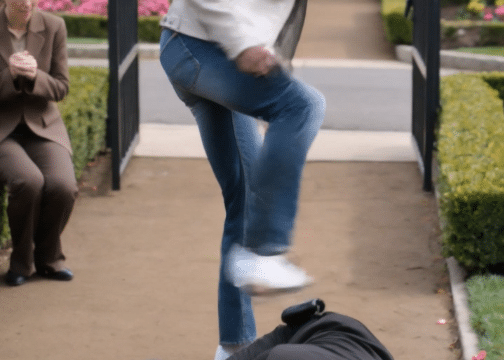
The kick came before anyone had time to understand how a simple request had turned into violence.
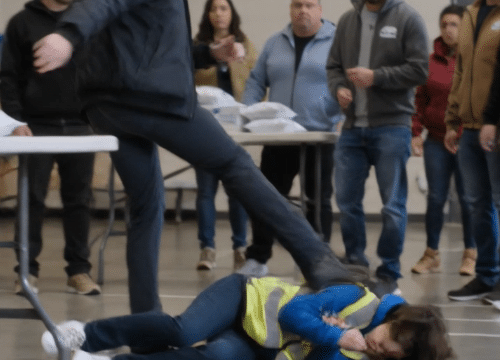
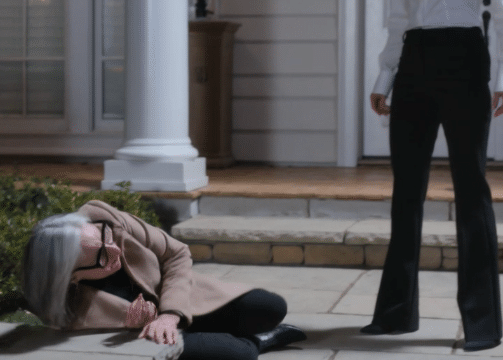
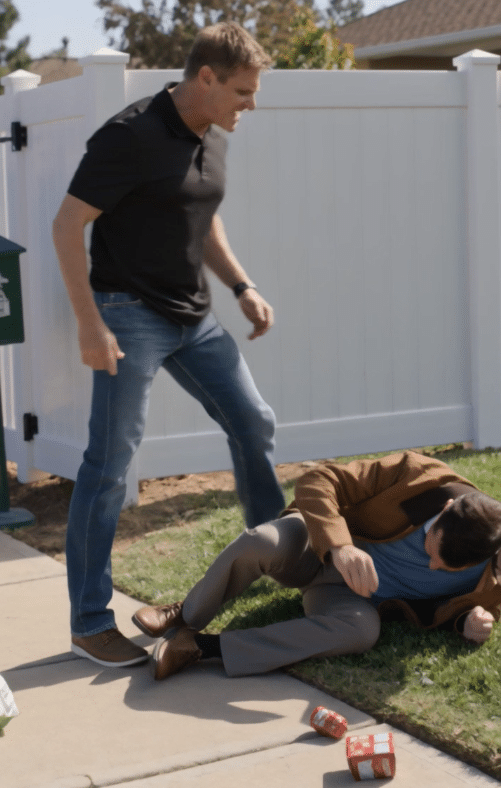
One second, the 58-year-old neighbor was standing beside the white fence with a small grocery bag in one hand, pointing toward the mess on the sidewalk. The next, the dog owner drove a hard kick into his chest and sent him stumbling backward onto the grass.
The grocery bag slipped from his fingers.
An apple rolled beneath the fence. A carton struck the pavement. Something plastic skittered across the sidewalk as his elbow slammed against the edge of a fence post, leaving behind a thin trace of blood.
He curled instinctively, grimacing as he fought for breath.
Around him, doors opened.
Neighbors appeared on porches and at the ends of driveways, but nobody moved toward him. They covered their mouths. They froze. Some took a frightened step backward.
The dog owner remained standing.
His large dog pulled at the leash beside him, confused by the sudden commotion. The man looked down at the neighbor as though the person on the ground had somehow become the problem.
The injured man swallowed hard.
“I only asked you to clean it…”
The words barely carried.
The dog owner stared at him with cold contempt.
“Trash. Don’t tell me what to do.”
Then he stepped closer.
The neighbor’s eyes widened as the man delivered two more forceful kicks into his back and side. He drew his arms inward, grimacing, breathing hard, trying to make himself smaller against the grass.
Nobody intervened.
And somehow, that wasn’t even the worst part.
The bully looked around at the white fences, the trimmed lawns, the familiar houses—and seemed convinced the entire neighborhood belonged to him.
“This is my sidewalk.”
Then a sound cut through the silence.
Brakes.
Hard.
A black SUV stopped at the curb.
And the man who thought he owned the sidewalk was about to discover who actually had authority over the street he was standing on.
Act II
The neighborhood had always looked like the kind of place where people believed problems could be solved with a polite conversation.
Every lawn was trimmed. Every fence seemed freshly painted. There was a pet-waste station near the sidewalk, installed years earlier after homeowners had complained about exactly the kind of mess that had started this confrontation.
The 58-year-old neighbor had never been interested in arguments.
He was the sort of person who carried his groceries home instead of driving three blocks. He knew which neighbor had a new baby, which elderly couple needed help bringing their trash cans back from the curb, and which houses had dogs that barked whenever a delivery truck passed.
That afternoon, he had simply noticed the mess.
The dog owner had been walking his large dog along the sidewalk. The animal stopped near the edge of the grass, leaving waste directly in the pedestrian path.
There was a bag station only a few yards away.
The neighbor had pointed toward it.
Nothing more.
But the dog owner had heard something completely different.
To him, the request wasn’t about cleanliness. It wasn’t about pedestrians. It wasn’t even about the dog.
It was a challenge.
He was forty years old, well dressed, confident, and accustomed to moving through the neighborhood as though his preferences carried more weight than everyone else’s.
He had spent years cultivating the image of someone who didn’t have to explain himself.
So when another resident politely asked him to clean up after his dog, something inside him snapped.
The neighbor hadn’t insulted him.
That was precisely why his reaction seemed so shocking.
There had been no shouting match beforehand. No long argument. No threat.
Just a request.
Yet the man’s response suggested that the very idea of being corrected by someone he considered beneath him was unbearable.
And that attitude hadn’t started that afternoon.
For months, residents had quietly complained about the same dog owner.
He left his trash bins out too long.
He parked where he wasn’t supposed to.
He ignored neighborhood notices.
When reminded of community rules, he treated them less like regulations and more like personal attacks.
Most people had learned to avoid him.
The 58-year-old neighbor hadn’t.
He believed rules existed because everyone was supposed to follow them—not because some people were important enough to ignore them.
That belief was now costing him dearly.
As he lay beside the fence, he could hear the dog’s leash rattling.
He could hear the wind moving through the trees.
He could hear the distant sound of a garage door opening.
But no footsteps came toward him.
The witnesses were afraid.
The bully knew it.
And that was why he had become even bolder.
Yet the black SUV idling at the curb had changed something none of them could see.
Because the woman stepping out wasn’t a random passerby.
She was the person responsible for enforcing the rules the bully had spent months pretending did not apply to him.
And she had brought witnesses of her own.
Act III
The first thing the homeowners board president saw was the man on the ground.
She didn’t ask what had happened.
She didn’t demand an explanation.
She didn’t look at the dog owner first.
She looked at the injured neighbor.
Two board members hurried around the SUV behind her, their expressions tightening as they took in the scattered groceries, the disturbed grass, and the residents standing silently along their doorways.
The board president walked directly between the bully and the man on the ground.
That single movement changed the entire atmosphere.
The bully’s shoulders remained squared, but his certainty began to crack.
The board president was sixty-two, dressed in a navy blazer and white blouse beneath a dark coat. She wasn’t shouting.
She didn’t need to.
The two board members positioned themselves between the aggressive dog owner and the injured resident.
Only then did the woman turn toward the bully.
“Then explain it to the board.”
Silence.
The words were simple.
But they landed harder than a threat.
The bully blinked.
For the first time, he seemed to understand that this wasn’t another neighbor asking him to pick up after his dog.
This was an official confrontation.
And the people standing behind the woman weren’t spectators.
They were members of the homeowners board.
The same board he had ignored.
The same board whose notices he had dismissed.
The same board whose authority he had repeatedly challenged whenever a rule became inconvenient.
The bully’s eyes moved from one board member to the other.
Then to the black SUV.
Then back to the woman.
The sidewalk suddenly felt very different.
A few minutes earlier, he had believed everyone around him was powerless.
Now the entire neighborhood was watching.
And there was something else he didn’t yet know.
The board president hadn’t come because someone called her about dog waste.
She had already been on her way to the neighborhood.
Earlier that afternoon, the board had been reviewing several complaints involving repeated violations at the property.
There were photographs.
Written notices.
Dates.
Records of previous warnings.
And the man’s name appeared more than once.
The dog incident wasn’t an isolated disagreement.
It was the latest entry in a growing record.
But the board president had no intention of making a spectacle out of the situation.
Her priority was the injured resident.
One board member moved toward the scattered groceries while another remained positioned firmly between the men.
The victim slowly pushed himself upright against the fence, still grimacing, one hand pressed against his side.
His humiliation was almost as painful as the physical impact.
He had asked for a sidewalk to be cleaned.
Now half the neighborhood had watched him get knocked down for saying it.
But there was something the bully had failed to understand.
The moment he attacked another homeowner, the argument stopped being about dog waste.
It became a matter for the entire community.
And the board had documentation.
The question was no longer whether the bully believed the rules applied to him.
The question was what would happen when the rules finally answered back.
Act IV
The board president had seen arrogance before.
She had seen homeowners threaten lawsuits over parking spaces. She had watched neighbors refuse to follow landscaping rules. She had dealt with people who believed money, influence, or sheer volume could make them immune to consequences.
But physical violence was different.
The community could argue over rules.
It could debate fines.
It could disagree over interpretations.
It could even vote to change regulations.
What it could not do was pretend an assault hadn’t happened.
The board members knew that.
The witnesses knew it.
And now the bully was beginning to realize it.
His confidence drained slowly, not dramatically.
He looked toward the neighbors who had watched the confrontation.
Only minutes earlier, they had seemed like a silent audience he could intimidate.
Now they were witnesses.
The scattered groceries remained across the pavement.
The pet-waste bag station stood only a short distance away, almost absurdly ordinary against the scene.
The white fence had a small mark where the neighbor’s elbow had struck.
Nothing about the setting looked extraordinary.
That was what made the moment so uncomfortable.
This wasn’t a dark alley.
It wasn’t a dangerous part of town.
It was a quiet suburban sidewalk where people walked their dogs, carried groceries, and waved at one another on ordinary afternoons.
And yet one man’s sense of entitlement had turned it into a place where another homeowner was lying injured on the grass.
The board president glanced toward the fallen man’s groceries.
Then she looked at the dog owner again.
Her expression remained controlled.
The two board members stayed between them.
No one needed to raise a voice.
The power had already shifted.
The bully had thought authority meant being the loudest person in the street.
The board president understood that authority was something entirely different.
It was responsibility.
It was documentation.
It was the ability to enforce decisions when people refused to follow them voluntarily.
For months, the bully had treated every warning as an insult.
He had mistaken patience for weakness.
He had assumed the people around him would continue backing away.
And, until that moment, they had.
But the board president had arrived before the situation could become something even worse.
The injured neighbor slowly looked up.
There was fear in his eyes.
There was embarrassment too.
But beneath both was something beginning to return.
Dignity.
He hadn’t done anything wrong.
He hadn’t provoked the attack.
He hadn’t demanded special treatment.
He had simply asked another person to clean up after his dog.
The bully had answered that ordinary request with violence because he believed the other man’s voice didn’t matter.
Now the entire neighborhood was watching him face people whose voices did matter.
The board president took one measured step forward.
The bully didn’t step back.
Not yet.
But the confidence in his face was gone.
And then she gave him the choice he had been avoiding all afternoon.
Explain yourself.
Not to the neighbor.
Not to the witnesses.
To the board.
The man stared at her.
For once, he had nothing clever to say.
Then his eyes widened slightly as the meaning finally settled in.
“The board?”
The words came out quieter than before.
And the question exposed something the bully had spent months trying to hide.
He had never really believed there would be consequences.
Act V
By the time the tension settled, the sidewalk no longer belonged to the man who had claimed it.
It belonged to everyone who lived there.
The white fences still stood in neat rows.
The lawns were still trimmed.
The grocery items still lay scattered where they had fallen.
The dog still tugged impatiently against its leash.
But the atmosphere had changed completely.
The 58-year-old neighbor slowly gathered himself beside the fence, breathing carefully.
One of the board members collected the groceries from the pavement.
Another stayed nearby, making sure there was space between the injured man and the person who had attacked him.
For the first time, the neighbor didn’t look like someone who had been defeated.
He looked like someone who had survived a moment that should never have happened.
The board president remained standing nearby.
She didn’t need to humiliate the bully in return.
She didn’t need to shout.
She didn’t need to threaten him.
The truth was already enough.
There had been a witness-filled sidewalk.
There were damaged belongings.
There was the visible aftermath of the assault.
There were prior complaints.
And there was a homeowners board that had finally arrived in person.
The dog owner had spent months behaving as though every neighborhood rule was optional.
He had mistaken politeness for weakness and silence for permission.
But silence had never meant approval.
Sometimes it meant people were waiting for someone with the authority to speak.
That afternoon, someone finally had.
The neighbor looked down at the thin trace left on the fence post, then at the pet-waste station only a few steps away.
Such a small thing had started everything.
A simple request.
A few words.
Clean up after your dog.
The tragedy was that the request had never been the real issue.
The real issue was whether one person believed he was entitled to ignore everyone around him.
The answer had finally arrived.
Not through revenge.
Not through another act of violence.
Through accountability.
As the neighbors slowly emerged farther from their doorways, the man who had once dominated the sidewalk stood under the weight of everyone’s attention.
He had wanted to prove that nobody could tell him what to do.
Instead, he had revealed exactly how badly he needed someone to.
And the question that had escaped his lips—“The board?”—would soon become much bigger than a moment of confusion.
It would become the beginning of a record.
A record of what happened.
A record of who witnessed it.
And, finally, a record that the rules he had treated as optional had never disappeared.
They had simply been waiting for him to discover that they applied to him, too.