Act I
The clipboard hit the concrete floor, and the warehouse fell into a silence that felt heavier than the stacks of cargo surrounding it.
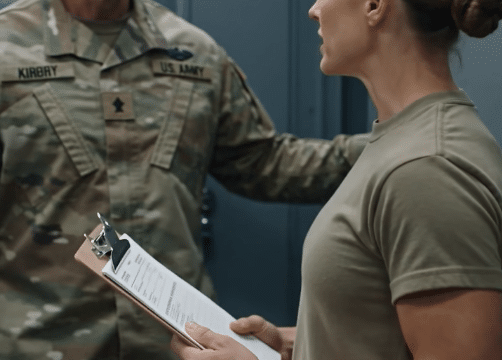
Captain Emma Hayes never raised her voice. She simply held her pen above the confirmation form and refused to sign.
“The shipment is still short…”
The words echoed through the logistics center.
Warehouse Chief Victor Sloan stared at her as if she had committed an act of betrayal. Forklifts idled in their lanes. Soldiers froze beside towering pallets. Everyone knew the convoy was scheduled to depart within minutes.
One missing shipment report would halt everything.
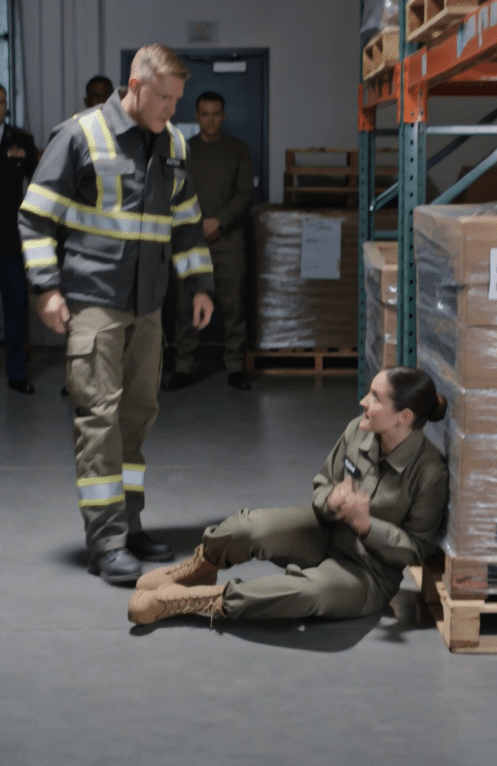
Victor stepped closer, his face burning with anger.
“Trash,” he snapped. “Sign what I tell you.”
Emma calmly pointed to the inventory sheet lying across the inspection table. Three sealed containers listed on the manifest simply weren’t there.
“I’m not certifying cargo that hasn’t been verified.”
The refusal humiliated him in front of his staff.
With a furious shove, he sent the checklist board crashing onto the floor. It skidded across the concrete, scattering inventory papers around the missing pallets. Emma stumbled into the edge of a pallet stack, scraping her forearm as she tried to protect the short-count report.
Pain flashed across her face.
Still, she reached for the same page.
“You don’t understand flexibility,” Victor growled.
Around them, warehouse personnel exchanged anxious glances.
Not one person spoke.
Then the massive steel warehouse doors slammed open.
Everything changed.
Act II
Victor Sloan had managed the logistics center for years.
His numbers always looked impressive.
Shipments departed on schedule.
Reports were signed without delay.
Higher headquarters praised efficiency, rarely asking how those results were achieved.
Inside the warehouse, however, people knew a different story.
Questioning paperwork was discouraged.
Delays were treated as personal disloyalty.
Problems were often “resolved” before anyone outside the warehouse ever learned they existed.
Emma Hayes had arrived only days earlier.
Unlike most new officers, she spent little time introducing herself. Instead, she walked inventory lanes, compared serial numbers, and checked every shipment against the original manifests.
Some soldiers quietly admired her attention to detail.
Others wondered why a newly assigned logistics officer cared so much about paperwork.
Victor assumed she was inexperienced.
He believed she would eventually learn that moving supplies mattered more than counting every box.
What he didn’t know was that Emma had already noticed a pattern stretching back months.
Small shortages.
Adjusted records.
Repeated corrections made after shipments left the warehouse.
Individually, they looked insignificant.
Together, they formed a trail impossible to ignore.
She had refused to sign because this shipment wasn’t an isolated mistake.
It was another piece of a much larger puzzle.
And someone outside the warehouse had already started assembling that puzzle.
Act III
The steel doors echoed shut behind a formation of uniformed officers.
Leading them was Colonel David Mercer.
Behind him walked members of an Army audit team carrying sealed folders and evidence cases.
No one spoke.
The warehouse became so quiet that the idle hum of overhead lights suddenly seemed loud.
Mercer’s eyes moved directly to the inventory sheet lying face-up beside Emma.
He didn’t ask what had happened.
He already knew enough.
Bending down, he picked up the short-count report and studied the highlighted entries.
Then he looked toward Victor.
“Do not touch the officer reviewing this audit.”
The sentence landed like a hammer.
Victor blinked.
“This audit?”
Mercer didn’t answer immediately.
Instead, he handed the paperwork to one of the auditors, who immediately compared it with documents already inside a sealed case.
Every page matched.
Emma’s report wasn’t an unexpected complaint.
It was evidence.
Act IV
Within minutes, the warehouse transformed from a shipping center into an investigation site.
Audit officers photographed pallets.
Security personnel secured inventory lanes.
Forklift operators were instructed to leave every shipment exactly where it stood.
No cargo would move until the review was complete.
Victor watched in disbelief as auditors opened historical inventory files reaching back nearly a year.
One discrepancy became five.
Five became dozens.
Missing equipment had repeatedly been concealed through altered documentation and rushed certifications.
The shortage Emma refused to ignore was simply the first one that could no longer be hidden.
Colonel Mercer finally turned toward Victor.
“You believed she was delaying your shipment.”
He paused.
“She was protecting Army property.”
The words carried across the warehouse.
For the first time, every soldier understood why paperwork mattered.
It wasn’t bureaucracy.
It was accountability.
Act V
The convoy never departed that afternoon.
Instead, the warehouse remained under audit for weeks.
Investigators uncovered systemic failures in inventory control, along with records that had been quietly altered to conceal shortages and avoid scrutiny.
Several long-standing procedures were rewritten.
Inventory verification became mandatory before every major shipment.
Independent audits were expanded across multiple logistics centers.
Victor Sloan was removed from his position pending the outcome of the investigation.
The authority he had used to intimidate others disappeared almost overnight.
Emma returned to work without celebration.
She simply continued counting, verifying, and documenting every shipment with the same calm professionalism that had brought the hidden problems into the light.
Only after the investigation concluded did many soldiers learn why her assignment orders had contained so few details.
Before arriving at the warehouse, she had served on a specialized logistics integrity task force responsible for evaluating supply accountability across military installations. Her transfer had never been routine.
She hadn’t been sent merely to process inventory.
She had been entrusted to uncover what others overlooked—or chose not to see.
Months later, every logistics officer at the installation received updated guidance with a single sentence printed across the top of every shipment certification:
If the inventory is incomplete, the signature waits.
To new personnel, it was another regulation.
To those who witnessed that day in the warehouse, it was a reminder that integrity isn’t measured by how quickly supplies leave a loading dock.
It’s measured by the courage to refuse a signature when the truth is still missing.