Act I
The truck waited less than five seconds.
That was all it took for Michael Grayson to lose control.
A loading cart had caught briefly on the edge of the warehouse ramp while a fifty-three-year-old logistics worker leaned on his crutch, carefully checking the shipping checklist against the pallet labels. One missing barcode could send thousands of dollars of inventory to the wrong destination.
He was trying to prevent a costly mistake.
Michael saw only a delay.
In front of warehouse workers, truck drivers, dispatch staff, and representatives from the company’s biggest client, the warehouse manager stormed across the loading dock.
“You’ve stopped my truck!”
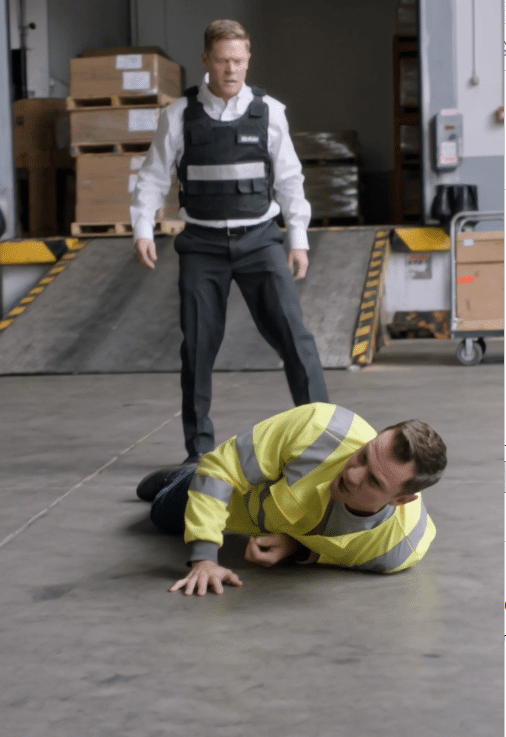
Before anyone could react, he drove a vicious kick into the worker’s chest.
The man crashed onto the concrete floor.
His crutch clattered away.
The shipping checklist skidded beneath a pallet.
His elbow struck the rough concrete, leaving only a thin streak of blood where the skin scraped the surface.
He struggled to breathe, yet his eyes remained fixed on the loading dock.
“The cart caught the dock edge…” he said between painful breaths.
Michael stood over him, furious.
“Trash. You delayed my trucks.”
The workers stared in disbelief.
Nobody moved.
Nobody dared.
The manager stepped closer.
Two more hard kicks landed against the man’s side and back.
The worker curled instinctively, grimacing in pain but still glancing toward the truck.
His first concern wasn’t himself.
It was whether the shipment had been loaded safely.
Michael pointed toward the exit.
“You slow everything down.”
The warehouse fell silent.
Everyone believed the client would appreciate the manager’s decisiveness.
Instead…
Outside the loading dock, the sharp sound of brakes echoed through the yard.
A black SUV had just arrived.
And everything Michael believed about authority was about to collapse.
Act II
The injured worker’s name was Daniel Carter.
Most employees knew him only as “Danny.”
Few knew anything about his life before the warehouse.
He never spoke about it.
He worked every overtime shift offered.
He inspected every outgoing shipment twice.
He insisted that paperwork mattered just as much as speed because mistakes rarely revealed themselves until they were already hundreds of miles away.
Some younger workers joked that Danny was too cautious.
Until one of his inspections prevented an entire pharmaceutical shipment from being delivered with the wrong refrigeration labels.
That single correction had saved millions.
He never accepted praise.
“Anyone can move boxes,” he often said.
“The hard part is making sure they arrive exactly where lives depend on them.”
Michael hated that attitude.
To him, warehouses weren’t about precision.
They were about numbers.
More trucks.
More deliveries.
Less waiting.
The client representatives visiting that afternoon were negotiating a contract worth tens of millions.
Michael wanted perfection.
When the cart snagged on the dock edge for a few seconds, he panicked.
If the visitors thought his operation lacked efficiency, the contract might disappear.
Someone had to absorb the blame.
The man using a crutch seemed like the easiest target.
No one noticed the client representative watching everything in complete silence.
He wasn’t studying the warehouse.
He was studying Daniel.
And recognition slowly appeared in his eyes.
Act III
The SUV door opened.
A tall man in a gray suit stepped out beneath a navy overcoat, followed by an assistant and the company’s transport coordinator.
The moment he reached the loading dock, he stopped.
His expression hardened.
He ignored Michael’s hurried greeting.
Instead, he walked directly toward the injured worker lying on the concrete.
Without saying a word, he crouched beside Daniel.
“You shouldn’t have had to experience this again,” he said quietly.
Daniel managed a tired smile.
“I’ve survived worse.”
The client representative carefully picked up the fallen checklist before handing it back to him with both hands.
Only then did he rise.
Every eye followed him.
His voice remained calm.
“You have no idea who you just hit.”
The sentence echoed across the warehouse.
Michael frowned.
“Who is he?”
No one answered.
The assistant quietly closed the contract folder.
The transport coordinator canceled the loading authorization with a single phone call.
Truck engines remained idling.
But nobody was thinking about deliveries anymore.
Because the client representative had just revealed that the man everyone dismissed as an ordinary warehouse worker carried a history none of them expected.
Act IV
Twenty-two years earlier, Daniel Carter had been one of the most respected logistics investigators in the country.
Whenever cargo disappeared, dangerous goods were mislabeled, or corruption infiltrated national supply chains, Daniel was the man government agencies called first.
He uncovered smuggling operations hidden inside legitimate freight.
He exposed executives who falsified safety inspections.
He testified in court against criminal shipping networks that believed profits mattered more than human lives.
During one investigation, a deliberate warehouse explosion left him permanently injured.
His right leg never fully recovered.
His career ended overnight.
But Daniel refused to leave the industry.
If he could no longer investigate nationwide, he would protect workers one warehouse at a time.
So he quietly accepted an ordinary logistics position.
He never mentioned his past.
He didn’t want respect.
He wanted honest work.
The client representative, Edward Lawson, remembered him well.
Years earlier, Daniel’s investigation had uncovered a counterfeit parts operation that would have destroyed Edward’s transportation company.
Daniel had saved hundreds of jobs without asking for recognition.
Edward never forgot.
He looked directly at Michael.
“You saw a crutch.”
He paused.
“I saw the man who built half the safety standards your warehouse claims to follow.”
Michael’s confidence disappeared.
“I… I didn’t know.”
Edward answered without raising his voice.
“No.”
“You never cared enough to ask.”
The words landed harder than any accusation.
Because everyone standing there knew they were true.
Act V
The unsigned contract left with Edward that afternoon.
So did every opportunity Michael believed he had secured.
His company launched an immediate investigation after reviewing warehouse security footage.
The video showed everything.
The cart had caught briefly on the dock edge.
Daniel had stopped the shipment to prevent an incorrect load from leaving the facility.
The delay lasted only seconds.
The assault lasted much longer.
Michael’s employment ended before the week was over.
Legal consequences soon followed.
Not because the client demanded revenge.
Because violence and humiliation had no place in a workplace built on trust.
Daniel returned after recovering from his injuries.
The first thing he did wasn’t ask for compensation.
It was inspect the repaired loading dock.
He smiled when he discovered new safety markings had been added to the ramp where the cart had caught.
Months later, the warehouse opened a training center dedicated to logistics safety and ethical leadership.
At its entrance stood a modest plaque.
It didn’t mention contracts.
It didn’t mention profits.
It carried only one sentence.
“The fastest delivery means nothing if you leave your humanity behind.”
Daniel never accepted a management position.
He continued walking the warehouse floor with his crutch, clipboard in hand, teaching younger workers that every shipment represented more than inventory.
It represented responsibility.
The truck that waited five seconds was forgotten within days.
The lesson learned on that loading dock lasted much longer.
Because everyone who witnessed that afternoon discovered the same truth.
Real strength isn’t measured by how loudly someone commands others.
It’s measured by whether they choose integrity when no one seems important enough to defend.
And the warehouse manager who attacked a disabled worker over a momentary delay learned far too late that the man lying on the concrete had spent a lifetime protecting people from leaders exactly like him.