Act I
The contract wasn’t even signed when the shouting began.
A single drop of fresh grape juice splashed onto the corner of a thick investment folder resting on the outdoor signing table. It was barely noticeable, a tiny purple stain no larger than a coin.
But to Richard Hale, owner of Blackstone Vineyards, it looked like disaster.
His biggest investor sat only a few feet away. Lawyers were present. Cameras from the local business journal waited to capture the historic partnership that would transform the winery into one of California’s premier wine destinations.
Richard refused to let anything ruin the moment.
His eyes locked onto the oldest man in the vineyard.
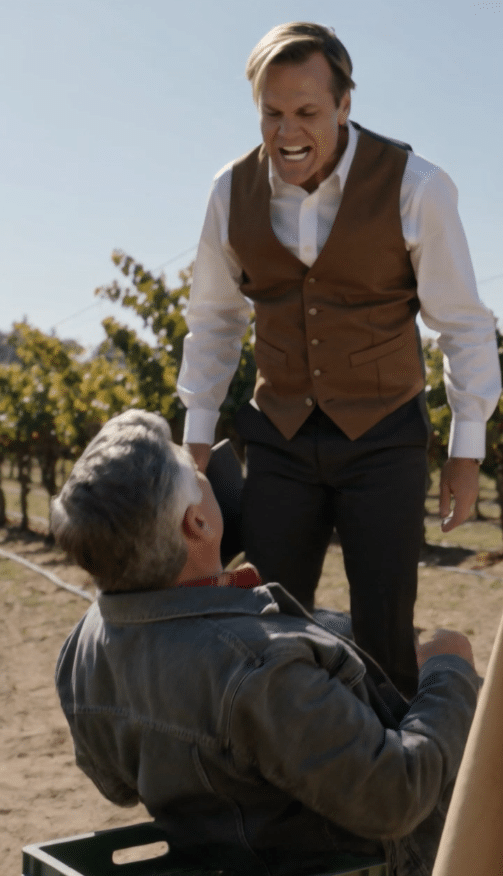
Seventy-three-year-old Samuel Brooks stood nearby carrying a wooden crate of freshly harvested grapes. A pair of worn pruning shears hung from his belt, and his faded denim jacket was stained from decades of honest work among the vines.
He hadn’t gone anywhere near the contract.
He hadn’t touched the table.
But he was the easiest person to blame.
Richard stormed away from the signing table.
Without warning, he drove a violent kick straight into Samuel’s chest.
The elderly gardener stumbled backward, crashing into the grape crate.
Hundreds of grapes burst across the dusty ground like scattered marbles. His pruning shears slid several feet away, and his hand slammed against the sharp wooden edge of the crate, leaving only a thin streak of blood across his knuckles.
The impact stole his breath.
Guests gasped.
Winery employees froze in place.
Investment assistants instinctively stepped backward.
Nobody dared interfere.
Samuel curled onto the dirt, struggling for air as he stared—not at himself—but at the folder that had caused the chaos.
“It was only one drop…” he whispered.
Richard sneered.
“Trash. You stained the contract.”
The old man tried to push himself upright.
Before he could, Richard stepped over him.
Two more brutal kicks landed against his side and back.
Samuel folded into himself, breathing harder with every second.
Then Richard delivered the final humiliation.
“You’re fired before they sign.”
Silence settled across the vineyard.
Everyone assumed the deal would continue.
No one realized the investor had already stopped reading the contract.
Because he had recognized the man lying in the dirt.
And everything was about to change.
Act II
To most visitors, Samuel Brooks looked like every other aging groundskeeper.
He arrived before sunrise.
He pruned damaged vines.
He repaired broken irrigation lines.
He quietly taught young seasonal workers how to tell healthy grapes from dying ones.
Few people even knew his last name.
Richard certainly didn’t.
As far as the winery owner was concerned, Samuel was simply another employee whose time had passed.
Someone replaceable.
Someone invisible.
Richard believed appearances created value.
Every wine tasting had to be flawless.
Every investor had to feel important.
Every photograph needed perfect rows of vines and smiling employees.
Reality didn’t matter.
Perception did.
So when the tiny drop of grape juice landed on the investment folder—likely shaken loose by the breeze as workers carried fresh harvests nearby—Richard panicked.
If the investor thought his winery lacked discipline…
If lawyers questioned his professionalism…
If negotiations collapsed…
Years of ambition could disappear.
Someone had to absorb the blame.
Samuel became the sacrifice.
The elderly gardener remained on the ground, quietly enduring the pain without anger.
He had spent an entire lifetime learning that some people valued power more than truth.
Still…
He never imagined history was repeating itself.
Nor did Richard realize that the man he had just fired had spent decades judging the very kind of people he had become.
The investor slowly closed the contract folder.
Not because of the stain.
Because of what he had just witnessed.
Act III
The air changed before anyone spoke.
The investor rose from his chair.
His secretary immediately followed.
So did the legal assistant carrying another leather portfolio.
Richard hurried forward with a nervous smile.
“I’m terribly sorry about this interruption. We’ll have security remove him immediately.”
The investor walked straight past him.
He crouched beside Samuel.
Carefully, respectfully, he helped the elderly gardener sit upright before brushing dirt from his faded jacket.
The entire vineyard watched in stunned silence.
Samuel looked up.
Recognition slowly appeared in his tired eyes.
“You’ve done well,” he said softly.
The investor smiled.
“Only because of lessons you refused to let me forget.”
Then he stood.
His expression hardened as he turned toward Richard.
“You just fired the wrong judge.”
The words echoed across the vineyard.
Richard frowned.
“Judge?”
Nobody answered.
The secretary quietly closed the investment folder.
The legal assistant slipped the unsigned contract back into his briefcase.
Suddenly the purple stain no longer mattered.
The deal no longer mattered.
Only one question remained.
Who exactly was Samuel Brooks?
And why had one of the country’s most respected investors just called him a judge?
Act IV
Nearly twenty years earlier, Samuel Brooks had served as one of the most respected appellate judges in the state.
His courtroom had become known for one simple principle.
Justice belonged to everyone.
Not only those who could afford it.
He ruled against corporations that exploited workers.
He protected family farms from dishonest acquisitions.
He refused political pressure.
He earned admiration from ordinary citizens—and powerful enemies among wealthy executives.
When his wife became seriously ill, Samuel quietly retired years before anyone expected.
He sold nearly everything to pay medical bills.
After her passing, he disappeared from public life.
Not because he was ashamed.
Because he no longer cared about titles.
Working among vineyards brought him peace.
The vines demanded patience.
The soil never lied.
The seasons rewarded humility.
Only a handful of people knew where the retired judge had gone.
One of them was Daniel Mercer.
Years earlier, Daniel had appeared before Judge Brooks as a struggling entrepreneur falsely accused of violating a predatory contract that would have destroyed his first company.
Samuel had seen through the deception.
His ruling saved the business.
Daniel never forgot.
That small company eventually grew into one of the country’s largest agricultural investment firms.
Every major acquisition Daniel made carried one personal rule.
Never invest with people who confuse wealth with character.
Richard had just failed that test in spectacular fashion.
Daniel looked directly into the winery owner.
“You worried about a drop on paper.”
His voice remained calm.
“But not the man who spent his life protecting people from men exactly like you.”
Richard’s face drained of color.
“I… I didn’t know.”
“No,” Daniel replied.
“You never bothered to.”
Act V
The investment collapsed before sunset.
Daniel instructed his legal team to terminate negotiations immediately.
Every winery owner in the region soon learned why.
Word traveled faster than any press release.
Not about the violence alone.
About the reason behind it.
Richard had assaulted an elderly man because he believed appearances mattered more than truth.
His reputation never recovered.
Several business partners quietly withdrew.
Employees resigned.
Distributors chose other vineyards.
The collapse Richard had feared became reality—but not because of a tiny stain on a contract.
Because character leaves stains no document can hide.
Samuel recovered from his injuries over the following weeks.
His hand healed quickly.
The bruises faded.
The memory lingered longer.
When he returned to the vineyard, something had changed.
Workers greeted him differently.
Young interns asked about his years on the bench.
Even visitors who had once mistaken him for an ordinary laborer stopped to thank him for the life of integrity he had lived.
Months later, Daniel purchased a neighboring vineyard.
Instead of naming it after himself, he dedicated the estate to the man who had taught him that justice and dignity should never depend on status.
At the entrance stood a simple stone marker.
It carried no long biography.
Only a single sentence.
“True character is revealed by how we treat those we believe cannot change our future.”
Samuel smiled when he first read it.
Because he knew something Richard never understood.
Titles fade.
Money changes hands.
Businesses rise and fall.
But the choices made in a single moment—especially when no one seems important enough to matter—can determine the rest of a person’s life.
And the winery owner who kicked an old gardener over one drop of grape juice learned that lesson only after discovering the man lying in the dirt had once spent decades deciding the fate of people exactly like him.