Act I
The emergency alarm echoed across the construction site.
A towering crane came to an abrupt stop just as a group of investors reached the observation deck.
Every conversation died instantly.
Thomas Gray lowered his hand from the emergency stop cord, his eyes fixed on one thing—a crane cable with strands beginning to unravel under tension.
Before anyone else noticed it, site commander Derek Stone stormed toward him.
“What have you done?”
Thomas tried to answer.
“The cable was fraying…”
But Derek wasn’t interested in explanations.
In front of engineers, workers, and investors, he accused the veteran safety officer of sabotaging the inspection that could secure the company’s biggest investment in years.
The entire site watched in silence.
The inspection had changed—but not for the reason Derek believed.
Act II
Thomas had spent most of his career preventing accidents no one else ever saw.
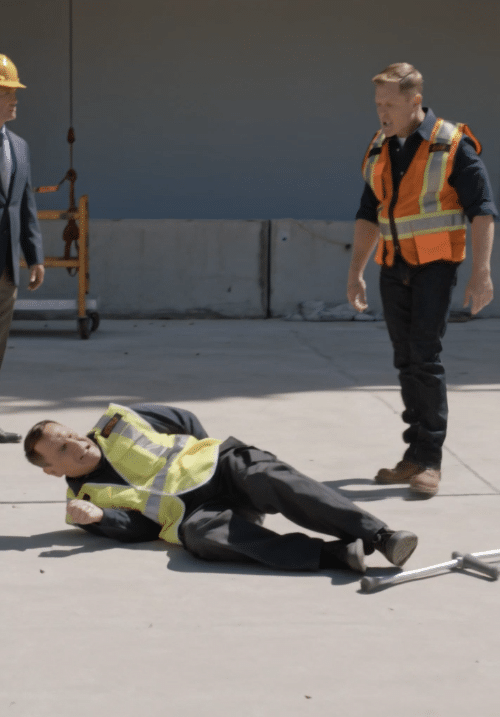
His limp, and the crutch he relied on, came from an earlier workplace incident that he had survived while helping evacuate fellow workers.
After recovering, he returned to construction for one reason.
He believed every worker deserved to go home safely.
That philosophy sometimes made him unpopular.
Production deadlines could wait.
Safety could not.
Derek saw things differently.
Delays meant angry investors.
Failed inspections meant lost contracts.
When the crane stopped unexpectedly, he didn’t ask why.
He looked for someone to blame.
Thomas, standing beside the emergency stop, became the obvious target.
The workers exchanged uneasy glances.
Some had noticed the cable too.
None spoke.
Not yet.
Act III
Among the visiting investors, Malcolm Price quietly stepped away from the group.
He ignored the heated argument.
Instead, he walked directly toward the crane.
Without saying a word, he examined the cable.
Several outer strands had snapped.
The remaining steel wires were carrying far more load than they should have.
A site engineer hurried over, took one look, and immediately ordered the area secured.
The crane would not move another inch.
Only then did Malcolm turn toward Derek.
“He stopped it just in time.”
The words were calm.
Measured.
Undeniable.
Every eye shifted from Thomas…
…to the cable.
Act IV
Maintenance records were reviewed.
The inspection logs showed the cable had been scheduled for replacement but the work had been postponed to avoid interrupting the investor visit.
That single decision changed everything.
The emergency stop had not ruined the inspection.
It had prevented a potentially catastrophic equipment failure.
The investors weren’t discussing delays anymore.
They were discussing leadership.
Malcolm watched as engineers carefully isolated the crane.
He nodded once.
“This is exactly why independent safety officers matter.”
For the first time all morning, Thomas wasn’t standing alone.
The people who had remained silent began speaking.
Several workers admitted they had also been worried about the cable but feared delaying production.
The atmosphere shifted completely.
Act V
Before the investor group departed, Malcolm met privately with the company’s executives.
“We can recover from a delayed schedule,” he said.
“We cannot invest where safety concerns are ignored.”
The message was impossible to misunderstand.
Within weeks, the site introduced new policies giving safety officers independent authority to halt operations without fear of retaliation.
Maintenance reporting procedures were strengthened.
Anonymous safety reporting was expanded across every project.
Thomas returned to work with the same checklist he carried every day.
Nothing about him had changed.
He still walked the site slowly.
He still noticed details others missed.
The only difference was that people listened sooner.
Because everyone finally understood the lesson that inspection day had revealed.
The emergency stop hadn’t endangered the project.
Ignoring the warning signs would have.