Act I
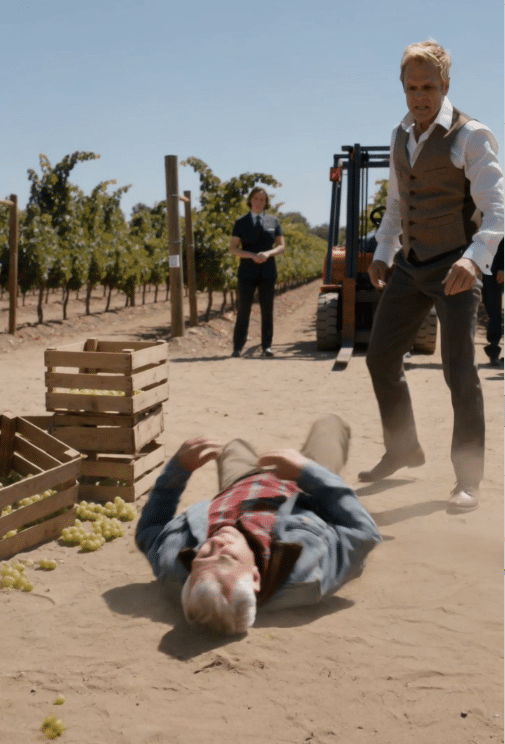
The wooden crate hit the ground with a dull crack.
Clusters of freshly harvested grapes scattered across the dusty vineyard path just as the client reached for the contract folder.
Walter Reed stared at the overturned crate in disbelief. A small forklift had backed into it moments earlier, but before anyone could explain what had happened, vineyard owner Calvin Pierce stormed across the path.
“The whole shipment is ruined!”
Walter tried to answer.
“The forklift backed into it…”
Calvin didn’t listen.
Instead, he pointed at the elderly worker in front of employees, guests, and the client whose signature could transform the business overnight.
The vineyard fell silent.
Everyone knew the accident hadn’t happened the way Calvin claimed.
No one dared to contradict him.
Someone, however, was paying very close attention.
Act II
Walter had spent decades harvesting grapes.
He knew every row of vines, every change in the soil, and every season’s unpredictable weather.
Even after retirement, he accepted seasonal work simply because he loved the vineyard.
He wasn’t fast anymore.
He wasn’t strong anymore.
But no one questioned his honesty.
Calvin, on the other hand, measured success differently.
He believed appearances mattered more than truth.
With a major partnership hanging in the balance, panic took over.
Instead of asking how the crate had fallen, he searched for the quickest person to blame.
Walter happened to be standing beside it.
Security cameras overlooked the loading lane.
Several workers had also seen the forklift reverse without checking its blind spot.
But facts had little chance against public anger.
The client watched quietly.
Not the grapes.
Not the damaged crate.
The people.
Act III
Elliot Grant had negotiated contracts all over the country.
He expected equipment failures.
He expected occasional mistakes.
What interested him was how leaders reacted when something went wrong.
Without saying a word, he stepped away from the contract table.
His secretary paused, folder still in hand.
Instead of examining the spilled grapes, Elliot walked straight to Walter.
He offered the older man a steady hand and waited until he was comfortably back on his feet.
Only then did he speak.
“We won’t partner with this place.”
The secretary slowly closed the contract folder.
No dramatic speech followed.
None was necessary.
Calvin’s expression changed instantly.
Act IV
Workers quietly explained what they had witnessed.
The forklift operator admitted reversing without seeing the crate.
Maintenance staff confirmed the loading path had become congested because of poor traffic planning.
The scattered grapes suddenly seemed insignificant.
The real issue wasn’t the accident.
It was the willingness to sacrifice an innocent employee to protect a reputation.
Elliot had spent years building businesses based on trust.
If leadership abandoned fairness under pressure, no contract could compensate for that risk.
Around the outdoor tasting table, the mood shifted completely.
The conversation was no longer about produce quality.
It was about character.
Calvin finally realized what had happened.
The partnership wasn’t ending because grapes had spilled.
It was ending because his leadership had been exposed.
Act V
Before leaving, Elliot turned back one last time.
“A harvest can recover from mistakes,” he said calmly.
“A company rarely recovers after people stop trusting its leaders.”
The words lingered long after the vehicles disappeared down the vineyard road.
An internal review followed.
Loading procedures were redesigned.
Forklift routes were separated from pedestrian walkways.
Employees were encouraged to report problems without fear of blame.
Walter returned to work a few days later.
He walked the same rows of vines with the same quiet dedication he always had.
Some of the younger workers thanked him for staying.
He simply smiled.
Because he understood something Calvin had forgotten.
A good reputation is never protected by blaming the weakest person in the room.
It’s protected by telling the truth—especially when the truth is inconvenient.