Act I
The pallet crashed to the factory floor just as the international delegation rounded the corner.
Boxes slid across the polished walkway. Workers froze. The steady hum of the production line suddenly felt painfully loud.
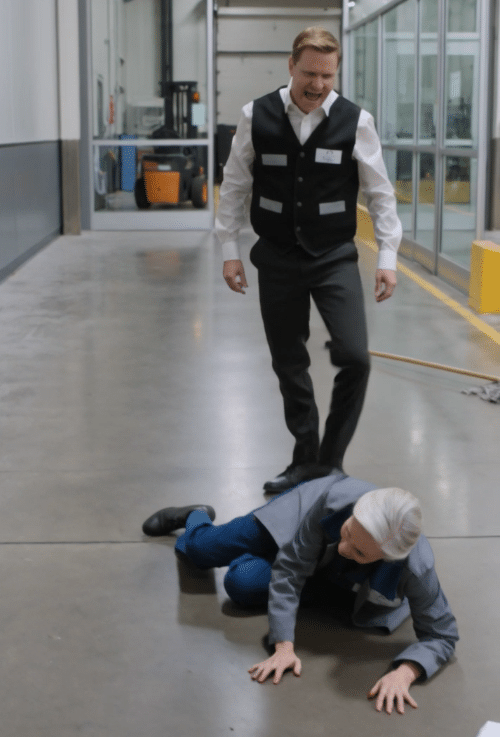
Ruth Carter tightened her grip on her mop, staring in disbelief. The forklift had taken the corner too fast, clipping the pallet behind her, yet before anyone could explain what had happened, floor supervisor Frank Walsh stormed toward her.
“You cost us the export deal.”
His accusation echoed through the factory.
Ruth tried to steady herself after stumbling backward.
“The forklift turned behind me…”
She never finished.
Frank cut her off in front of every employee and every visiting executive, pointing at her as though the entire disaster belonged to her alone.
Around them, workers exchanged nervous glances. No one stepped forward.
Everyone understood exactly what was happening.
Someone powerless had just become the easiest person to blame.
But someone else had witnessed everything.
Act II
Ruth had worked at the factory for nearly twenty years.
She wasn’t an engineer. She wasn’t a supervisor. She wasn’t part of management.
She simply arrived before sunrise every morning to keep the production floors spotless.
Most employees knew her by name.
She remembered birthdays, brought homemade cookies during holidays, and quietly encouraged new hires who looked overwhelmed.
Frank barely noticed any of that.
To him, appearances mattered more than people.
The overseas delegation represented the largest export opportunity in company history. One mistake—even one that wasn’t actually a mistake—could cost millions.
Instead of investigating what happened, Frank made a decision in seconds.
He would protect his own reputation.
If someone had to carry the blame, it would never be him.
Unfortunately for Ruth, she happened to be standing closest to the fallen pallet.
The truth was much less dramatic.
Security cameras would later show the forklift entering the turn too quickly, forcing the pallet sideways before it tipped over.
Ruth had already finished cleaning the walkway.
She wasn’t even facing the forklift when it happened.
But facts often arrive more slowly than anger.
And anger had already taken control of the room.
The visitors watched silently.
Not because they believed Frank.
Because they wanted to see what kind of company responded this way under pressure.
Their answer was coming.
Act III
The lead visitor had been walking near the back of the tour.
Kenji Mori wasn’t speaking much.
He preferred observing.
He watched how employees greeted each other.
He watched whether supervisors thanked workers.
He watched whether problems produced teamwork—or panic.
When the shouting began, he stopped walking.
His interpreter looked toward him.
“So… should we continue?”
Kenji shook his head.
Instead of approaching the damaged pallet, he walked directly toward Ruth.
The entire production floor became silent.
He offered her a hand.
Only after making sure she was steady did he turn toward Frank.
His expression never changed.
“We have enough to decide.”
The interpreter translated the sentence.
Frank blinked.
“What do you mean?”
Kenji didn’t answer immediately.
He looked once more at the fallen pallet.
Then at the forklift.
Then back at Frank.
He had already seen everything that mattered.
Act IV
Maintenance staff quickly confirmed that the forklift had clipped the pallet while turning.
Several employees quietly admitted they had witnessed the same thing.
The security office verified that camera footage existed.
Frank’s confidence disappeared.
Moments earlier, he had spoken with absolute certainty.
Now he avoided everyone’s eyes.
The export delegation wasn’t discussing damaged goods anymore.
They were discussing leadership.
One executive quietly closed the presentation folder.
Another removed his visitor badge.
No one raised their voice.
No one argued.
The decision spread through the group without a single dramatic announcement.
Trust, once broken, rarely needs a formal explanation.
Frank finally understood that the pallet wasn’t what had endangered the contract.
His own behavior had.
Act V
Before leaving, Kenji spoke privately with the factory owner.
“We expect mistakes,” he said calmly.
“We do not expect people to be blamed before the facts are known.”
The owner stood in silence.
He knew exactly what had happened.
Within days, an internal review was launched.
Safety procedures around forklift traffic were rewritten.
Supervisors received mandatory leadership training.
Most importantly, employees were instructed that investigations would come before accusations.
Ruth returned to work the following week.
She didn’t ask for recognition.
She simply picked up her mop and smiled at the coworkers who welcomed her back.
As for Frank, the memory that stayed with him wasn’t the sound of the pallet hitting the floor.
It was the quiet sentence that followed.
“We have enough to decide.”
Because in the end, the international visitors hadn’t judged the factory by an accident.
They judged it by how it treated the person who had no power to defend herself.