Act I
The papers were already in his hands when the old veteran realized how far they were willing to go.
On the small wooden porch of his aging American home, the 69-year-old man held onto the deed documents like they were the last piece of his life he could still protect.
The old American flag beside the porch moved gently in the afternoon wind.
For decades, that house had been more than wood and walls.
It was where he came home after serving his country. It was where he rebuilt his life after losing his leg. It was the one place where he still felt like he belonged.
But the man standing in front of him didn’t see a home.
He saw an opportunity.
The debt-company representative adjusted his expensive suit and pushed the transfer papers closer.
“Sign it.”
The veteran’s hand trembled, but his voice remained steady.
“This is my home.”
The representative smiled.
Not kindly.
Not respectfully.
Like a man who had already decided he had won.
“Trash,” he said coldly. “Not anymore.”
The words hung in the air.
Neighbors watching from across the street went silent.
Everyone knew the old veteran was outnumbered.
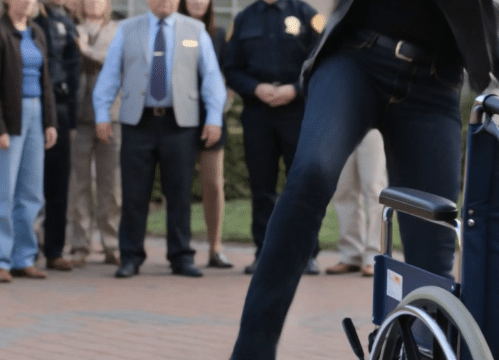
One man with an artificial leg.
One powerful company representative with documents, money, and confidence.
The veteran slowly shook his head.
“No.”
That single word changed the man’s expression.
The representative had dealt with frightened people before.
He knew how to pressure them.
He knew how to threaten them.
But he wasn’t prepared for someone who had already lost almost everything and still refused to surrender.
His patience disappeared.
And what happened next shocked everyone watching.
Act II
The veteran barely had time to react.
The representative stepped forward with anger replacing his fake professionalism.
To him, the old man wasn’t a person.
He was a problem standing between him and a property transfer.
The porch boards creaked under their feet as the argument grew louder.
“You don’t understand how this works,” the representative said.
The veteran looked down at the papers.
“I understand exactly what you’re trying to do.”
For a moment, nobody spoke.
The representative hated that.
He hated that an elderly disabled man was looking at him without fear.
He hated that the house meant more to someone than the money it could bring.
So he chose intimidation.
One violent act meant to end the argument forever.
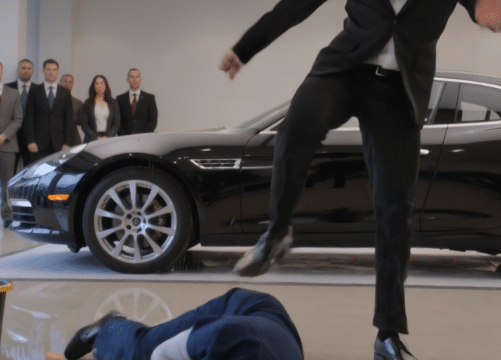
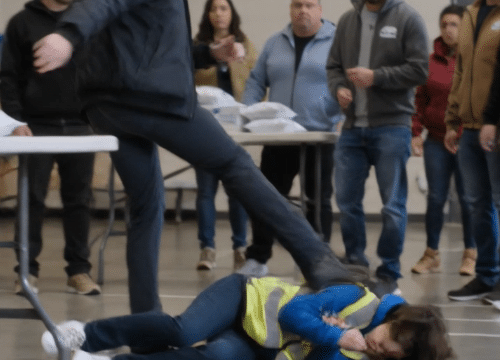
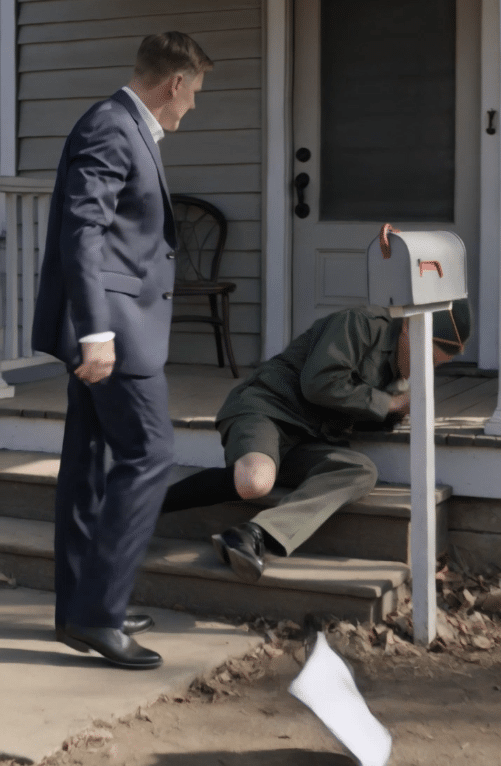
The kick came suddenly.
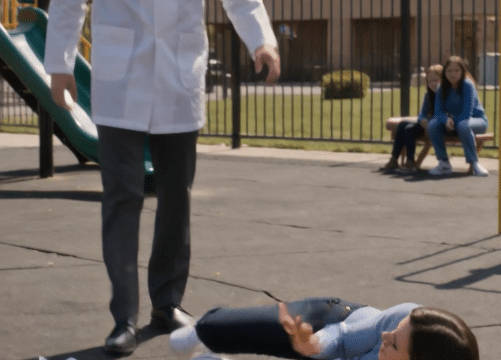
The veteran was thrown backward into the porch step, sending the house papers flying across the yard.
The sound of paper scattering across the dirt was almost louder than the impact itself.
His hand scraped against the edge of the porch, leaving a small mark as he fought to stay conscious.
But even while hurting, his eyes searched for one thing.
The deed papers.
Not because they were valuable.
Because they represented everything he had left.
The representative walked over and grabbed them.
He held them above the fallen veteran like a victory flag.
And that was when everyone realized this was never just about debt.
It was about power.
Act III
The veteran tried to push himself up.
His hands shook.
His breathing was heavy.
But his eyes stayed fixed on the man holding his home in his hands.
The representative looked down at him.
“Sign, or sleep outside.”
The cruelty of the statement shocked even the people who had been afraid to intervene.
The old man had served his country.
He had sacrificed his body.
He had spent his life protecting others.
And now someone was standing on his porch trying to erase everything he had built.
The representative lifted the documents again.
“This house is finished.”
Then the sound of an engine interrupted him.
At first, nobody understood what they were hearing.
Then a black SUV turned through the gate.
It stopped hard in the driveway.
Dust rose around the tires.
The doors opened.
Two bodyguards stepped out first.
Then came a man wearing a long charcoal coat over a perfectly tailored black suit.
He didn’t rush.
He didn’t shout.
He simply walked toward the porch with the kind of confidence that made everyone else move aside.
The representative frowned.
He had expected another neighbor.
Another person who would stay quiet.
Instead, the entire atmosphere changed.
The newcomer looked at the veteran lying beside the porch.
Then he looked at the scattered papers.
Finally, he looked at the man holding them.
And his expression turned cold.
Act IV
The representative tried to maintain his confidence.
“Who are you supposed to be?”
The man ignored the question.
He walked closer.
The bodyguards moved beside the veteran, shielding him and carefully collecting the scattered documents from the yard.
One of them picked up the deed.
Another helped the old man sit safely away from the porch edge.
The stranger looked at the document in his hand.
Then he looked back at the representative.
His voice was calm.
But everyone heard the authority behind it.
“Nobody takes this house.”
For the first time that day, the representative hesitated.
The sentence wasn’t a threat.
It was a promise.
The veteran looked up at the man standing in front of him.
There was something familiar in his eyes.
Something that suggested this wasn’t a random rescue.
The stranger had known exactly whose house this was.
The representative noticed it too.
His confidence began to disappear.
“You don’t understand,” he said.
But the stranger did.
He understood the company records.
He understood the history behind the property.
And he understood something the debt collector never bothered to learn.
This was not just another house.
This was the home of a man whose service and sacrifices had quietly changed countless lives.
The stranger turned toward the representative.
“The paperwork you’re holding doesn’t give you the right to destroy someone.”
The representative said nothing.
Because for the first time, his expensive suit and corporate authority felt meaningless.
The balance of power had shifted.
Completely.
Act V
The veteran sat on his porch while the documents were returned to his hands.
His fingers closed around the deed carefully.
Almost like he was afraid it might disappear again.
The old flag continued moving in the wind above him.
A reminder that some things could not be bought.
Some things could not be taken.
The stranger stood beside him.
The representative stepped backward.
The same man who had arrived believing he controlled the entire situation was now searching for an escape.
The neighbors who had watched silently finally stepped forward.
They had seen everything.
They had seen the threats.
They had seen the cruelty.
And they had seen the moment someone finally stood up.
The representative looked at the gathered faces around him.
Nobody looked afraid anymore.
Because everyone understood the truth.
Power was never just about money.
It was about what you were willing to protect.
The stranger handed the veteran the final page of the deed.
“This stays with you.”
The veteran looked down at the paper.
Then back at the man who saved his home.
A lifetime of hardship had taught him not to expect kindness.
But sometimes, help arrives from the last place you expect.
The debt representative stared at the man in the black coat, completely defeated.
His arrogance was gone.
His certainty was gone.
Only confusion remained.
“Who are you?”
The stranger didn’t answer.
He didn’t need to.
The papers were back where they belonged.
The veteran was still standing.
And the house that someone tried to steal remained exactly where it had always been.
Home.