Act I
The contract was already inches from the old man’s trembling hands.
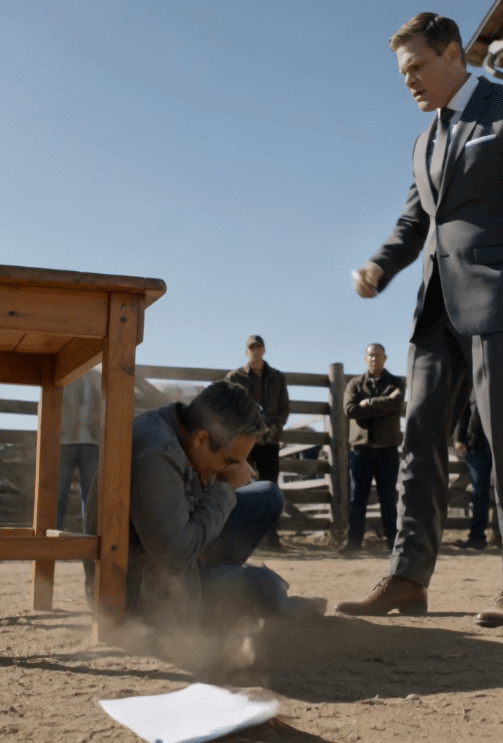
Two hired enforcers held the seventy-six-year-old farmer on both knees in the dry dirt, their grip tightening each time he tried to straighten his back. Across the weathered wooden table, the investor calmly uncapped a pen as if this were nothing more than an ordinary business meeting.
“I won’t sell my land.”
The words barely left the old farmer’s mouth before the investor’s expression hardened.
“Trash. Sign it.”
The wind carried dust across the empty farmyard. Beyond the faded fence stood the red barn his father had built by hand after returning home from war. Every fence post, every field, every weathered board held generations of memories that couldn’t be measured by market value.
To the investor, however, it was only acreage waiting to become another luxury development.
To the old man, it was home.
He refused to lower his eyes.
That refusal would cost him dearly.
But someone else was already on the way.
Act II
The investor had spent months trying to acquire the property.
He had offered increasingly larger sums of money.
He had sent lawyers.
He had promised retirement homes, comfortable living, and “a better future.”
Every answer had been the same.
No.
The farm had survived droughts, floods, economic crashes, and changing generations.
It had been passed from parent to child for more than a century.
The old farmer often said land wasn’t something you truly owned.
You simply cared for it until the next generation was ready.
The investor didn’t understand that kind of thinking.
He believed everyone had a price.
And when money failed, intimidation became his next strategy.
He shoved the contract even closer.
When the farmer refused once more, rage replaced patience.
The kick came without warning.
It hurled the elderly man backward into the edge of the old wooden table.
The contract slipped into the dirt.
The pen rolled across the yard.
His forehead scraped against the rough wood, leaving only a small trace of blood.
He struggled to breathe as trembling hands searched the ground for support.
Still, his eyes drifted toward the farmhouse.
Toward the porch where generations of family photographs still hung inside.
Toward the life he was trying to protect.
The investor stepped forward again.
“This farm is mine now.”
The crowd of neighbors and workers stood frozen.
No one knew what to do.
Then the silence broke.
Not with voices.
With engines.
Act III
A convoy of black SUVs surged into the farmyard, tires throwing dust into the fading afternoon light.
The vehicles stopped in perfect formation.
Doors opened almost simultaneously.
Men in dark suits stepped out first, quickly spreading across the yard.
Then another figure emerged.
Tall.
Calm.
Completely unhurried.
His charcoal coat moved gently in the wind as he surveyed the scene.
He didn’t shout.
He didn’t rush.
He simply looked at the old farmer on the ground.
Then at the contract lying in the dirt.
Bodyguards immediately separated the enforcers from the injured farmer without a word.
Only then did the newcomer speak.
“Let him go. Give me the contract.”
The authority in his voice carried farther than any yell could have.
The investor frowned.
He wasn’t accustomed to being interrupted.
Especially not on property he believed was already his.
For the first time that afternoon, uncertainty crossed his face.
The neighbors exchanged confused glances.
Who was this man?
And why did everyone around him move with such discipline?
The answer was about to reshape everything.
Act IV
The powerful visitor bent down and carefully lifted the dirt-covered contract.
He didn’t even bother reading it immediately.
Instead, he helped the old farmer sit upright before handing the paperwork to one of his aides.
Only then did he face the investor.
“You’ve mistaken pressure for ownership.”
His voice remained calm.
“You cannot force a signature.”
The investor tried to regain control.
“This is a private business matter.”
The visitor said nothing.
One of his associates quietly produced a folder.
Inside were property records, easement documents, conservation agreements, and legal filings stretching back decades.
The investor’s confident expression began to crack.
The farm wasn’t simply private land.
Large portions were protected under longstanding agricultural preservation agreements, and the family held rights that made any coerced sale legally meaningless.
Witnesses had already recorded what happened.
Security footage from neighboring buildings had captured the confrontation.
The discarded contract, the witnesses, and the evidence told the story without exaggeration.
The investor looked around.
No one stood beside him anymore.
Not even the men he had hired.
His expensive suit suddenly offered no protection at all.
For the first time, genuine fear replaced arrogance.
Act V
Medical responders checked the old farmer while neighbors gathered around him.
Despite everything, his first question wasn’t about himself.
“Is the contract gone?”
The visitor smiled faintly.
“It won’t threaten your family again.”
The papers were collected as evidence.
The forced sale ended before it had ever truly begun.
As the dust settled across the quiet farmyard, the old man slowly stood with assistance.
He looked toward the barn one more time.
Its faded red paint glowed beneath the late-afternoon sun exactly as it had for decades.
Some things were worth protecting, not because they were valuable, but because they carried the weight of every generation that came before.
The investor stared at the convoy, then back at the stranger whose arrival had dismantled everything he thought he controlled.
His confidence finally disappeared.
“Who are you?”
The man looked down at the weathered fields before answering only with a quiet glance toward the old farmer.
In that moment, everyone understood.
Real power wasn’t measured by wealth, threats, or contracts.
It belonged to those willing to stand between the vulnerable and those determined to take what wasn’t theirs.
And the farm remained exactly where it had always belonged—with the family that had never stopped fighting for it.