Act I
The old paint can had barely finished clanging into the regular trash bin when the elderly volunteer lifted one gloved hand and pointed calmly toward the hazardous waste sign.
“Paint goes over there.”
Her voice wasn’t angry. It wasn’t demanding. It was the kind of patient reminder she had repeated thousands of times over the years, helping neighbors dispose of dangerous materials safely.
The man beside the expensive pickup looked at her as though she had insulted him.
A slow smile spread across his face—not from amusement, but from contempt.
“Trash. I don’t listen to old women.”
The sorting area fell strangely quiet.
Workers paused between bins.
Residents waiting with batteries and old chemicals stopped moving.
Everyone sensed the same thing.
This was no longer about a paint can.
It was about someone who believed money made him untouchable.
And nobody yet realized just how wrong he was.
But the worst moment was still seconds away.
Act II
Margaret had volunteered at the county transfer station for nearly two decades.
She wasn’t paid.
She wasn’t looking for recognition.
After retiring from a career in environmental education, she had decided that protecting her community could be as simple as standing beside the hazardous waste station a few mornings every week.
She knew why every rule existed.
One improperly discarded paint can could contaminate waste streams.
One careless mistake could expose sanitation workers to toxic chemicals.
To her, every reminder mattered.
The driver saw none of that.
All he saw was an elderly woman in a faded green vest correcting him.
His pride couldn’t tolerate it.
Instead of walking the few extra steps to the hazardous waste area, he stepped toward her.
The crowd stiffened.
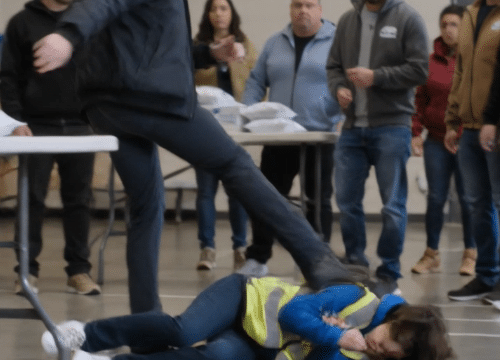
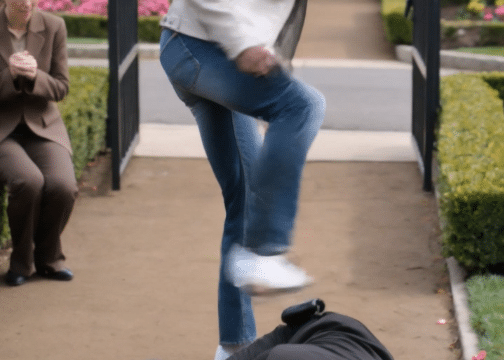
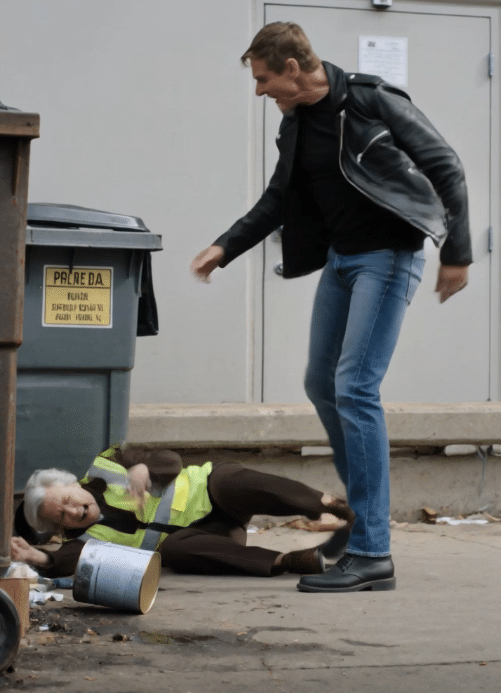
Before anyone could react, he lashed out.
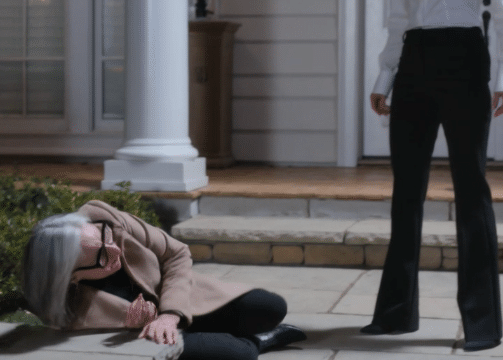
The impact knocked Margaret backward into the side of a sorting bin.
Her gloves slipped from her hands.
The guide board rattled loudly.
One hand scraped against the concrete as she fell, leaving only a small trace of blood.
She tried to catch her breath.
She wasn’t thinking about herself.
Her eyes immediately searched for the paint can.
Even lying on the ground, she worried someone else might throw hazardous waste into the wrong container.
The driver showed no concern.
He sneered down at her.
“Sort that from the ground.”
Several witnesses looked horrified.
Yet no one moved.
Fear had frozen the entire station.
Until a sound echoed across the entrance.
Heavy brakes.
Multiple vehicles.
Everything changed at once.
Act III
County inspection vehicles rolled to a sudden stop outside the transfer station.
Doors opened almost simultaneously.
Officials stepped out in formation.
At their center walked a stern county environmental officer whose expression revealed nothing except absolute control.
Workers immediately stopped what they were doing.
Conversations vanished.
Even the machinery seemed quieter.
The officer’s eyes swept across the scene.
The overturned gloves.
The frightened witnesses.
The paint can sitting inside the wrong container.
The elderly volunteer still trying to rise.
Then he looked directly at the driver.
“Seal this site.”
Nobody questioned the order.
Inspection staff moved instantly.
Entrances were secured.
Workers preserved the disposal area exactly as it was.
The wealthy driver laughed nervously.
“This is ridiculous.”
But nobody laughed with him.
Instead, every employee looked toward Margaret with concern.
Not because she held authority.
Because they knew what she had spent years protecting.
The driver suddenly realized he was standing alone.
And he hated the feeling.
Then the truth began surfacing.
Act IV
The officer knelt beside Margaret first.
Not the overturned bins.
Not the hazardous waste.
Her.
He quietly asked whether she was all right before standing again.
His expression hardened.
Witnesses began describing everything they had seen.
Several had recorded the confrontation.
Security cameras overlooked the entire sorting area.
Nothing needed guessing.
The evidence spoke for itself.
The officer examined the improperly discarded paint can.
Then he turned toward the driver.
“You ignored safety procedures.”
His voice remained calm.
“You assaulted a volunteer.”
Still calm.
“You endangered employees and contaminated regulated waste.”
Even calmer.
That composure frightened the driver more than shouting ever could.
He tried explaining that he had only lost his temper.
Nobody interrupted.
Nobody defended him.
The same crowd he had expected to impress now looked away in disappointment.
For the first time all afternoon, confidence disappeared from his face.
“Who are you?” he asked quietly.
The officer answered without raising his voice.
“I’m the county official responsible for enforcing the laws you just violated.”
Silence settled over the transfer station.
The realization hit harder than any argument.
This had never been about status.
It had always been about responsibility.
One final lesson remained.
Act V
Medical personnel checked Margaret while inspectors documented the scene.
She insisted on only one thing.
“Please make sure that paint goes into the hazardous waste area.”
The request caught everyone off guard.
After everything that had happened, she still cared more about protecting the environment than seeking revenge.
The officer nodded.
“It will.”
The paint can was removed correctly.
The contaminated container was secured.
Statements were collected.
Evidence was preserved.
The driver watched as the consequences unfolded one decision at a time.
His expensive truck.
His confident posture.
His arrogant words.
None of them carried any weight anymore.
They couldn’t erase what dozens of witnesses had seen.
As Margaret was helped to her feet, employees and residents quietly applauded.
Not because she had won an argument.
Because she had refused to abandon the principles she believed in, even after being humiliated.
The officer thanked her publicly for years of service.
Many people in the crowd admitted they had never realized how much volunteers protected their community until that day.
Long after the inspection vehicles departed and the transfer station reopened, one image remained with everyone who had witnessed the incident.
It wasn’t the expensive pickup.
It wasn’t the shouting.
It wasn’t even the confrontation.
It was an elderly volunteer, still worried about a single misplaced paint can while others worried about her.
That was the difference between someone who sought respect and someone who quietly earned it.
And in the end, that difference changed everything.