Act I
The black SUV was already inches from the yellow barricade when the officer stepped forward and raised one hand.
“Sir, this lane is closed.”
Behind the barricade, flashing emergency lights reflected off food trucks and festival banners. The restricted lane had been kept open all morning for ambulances, fire crews, and police vehicles if disaster struck.
The driver didn’t even glance at the warning signs.
Instead, he lowered his window just enough to sneer.
“Trash. I know people here.”
The officer didn’t argue.
He calmly repeated that the emergency lane had to remain clear for everyone’s safety.
That simple reminder seemed to offend the businessman more than the road closure itself.
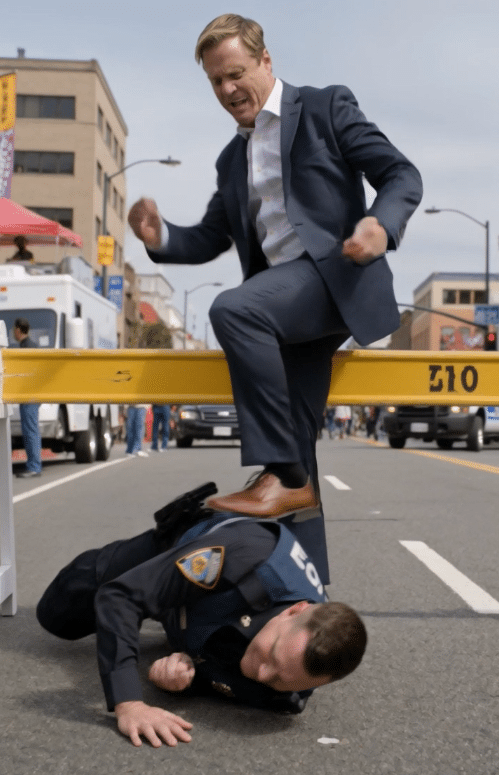
Within seconds, the confrontation escalated. The officer was knocked backward into the barricade, which rattled loudly across the pavement as nearby festivalgoers froze in disbelief.
Music from the festival continued in the distance.
But around the emergency lane…
Everything went silent.
Standing over the fallen officer, the businessman smirked.
“Move, badge boy.”
He believed the badge meant less than his connections.
He was about to discover exactly how wrong he was.
Act II
The officer had worked downtown festivals for nearly ten years.
Most people never noticed officers assigned to traffic control.
That was precisely how they liked it.
If an emergency lane stayed empty all day, it usually meant nothing terrible had happened.
Success looked ordinary.
Every barricade, every detour, every traffic cone existed because someone had already imagined the worst-case scenario before it became reality.
The officer understood that.
He had once helped clear a route that allowed paramedics to reach a child in time.
Another year, firefighters had reached a burning restaurant because the emergency corridor remained open.
Those memories stayed with him.
That was why he refused to move.
Not because of pride.
Because the next emergency never announced itself in advance.
The businessman saw only an inconvenience.
The officer saw responsibility.
The crowd could now see the difference.
Then police radios crackled.
A command vehicle had arrived.
Act III
A police command vehicle braked sharply behind the barricade.
Several officers stepped out immediately.
Behind them walked the Police Commander.
He didn’t rush.
He didn’t shout.
He simply looked from the damaged barricade to the officer on the ground, then toward the businessman still standing in the middle of the emergency lane.
His expression hardened.
“Secure him.”
The command cut through the silence.
Officers moved without hesitation.
Within seconds, the businessman realized nobody was impressed by his confidence anymore.
The lane belonged to law enforcement once again.
Festival staff quietly guided pedestrians back.
Food vendors stopped serving for a moment.
Even the music seemed distant now.
The businessman finally frowned.
“Who are you?”
No one answered immediately.
The commander’s authority spoke louder than introductions ever could.
Act IV
The commander walked toward the injured officer first.
“Can you stand?”
The officer nodded.
His first words surprised everyone nearby.
“Keep the lane clear.”
Even after everything that had happened, his concern remained the same.
The commander gave a small approving nod.
Around them, younger officers watched silently.
Many had trained under the injured officer during their first months on patrol.
He had earned a reputation for staying calm when others lost theirs.
He wasn’t known for dramatic arrests.
He was known for preventing emergencies before they happened.
The businessman had mistaken restraint for weakness.
It was a costly mistake.
As officers documented the scene, witnesses willingly stepped forward.
Several had recorded the confrontation from different angles.
What had begun as an attempt to intimidate one officer had unfolded in front of hundreds of potential witnesses.
The commander’s stare never left the businessman.
“Public safety isn’t negotiable.”
The words landed harder than any raised voice.
Act V
Within minutes, the emergency lane was open again.
Barricades were reset.
Traffic resumed according to plan.
Festival music slowly returned as families continued enjoying the event.
The officer received medical attention for minor injuries before returning to thank the volunteers who had helped restore the barricade.
Nearby children watched the scene with curiosity.
One asked why the road had stayed empty all day.
The officer smiled.
“Because hopefully no one needs it.”
The answer stayed with several adults who overheard it.
The businessman had believed influence could erase rules.
Instead, he learned that emergency rules exist for people he may never meet—someone waiting for an ambulance, a firefighter racing toward danger, or an officer responding to a crisis.
Those rules were never about convenience.
They were about time.
And sometimes, time is the only thing standing between life and tragedy.
Long after the festival ended, people remembered the confrontation.
Not because someone tried to bully a police officer.
But because one officer quietly refused to abandon his duty, proving that real authority isn’t measured by who you know.
It’s measured by the responsibility you’re willing to uphold when everyone else wants the easy way out.