Act I
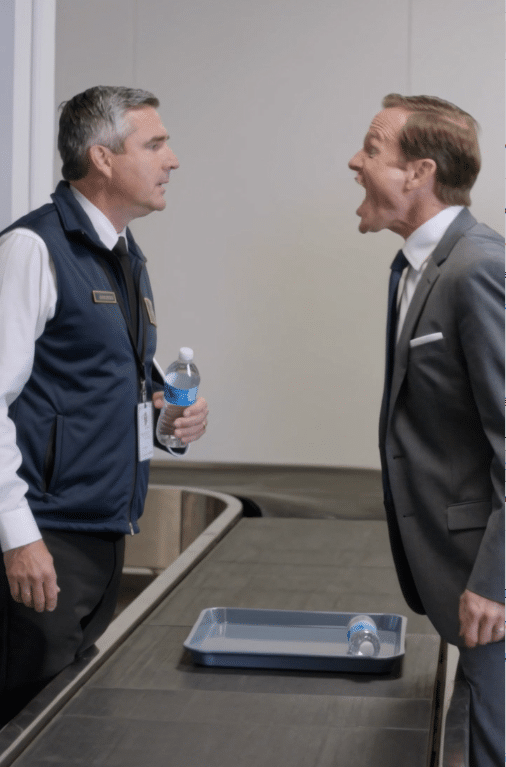
The security line had already stopped moving when the elderly volunteer pointed toward an empty plastic tray.
“Sir, bottle in the tray.”
His voice was calm, patient, and practiced.
Behind the businessman, dozens of travelers waited quietly. Families with children shifted their luggage forward inch by inch. An elderly couple stood near the passenger assistance area, watching the growing delay with worried expressions.
The businessman didn’t move.
Instead, he tightened his grip around the water bottle and looked at the older man with open contempt.
“Trash. You don’t order me.”
The checkpoint fell strangely quiet.
The volunteer never argued.
He simply smiled and gestured toward the conveyor belt again.
“It only takes a moment.”
He never finished another sentence.
The businessman drove a hard kick straight into the veteran’s chest.
The older man was thrown backward into a stack of plastic security trays.
The trays crashed from the belt, scattering across the polished floor in a cascade of sharp echoes.
The unopened water bottle rolled away between waiting passengers.
His shoulder struck the edge of the conveyor belt, leaving only a small scrape before he collapsed beside the fallen trays.
For a moment, the veteran struggled to catch his breath.
Then the businessman stepped forward.
Two more hard kicks landed against his back and side as he instinctively curled to shield himself.
The line remained frozen.
Not because people didn’t care.
Because no one could believe what they were seeing.
A man had just assaulted an elderly volunteer over a routine security instruction.
But the checkpoint cameras weren’t the only witnesses.
Someone inside the secured area had already recognized exactly who had fallen.
Act II
The businessman had spent years believing priority boarding meant priority everywhere.
Airports.
Hotels.
Restaurants.
Rules were inconveniences meant for people with less money, less influence, and less importance.
He looked down at the injured volunteer with complete indifference.
“Stay out of business class.”
The words drew quiet gasps from nearby passengers.
The veteran slowly pushed himself upright using his remaining arm.
Pain tightened across his chest, but dignity never left his face.
He didn’t volunteer because anyone asked him to.
After leaving military service decades earlier—and losing an arm during that chapter of his life—he chose not to disappear into retirement.
Instead, he dedicated his time to helping travelers who needed patience more than authority.
He guided elderly passengers through confusing checkpoints.
He reassured nervous first-time flyers.
He carried bags when someone couldn’t.
He never carried a badge with enforcement powers.
Only a volunteer badge and a willingness to serve.
Most travelers forgot his name within minutes.
He never minded.
Helping strangers had become his quiet mission.
The businessman mistook that kindness for weakness.
Then a side security door burst open.
Every head turned at once.
The atmosphere changed instantly.
Act III
Airport supervisors hurried through the doorway first.
Behind them walked the senior airport security official.
He didn’t rush.
He didn’t shout.
His measured steps alone seemed to quiet the terminal.
Checkpoint officers immediately straightened.
Conveyor belts stopped.
Conversations disappeared.
The businessman frowned, confused by the sudden change.
The official looked only once toward the injured veteran.
Recognition flashed across his face.
It lasted less than a second.
Then his expression hardened.
His voice carried across the checkpoint with absolute authority.
“Stop the line. Detain him.”
No one hesitated.
Security officers immediately surrounded the businessman while supervisors moved to shield the injured veteran and clear space around him.
Passengers stepped back without being asked.
The checkpoint that moments earlier had revolved around one impatient traveler now revolved around one quiet volunteer.
For the first time that morning, fear crossed the businessman’s face.
He realized every employee in the terminal was responding to someone else.
And that someone clearly knew the man lying on the floor.
What the businessman couldn’t possibly know was that the veteran’s story had shaped airport security in ways most passengers would never see.
Act IV
Years earlier, the veteran had been invited to consult on improving assistance programs for aging veterans and travelers with disabilities passing through major airports.
After struggling through inaccessible checkpoints himself, he refused to complain without offering solutions.
He documented unnecessary obstacles.
He proposed practical improvements.
He trained volunteers to recognize travelers who were too proud—or too frightened—to ask for help.
Many of those recommendations were eventually adopted.
Assistance areas became easier to navigate.
Volunteer training expanded.
Thousands of elderly passengers found airports less intimidating because one veteran believed service didn’t end with military retirement.
The senior security official had worked alongside him during those reforms.
He knew exactly how much the airport owed the quiet man now sitting among scattered trays.
This wasn’t simply an assault.
It was an attack on someone whose compassion had quietly improved the experience of countless travelers.
The businessman finally found his voice.
“Who are you?”
The question no longer carried arrogance.
Only uncertainty.
The official didn’t answer directly.
He didn’t have to.
Every security officer standing silently behind him already had.
Authority wasn’t measured by expensive luggage, luxury watches, or premium boarding passes.
It was measured by responsibility.
And the veteran had spent a lifetime carrying more responsibility than most people ever realized.
The balance of power shifted completely.
The terminal had witnessed far more than an argument over a water bottle.
It had witnessed the difference between privilege and character.
Act V
Medical staff carefully examined the veteran while airport supervisors gathered the scattered trays and restored order to the checkpoint.
One young officer retrieved the water bottle from the floor.
The veteran looked up with a tired smile.
“Let’s keep the line moving.”
Even after everything that had happened, his first concern was the passengers waiting behind him.
The official nodded quietly.
Within minutes, security resumed.
Families continued toward their flights.
The elderly couple the veteran had been helping earlier paused before entering the screening lane.
The woman gently squeezed his hand.
“Thank you.”
He simply smiled.
No speeches followed.
No cameras appeared.
No applause echoed through the terminal.
Only the steady rhythm of travelers moving forward once again.
The businessman stood alone, the confidence that had defined him only moments earlier completely gone.
He had believed that a premium ticket placed him above ordinary rules.
Instead, he discovered that respect cannot be purchased with status, wealth, or a boarding pass.
People would later remember the checkpoint for many reasons.
They remembered the calm order that returned after a single command.
They remembered the official whose authority needed no explanation.
But above all, they remembered the one-armed veteran.
A man who had already sacrificed once for his country, yet still chose to spend his retirement making difficult journeys easier for strangers.
Because the strongest people are rarely the loudest in the room.
More often, they’re the ones who quietly serve others without expecting recognition.
And when someone mistakes that quiet strength for weakness, they often discover the truth only after the entire world has turned to stand beside it.