Act I
The trash bag was already sitting beside the bear-proof bin when the elderly volunteer raised one weathered hand.
“Please use the bear-proof bin.”
His voice carried no anger. Only quiet patience.
Around the mountain campground, families were packing up after breakfast. Children chased each other between towering pine trees while campers loaded coolers into SUVs. A cool breeze swept through the forest, carrying the familiar scent of pine needles and damp earth.
The volunteer pointed once more toward the heavy steel container and the large sign explaining why every piece of trash had to be locked inside.
One forgotten bag could attract a bear.
One careless decision could put wildlife—and every family in the campground—in danger.
The wealthy camper didn’t even glance at the sign.
Instead, he stared at the old man as though he were an obstacle standing between him and the rest of his vacation.
“Trash. I paid the entrance fee.”
The words echoed across the campsite.
Nearby campers fell silent.
The volunteer offered the same gentle smile he’d given thousands of visitors over the years.
“The fee helps protect this park, sir. The rules protect everyone in it.”
He never finished another sentence.
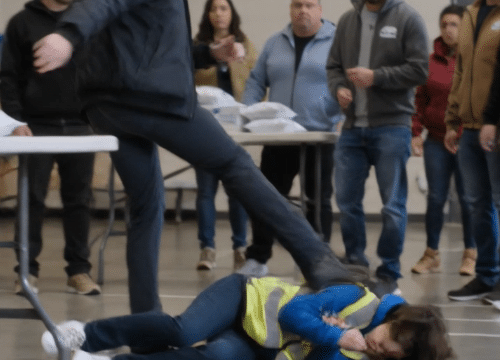
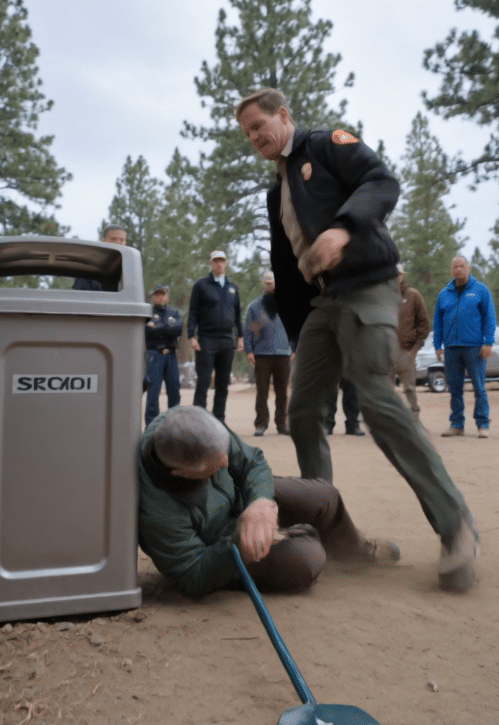
The man drove a vicious kick straight into the volunteer’s chest.
The elderly volunteer crashed backward into the metal bear-proof bin.
The impact rang through the campground like a hammer striking steel.
His trash picker slipped from his hand and clattered across the dirt road. The abandoned trash bag slid away as his elbow struck the sharp edge of the metal container, leaving only a small trace of blood before he collapsed to the ground.
Pain stole his breath.
He tried to push himself upright.
Before he could—
The camper stepped closer.
Two more brutal kicks landed against the old man’s side and back as he instinctively curled beside the bin.
Not because he had insulted anyone.
Not because he had threatened anyone.
Only because he had asked someone to follow the rules.
No one moved.
Everyone simply watched in stunned disbelief.
But someone unexpected had just entered the campground.
Act II
The wealthy camper believed the park belonged to people who could afford it.
His designer hiking boots had never touched real hardship.
His expensive SUV still gleamed despite the dusty mountain roads.
To him, paying an entrance fee wasn’t simply buying access.
It meant buying exemption.
He looked down at the elderly volunteer struggling to breathe.
“I do what I want here.”
His family stood nearby in uncomfortable silence.
Even they seemed unable to recognize the man standing before them.
The volunteer, meanwhile, had spent nearly fifteen years protecting this national park without asking for anything in return.
He wasn’t a ranger.
He wasn’t paid.
Every spring he returned to clean trails, repair campsites, teach children about wildlife safety, and remind visitors why simple rules mattered.
Many laughed politely.
Some ignored him.
But most listened.
Because experience had taught him something many visitors never understood.
A single trash bag left outside wasn’t just litter.
It was an invitation.
Black bears that learned to associate humans with food often returned again and again.
Eventually, those bears stopped fearing people.
And when that happened…
The bears almost always paid the price.
The volunteer wasn’t protecting garbage.
He was protecting lives.
Animal lives.
Human lives.
The future of the park itself.
Then the peaceful sounds of the forest disappeared beneath another sound.
The sharp squeal of tires.
A ranger vehicle had just entered the campground far faster than anyone expected.
Act III
Dust rose along the dirt road as the ranger vehicle skidded to a controlled stop beside the campsite.
Before the engine had fully settled, park managers stepped out.
Then came the Chief Ranger.
His weathered face revealed nothing.
Years spent rescuing lost hikers, confronting poachers, and protecting millions of acres of wilderness had taught him that true authority rarely needed raised voices.
Nearby campers instinctively stepped aside.
Conversations ended.
Even birds seemed to vanish into the trees.
The wealthy camper frowned.
He didn’t understand why the entire campground had suddenly fallen silent.
The Chief Ranger looked first at the volunteer lying beside the metal bin.
His expression hardened.
Then he turned toward the attacker.
Only five words left his mouth.
“Step away from my volunteer.”
The sentence was calm.
But every ranger understood it as an order.
Within seconds, park staff moved between the injured volunteer and the camper.
Others carefully secured the area so medical responders could reach the elderly man safely.
For the first time that morning, confidence disappeared from the wealthy camper’s face.
He looked around.
Every ranger.
Every employee.
Every volunteer.
Every camper.
No one stood beside him anymore.
He had believed he was arguing with an old man.
He had no idea who that old man truly was.
Act IV
Long before he became one of the park’s most respected volunteers, the elderly man had been instrumental in preventing one of the worst wildlife crises the region had ever faced.
Years earlier, a series of careless food-storage violations had caused multiple dangerous encounters between campers and bears. Public pressure demanded that the animals be removed. Several bears had already been euthanized after becoming dependent on human food.
Most people blamed the bears.
He blamed human carelessness.
The volunteer spent months documenting patterns, speaking with biologists, helping redesign campground safety procedures, and advocating for stronger bear-proof storage throughout the park.
His persistence transformed policy.
New food lockers were installed.
Educational programs expanded.
Wildlife conflicts dropped dramatically over the following years.
Hundreds of bears—and countless campers—were safer because one retired man refused to accept that “this is just how things are.”
The Chief Ranger had never forgotten it.
Whenever new rangers entered the service, he pointed toward the volunteer’s example.
“Respect isn’t earned by wearing a badge,” he often said.
“It’s earned by protecting something that can’t protect itself.”
That’s why anger burned beneath his otherwise controlled expression.
This wasn’t merely an assault.
It was an attack on someone who had quietly helped shape the park into a safer place for everyone standing there.
The wealthy camper swallowed hard.
His voice no longer carried arrogance.
“Your volunteer?”
The question sounded almost childish.
The Chief Ranger answered with silence.
He didn’t have to explain.
Every ranger standing behind him already had.
The authority in that campground wasn’t measured by expensive equipment or luxury vehicles.
It was measured by service.
And the old man on the ground had earned that respect many times over.
The balance of power shifted in an instant.
Yet the greatest lesson was still unfolding before everyone’s eyes.
Act V
Paramedics arrived moments later and carefully examined the elderly volunteer.
Despite the pain in his chest and elbow, his eyes searched only for one thing.
The trash bag.
“Please…”
He managed between breaths.
“Make sure it goes inside the bin.”
A young ranger quietly picked up the bag, secured it inside the bear-proof container, and locked the heavy metal latch.
Only then did the volunteer allow himself to relax.
The Chief Ranger watched silently before removing his own gloves and helping clean the scattered campsite alongside the volunteers.
Without speeches.
Without cameras.
Without trying to impress anyone.
Campers who had witnessed everything slowly joined in.
One family picked up litter along the trail.
Another helped clean nearby picnic tables.
Children who had watched the frightening confrontation began asking their parents why the rules mattered so much.
For many of them, that morning became a lesson they would never forget.
The wealthy camper stood alone.
The confidence that had fueled his cruelty had disappeared entirely.
He had believed the entrance fee purchased privilege.
Instead, he learned that parks belong to everyone willing to protect them.
The mountains would remember nothing about his expensive SUV.
The forest wouldn’t care about his designer hiking gear.
But people would remember the elderly volunteer who, even while injured, cared more about a hungry bear finding human food than about his own pain.
Because true guardians of nature rarely seek recognition.
They quietly protect places—and lives—that most people never realize are in danger.
And when someone mistakes kindness for weakness, they often discover too late that the strongest people in the wilderness are not always the ones wearing the most expensive boots.
Sometimes…
They’re simply the ones everyone else has already learned to follow.