Act I
“Please stay on the path.”
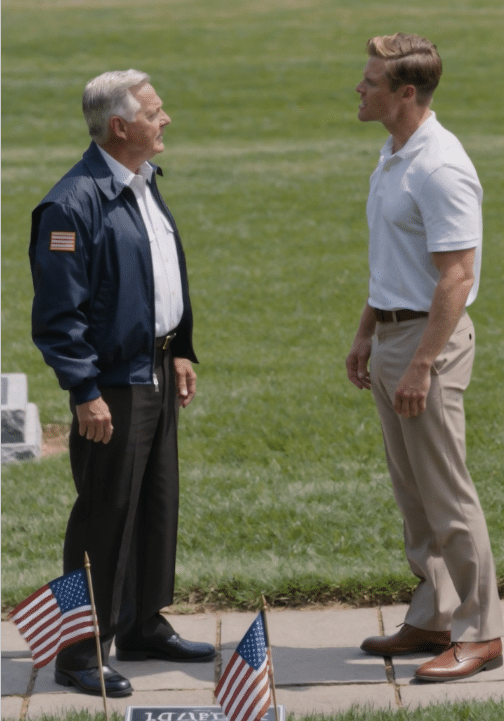
The elderly volunteer’s voice was calm, steady, and respectful despite the crowd moving through the national military cemetery on Memorial Day.
A wealthy family had stepped beyond the stone walkway and onto the carefully maintained grave grass, weaving between rows of white headstones and small American flags to take photographs.
The seventy-three-year-old veteran pointed gently toward the cemetery guide sign.
“The grass is protected. Please use the path.”
Instead of stepping back, the father turned slowly.
His expression hardened.
“Trash. I paid to be here.”
The surrounding visitors fell silent.
Some lowered their cameras.
Others exchanged uncomfortable glances, hoping the confrontation would end with nothing more than harsh words.
The veteran never raised his voice.
“This isn’t about payment,” he replied quietly. “It’s about respecting those who never came home.”
Those words only fueled the man’s anger.
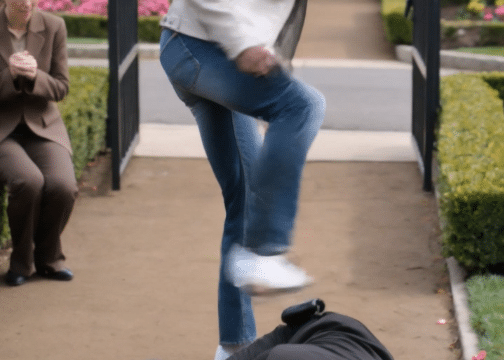
Without another warning, he lunged forward and drove a brutal kick into the veteran’s chest.
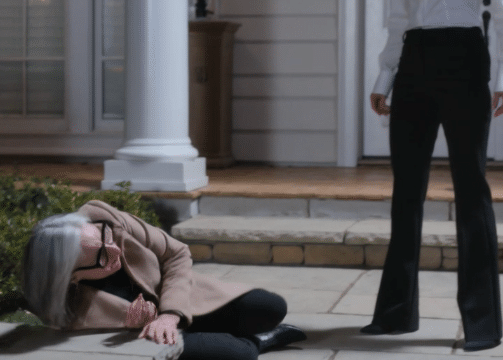
The older man crashed backward onto the stone path.
His prosthetic leg struck the edge of the walkway with a sharp crack. The cemetery guide sign slipped from his hand into the grass, and his elbow scraped against the stone, leaving only a small trace of blood.
A child nearby began crying.
No one moved.
But the silence was about to be broken.
Act II
The veteran struggled to breathe.
Years of military discipline kept him from crying out, but the pain showed plainly across his weathered face.
He tried to push himself upright.
The bully stepped closer instead.
Two more hard kicks landed against the veteran’s back and side before he curled instinctively to protect himself.
“Don’t lecture my family.”
The father’s voice echoed across the cemetery.
His wife stood frozen.
Even she seemed shocked by what had just happened.
Around them, dozens of visitors stared in disbelief.
Some instinctively reached for their phones.
Others looked toward the cemetery entrance, silently wishing someone—anyone—would intervene.
The veteran’s cap had fallen beside one of the small American flags.
Pinned to it were ribbons and insignia from decades of service.
Few people noticed them.
One man would.
And the moment he did, everything changed.
Act III
The rhythmic sound of polished military boots rolled across the cemetery.
Heads turned.
A uniformed military delegation had just entered through the main gate.
Leading them was a senior officer whose presence commanded immediate attention.
Conversation stopped.
Workers straightened.
Visitors stepped aside without being asked.
Then the officer saw the veteran lying on the stone path.
His expression changed instantly.
Not panic.
Recognition.
He strode forward without hesitation, uniformed escort following in perfect formation.
The bully barely glanced at him.
He was still too consumed by his own arrogance.
The officer stopped only a few feet away.
His voice was calm.
Cold.
Absolute.
“Stand down. Now.”
The words cut through the cemetery more sharply than any shout ever could.
The father froze.
For the first time since the confrontation began, uncertainty crossed his face.
Act IV
The soldiers moved immediately.
Without touching the bully, they formed a protective line around the fallen veteran.
The senior officer knelt beside the older man.
He carefully picked up the veteran’s cap from the stone path.
His eyes lingered on the worn insignia stitched into the fabric.
Then he looked back at the man on the ground.
“Sergeant…”
The veteran managed a faint nod.
They knew each other.
Not as strangers.
Not merely through military records.
Years earlier, the officer had served under the veteran during a deployment that had changed both of their lives forever.
The prosthetic leg.
The scars.
The quiet dignity.
The officer remembered every part of that history.
He rose slowly and turned toward the bully.
His face remained composed, but his disappointment carried more weight than anger ever could.
“You assaulted a man who spent his life protecting people he’d never meet.”
No one spoke.
Even the wind seemed to disappear.
Military police who had accompanied the delegation stepped forward to secure the scene while cemetery staff guided stunned visitors away from the restricted area.
The father suddenly realized that every nearby camera had witnessed what happened.
Every excuse he had prepared sounded meaningless before he ever spoke it.
Act V
The veteran finally accepted help to sit upright.
He brushed dust from his jacket before anyone brushed it away for him.
His first concern wasn’t himself.
He reached toward the small American flag that had tipped during the struggle and quietly placed it back into the ground.
The senior officer watched with unmistakable respect.
“This man volunteered here because he believed remembrance is a duty,” he said to those gathered nearby. “Today he honored that duty even when others failed to honor him.”
Several visitors removed their hats.
Others lowered their heads.
The atmosphere shifted from shock to quiet reflection.
As authorities questioned witnesses, the wealthy father’s confidence dissolved completely.
He stared at the officer, then at the soldiers surrounding the veteran.
His voice was barely audible.
“Who are you?”
The officer answered without raising his voice.
“I’m someone who remembers exactly what this place is for.”
The bully had no reply.
Around him stood people who finally understood that Memorial Day was never meant to celebrate privilege, status, or appearances.
It existed to honor sacrifice.
And the elderly volunteer lying on that stone path had spent a lifetime protecting that meaning.
Long after the crowd dispersed, visitors continued walking only along the designated paths.
Many paused beside the veteran to offer quiet thanks before leaving.
The ceremony resumed.
The flags continued to flutter gently in the afternoon breeze.
And for everyone who witnessed the confrontation, the deepest lesson of the day did not come from a speech.
It came from one aging veteran who chose respect over pride—and from the officer who refused to let that respect be trampled.