Act I
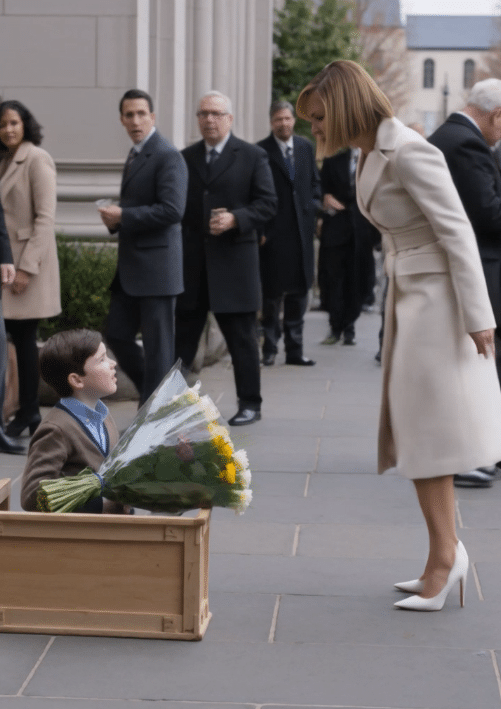
The bouquet had already brushed against her white coat before the boy could catch it.
A light gust of wind carried the small bundle of flowers from the edge of the wooden table, and the twelve-year-old reached for it with both hands, panic spreading across his face.
“I’m sorry,” he whispered instinctively, stepping backward.
The woman looked down at the faint petal resting against her expensive sleeve as though something filthy had touched her.
“Trash. Your flowers touched me.”
The church doors behind them were still opening as families poured onto the stone sidewalk after the afternoon service.
People slowed.
They watched.
No one spoke.
The boy tightened his grip on the remaining bouquets. Those flowers represented hours of work beside his mother, who tied every ribbon by hand so they could afford groceries before winter arrived.
He expected anger.
He never imagined cruelty.
With startling force, the woman lashed out, knocking him backward onto the cold stone beside the flower table. Bouquets scattered across the sidewalk, petals spinning through the wind. His elbow scraped the pavement, leaving only a small trace of blood as he struggled to breathe.
He tried to sit up.
Before he could, she struck him again, twice in quick succession, while the bouquets rolled away across the church steps.
Gasps rippled through the crowd.
Still, no one intervened.
She stood over him with absolute contempt.
“Poor kids don’t belong here.”
Those words echoed louder than the church bells.
But she had no idea whose church she had chosen for her cruelty.
And the truth was only seconds away.
Act II
Every Sunday, Daniel arrived before sunrise.
While other children slept, he helped his widowed mother arrange fresh bouquets outside the church entrance.
They never begged.
They never asked for charity.
They simply sold flowers to worshippers heading home after service.
Most people knew the quiet boy with the gentle smile.
Few knew his story.
His father had once been the church’s groundskeeper, maintaining the gardens for nearly twenty years before losing his life while rescuing two children during a flood.
After his death, Daniel insisted on helping his mother however he could.
He refused to let her carry every burden alone.
The flowers were never just flowers.
Each bouquet represented school supplies.
Medicine.
Electricity.
Another week together.
The congregation admired the boy’s determination.
But admiration is often silent.
Cruelty rarely is.
As Daniel struggled on the pavement, many people lowered their eyes.
Some feared confrontation.
Others convinced themselves someone else would step forward.
No one did.
Until the heavy church doors opened once more.
Act III
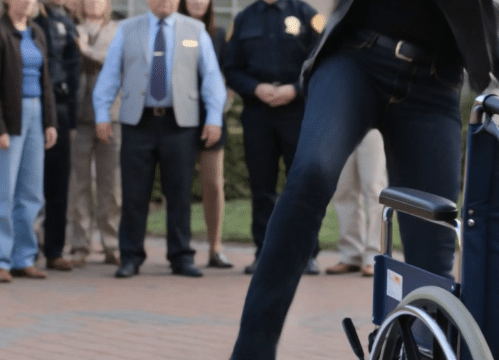
The sound cut through the silence.
Two assistants emerged first.
Behind them walked an older man in a dark overcoat whose calm expression somehow carried more authority than shouting ever could.
The conversations stopped instantly.
Even longtime members straightened as he approached.
He didn’t hurry toward the wealthy visitor.
He looked first at the scattered bouquets.
Then at the frightened boy trying to protect the crushed flowers instead of himself.
His expression hardened.
The assistants immediately moved between Daniel and the woman.
The man spoke only four words.
“Not outside my church.”
His voice wasn’t loud.
It didn’t need to be.
The woman frowned.
“And who exactly are you?”
He ignored the question.
Instead, he bent down and carefully picked up one of the damaged bouquets.
His fingers brushed away the dirt before handing it back to Daniel.
“I remember when your father first planted the roses behind the chapel,” he said quietly.
Daniel stared.
“You remember him?”
“I remember every person who built this place.”
The crowd exchanged uncertain glances.
The woman suddenly wasn’t smiling anymore.
Act IV
The respected church leader slowly turned toward the gathering crowd.
“Many of you know this building.”
“Few of you know the sacrifices behind it.”
He looked toward the stained-glass windows rising above the entrance.
“When the community wanted to expand this church years ago, funding disappeared.”
“Your father worked for months without pay because he believed this place should remain open to everyone.”
Daniel lowered his eyes.
His mother quietly wiped away tears.
The church leader continued.
“When he died, we promised his family they would always remain part of this community.”
He looked directly at the woman.
“You looked at a poor child.”
“I saw the son of a man who helped keep these doors open.”
Silence settled over the churchyard.
The assistants gently helped Daniel stand.
Members of the congregation finally stepped forward, gathering the scattered bouquets one by one.
Some looked ashamed.
Others couldn’t meet the boy’s eyes.
The woman glanced around, searching for support.
There was none.
The confidence she had worn only moments earlier began to disappear.
Act V
A breeze carried loose flower petals across the stone sidewalk.
The church leader accepted one bouquet from Daniel.
Then he placed several bills into the small wooden box without asking for change.
Others quietly followed.
Within minutes, every bouquet on the table had been purchased.
Not out of pity.
Out of respect.
The leader addressed the congregation one final time.
“A church is not measured by the beauty of its building.”
“It is measured by how it treats the smallest person standing outside its doors.”
His words settled over the crowd.
No applause followed.
Only reflection.
Daniel’s mother wrapped an arm around her son as volunteers helped straighten the overturned flower table.
The crushed petals remained scattered across the sidewalk.
A reminder that dignity can be bruised but not destroyed.
Across from them, the wealthy visitor’s composure completely unraveled.
She stared at the respected leader, then at the congregation standing beside the boy she had dismissed.
Her voice, once filled with contempt, now carried only uncertainty.
“Your church?”